



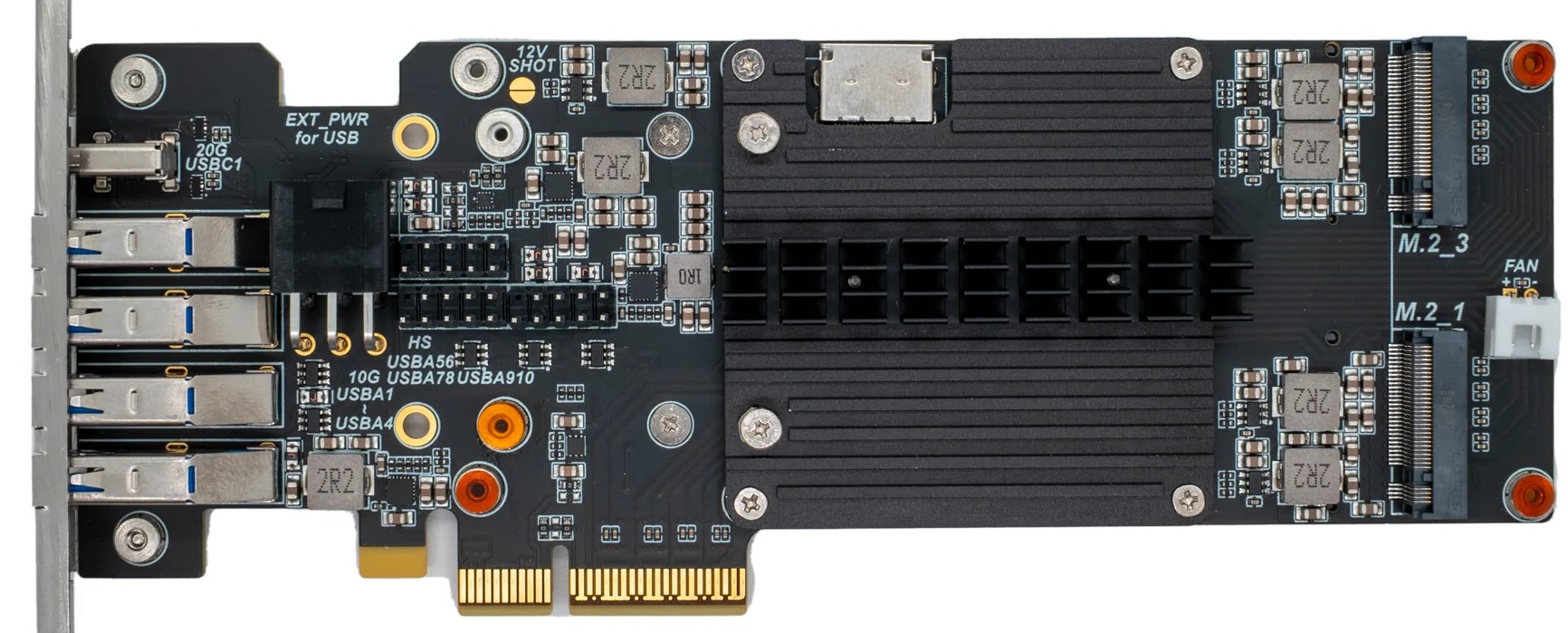
WisdPi has launched a new PCIe expansion card that uses AMD’s Promontory 21 chipset to add more storage and connectivity options to desktop and small form factor systems. The card is called the All in Expansion Card, and it combines four M.2 slots, one OCuLink port, multiple USB ports, and internal USB headers on a single add in board.
The design is unusual because Promontory 21 is not a random bridge chip. It is part of the same chipset family used on AMD AM5 motherboards, including B650 boards and higher end X670 and X870 designs that use two chipset dies. In this case, WisdPi is placing that chipset on a PCIe card to expand another system rather than building it directly into a motherboard.
The card costs $199 without extra cables. WisdPi also sells a 40 cm OCuLink to OCuLink cable and a 40 cm OCuLink to 4x SATA cable for $15 each. The board connects to the host system through a PCIe 4.0 x4 interface and measures 175 mm by 70 mm.
WisdPi says the card supports x86 and Arm systems with standard PCIe, including AMD and Intel PCs, Mac Silicon systems, and Raspberry Pi 5 platforms. That broad compatibility could make it useful for enthusiasts, mini PC builders, homelab setups, and storage focused projects.
The card turns one PCIe slot into a multi purpose expansion hub
The main appeal of the card is simple: it adds a lot of extra connectivity through one PCIe slot. On the rear I/O, it includes one USB 3.2 Gen 2x2 Type C port running at 20 Gbps and four USB 3.2 Gen 2 Type A ports running at 10 Gbps.
Internally, the card provides six USB 2.0 front panel headers, four M.2 slots, and one OCuLink port. The OCuLink port can multiplex PCIe and SATA signals, and users can switch between those modes through an onboard DIP switch.
| Feature | WisdPi All in Expansion Card |
|---|---|
| Chipset | AMD Promontory 21 |
| Host interface | PCIe 4.0 x4 |
| Price | $199 without cables |
| Board size | 175 mm by 70 mm |
| M.2 slots | Four |
| OCuLink | One port with PCIe and SATA modes |
| Rear USB | One 20 Gbps Type C, four 10 Gbps Type A |
| Internal USB | Six USB 2.0 front panel headers |
| Extra hardware | External power connector, aluminum heatsink, fan header |
The four M.2 slots are likely the biggest draw. Many compact motherboards and mini PCs run out of storage expansion quickly, especially if they only include one or two internal M.2 connectors. A card like this can turn a spare PCIe slot into a much more flexible storage platform.
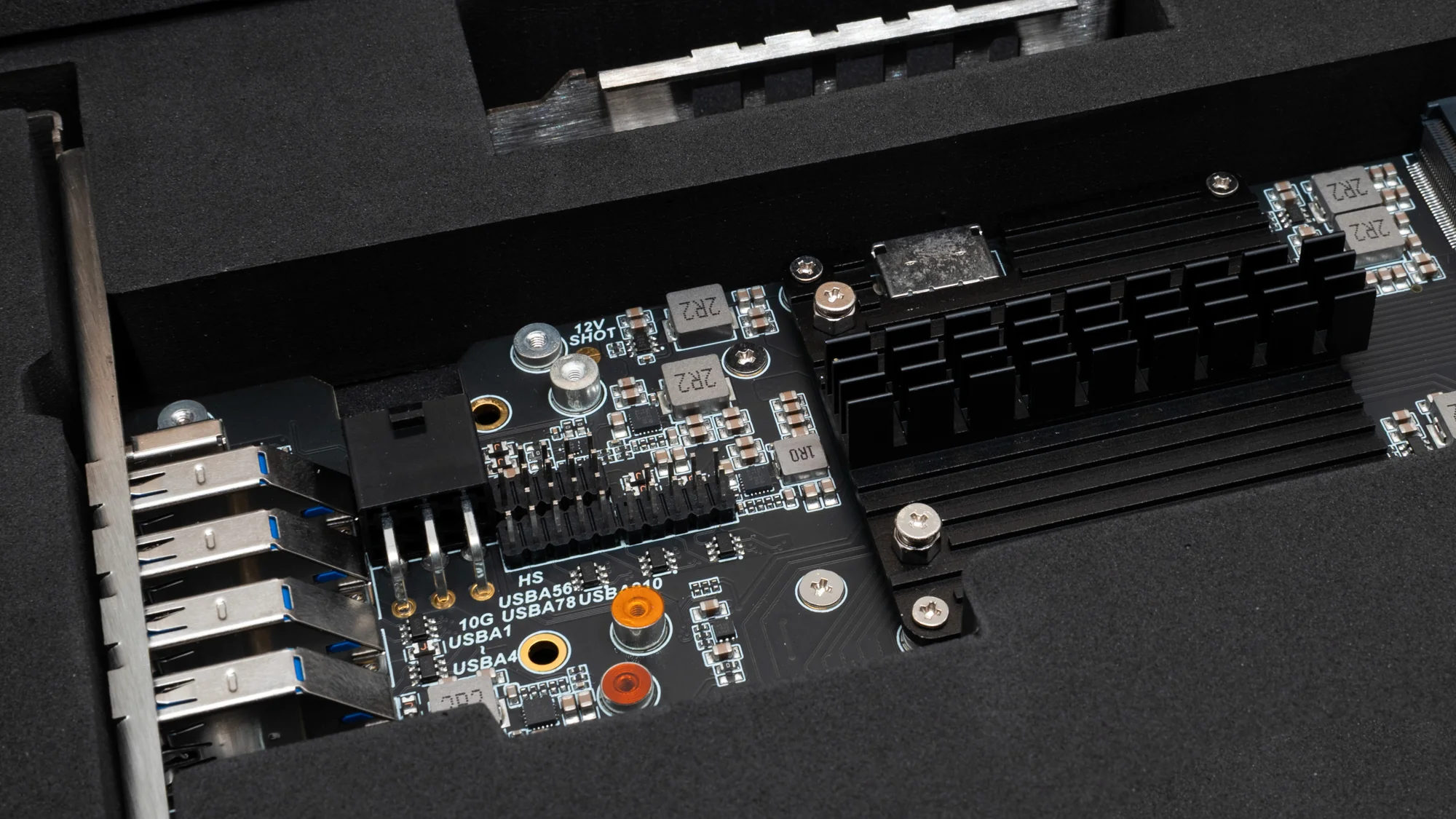
The OCuLink port also makes the card more interesting. OCuLink has become popular among mini PC and handheld enthusiasts because it can provide a cleaner external PCIe connection than typical USB based solutions. Depending on how the card is configured, it could be used for external storage, PCIe expansion, or SATA connectivity.
These chipset expansion cards are becoming more common
WisdPi is not the only company exploring this type of product. Minisforum is also working on a similar AMD B650 chipset based PCIe card for M.2 and OCuLink expansion. A year ago, products like this were mostly custom projects or niche experiments, but they are now moving closer to commercial availability.
That shift makes sense. PC builders are using more NVMe drives than ever, and compact systems often need more expansion than their motherboards can provide. At the same time, OCuLink has created more interest in external PCIe connectivity, especially for eGPU docks, fast storage boxes, and modular mini PC setups.
Using a real AMD chipset gives these cards a different identity from basic PCIe splitters or USB expansion boards. The card can expose multiple types of I/O from a single host connection, although real world performance will still depend on the PCIe 4.0 x4 uplink and how many devices are active at once.
That bandwidth limit is important. Four M.2 drives, USB ports, and OCuLink all sharing one PCIe 4.0 x4 connection means users should not expect every attached device to run at full speed at the same time. For many workloads, that may be fine. For heavy simultaneous storage transfers, the host link could become the bottleneck.
The card could be useful for homelab and mini PC builds
The most obvious buyers are people building storage dense systems, small servers, compact workstations, or experimental homelab machines. A card with four M.2 slots and OCuLink could help turn a limited platform into something much more flexible.
It may also appeal to Raspberry Pi 5 and Arm system users who want more advanced PCIe expansion, although compatibility and software behavior will need careful checking. Support on paper does not always mean every function works perfectly across every operating system or firmware setup.
The external power connector, aluminum heatsink, and fan header also show that WisdPi expects the card to handle serious loads. Multiple NVMe drives can generate a lot of heat, and chipset based expansion adds its own thermal needs.
At $199 before cables, this is not a cheap accessory. But it is more than a simple adapter. It is a compact expansion platform built around an AMD chipset, and that makes it one of the more interesting niche PC accessories to appear this year.
For users who only need one extra M.2 drive, cheaper options will make more sense. But for builders who want four M.2 slots, OCuLink flexibility, extra USB, and broad platform support, WisdPi’s new card could be a useful solution, especially as chipset based PCIe expansion cards become a more serious category.



Discussion (0)
Be the first to comment.