


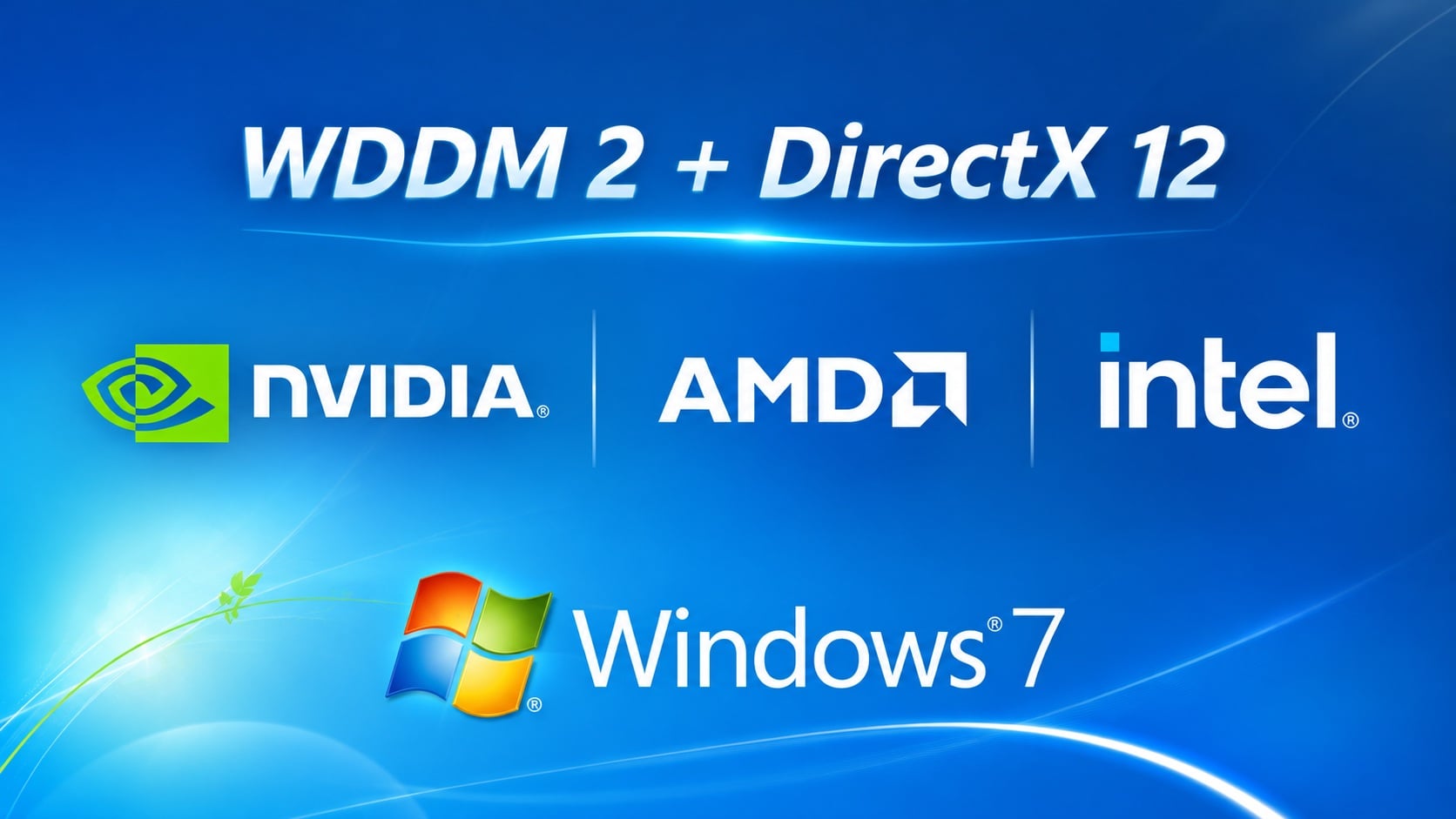
Windows 7 can reportedly run modern NVIDIA, AMD, and Intel graphics cards through an unofficial community project that brings Windows Display Driver Model 2.0 support to Microsoft's older operating system.
The project, called WDDM2Win7, allows certain GPUs from NVIDIA's GeForce RTX 40 and RTX 50 series, AMD's Radeon RX 7000 and RX 9000 series, and Intel's Xe graphics family to operate on Windows 7.
Developers have also demonstrated DirectX 12 applications running on the modified operating system, suggesting that newer graphics software could become compatible with Windows 7.
However, the project remains experimental, and support for modern hardware does not guarantee that all games or graphics features will work correctly.
NVIDIA RTX 5060 and AMD Radeon RX 9060 XT Demonstrated on Windows 7
Windows enthusiast Bob Pony shared screenshots showing several modern graphics processors operating on genuine Windows 7 installations.
The demonstrations included NVIDIA's GeForce RTX 5060, AMD's Radeon RX 9060 XT, and Intel UHD Graphics 770 running alongside an Intel Core i5 14500 processor.
The screenshots also included hardware information from GPU Z, Windows Experience Index results, and system properties showing the Windows 7 kernel version 6.1.7601.
This is important because the demonstrations involved actual Windows 7 installations rather than newer operating systems modified to resemble Windows 7.
The NVIDIA RTX 5060 reportedly completed Windows System Assessment Tool benchmarking successfully, while the AMD Radeon demonstration included Counter Strike gameplay.
The following hardware was demonstrated or identified as supported by the project.
| GPU Manufacturer | Supported Graphics Families | Demonstrated Hardware |
|---|---|---|
| NVIDIA | GeForce RTX 40 and RTX 50 series | GeForce RTX 5060 |
| AMD | Radeon RX 7000 and RX 9000 series | Radeon RX 9060 XT |
| Intel | Xe based graphics | Intel UHD Graphics 770 |
These demonstrations indicate that the backport can recognize and operate selected modern graphics processors, although wider compatibility testing is still necessary.
WDDM 2.0 Backport Brings Modern Graphics Support to Windows 7
Windows 7 originally launched in October 2009 with Windows Display Driver Model 1.1.
Microsoft later introduced WDDM 2.0 alongside Windows 10 in 2015, bringing improvements to graphics memory management, driver architecture, and support for DirectX 12.
These changes became important for newer graphics hardware, which increasingly depends on more recent Windows graphics infrastructure.
The WDDM2Win7 project attempts to overcome this limitation by bringing parts of the newer graphics driver system to Windows 7.
The project uses unofficial system modifications and adapted drivers to make modern GPUs compatible with the older operating system.
Community developers EAZY BLACK, VisualEhrmanntraut, and kryptik have been credited for their contributions.
DirectX 12 Applications Can Also Run on Modified Windows 7 Systems
Another important part of the project is its reported ability to run DirectX 12 applications.
Windows 7 was not originally designed around the graphics infrastructure required by modern DirectX 12 implementations.
Microsoft previously introduced limited DirectX 12 support for Windows 7 in 2019, allowing selected games such as World of Warcraft to use the graphics API.
However, that implementation depended on individual developers adding support to their applications.
It also did not introduce WDDM 2.0 compatibility throughout the operating system.
The new community backport takes a different approach by modifying the graphics infrastructure itself.
Demonstrations suggest that DirectX 12 applications can operate on the modified system, potentially allowing additional graphics software to run on Windows 7.
Still, compatibility with demonstration applications does not mean that every modern DirectX 12 game will function correctly.
Modern Gaming Features Still Need Further Testing
Although the initial results are promising, the project has several limitations.
Recognizing a graphics card and successfully completing benchmarks does not necessarily mean its complete driver functionality is available.
Modern technologies such as hardware ray tracing, temporal upscaling, and manufacturer specific software utilities may require further development.
There are also questions about long term driver stability and compatibility with demanding games.
Another community project, VxKex, could help address certain software compatibility problems by extending Windows 7 application programming interfaces.
VxKex allows some applications designed for newer Windows versions to run on Windows 7, although it does not provide WDDM 2.0 functionality itself.
Combining these projects could improve compatibility, but the results will depend on individual applications and hardware configurations.
Windows 7 Security Support Ended Years Ago
Despite these technical improvements, Windows 7 remains an unsupported operating system.
Microsoft ended mainstream security support in January 2020, while its Extended Security Updates program concluded in January 2023.
Steam also discontinued official Windows 7 support in January 2024.
These limitations remain important because unofficial graphics driver modifications do not restore Microsoft's security updates or guarantee compatibility with modern gaming services.
Running Windows 7 on internet connected hardware can therefore expose systems to vulnerabilities that are no longer addressed through regular operating system updates.
For enthusiasts interested in older software, hardware experimentation, and operating system preservation, WDDM2Win7 provides an opportunity to explore modern graphics hardware on Windows 7.
However, the project is still unofficial and experimental. It is primarily suitable for testing and preservation purposes rather than replacing a fully supported modern Windows installation.

Discussion (0)
Be the first to comment.