



Khronos has released Vulkan 1.4.351, adding six new extensions to the graphics and compute API. The update is mainly aimed at developers working on ray tracing, shader synchronization, GPU profiling, image processing, and mobile GPU optimization.
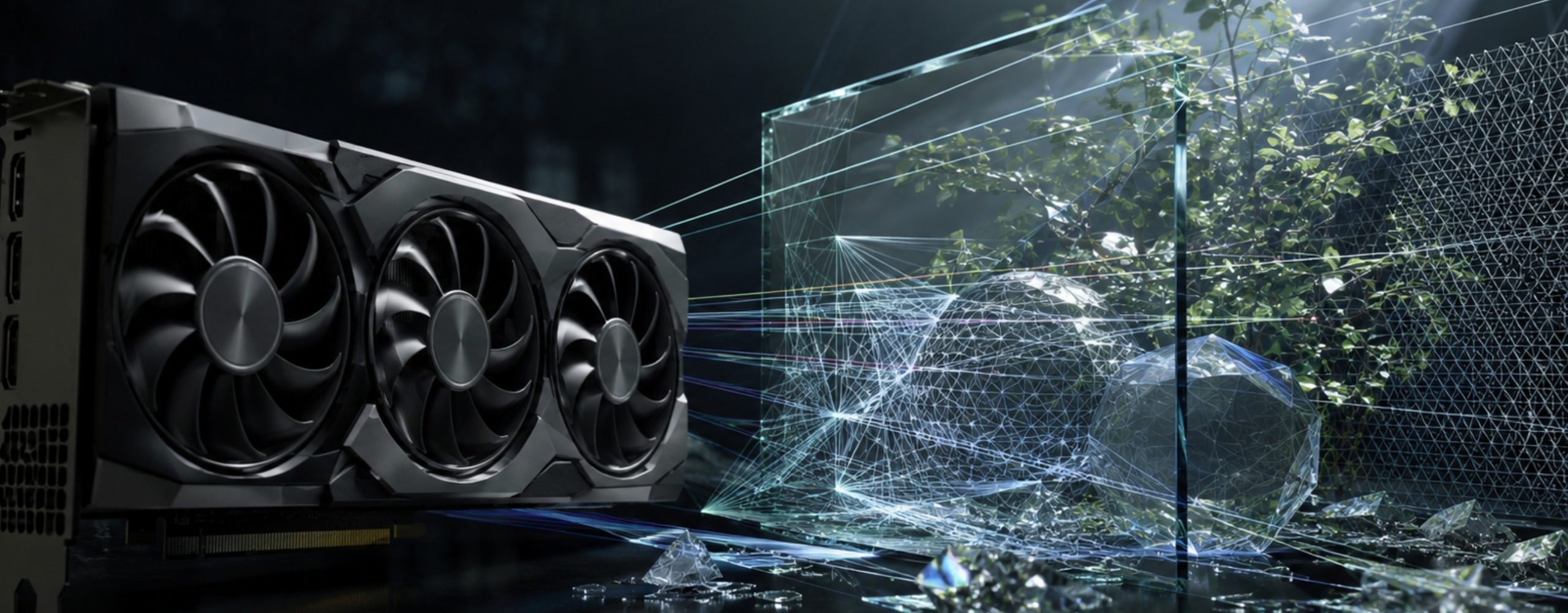
The most important addition is VK_KHR_opacity_micromap. This extension is designed to improve ray traced scenes that include transparent geometry, such as foliage, fences, glass like surfaces, or other objects where only parts of a triangle should be treated as visible.
Instead of using more geometry or relying heavily on any hit shaders during ray traversal, developers can attach an opacity micromap when building an acceleration structure. The micromap stores opacity data in a compressed form, allowing the Vulkan implementation to mark parts of a triangle as opaque, transparent, or a possible hit.
That can help ray tracing performance because the GPU gets more useful visibility information earlier in the process. It is especially useful for complex scenes where transparency can add a lot of extra shader work.
| Extension | Main purpose |
|---|---|
| VK_KHR_opacity_micromap | Improves ray tracing with transparent geometry |
| VK_EXT_shader_split_barrier | Adds finer control over shader synchronization |
| VK_AMD_gpa_interface | Exposes AMD GPU performance tools |
| VK_QCOM_elapsed_timer_query | Adds elapsed time query support |
| VK_QCOM_image_processing3 | Adds image processing support for upscaling and sharpening |
| VK_QCOM_shader_multiple_wait_queues | Adds a compiler hint for loop optimization |
The second major cross vendor extension is VK_EXT_shader_split_barrier. It splits the current control barrier behavior into separate arrive and wait operations. This gives developers more control over how subgroups synchronize inside a workgroup, without forcing every subgroup to wait at the same point before continuing.
That may sound technical, but the goal is simple. It can help shader code run more efficiently when different parts of a workgroup do not need to stop at the same time.
The update also includes VK_AMD_gpa_interface, an AMD extension for GPU performance analysis. It exposes AMD’s GPU Performance API interface for global performance counters, streaming performance monitors, and SQTT thread traces on Radeon GPUs. This should be useful for developers profiling graphics workloads on AMD hardware.
Qualcomm gets three extensions in this update. VK_QCOM_elapsed_timer_query adds a way to measure elapsed time between GPU commands. VK_QCOM_image_processing3 adds support for predefined image gather operations used in tasks such as super resolution upscaling and contrast adaptive sharpening. VK_QCOM_shader_multiple_wait_queues adds a compiler hint that can help optimize loops by using multiple wait queues.
NVIDIA has already listed support for VK_KHR_opacity_micromap and VK_EXT_shader_split_barrier in its Vulkan developer beta drivers for Windows and Linux.
For normal PC gamers, Vulkan 1.4.351 will not instantly change how games look or run. These changes matter more to engine developers, driver teams, and studios building future games. Over time, though, extensions like opacity micromaps can help make Vulkan ray tracing more efficient and give developers better tools for complex graphics workloads.



Discussion (0)
Be the first to comment.