



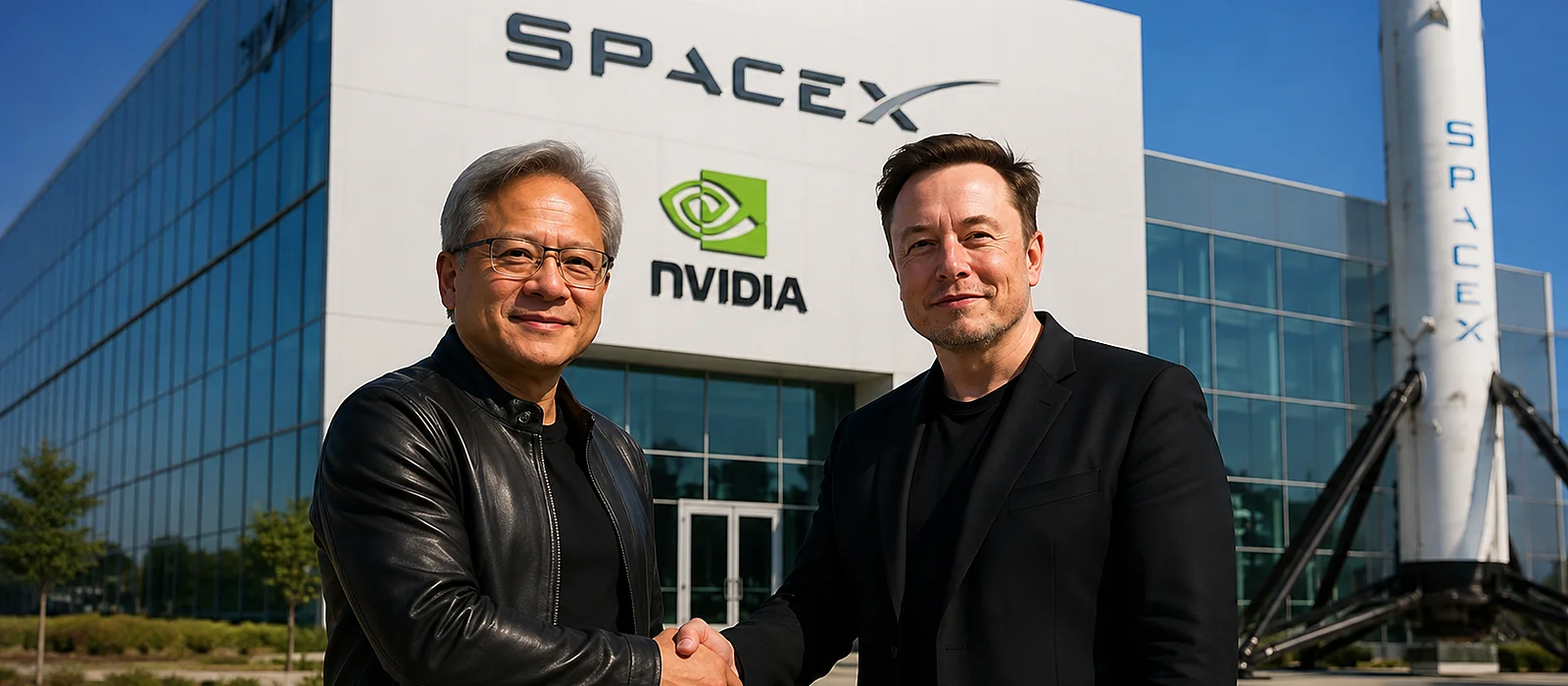
SpaceX plans to use NVIDIA GPUs exclusively for its artificial intelligence infrastructure, with Elon Musk describing the company’s hardware as the strongest option currently available.
The company intends to deploy NVIDIA’s Vera Rubin platform across future data centres on Earth and potentially in orbit. SpaceX reportedly expects around 2GW of AI computing capacity to be installed by the end of 2026, followed by a much larger expansion to 10GW by the end of 2027.
The scale of the plan would make SpaceX one of NVIDIA’s most important infrastructure customers. It would also deepen the company’s dependence on a single supplier for AI accelerators, networking, memory, and supporting software.
Vera Rubin NVL72 Will Power the Initial Expansion
SpaceX plans to use NVIDIA’s Vera Rubin NVL72 rack platform, which is also known internally as Kyber.
The rack combines large numbers of Rubin GPUs with Vera CPUs, high speed interconnects, and substantial memory capacity. It is designed for training and running large AI models across tightly connected systems.
| SpaceX AI plan | Reported detail |
|---|---|
| Main GPU supplier | NVIDIA |
| Hardware platform | Vera Rubin NVL72 |
| Initial capacity target | 2GW by the end of 2026 |
| Longer term target | 10GW by the end of 2027 |
| Deployment locations | Terrestrial and potentially orbital data centres |
| Supplier strategy | Exclusive NVIDIA GPU use |
A 10GW deployment would require an enormous amount of electrical power, cooling equipment, networking hardware, land, and construction capacity. The final number of GPUs would depend on rack power, system design, utilisation, and how much of the capacity is assigned to training or inference.
SpaceX has not provided a detailed schedule showing how many sites will be built or where the terrestrial facilities will operate.
Orbital AI Infrastructure Is Part of the Plan
The more unusual part of the strategy is SpaceX’s interest in placing AI computing systems in orbit.
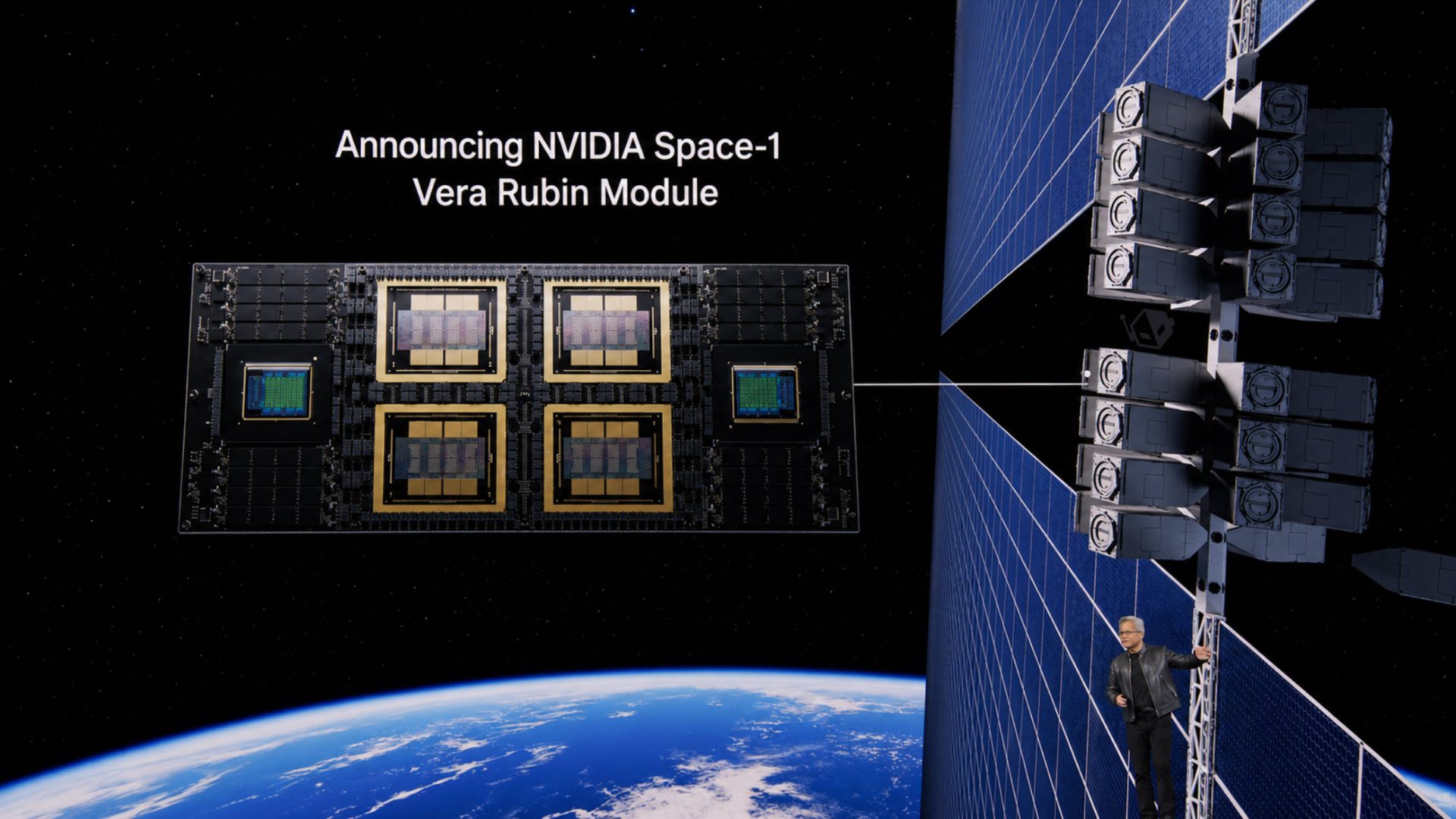
NVIDIA has introduced a space-certified Vera Rubin module called Space-1. It combines four Rubin GPUs, two Vera CPUs, and a large pool of memory inside hardware intended for satellites and orbital vehicles.
| Space-1 feature | Purpose |
|---|---|
| Four Rubin GPUs | AI training and inference |
| Two Vera CPUs | General processing and system control |
| Space-certified design | Operation in orbital conditions |
| Shared architecture | Similar software environment to terrestrial Rubin systems |
| Intended applications | Satellite analysis, autonomy, and orbital services |
NVIDIA says the module can provide up to 25 times the AI computing capability of an H100 for selected orbital workloads.
The system is intended for applications such as geospatial analysis, autonomous spacecraft operations, satellite image processing, and on-orbit data interpretation. Companies including Aetherflux, Axiom Space, and Planet Labs have also been linked with the platform.
Using the same architecture on Earth and in orbit could allow developers to move software between environments with fewer changes.
Space-Based Data Centres Could Address Some Physical Limits
SpaceX believes orbital computing could reduce several constraints affecting conventional data centres.
Large terrestrial facilities require land, electricity, cooling systems, water, and access to high capacity power grids. Securing those resources can delay construction and raise costs.
Solar energy is more consistently available in orbit, and heat can be radiated into space. However, this does not mean orbital data centres receive unlimited power or cooling without engineering limits.
| Potential orbital advantage | Practical challenge |
|---|---|
| Continuous solar access | Large solar arrays are required |
| Reduced land demand | Launch and assembly remain expensive |
| No local water requirement | Heat rejection requires large radiators |
| Processing near satellites | Communication links must be reliable |
| Global coverage | Latency depends on orbital position |
| Modular expansion | Repairs and replacement are difficult |
Cooling in space is particularly complex because there is no air to carry heat away. Hardware must use radiators to release thermal energy, which can require a large surface area.
The absence of atmospheric cooling means orbital systems need carefully designed thermal structures rather than simply operating in cold space.
Launching Thousands of GPUs Would Be Difficult
Moving AI hardware into orbit would create a major logistics challenge.
Large compute clusters require far more than GPUs. Each installation also needs processors, memory, storage, networking equipment, power conversion hardware, solar panels, radiators, shielding, and structural support.
| Orbital infrastructure requirement | Main concern |
|---|---|
| Launch capacity | Large mass must be delivered to orbit |
| Radiation protection | Electronics need additional resilience |
| Power generation | Solar arrays must support high continuous demand |
| Thermal control | Heat must be removed through radiation |
| Networking | Satellites need high speed optical or radio links |
| Maintenance | Failed equipment is difficult to replace |
| Hardware refresh | AI chips become outdated quickly |
Modern AI accelerators also change rapidly. A data centre launched into orbit could become technically outdated before the end of its physical life.
SpaceX may be able to reduce launch costs through reusable rockets, but transporting hundreds of thousands of accelerators and supporting systems would still be a large industrial undertaking.
NVIDIA Gains Another Major Vera Rubin Customer
The commitment represents a significant commercial win for NVIDIA.
The company is already supplying Vera Rubin systems to cloud providers, AI laboratories, and large enterprise customers. SpaceX adds another buyer planning deployment at a multi-gigawatt scale.
NVIDIA’s strength comes from more than the GPU itself. Its CUDA software, networking technology, libraries, and developer tools make it easier for customers to deploy large AI workloads.
| NVIDIA advantage | Why it matters |
|---|---|
| CUDA ecosystem | Broad support for AI software |
| High performance GPUs | Strong training and inference capability |
| NVLink and networking | Connects large accelerator clusters |
| Full rack systems | Simplifies data centre deployment |
| Shared terrestrial and orbital architecture | Supports software portability |
| Established developer base | Reduces migration and training effort |
Exclusive use of NVIDIA hardware may simplify SpaceX’s software and infrastructure planning because every site can use a common platform.
The disadvantage is greater dependence on NVIDIA’s pricing, delivery schedule, and product roadmap.
A Single-Supplier Strategy Carries Risk
SpaceX’s exclusive commitment could expose it to supply shortages or changing costs.
Demand for AI GPUs remains high, and the most advanced systems require complex manufacturing from several suppliers. Shortages in high bandwidth memory, packaging, networking, or power equipment could delay the rollout even if NVIDIA can supply the GPU dies.
| Risk | Possible effect |
|---|---|
| GPU supply limits | Slower deployment |
| Higher NVIDIA pricing | Increased infrastructure cost |
| Memory shortages | Delayed complete systems |
| Packaging constraints | Limited rack availability |
| Export rules | Regional deployment restrictions |
| Technology dependence | Harder migration to competing hardware |
A multi-vendor strategy could reduce those risks, but it would require more engineering work. Different accelerators use different software tools, communication methods, and optimisation techniques.
SpaceX appears to have decided that NVIDIA’s performance and ecosystem justify the concentration risk.
SpaceX Has Also Discussed an Anthropic Partnership
SpaceX previously announced plans involving Anthropic for a multi-gigawatt orbital AI data centre.
That partnership would likely combine Anthropic’s AI models with SpaceX launch, satellite, and communications capabilities. NVIDIA hardware would provide the computing platform.
The exact relationship between the Anthropic project and SpaceX’s broader 10GW plan has not been fully explained.
It is also unclear how much of the planned capacity will operate in orbit compared with terrestrial data centres.
The 2027 Target Is Highly Ambitious
Bringing 10GW of AI computing capacity online by the end of 2027 would require an exceptionally fast construction and deployment schedule.
The project would need power generation, substations, cooling, networking, buildings, permits, and hardware supply at a scale normally spread across several years.
Orbital capacity would add further delays because the supporting infrastructure must be designed, manufactured, launched, and tested in space.
The target may therefore describe planned or contracted capacity rather than systems that are fully operational and running at maximum load.
Even with those uncertainties, SpaceX’s decision shows how quickly AI infrastructure plans are growing. The company is preparing for large terrestrial deployments while also exploring whether some processing can eventually move beyond Earth.
NVIDIA stands to benefit from both parts of that strategy. If SpaceX reaches even a portion of its 10GW target, the agreement would become one of the largest single commitments to NVIDIA’s Vera Rubin platform.



Discussion (0)
Be the first to comment.