2017 was not a good year for Kaspersky and their security products. Although it was a company with a good reputation in the security world, the negative assertions made by the United States and more recently, Great Britain, regarding how Russia is using Kaspersky products to spy on other states, have not done it any good. However, that does not mean that the end users like you or us cannot use Kaspersky products. Their best security suite is called Kaspersky Total Security, and that is what we tested during the last few days. Now we know more about its efficiency and performance, and we want to share our findings with you. Read this review and see whether Kaspersky is worth buying and using:
What is Kaspersky Total Security good at?
Kaspersky Total Security is a security suite that excels at:
Offering you top-notch protection against malware
Stopping you from visiting dangerous websites
Providing a user interface that is both easy to use for beginners and complex enough for experienced users who want advanced settings
Bundling many useful extras, including a VPN service that can increase your privacy when connected to public networks
Kaspersky Total Security vs. Kaspersky Internet Security
Both Kaspersky Total Security and Kaspersky Internet Security offer the same level of security and protection against malware and other cyber-threats. However, in addition to everything found in Kaspersky Internet Security, the slightly more expensive Kaspersky Total Security also gives you access to Kaspersky Safe Kids and bundles the Secure Password Manager and File Backup & Encryption tools. Considering that the difference in price is roughly 25 percent, we are inclined to view Total Security as a better deal for parents that need parental controls. Internet Security is the better deal for everyone else.
Pros and cons
Here are some of the most positive aspects of Kaspersky Total Security:
It offers top-notch anti-malware and anti-phishing protection, both online and offline
The antivirus engine is fast when scanning your computer
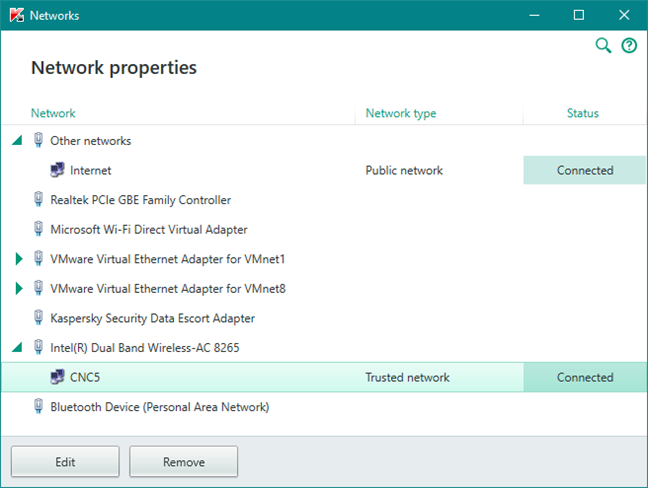
Kaspersky automatically detects the network profile you set in Windows and adjusts its firewall protection accordingly, without any user input
The security suite has almost no impact on the overall performance of your computer
The user interface is easy to use and understand, and it looks good
Most of the tools bundled in this security suite are useful and easy to use
Kaspersky Total Security includes a VPN service, and that is useful when it comes to protecting you on unsafe, public Wi-Fi networks
There are also a few weaknesses about this product:
The firewall module could use some improvement so that it does not leave any open ports, at least when you use a public network profile
Because it provides useful features, the Kaspersky Protection browser add-on should also be ported to Opera (it uses Webkit just like Google Chrome) and Microsoft Edge
We wished that Kaspersky Secure Connection would have offered more traffic than only 200 MB per day
Product rating4/5
Verdict
Kaspersky Total Security manages to impress when it comes to the anti-malware protection it offers. For the money you pay, you get a very good antimalware engine, excellent protection when browsing the web, and a lot of extra features and tools that can help you increase your security. Also, having a VPN service built into a security suite is a welcome feature that can protect you efficiently when connecting to public and unsafe networks. The only significant aspect that is not that great about Kaspersky Total Security is the fact that the firewall module is only average in effectiveness. Also, the current allegations that the United States and, more recently, Great Britain, have made against Kaspersky might lead many users away from it. We cannot prove whether these allegations are true. Kaspersky has denied these claims, saying it has become a scapegoat in the midst of rising tensions between Washington and Moscow. What we know for sure though is that, when it comes to antivirus products, Kaspersky remains one of the best in the market.
The download and installation experience
Getting Kaspersky Total Security on your Windows PC means that you first have to download it from the official website. The file you download is an executable file called kts18.0.0.405aben_12562.exe with a size of 2.30MB. The good thing is that you do not have to provide Kaspersky with any personal information before downloading the trial.
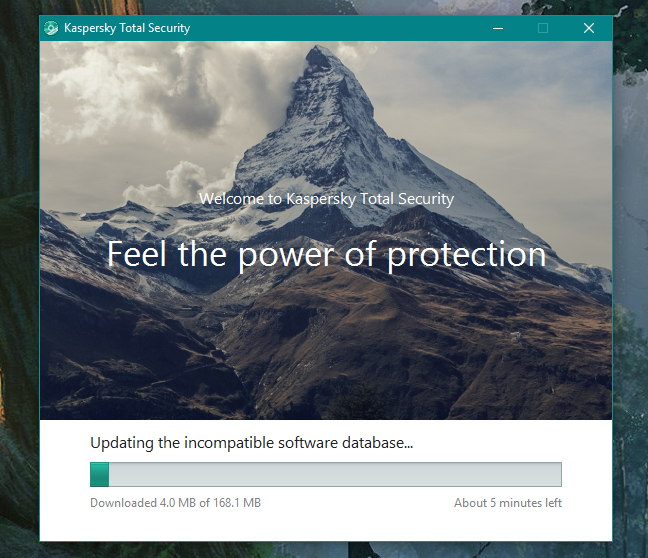
Running the setup file means that you get to download another 168.1MB of data from Kaspersky's servers, which is less than what you have to download for other similar security suites.
Kaspersky, Total Security, 2018, Internet Security
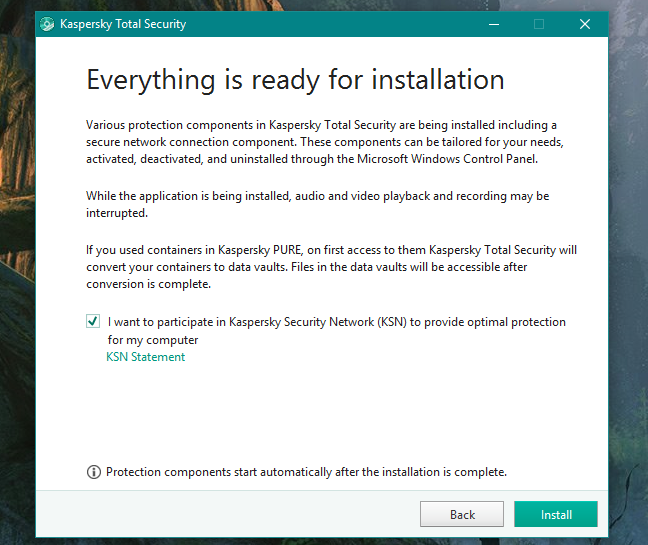
During the installation, you can choose whether you "want to participate in Kaspersky Security Network (KSN) to provide optimal protection..." and also whether you want to "turn on protection against ads to install only desired software and block additional installations." Our recommendation is for you to enable both these options as they help Kaspersky react faster against new cyber threats and protect you against potentially unwanted software.
Kaspersky, Total Security, 2018, Internet Security
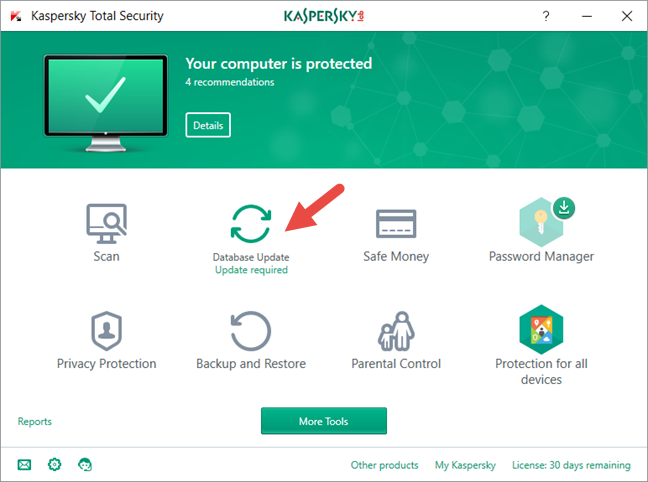
When the installation is done, Kaspersky Total Security informs you of this and starts working as soon as you press Done. There's no need for you to reboot your Windows computer, as the security suite loads its services immediately after it is installed. However, although we waited for 15 minutes and the user interface said that an update was required, Kaspersky Total Security did not initiate an automatic update of its anti-malware definitions. Seeing that, we rebooted the computer but that did not work either, so we had no choice but to load the suite's user interface and manually run the update. This behavior needs to be improved so that Kaspersky immediately updates its database.
Kaspersky, Total Security, 2018, Internet Security
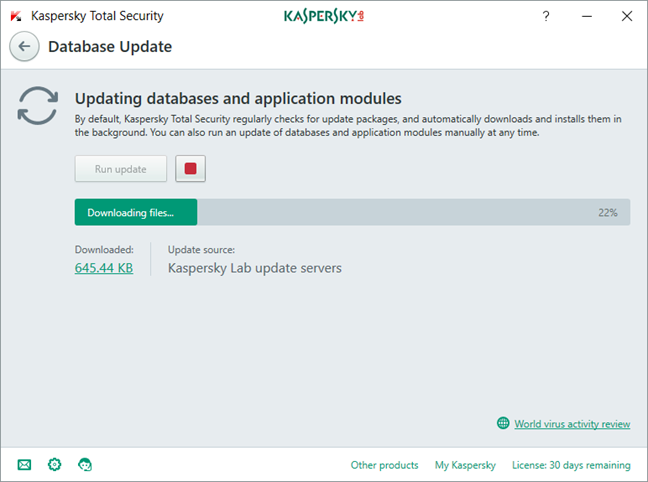
The first update of the malware database meant that Kaspersky Total Security downloaded another 2.66MB of data from the internet, which is very little.
Kaspersky, Total Security, 2018, Internet Security
Our first interactions with Kaspersky Total Security were mostly positive. We liked that you do not have to provide any personal information to download and use the trial version. We also liked how easy it is to set up Kaspersky on our Windows computer. What could be improved is the way the suite gets updated the first time after it is installed. The auto-update process should be triggered automatically, soon after you install the suite.
Integration with Windows, web browsers and universal Windows platform apps
During the installation, Kaspersky Total Security disables both Windows Firewall and Windows Defender. That is a good thing because it eliminates the chance of conflicts or performance hogs. The security suite is also well integrated with all the networking features found in modern Windows operating systems. We did not have any problems joining our test laptop to the homegroup on our local network, or when we created a Homegroup. We had no issues either when downloading, installing or updating universal Windows platform apps from the Windows Store. Kaspersky Total Security can automatically detect the network profile that you assign to Windows (public or private), and it can adjust its protection, even if you change the network type repeatedly. There is no need for user intervention to adjust the firewall, and that is great.
Kaspersky, Total Security, 2018, Internet Security
Talking about the online security you get from Kaspersky Total Security, you should know that this security suite scans all the internet traffic that goes on your computer, so you get the same protection regardless of the web browser that you prefer using.
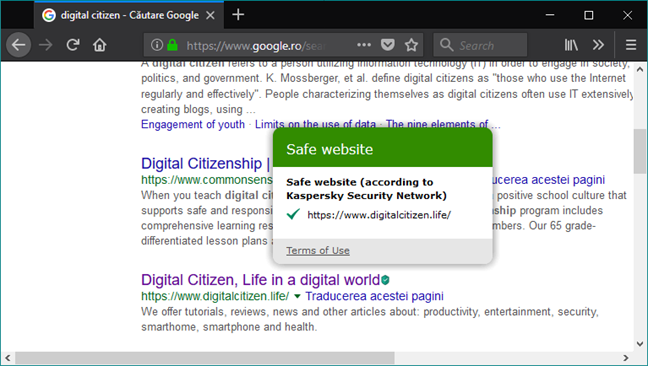
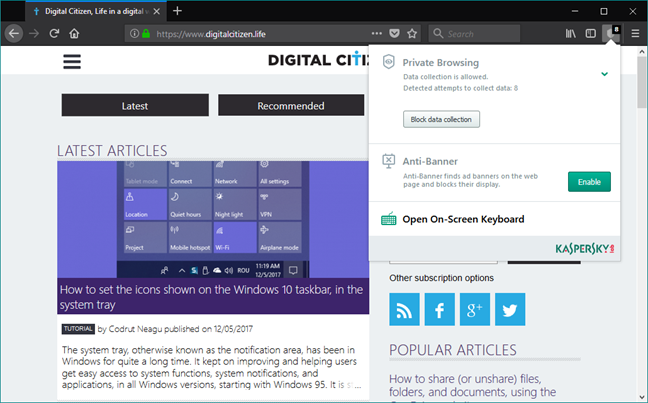
However, if you are a Chrome or a Firefox user, then you also get the Kaspersky Protection browser extension, which provides some additional security features. The extension can give you instant security ratings for search results, help you block banners on the pages that you visit and stop websites from collecting data about you.
Kaspersky, Total Security, 2018, Internet Security
We also checked whether the security suite protects all its processes from unwanted termination. If it cannot protect its processes, nasty viruses can disable your antivirus and do whatever they want on your Windows computer. As we expected, Kaspersky Total Security did protect its core antivirus processes.
Regarding resource consumption, the security suite needs about 90MB of RAM to run its processes, which is a small value for software of this kind. Also, Kaspersky Total Security had almost no effect on the boot time of our test computer. We used BootRacer to measure this before and after we installed the suite, and we found nothing meaningful in this area.
To check whether the internet or local network speeds are affected by Kaspersky Total Security, we also ran a few tests with Speedtest.net and with LAN Speed Test. The speeds were the same before and after installing the security suite, which means that it has no adverse effect on internet or local network data transfers. That is an excellent result!
Kaspersky Total Security is well integrated with Windows 10 and its networking features. We appreciate the fact that it automatically detects your Windows network profile and adjusts its firewall accordingly. We also like that it does not appear to affect computer performance or internet and network transfer speeds negatively.
Ease of use & configuration
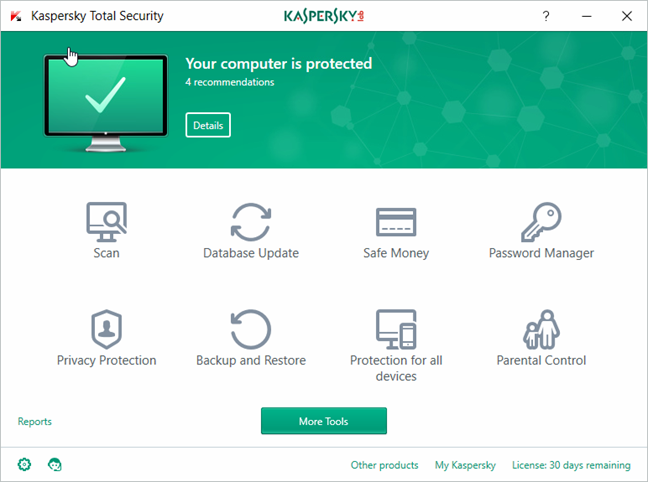
The user interface offered by Kaspersky Total Security shows a large status and recommendations section in its top area and offers easy access to everyday security tasks. It uses large tiles, painted green when everything is OK with your computer and red when something bad happens. You cannot miss the fact that you are having problems that require action. On the central console, you get quick access to Scan, Database Update, Safe Money, Password Manager, Privacy Protection, Backup and Restore, Parental Control and Protection for all devices.
Kaspersky, Total Security, 2018, Internet Security
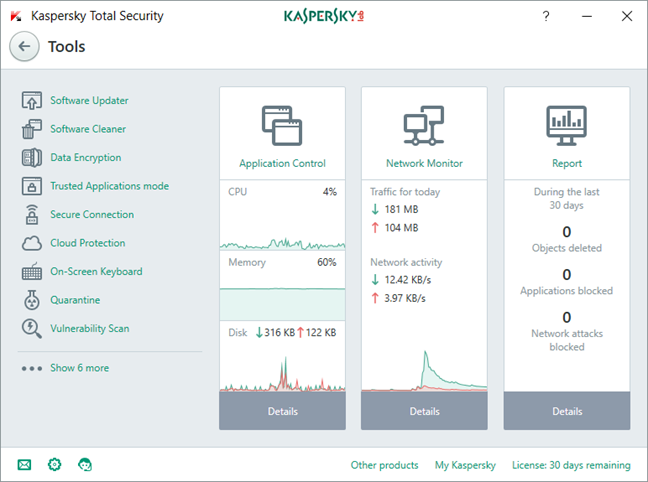
If you are looking for more, click or tap the More Tools button from the bottom of the user interface, and you get access to things like Reports, Network Monitor, Software Updater, Data Encryption, Trusted Applications mode, Secure Connection, Quarantine, and so on. There is a lot available in here, making the suite worthy of its Total Security name. The good news is that most of these tools and features are useful and can help you increase your system's security. We will talk more about the additional features offered by Kaspersky in the Extra features section of this review.
Kaspersky, Total Security, 2018, Internet Security
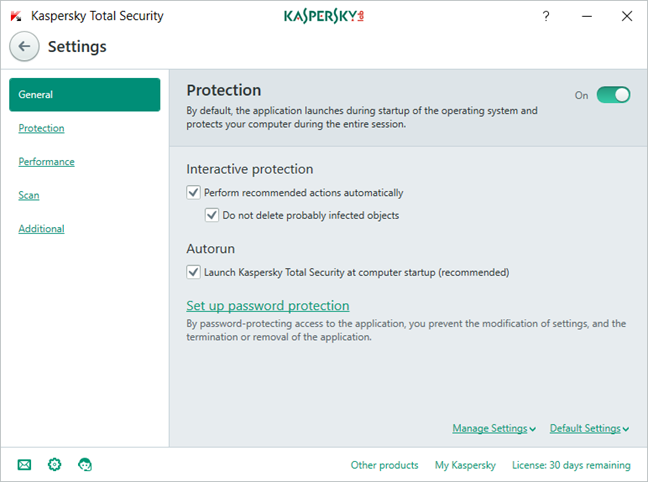
Going back to the main user interface, on its bottom left corner you can find a small cogwheel that takes you to all the available settings. If you want to configure Kaspersky Total Security in detail, this is where you do it. The Settings are divided into five different sections: General, Protection, Performance, Scan, and Additional.
Kaspersky, Total Security, 2018, Internet Security
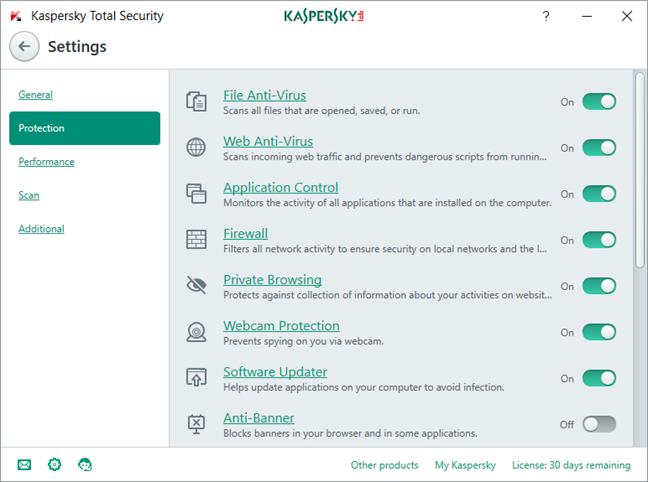
Probably the most critical settings section is Protection, where all the protection modules that are built into Kaspersky Total Security are found. We like the fact that you can quickly turn any protection module on or off with just a click or tap on the available switches. If you want to dive into their most advanced settings and details, you can click or tap on the name of the protection module that interests you.
Kaspersky, Total Security, 2018, Internet Security
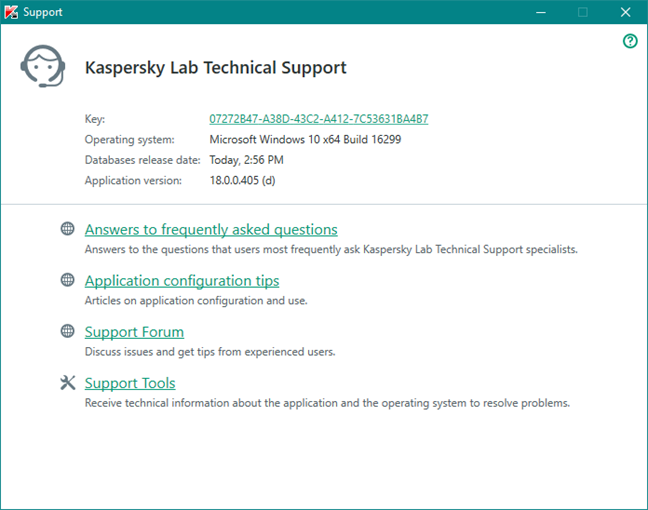
Regarding help and support, Kaspersky Total Security offers almost everything you would wish. Most of the actions and settings around the security suite are well explained in context, but if you need more complex help or support, you can go online and browse the documentation, scour the forums, live chat with support technicians or even call them on the phone. However, the phone option is available only in some countries, not in all.
Kaspersky, Total Security, 2018, Internet Security
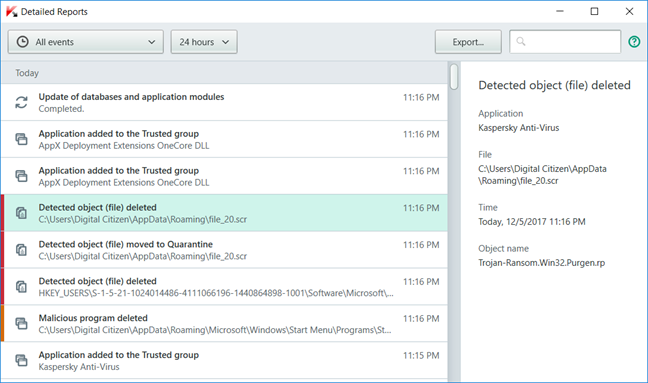
If you care about reports and statistics, Kaspersky Total Security has them. You can see what has happened on your computer during various periods of time and, if you need to, you can also check detailed logs of absolutely everything that went on your device from a security perspective.
Kaspersky, Total Security, 2018, Internet Security
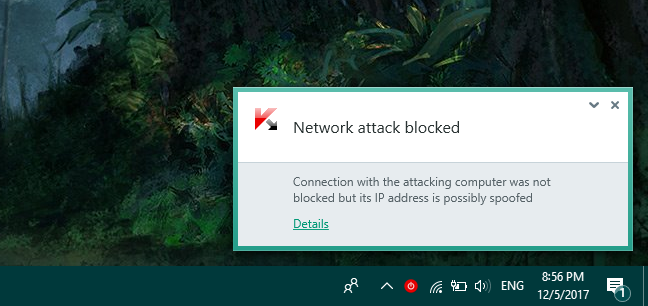
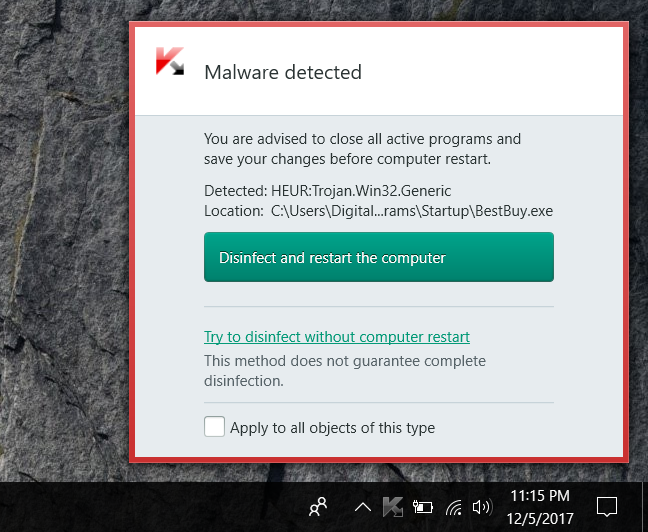
When something important takes place on your Windows computer, Kaspersky Total Security tell you about it through a concise and easy to understand notification. We have seen alerts regarding malware, and also notifications about firewall interventions.
Kaspersky, Total Security, 2018, Internet Security
Kaspersky Total Security offers a user interface that looks good and is easy to use. We like the way it is structured and the number of options and settings available. It is designed for both casual and experienced users in mind, and that is excellent.
On the next page of this review, you can see how capable Kaspersky Total Security is to protect your computer from network attacks and malware. You can also see what additional features are included in this security suite, and check our recommendations for what settings you should adjust.
Firewall protection
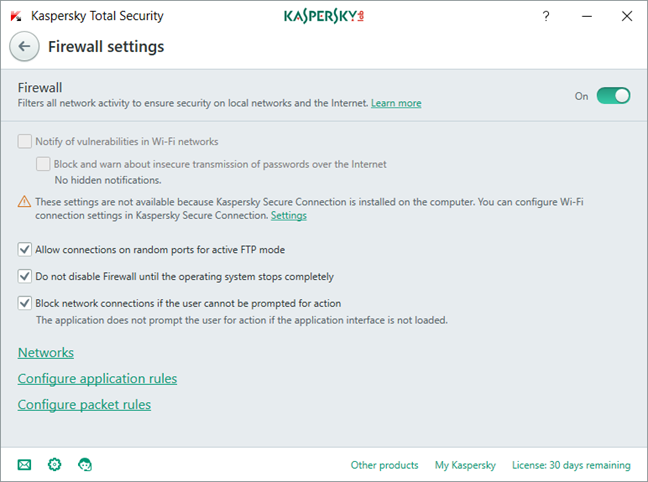
Kaspersky Total Security includes a good firewall module that is well integrated with Windows 10. The firewall can detect the type of network that you are connected to (public or private) and can automatically adjust its protection level depending on what you choose in Windows. This process is automated, so you do not have to configure the firewall manually.
Kaspersky, Total Security, 2018, Internet Security
To test Kaspersky's firewall efficiency, we used two different network vulnerabilities scanners: Nmap and Nessus. When using a private network profile, Nmap managed to identify 9 open ports, while Nessus found 7 open ports and vulnerability to man-in-the-middle attacks. After setting the network profile to private, Nmap found 5 open ports, while Nessus managed to identify 3. Both Nmap and Nessus were able to read the MAC address but not the name of the operating system used on our test system. Unfortunately, these are not great results. The effectiveness of Kaspersky's firewall is rather average when compared to the firewall modules that are included in other security suites.
We like the fact that the firewall module from Kaspersky Total Security is well integrated with Windows 10. However, regarding network protection, the firewall is only average and does not excel.
Antivirus and antispyware protection
The first thing we checked about the antivirus was to see how well it handles online threats that you encounter while browsing the web. Earlier we mentioned that Kaspersky Total Security includes a browser add-on called Kaspersky Protection. If you are using Google Chrome or Mozilla Firefox, this extension gives you instant security ratings for your search results, as well as helping you block banners on the pages you visit, or block websites from collecting data about you.
Kaspersky, Total Security, 2018, Internet Security
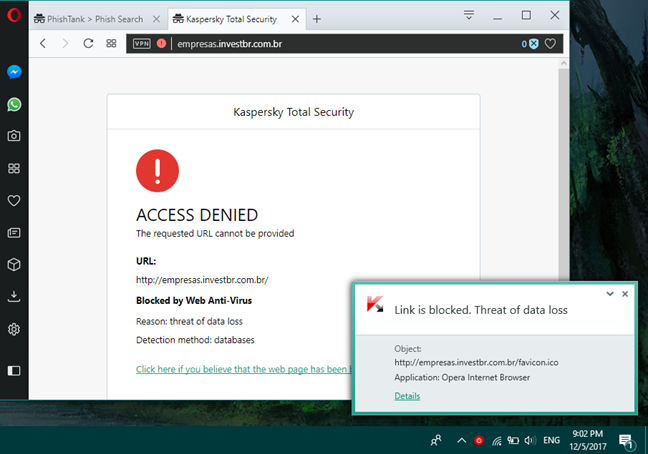
Even if you do not enable the Kaspersky Protection browser add-on or if you prefer using other web browsers like Microsoft Edge or Opera, Kaspersky Total Security still protects you by scanning all the internet traffic that goes through your Windows computer.
To see how well you are protected while surfing the internet, we used the most popular web browsers (Microsoft Edge, Google Chrome, Mozilla Firefox, and Opera) and visited several dangerous websites. To get equivalent results, we did not use the add-on provided by the security suite in any of these web browsers. The good news is that Kaspersky Total Security blocked our access to the infected web pages each time we tried, in all the web browsers.
Kaspersky, Total Security, 2018, Internet Security
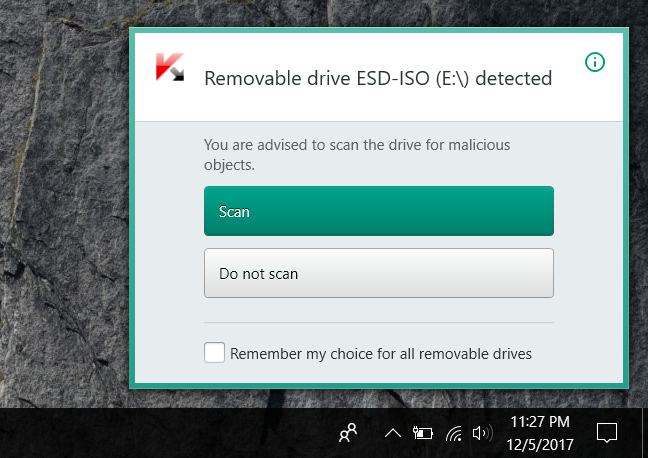
Next, we wanted to see what the security suite does when we plug in a removable USB memory stick full of malware. The behavior we saw was what we wanted: Kaspersky Total Security detected the USB memory stick and asked whether we wanted to scan it for malware. We said yes and, in a few minutes, it was cleaned automatically of all malware.
Kaspersky, Total Security, 2018, Internet Security
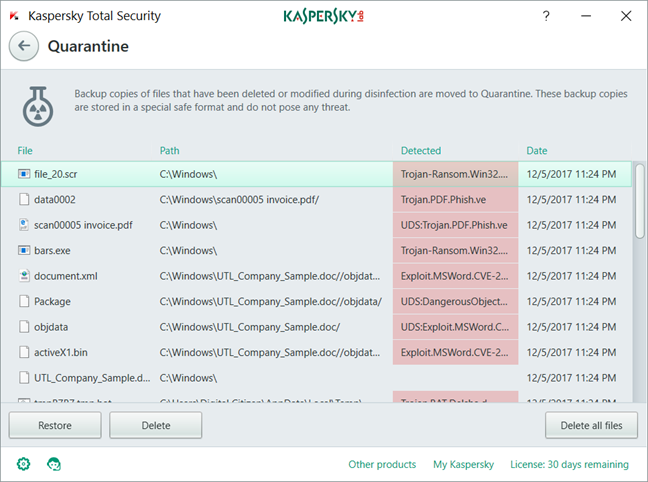
Next, we took our test laptop, we installed Windows 10 on it, and we filled it with malware of all kinds, including some nasty ransomware. After a few reboots in which we made sure that the test computer was a ticking time bomb, we went online with the purpose of downloading and installing Kaspersky Total Security. We managed to do that and, after the security suite was up and running, infected files started to get disinfected or removed from our system.
Kaspersky, Total Security, 2018, Internet Security
After another few reboots, the laptop was usable again, and Kaspersky confirmed that it still is a solid product when it comes to the anti-malware protection that it offers.
Kaspersky, Total Security, 2018, Internet Security
We believe that antivirus scanning speed is yet another important attribute when evaluating a security product. On our test computer, which runs on Windows 10, Kaspersky Total Security spent an average of 3 minutes to scan the 126 GB system partition with 35 GB of files on it. That is a fast scanning time in our opinion.
Finally, we looked at what other independent security organizations had to say about Kaspersky:
AV-Test rated Kaspersky with their maximum score of 6 points out of 6, in all their tests (Protection, Performance, Usability).
AV-Comparatives awarded Kaspersky with their top Advanced+ badge in all their security tests this year (Malware Protection, Performance, Real World Protection).
Kaspersky Total Security offers one of the best antimalware engines on the market. If you want the best of the best, we are sure that you cannot go wrong if you choose to use a Kaspersky antivirus.
Extra features
Kaspersky Total Security bundles more than a few additional tools and some of them will undoubtedly be useful, while others maybe not so much:
Kaspersky, Total Security, 2018, Internet Security
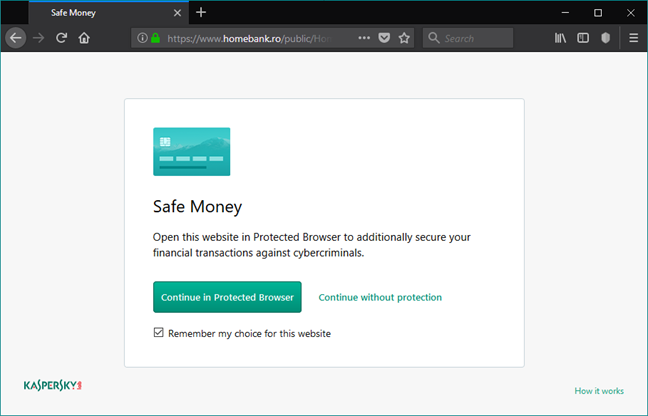
Safe Money - when performing financial transactions online, Safe Money opens a protected browser window that continuously checks if your data is safe from prying eyes. You should use it for online banking and shopping.
Password Manager - stores your passwords in a safe manner and lets you use them whenever you need, in your web browsers. It works with Windows, OS X, Android, and iOS. You have to create an account on the My Kaspersky portal to use it. By default, this tool is not installed, but you can download and install it directly from the main user interface.
Privacy Protection - includes reports and settings for Private Browsing sessions and a Webcam Access feature that lets you know if someone is trying to use your webcam.
Backup and Restore - lets you create backups of your files so that you can later restore them if you need to.
Parental Control - allows you to set how much time your child uses the computer and when.You specify the apps and games he or she is allowed to run, restrict internet access according to your rules, block or allow communication through instant messengers and block the transfer of private data (e.g., home address, credit card numbers) from your child to third parties.
Protection for all devices - lets you connect all your Kaspersky protected devices to your account on the My Kaspersky portal. There, you can manage the protection of your devices remotely, from any web browser.
Software Updater - searches for updates that could improve your computer's performance or that could fix bugs or security issues found in the apps that you have installed on your computer. You can find the list of all the software monitored by Kaspersky, on this webpage: Compatible applications.
Software Cleaner - checks whether you have installed apps on your computer that you use rarely, or that could be classified as adware. If you believe they were installed by mistake, you can quickly remove them using this tool. However, some people might find it annoying to see it pop up repeatedly to remind them that they have apps they have not used for a while.
Data Encryption - lets you create a data vault that is encrypted using AES-256 encryption, and in which you can place the folders and documents that you want to protect.
Trusted Applications mode - when enabled, this mode protects you by automatically blocking any app that is not found in Kaspersky Security Network database.
Cloud Protection - lets you connect or disconnect your computer to the Kaspersky Security Network. It is a good idea to keep this option on, as it helps Kaspersky's security suite protect you better and respond faster to cyber threats.
On-Screen Keyboard - an on-screen keyboard that should be used when you want to make sure that the data you enter is not logged by third-party apps or by malware.
Vulnerability Scan - this wizard scans Windows and third-party applications (like Flash or Java) for known vulnerabilities, and it warns you when appropriate.
Kaspersky Rescue Disk - a free tool which you can download from Kaspersky's website. You use it to create a rescue disk that can be used for disinfecting computers that are so severely infected with malware that they cannot boot Windows.
Browser Configuration - this tool analyzes the configuration of Internet Explorer, and it recommends improvements to its security settings. If you are using Windows 10 and you never open Internet Explorer, this tool is rather useless.
Privacy Cleaner - cleans your computer history of recent commands and accessed files, cookies, caches, logs and other data, so that your activity is kept private.
File Shredder - gives you the option to delete sensitive data from your computer permanently, with little or no chance of recovery.
Unused Data Cleaner - searches and deletes unused data on your device, things like log and history files, temporary files or recycle bin contents. This tool adds little value to the whole package, as Windows can clean junk files by its own - you do not need a particular app for this purpose.
Microsoft Windows Troubleshooting - this wizard checks for system problems that may have been caused by malware activity or the disinfection performed by the suite and tries to help you out when problems are found.
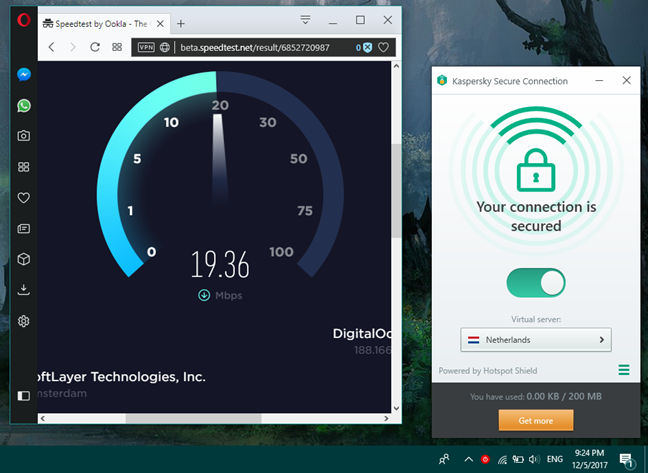
Secure Connection - a VPN service offered by Kaspersky in association with Hotspot Shield. Using a VPN service is an excellent idea especially if you want to stay safe when you connect to public untrustworthy wireless networks. It is an excellent addition to Kaspersky Total Security, but unfortunately, it is capped at a maximum of 200MB internet traffic per day. If you want more, you have to buy a separate subscription. We have tested Secure Connection VPN tool here: Security for everyone - Reviewing Kaspersky Secure Connection VPN.
Kaspersky, Total Security, 2018, Internet Security
There are many additional tools bundled in Kaspersky Total Security. Most of them are useful and some, like the Secure Connection VPN, are mandatory if you want increased privacy and protection. We like most of what Kaspersky bundles but you should note that a few of these extras do not provide much value.
Default settings you might want to adjust
Most of the settings in Kaspersky Total Security are configured well by default, but there also a few which you might prefer to change:
Kaspersky, Total Security, 2018, Internet Security
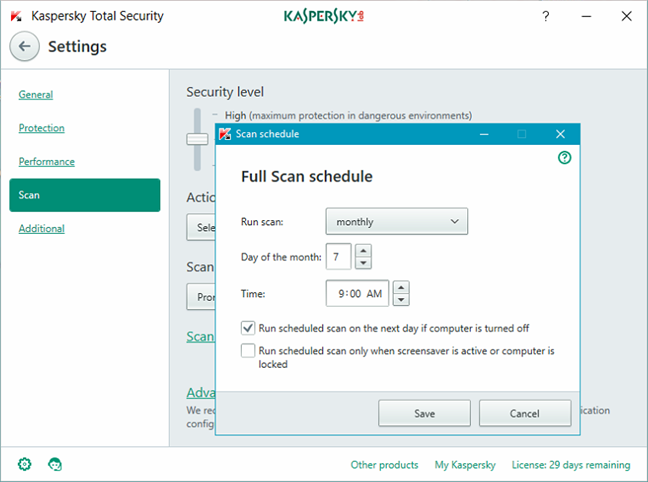
Kaspersky Total Security is set by default to scan your computer while it is idle. This is a great approach. However, there are no antivirus scans scheduled at regular time intervals. If you want to increase your security even further, you might want to schedule at least a full scan once a month. You can do this in "Settings -> Scan -> Scan schedule."
Kaspersky Total Security can be set to detect not just viruses, worms, trojans, adware but also other types of software that can be used by hackers to "damage your computer or personal data." This is a setting which is disabled by default - you can find it in "Settings -> Additional -> Threats and Exclusions settings -> Detect other software that can be used by criminals to damage your computer or personal data."
By default, Kaspersky Total Security uses its "Advanced Disinfection technology" and, although it is a good thing, this technology also "requires considerable computer resources." That means that, unless your PC is powerful, Kaspersky Total Security can slow it down significantly when malware infections are detected on it. If you would rather preserve your computer's performance, you might consider disabling this option. This setting is found in "Settings -> Additional -> Threats and Exclusions settings."
It is a good thing to get notifications about security-related events that take place on your computer, but if you do not want to hear sounds when you get them, or if you do not want to receive advertisements and promotional notifications from Kaspersky. You can change these behaviors in "Settings -> Additional -> Notifications."
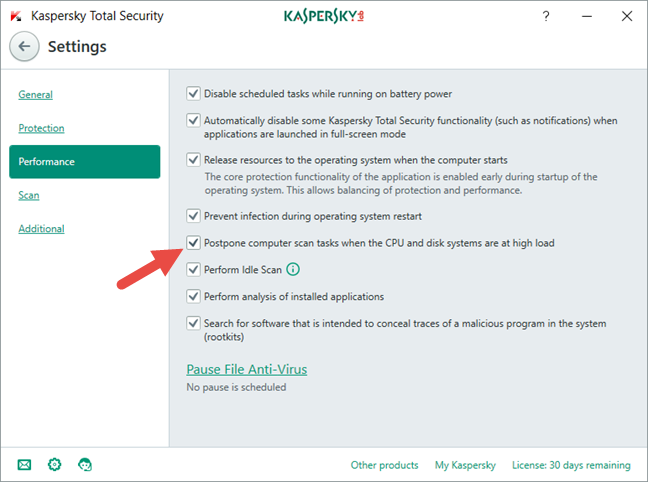
If Kaspersky Total Security is having a hard time running scans when your processor and disks are under heavy load because you work on your computer, you can postpone Kasperky's scans until your computer resources are being freed up. This setting is found in "Settings -> Performance -> Postpone computer scan tasks when the CPU and disk systems are at high load."
Kaspersky, Total Security, 2018, Internet Security
We found Kaspersky Total Security to be well configured by default. However, it has a lot of settings and options to choose from, so it is a good idea to review everything and set Kaspersky to run according to your personal preferences.
What is your opinion about Kaspersky Total Security?
Kaspersky Total Security is a premium security suite that excels at protecting you against malware and dangerous websites, although it is not so spectacular when it comes to stopping threats originating from your local network. Considering that some governments do not appear to like Kaspersky's products lately, we are curious what you think. Would you buy it, or do you prefer to look elsewhere? Share your views in a comment below.



















Discussion (0)
Comments are closed.