Do you need to speed up your computer or laptop, without paying much money? A great way to do that is to purchase and install an SSD drive. On Amazon, the Kingston A400 SSD is one of the most popular budget choices you can find and, if you look at the reviews, users love it. Is its popularity well deserved? How fast is this SSD drive? Read this review and see whether Kingston A400 is a good choice for you:
Users who need an affordable storage solution to speed up their computers
Mobile users who need an SSD drive with low power consumption
Pros and cons
Here are the pluses we identified for Kingston A400:
The price makes it a natural choice for all budget users
The performance you get is respectable, enough to speed up your computer in a noticeable way
Low power consumption
The only downside to consider is the fact that this SSD drive uses TLC NAND, which makes it less durable than SSDs with other types of NAND flash memory. It is not recommended for business environments and users who need durable storage solutions.
Product rating4/5
Verdict
Kingston A400 is a great choice for budget users. If you need to speed up your PC and ditch the slow HDD drive that you have, Kingston A400 SSD is a good choice that delivers noticeable speed improvements. It is not the fastest SSD drive that you can get, nor does it use the most durable type of flash memory, but it does feature a 3 years warranty, and it gives you respectable performance at a low price that is hard to beat.
Unboxing and hardware specifications
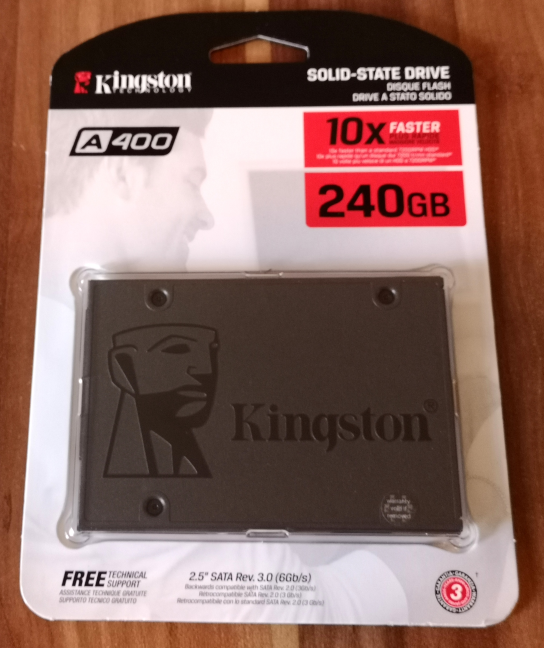
The packaging used for Kingston A400 SSD is small and simple. You get to see the model name, the capacity of the version that you purchased, and the SSD itself.
Kingston A400 SSD
Kingston A400 comes in a 7mm form factor that is suitable both for laptops and desktop computers. This model is available in several storage capacities: 120 GB, 240 GB, 480 GB, and 960 GB. The speed of data transfers varies between these capacities, as follows:
120GB — up to 500MB/s Read and 320MB/s Write
240GB — up to 500MB/s Read and 350MB/s Write
480GB — up to 500MB/s Read and 450MB/s Write
960GB — up to 500MB/s Read and 450MB/s Write
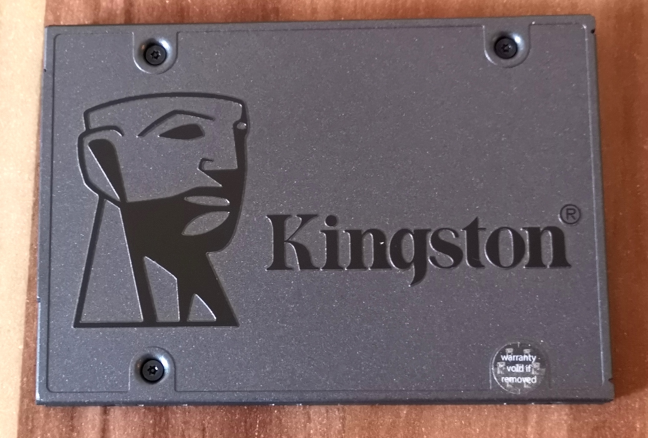
We tested the 240 GB model that you see in the picture below. The case of the Kingston A400 is made of light plastic materials, and this SSD drive weighs only 1.4 ounces or 41 grams. Even though Kingston states that A400 is shock and vibration resistant, it feels somewhat fragile, and we would not want to test its stated ruggedness.
Kingston A400 SSD
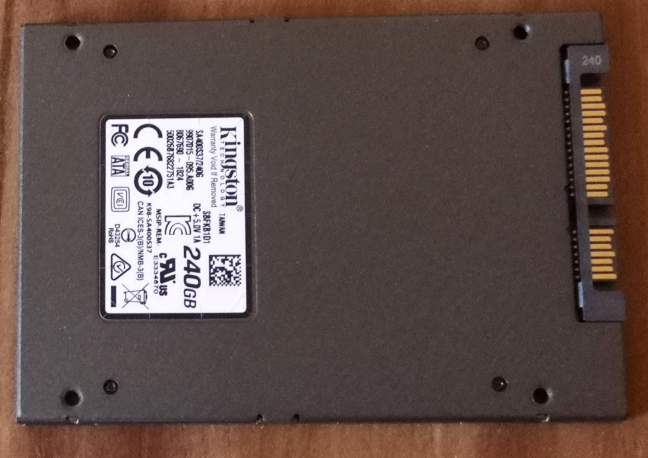
The interface used by this model is SATA Rev. 3.0. The controller used is named 2 Ch², and it is not found on other models of SSD drives. At least not at the time this review was written. Kingston A400 uses TLC NAND flash memory for storing data. It is the cheapest form of flash memory for storage drives, and it is less durable than other types that are used in more expensive drives. TLC NAND is not recommended for business environments and users who need durable storage that is used heavily, on a regular basis.
Kingston A400 SSD
The advertised power consumption is 0.195W when the drive is idle and 0.279W under average usage conditions. The power consumption is on the low side, making this SSD a good choice for laptop users. The operating temperature can be anything from 32°F to 158°F or 0°C to 70°C.
Kingston A400 SSD
If you would like to know more about the specifications of this product, go to this page: Kingston A400 SSD DataSheet.
Performance in benchmarks and Windows
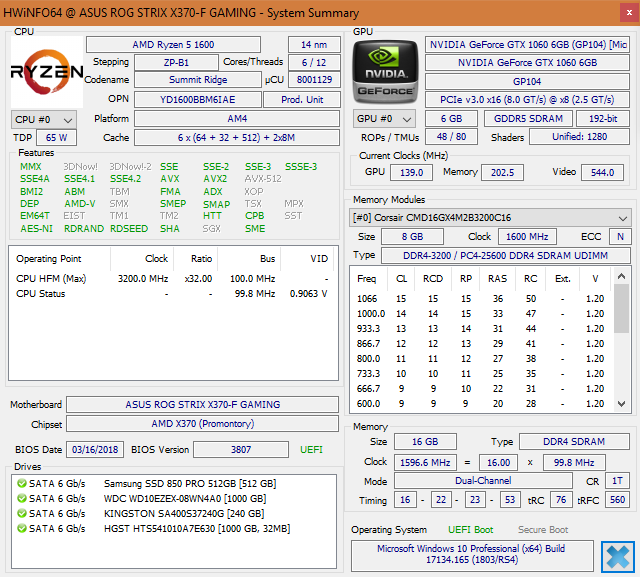
We plugged the Kingston A400 SSD drive into a computer with an AMD Ryzen 5 1600 processor, an ASUS ROG STRIX X370-F GAMING motherboard, 16 GB of RAM DDR4 running at 1600 MHz, made by Corsair, and an MSI NVIDIA GeForce GTX 1060 OC 6GB video card. You can see more details about it in the screenshot below, which shares detailed system information.
Kingston A400 SSD
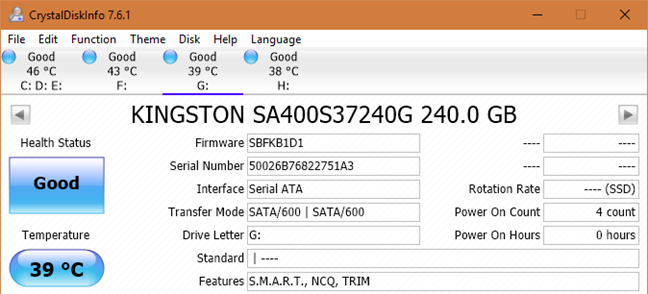
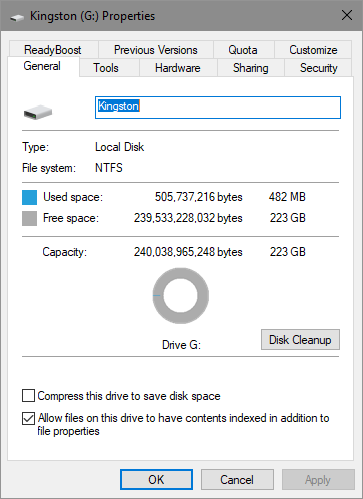
The PC had Windows 10 Pro installed, with all the latest updates. Windows 10 recognized the drive without issues and allowed us to use it. As you can see below, the actual storage space available for our 240 GB drive, was 223 GB.
Kingston A400 SSD
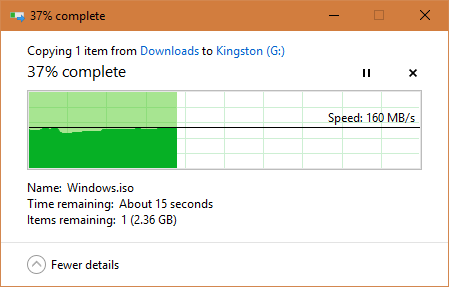
First, we transferred a file using Windows 10. We took a large 4GB file and copied it to another (more expensive) SSD. Kingston A400 SSD wrote that file at a speed of approximately 160 MB/second.
Kingston A400 SSD
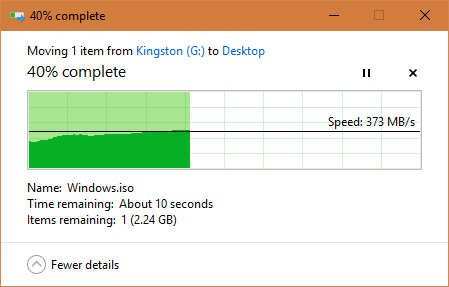
It then read the same file at a speed of approximately 373 MB/second.
Kingston A400 SSD
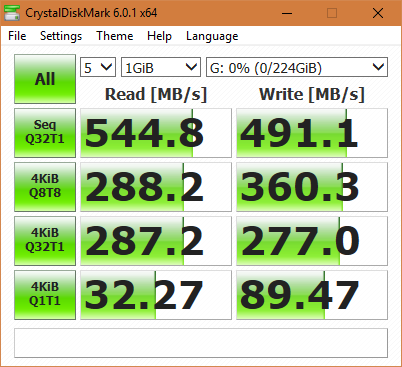
We also used benchmarks to evaluate Kingston's promises for speed. The first benchmarking app that we ran was CrystalDiskMark, which executes several tests for reading and writing data, both sequentially and randomly:
Seq Q32T1 - Sequential (Block Size=128KiB) Read/Write with multi Queues & Threads
4K Q8T8 - Random 4KiB Read/Write with multi Queues & Threads
4K Q32T1 - Random 4KiB Read/Write with multi Queues & Threads
4K Q1T1 - Random 4KiB Read/Write with multi Queues & Threads
The speeds measured with this app were slightly better than those advertised by Kingston, which is great.
Kingston A400 SSD
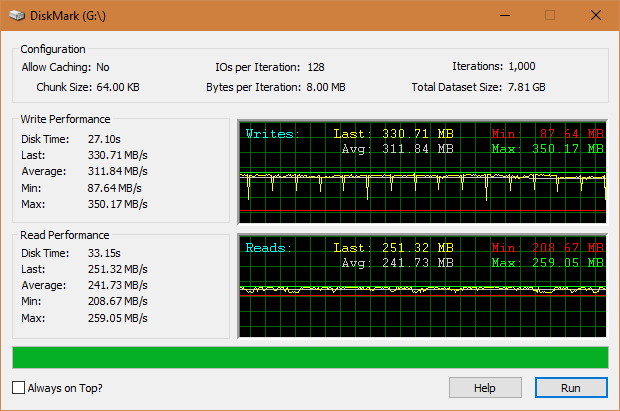
The second benchmark that we used is DiskMark, which evaluates both read and write performance and automatically calculates the average speed you get during file transfers. This app writes and reads data packages to determine the disk's performance and lets users choose a size for the packages, as well as the number of runs it makes. This time we obtained lower average speeds than those advertised by Kingston.
Kingston A400 SSD
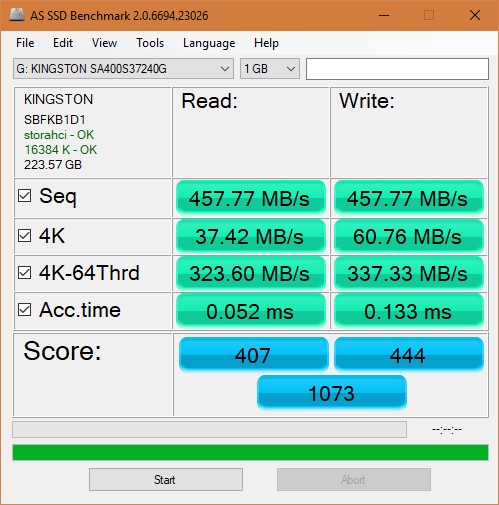
Lastly, we ran the AS SSD Benchmark, which is similar to CrystalDiskMark in the tests it makes. This benchmark determines the sequential and random read and write performance of the drive, measuring how long it takes to read and to write a file with a size of 1 GB. We had good results, but they were also different from what Kingston advertises, and from other tests that we ran.
Kingston A400 SSD delivers a good bang for the buck regarding raw performance numbers. It is not the fastest drive you can use, but for the price you pay, it is difficult to find better alternatives.
What is your opinion about the Kingston A400 SSD?
Now you know our opinion about the Kingston A400 SSD drive and how it performed in our testing. If you already have this SSD drive at home, do not hesitate to share your experience in a comment below. Other readers want to know about your experience.
im sorry but that benchmark with 1gb test is misleading and inacurate of real values, you should do it with 3gb or 5gb.
Anonymous ·
Will keep it in mind for future testing.
GuccizBud ·
Yeah, there’s the fact read/write speeds don’t fully stabilize (downward) with only 1 GB, especially on an SSD, and 4 GB would be more like it.
That aside, if you buy this, go for the 480 GB . . . you’ll only pay about $20-25 more, the write speed is about 100 MB/sec faster (as mentioned here), and if you’re looking to clone your C: drive over to an SSD to use as your BOOT_MAIN, there’s more chance of the contents of your old mechanical C: drive fitting.
















Discussion (3)
im sorry but that benchmark with 1gb test is misleading and inacurate of real values, you should do it with 3gb or 5gb.
Will keep it in mind for future testing.
Yeah, there’s the fact read/write speeds don’t fully stabilize (downward) with only 1 GB, especially on an SSD, and 4 GB would be more like it.
That aside, if you buy this, go for the 480 GB . . . you’ll only pay about $20-25 more, the write speed is about 100 MB/sec faster (as mentioned here), and if you’re looking to clone your C: drive over to an SSD to use as your BOOT_MAIN, there’s more chance of the contents of your old mechanical C: drive fitting.
Good review, thanks for this.