The iPhone 6 got more than its fair share of criticism for its size and shape: it was too big compared to the iPhone 5 and the rounded edges and the materials used made the smartphone rather slippery. Lots of Apple fans wanted something a bit more conservative and closer to the design of the last generation, and boy, did they get it. By popular demand, Apple used most of the iPhone 6S hardware in the 5S package, making the iPhone SE the smallest flagship smartphone currently available on the market. Its powerful hardware coupled with the smaller screen, have the potential to blow away the competition in terms of computing and multimedia performance. Understandably, we were very eager to test this amazing little smartphone and we did, for about a week. Let's see how it performed, in this review:
Packaging, design and build quality of the iPhone SE
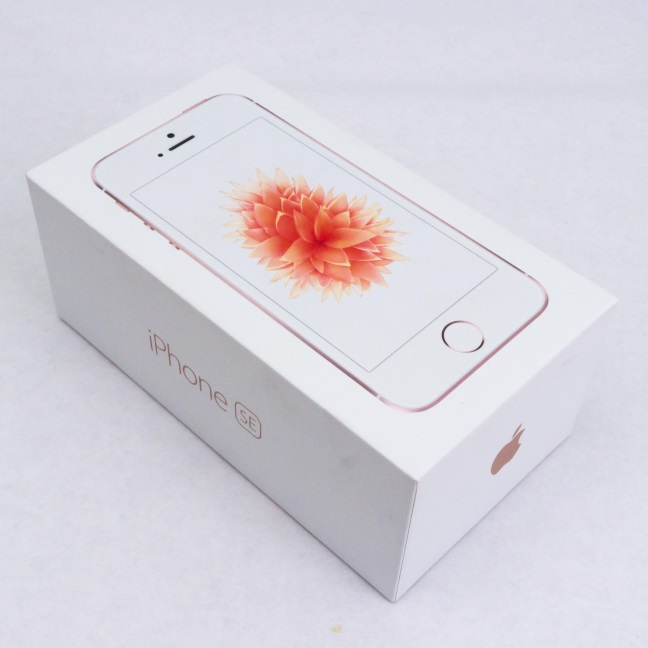
Minimalism is the trademark of Apple and the packaging of the iPhone SE is no exception: a white, simple box, with the contents carefully and tightly packaged.
iPhone SE, iOS, smartphone, review
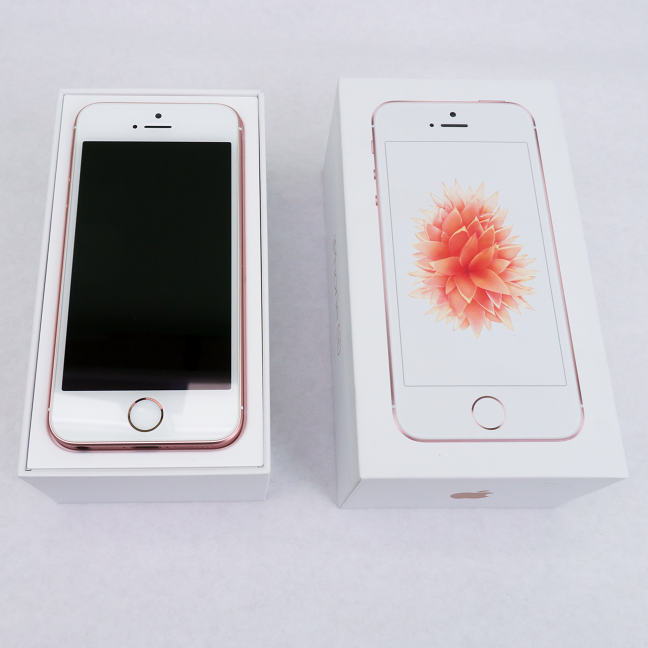
The smartphone is the first thing you will see when opening the box, with the rest of the accessories tucked away beneath it. No, it's not an iPhone 5S. We promise.
iPhone SE, iOS, smartphone, review
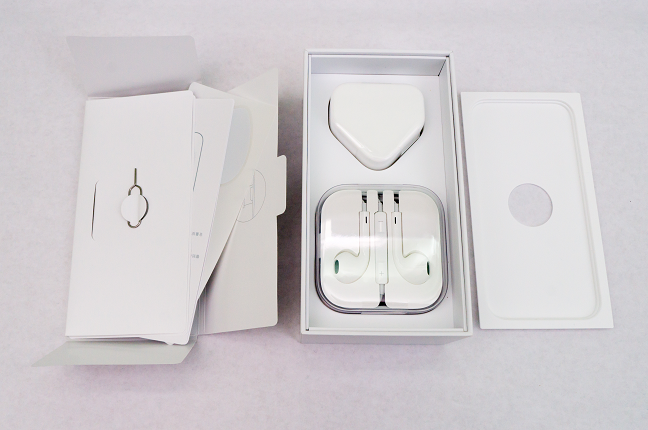
The package contents are: the charger, the charger cable (of course, with the Lightning connector, not micro USB), the earphones and a smaller package with the manuals. The box containing the manuals also contains a pair of Apple logo stickers and the ejection tool for the SIM tray.
iPhone SE, iOS, smartphone, review
The traditional Apple earphones are neatly packaged in their own box. The whole unpacking experience for the Apple iPhone SE shows the attention to detail and the philosophy of Apple products: the best feel and best experience possible.
iPhone SE, iOS, smartphone, review
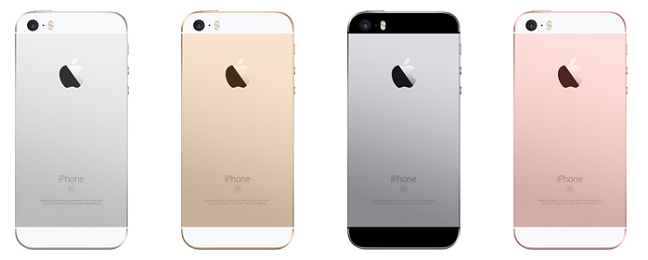
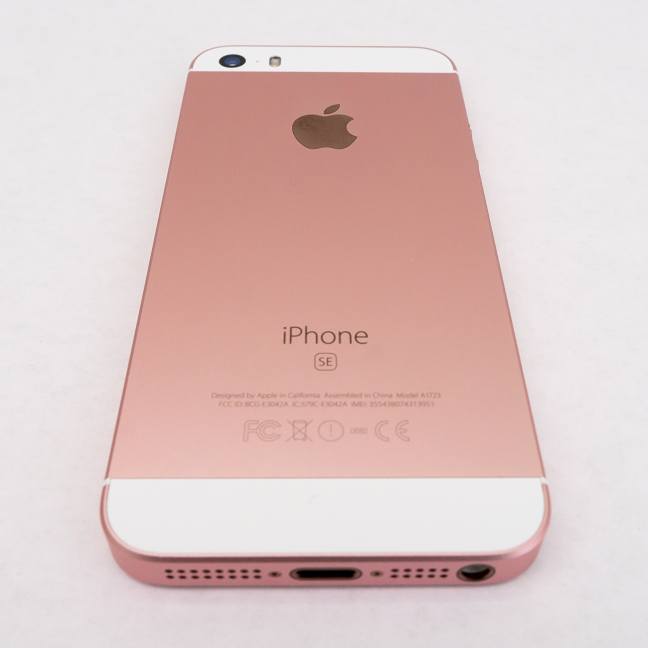
At launch, users can choose between four colors for their iPhone SE: Silver, Gold, Space Gray and Rose Gold (the unit we are reviewing today).
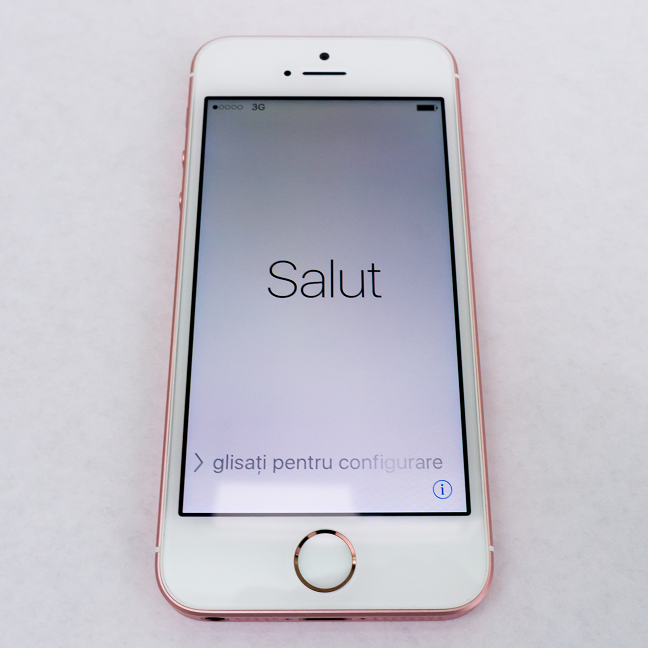
Even considering the fact that the design has been around for three years, the fact remains that it's still the most elegant smartphone made by Apple to date. And yes, that includes the iPhone 6. The front contains the earpiece, the camera, the proximity and light sensor and, hidden in the Home button, a fingerprint sensor.
iPhone SE, iOS, smartphone, review
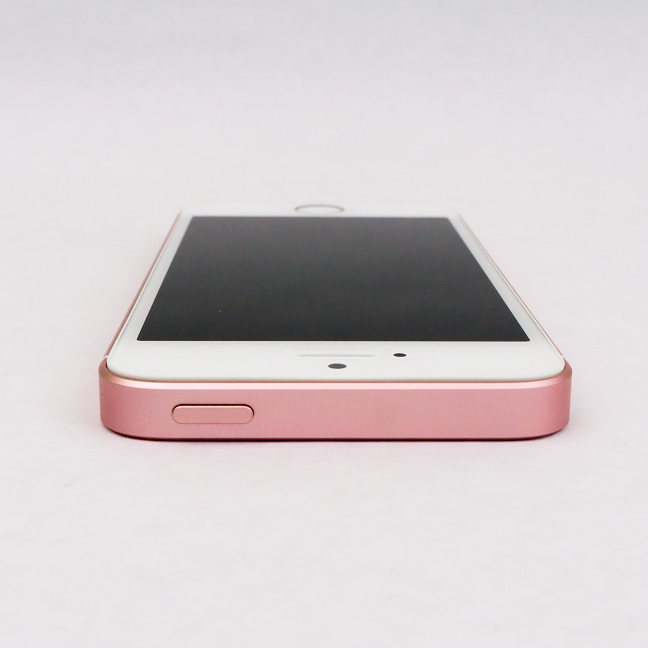
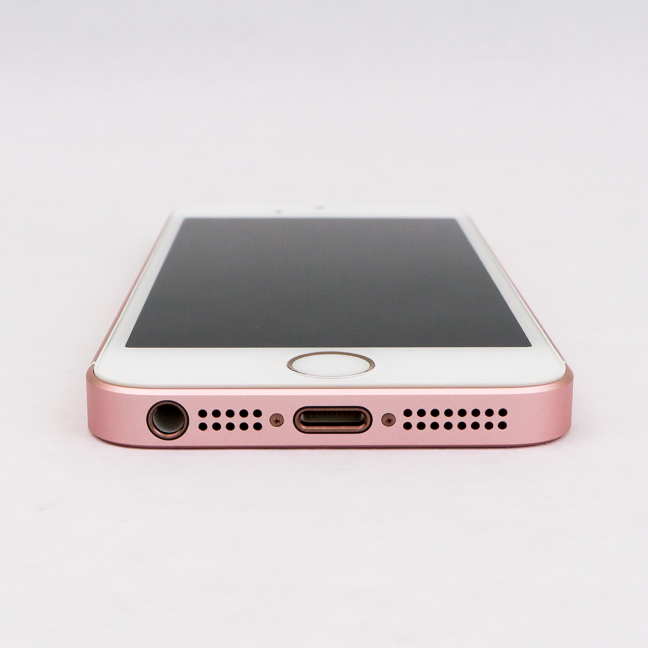
The top of the phone houses only the Power button, while the bottom contains, from left to right, a 3.5 mm headphone jack, the main microphone, the Lightning connector and the built-in speaker. It's 2016 and the iPhones still have no dual speakers. I guess some things never change with Apple and that's not a good thing to hear when you discuss technology.
iPhone SE, iOS, smartphone, review
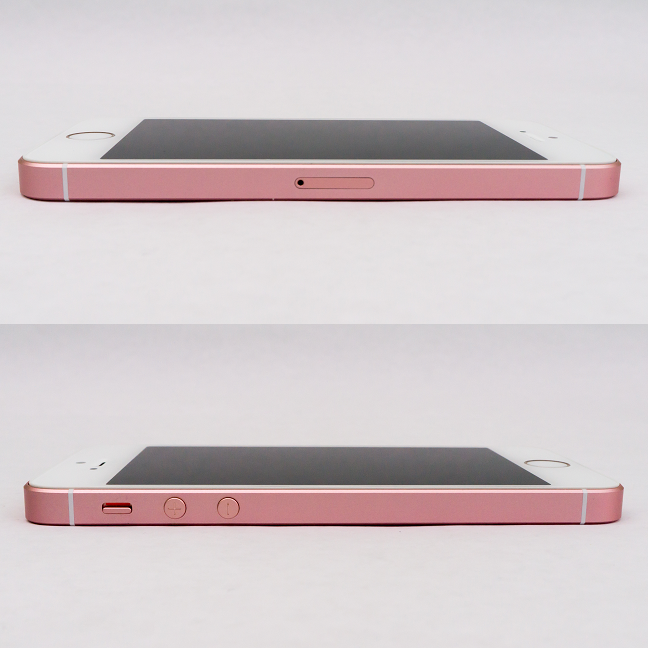
The left side only contains the SIM tray, while the right side contains the Ring/Silent switch and the Volume buttons - the same clean design that we loved in the iPhone 5 and the iPhone 5S.
iPhone SE, iOS, smartphone, review
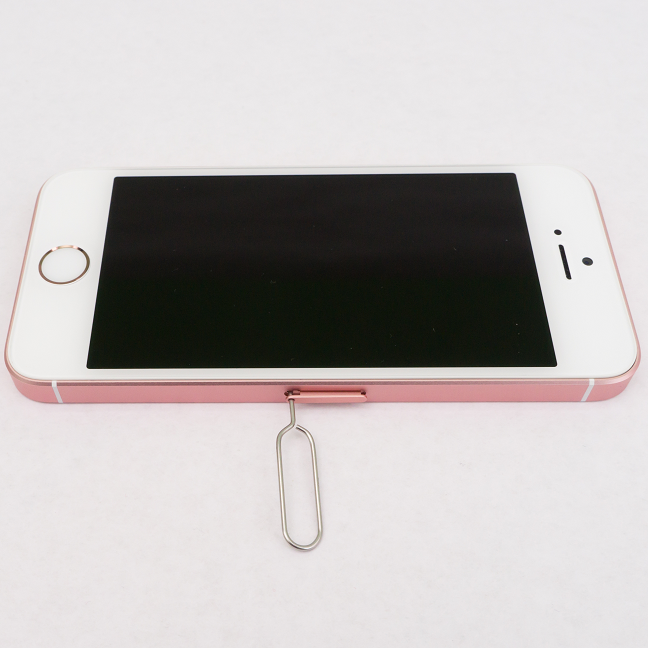
The SIM tray can be ejected using the provided tool, and you get a sense of the quality of the manufacturing process by the way everything fits and feels.
iPhone SE, iOS, smartphone, review
On the back of the phone you'll find the main camera and the True Tone flash (dual LED, dual color) and of course, the Apple logo.
iPhone SE, iOS, smartphone, review
The package is, as usual from Apple, clean, minimalistic and very user-oriented. The exterior of the smartphone has the same sturdy build as the one of the iPhone 5S and the materials feel premium. Despite the "old-school" looks, the iPhone SE still feels as fresh and stylish as its predecessor felt three years ago. On a market dominated by 5.5 inch screens and phablets, the device looks incredibly tiny and is also very comfortable to handle.
Hardware specifications of the iPhone SE
You may now be wondering why I chose the nickname of iFrankenstein. That's because the iPhone SE is a mix of components taken from three different smartphones: the iPhone 5S, the iPhone 6 and the iPhone 6S.
Obviously, the case is taken from iPhone 5S. The chipset, Apple A9, with a dual-core 1.84 GHz Twister processor, 2 GB of memory and PowerVR GT7600 six-core graphics, is taken from the iPhone 6S (aka the fastest iPhone to-date). The Retina screen is again identical to the one on the iPhone 5S which, at the time of launch was a very good screen, with good color reproduction and viewing angles. It is still holding its own, even now. This means that the resolution is not up to today's standards, with a mere 640 x 1136 pixels (~326 ppi pixel density), but on a 4 inch screen, do you really need a larger resolution? The use of the older screen means that unlike the iPhone 6, the SE has no 3D Touch (a feature which allows the user to perform various actions, depending on how hard he or she touches the screen).
The front facing camera (1.2 Megapixels, f/2.4 aperture) can record 720p videos and is taken from the iPhone 5S, while the main camera is the 12 Megapixel iSight camera (f/2.2 aperture and 29 mm focal range) used on the iPhone 6S, but without the optical image stabilization. The camera has phase detection autofocus and a five-element lens and we're very happy the engineers at Apple have managed to squeeze it into the body of an iPhone 5S. It is capable of recording videos of 1080p with up to 120 frames per second and 4K videos at 30 frames per second (here's a great article on screen sizes, written by my colleague Codruț: What do 720p, 1080p, 1440p, 4K and 8K mean?).
iPhone SE, iOS, smartphone, review
The fingerprint sensor is taken from the iPhone 6, not the 6S, and there's probably a good reason for that, either related to the size of the hardware involved or the costs.
Storage is one of the weak points of any iPhone. Not necessarily the storage space, but the lack of upgrade options. iPhone SE also has no SD card and with only two options available (16 GB - the one we tested - and 64 GB), the smartphone either has limited space available or an unnecessarily high price. The device is, of course, LTE (4G) capable and has an 802.11 a/b/g/n/ac wireless adapter. The iPhone SE also has a Bluetooth 4.2 adapter and NFC support. The battery capacity is very small by today's standards, with only 1620 mAh. Considering the frugal consumption of the A9 chipset, it just might be enough for the iPhone SE, but we will test that later in our review.
The smartphone is 4.87 inches (123.8 mm) in height, 2.31 inches (56.6 mm) in width and 0.3 inches (7.6) mm thick. This makes it one of the smallest smartphones available today and also one of the lightest, with a weight of only 3.99 ounces (113 grams).
The iPhone SE is, at least on paper, quite a Frankenstein's monster, with very powerful components transplanted from the other Apple smartphones. Before we put this tiny monster to the test, let's take a quick look at the software environment. You can find the specs of the new iPhone SE on the official page: iPhone SE specs.
The software and the user interface of the iPhone SE
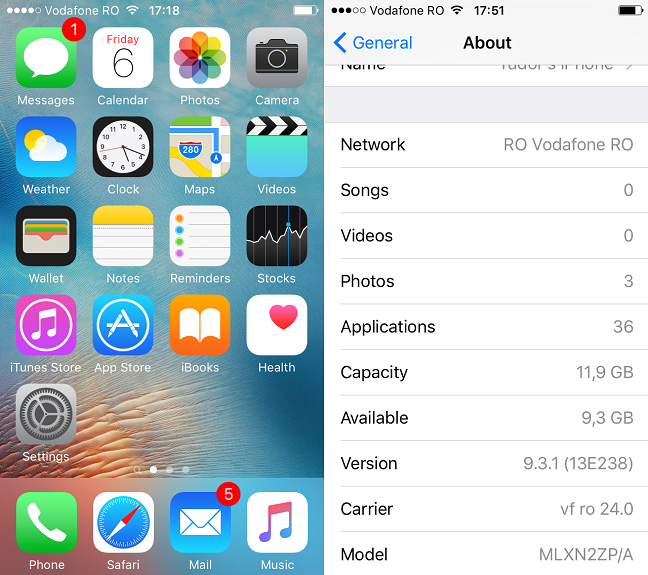
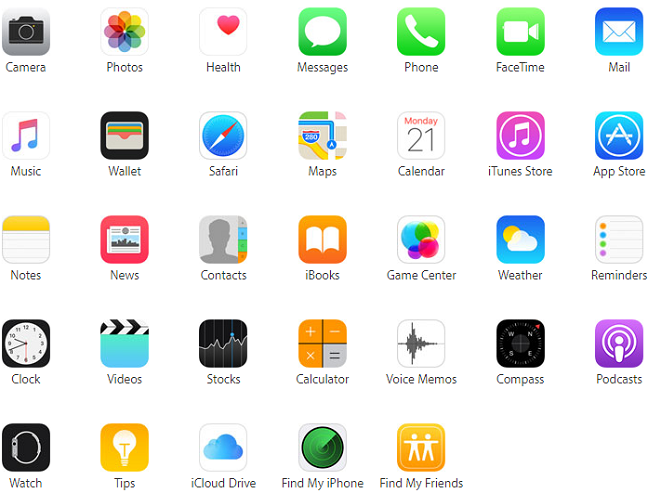
The iPhone SE, at the time of the review, comes with iOS 9.3.1. The 3D Touch options are missing but other than that, it comes with all the features that this version has to offer. As far as graphics go, the new iOS has only minor changes from iOS 8 and the applications are almost the same.
iPhone SE, iOS, smartphone, review
The operating system occupies 5.1 GB. The usual applications are there, with few notable additions. One of them is NightShift, which uses the clock and geolocation to automatically shift the display colors to the warmer end of the spectrum after sunset. Studies have shown that this reduces the eye strain and helps the user fall asleep easier. Now I'm not saying you stare at your screen for an hour before bed, but I do. And you do too. Admit it!
iPhone SE, iOS, smartphone, review
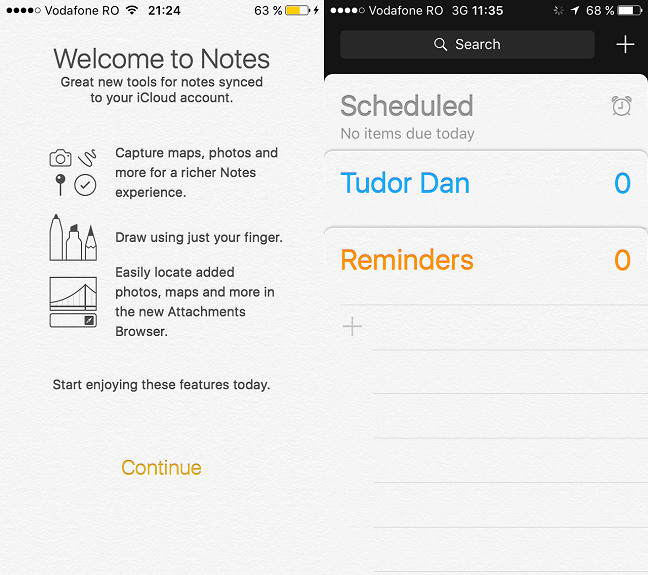
Another addition is the Health dashboard, which manages third-party fitness apps and organizes the data more efficiently. The Notes app now has an additional layer of security, requiring a Touch ID in order to open. Also, Siri is supposedly smarter, allowing you to search through videos and photos, but she is still far from understanding context in questions. Mind you, I did not ask the meaning of life, but she can't even lock the screen, not a complex task at all.
iPhone SE, iOS, smartphone, review
The Notification Center is accessed by swiping down from the top of the phone and features two sections, Today and Notifications. Nothing changed here. The iPhone STILL has no quick search option (that's when you type the number in the Phone app and it shows you all the contacts which contain the string of numbers or the corresponding letters), a feature present even on the most basic Android smartphones, but it does have the Spotlight Search. With a downwards swipe of the screen, you can access it and it will search for the given string in a variety of locations like the phone book or your e-mails. It even does simple math!
A double click of the Home button lets the user access the task switcher, while a swipe up from the bottom of the screen opens the Control Center, which handles volume and connectivity settings. If you want to learn more about iOS 9.3, have a look here: iOS Updates.
As usual for Apple operating systems, the evolution is incremental. We get the same look as in the previous version, the usual apps and the same trouble-free, although heavily restricted environment.
Let's now turn the heat on! On the next page, you will find the benchmark session and more importantly, the real life testing and details about our user experience.
Benchmark performance of the iPhone SE
The benchmark session was atypical since some of the tools we usually use in our tests are not available on iOS. That includes the Vellamo suite, which tests the CPU and browser performance, and PCMark, which we usually use for our battery tests.
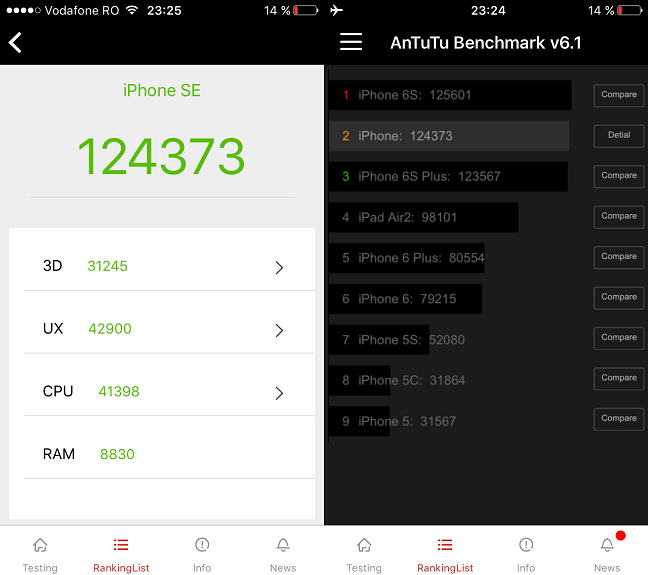
For the CPU, we used AnTuTu 6.1 instead, which showed just how powerful this little monster is.
iPhone SE, iOS, smartphone, review
With 124373 points, the SE absolutely crushes both the iPhone 5S and the iPhone 6, and is ranked in the top five smartphones at the time of the review. Only the Samsung Galaxy S7 and the Xiaomi MI 5 (which we recently reviewed) are able to catch up with this speedy dwarf, and considering both the price and the size of the smartphone, it's a remarkable achievement. The direct competitor to the iPhone SE, the Sony Xperia Z5 Compact, only managed a score of around 75000, nowhere near the level of the iPhone SE.
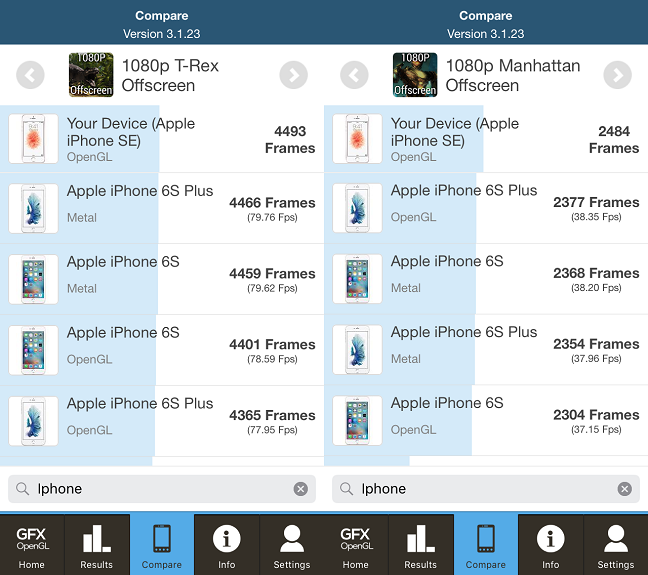
Next, we used GFXBench GL to test the graphics subsystem. We were expecting good results, especially since the iPhone 6S is a top performer and the iPhone SE has the same hardware. And it again delivered.
iPhone SE, iOS, smartphone, review
Both in the 1080p T-Rex Offscreen (4493 frames) and the 1080p Manhattan Offscreen (2484 frames), the iPhone SE is number one in the Apple range of handsets. Even when comparing to the top performers right now, very few handsets can reach this level of performance. Only the Samsung S7 can best the small Frankenstein by 16%, with the Xiaomi MI5 and the new HTC 10 having a roughly similar score (1% difference). Again, the direct competitor to the iPhone SE, the Sony Xperia Z5 Compact, only managed a score of 3135/1562 frames in the 1080p T-Rex Offscreen and 1080p Manhattan Offscreen respectively. And remember, these are offscreen tests, performed at the same 1080p resolution in order to level the field for benchmarking. Considering the low resolution of the iPhone SE screen (640 x 1136 pixels), its real-life performance is simply unbeatable and running the Manhattan on-screen shows exactly that: the iPhone SE achieves almost double the frame count of the Samsung S7 (taking a heavy hit due to the large resolution of 1440 x 2560 pixels) and only the iPhone 6S (3461 frames) manages to even get close to the score of the iPhone SE (3602 frames). If gaming is your thing, you'll only have to worry about the diminutive size of the screen.
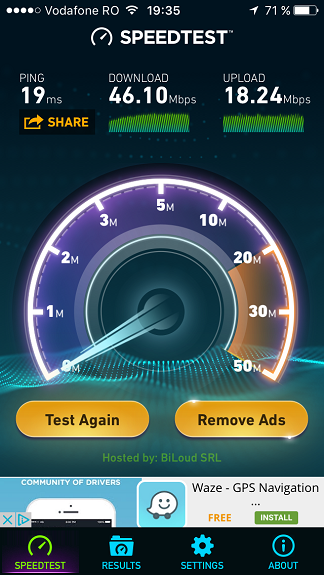
Next, we tested the network connection using Speedtest.net by Ookla. We tested the LTE (4G) connection in an area with good but not great signal strength, so the speeds you obtain might be higher. The results show a solid level of performance, with 46.10 Mbps download speed and 19.24 Mbps upload speed.
iPhone SE, iOS, smartphone, review
Finally, since the PCMark suite was not available, we used the test suite from GFX Bench GL. Surprisingly enough (since the battery only has a capacity of 1620 mAH), the iPhone SE managed 145 minutes of continuous operation, compared to the 176 minutes obtained by its competitor, the Sony Z5 Compact. This is a good result for an iPhone, although mediocre compared to other smartphones.
As expected, the small iPhone SE performs extremely well in all our tests. The battery seems to be its only weak point, but strictly looking at the raw performance, there aren't many smartphones on the market today which are able to match the iPhone SE.
The smartphone experience on the iPhone SE
I have to admit, I'm a hardcore Android fan. I love the free apps, the freedom to mod and change the user interface, as well as the level of customization available on Android smartphones. That's probably the reason why our editor-in-chief wanted me to review the iPhone SE. I can see his grin right now. Although writing about it here might not be the best idea. Of course, at first, I only saw the flaws: the lack of a status LED, the lack of quick search, the fact that some apps which are free on Android aren't so on iOS… But, after a couple of days, once I accepted the differences, everything started to make sense.
On one hand, we have the price. The starting price at the time of the review for the 16GB version is just 399 USD, an excellent price for this level of performance and lower than its main competitor, the Sony Z5 Compact. Then, we have the size. The size of the iPhone SE is perfect for people who dislike large smartphones. It's light, easy to handle, the performance is stellar and the whole experience is just top-notch. But what really made me re-think my approach towards the iPhone SE was an awesome feature present in the iOS 9. When an unknown number calls you, the OS searches through your emails and attempts to match the number with a name. I was pretty shocked to see the number on the screen and underneath "Maybe:" followed by the name of the person calling. And, indeed, it was a business contact which I omitted to store in the Contact List, but who had the signature in one of his e-mails. This feature can make a huge difference, especially if you don't usually answer unknown callers.
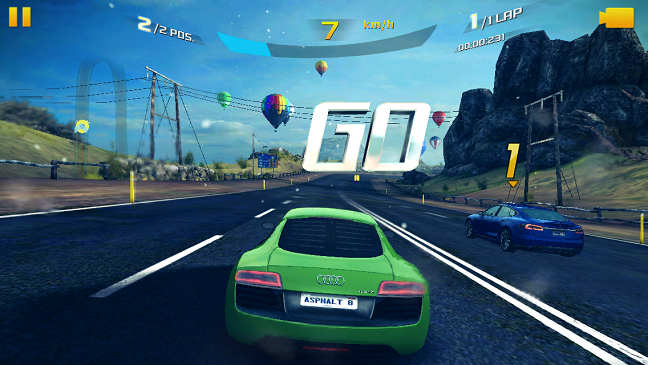
Performance is at the level you would expect from the benchmarks: perfect! I played quite a lot games like Plants vs Zombies 2 and Asphalt 8, which have detailed graphics and may be difficult to play fluently on older phones. On the iPhone SE the frame rate was very good, there were no frame drops or slowdowns, and although the smartphone did get warm, heat never got to be an issue.
iPhone SE, iOS, smartphone, review
The screen is still decent, despite the technology being more than three years old. The color rendition is close to perfect, the pixel density (~326 pixels per inch) is just right, the viewing angles and the brightness are excellent. The adaptive brightness always finds the right balance and does so smoothly, without visible steps. The bezels could have been smaller, but the idea was to keep the exact same dimensions as the iPhone 5/5S and just put the good stuff inside.
The audio quality is also great. Both when having a phone conversation and when listening to music using the provided headset. Sadly, the old architecture of the iPhone 5/5S is still present, so there is only one speaker and it's not very loud. Thus, unlike for example the Lenovo X3 Vibe, listening to media on the speaker is not recommended.
We tested the 16GB version, and without the possibility to increase the storage space, it's cutting it pretty close. The iOS already eats up around 5GB and if you fancy a bit of gaming, you are soon down to about 4 GB of free space. Download a music album or two, throw in some pictures or a few video recordings and you might find yourself in a bit of a tight spot.
Signal reception is not great, at least compared to my old Sony Xperia Z1. When in areas with poor signal coverage, the Z1 Compact manages to hold on to the signal better than the iPhone SE. The differences are small though.
The Home button doubles as a fingerprint sensor and while it's not the second generation sensor found on the iPhone 6S, I found it to be fast and accurate. Pressing the Home button, in fact pressing any button on the iPhone SE, feels nice and gives the user the right amount of feedback.
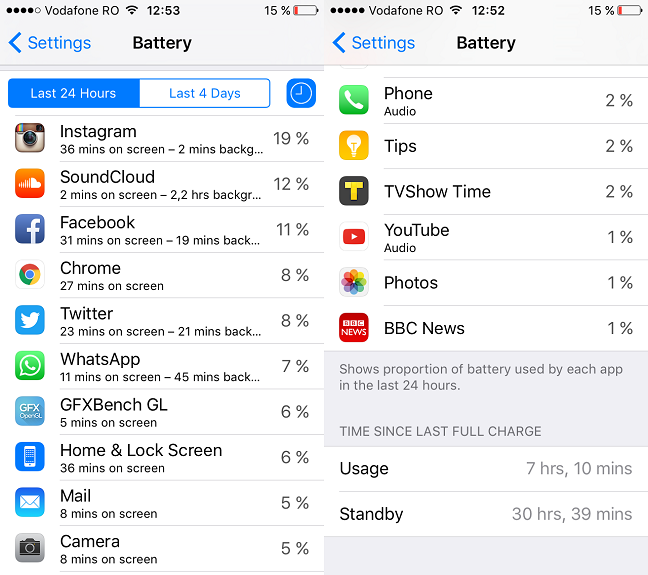
The first couple of days I only used the smartphone lightly, with only one hour of talking and without gaming and watching videos too much. Being used to tweaking my smartphone's settings, I also switched some apps' network access off, in order to conserve battery. Tip: if you don't need LTE (4G) speeds (and most of the times you don't, since the maximum 3G bandwidth of 7.2 Mbps is sufficient for streaming and multimedia), switch to 3G networks only because 4G uses more battery power than 3G. This is especially true in areas with poor 4G coverage, but a difference exists even when the 4G signal is good. Even with these small tweaks, the result was surprising.
iPhone SE, iOS, smartphone, review
Almost two days on a single charge! I was certainly not expecting this result, since my Z1 Compact manages roughly the same result under light usage.
After testing the iPhone SE with these settings, I switched to the default settings and used the smartphone more frequently. With this usage pattern, it only lasted a day, which is closer to what you can expect from the tiny battery. Although the battery performance is only average, when we insert the capacity into the equation, the result is admirable. It seems that Android smartphones still have some things to learn from iOS regarding power usage.
The smartphone experience on the iPhone SE is very good. Despite me being an Android fanboy, I had to ultimately admit that the iPhone SE offers a simple, easy to use interface, excellent features and solid performance. My only real complaint is that some applications which are free on the Android platform must be purchased on the iOS.
The camera experience on the iPhone SE
iPhones have always been famous for their picture quality. The iPhone SE is no exception, with a 12 Megapixel iSight camera (f/2.2 aperture and 29 mm focal range) which can also be found on the iPhone 6S.
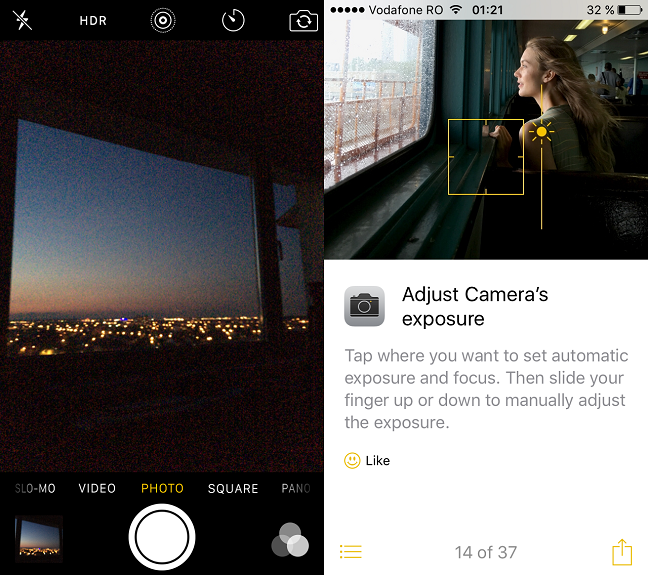
The interface is simple and allows you to quickly switch between taking pictures, making panoramas, recording normal and slow-motion videos, as well as timelapses. When tapping the screen in order to focus, you have the option to change the exposure using a slider on the screen.
iPhone SE, iOS, smartphone, review
The iPhone SE inherits the Live Photo feature from the 6S. It's a feature similar to HTC's Zoe which instead of taking a picture, records a short video. In the case of the iPhone, it records a 3 second video, 1.5 seconds before and 1.5 seconds after the shutter is pressed. Wait, what? BEFORE I press the shutter? Indeed. And no, the iPhone hasn't mastered time travel, it just starts recording (with a 1.5 second buffer) as soon as you open the Camera app. It also takes a still picture when you press the shutter button.
The picture quality is very good, with neutral colors but a bit more noise than we would have wanted. No distortion or chromatic aberration can be detected and the dynamic range is very good and made even better with a true auto HDR function. The lack of optical image stabilization is not a problem for the iPhone SE because it always uses correct exposure times in order to eliminate the risk of shaky pictures. Actually, none of the pictures I took had any problems with camera shake, even in low light.
iPhone SE, iOS, smartphone, review
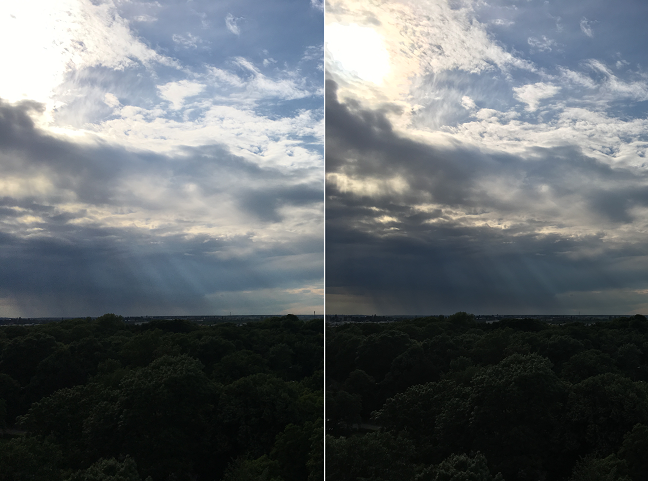
The HDR can be set to ON, OFF and AUTO. When active, it discreetly enhances the dynamic range, without introducing aberrations or shadowing. It's a true HDR, because it doesn't post-process a single photo, it takes two separate photos with different exposures and then stitches them together. Below you have a picture taken without HDR (left) and with HDR (right). You can see slightly more detail both in the dark parts and the over-exposed areas with HDR on.
iPhone SE, iOS, smartphone, review
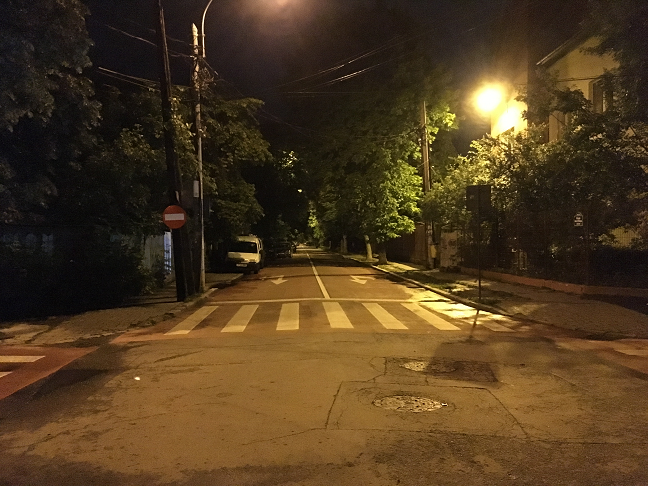
Indoor pictures are also good, with good lighting. The dual LED flash does its job when needed, providing sufficient light without overexposing the shot. However, despite its BSI sensor (backside illuminated) which is supposedly better in low-light conditions, the night shots are not the best we've seen. They are, however, above average in terms of detail reproduction and white balance.
iPhone SE, iOS, smartphone, review
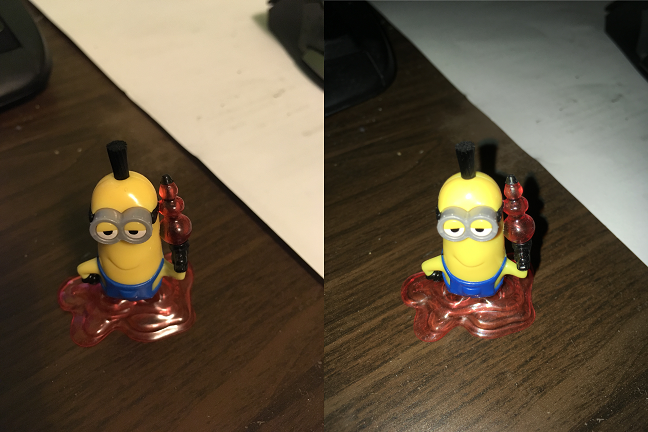
Macro shots are very good, with the iPhone SE being able to get very close to the subject (1.2 inches or 3 cm). Below, we see the same subject without flash and with flash. The color reproduction is better with the flash on, although there is a little bit of overexposing going on.
iPhone SE, iOS, smartphone, review
The videos are detailed, with nice, neutral colors and a steady framerate. For 1080p recording, the bitrate is roughly 17 Mbps, an average value. The software stabilization works smoothly and the videos are not shaky at all. The sound recording is mono, but the quality is above average. Here is a sample including fast moving objects as well as static scenery.
The Timelapse feature can produce some interesting results to say the least. Take a look at a timelapse video:
There is also the Slow Motion setting, which records videos at higher frame rates (240 fps) and the plays them at 30 fps. The result is not visible unfortunately if you download the video from the smartphone using third-party apps like Dropbox.
The secondary camera needs to go back to 2013. Seriously! And never return. With devices sporting 8 Megapixel front-facing cameras, the quality of the 1.2 Megapixel shots taken with the iPhone SE is simply awful, especially in less than ideal lighting conditions.
iPhone SE, iOS, smartphone, review
As always, you can take a look at the full gallery to see the actual quality of the photos and video recordings.
The iPhone SE has a great main camera, finely tuned and with a simple user interface. Both the photos and videos are great, and the only big disappointment is the front-facing camera. The pictures are not shaky, despite the lack of optical image stabilization, due to the carefully chosen camera settings and some aid from the software stabilization. Overall, a good experience!
Pros and cons of the iPhone SE
Summarizing our findings, we liked the following about the iPhone SE:
Good starting price
The smartphone is very solid and well built, as was its predecessor
Top performance, both in CPU and graphics-intensive applications
Excellent audio quality
Mature and bug-free OS
Good main camera
We also found some things we didn't like:
Outdated front-facing camera
The iPhone SE offers a single speaker
You get only mono sound recording
The 16GB version hasn't got an awful lot of storage space, and there is no memory card support, which sucks
Product rating4/5
Verdict
We feel that Apple has made the right choice upgrading the iPhone 5S and renaming it iPhone SE. It is a huge leap forward in terms of performance. While the design might feel outdated to some, the quality of the product is still there and the price is very good. It isn't suited for people with big hands or people who need lots of screen real estate. But those of you who want an upgrade to the iPhone 5S or those of you who want a small, powerful smartphone should definitely take the iPhone SE into consideration. It's a tiny monster that's worth buying.
I know I’m just an old guy…but can’t these kids designing these phones, learn from the criticisms that are being so generously chucked at them? After all these bloody years they still can’t figure out there are materials available that are non-breakable (for the screens DUHHHHH!!!) and for better grip on the phone itself. DUHHHHH!!!
I can’t believe that I’m still reading these comments about screens breaking and casings that are very slippery. The dummies designing them would get a bloody job with me. Don’t you worry about that. And that kind of stupidity/contempt/disdain etc. is the very reason I don’t own one of these confounded gadgets!

















Discussion (1)
I know I’m just an old guy…but can’t these kids designing these phones, learn from the criticisms that are being so generously chucked at them? After all these bloody years they still can’t figure out there are materials available that are non-breakable (for the screens DUHHHHH!!!) and for better grip on the phone itself. DUHHHHH!!!
I can’t believe that I’m still reading these comments about screens breaking and casings that are very slippery. The dummies designing them would get a bloody job with me. Don’t you worry about that. And that kind of stupidity/contempt/disdain etc. is the very reason I don’t own one of these confounded gadgets!