In recent months ASUS released plenty of new smartphones, for all price ranges . One of their newest smartphones is ASUS ZenFone Go, that aims to offer mid-range hardware at a price designed for emerging markets. It's a device that looks good and one that promises to deliver decent hardware performance at an affordable price. We saw its specs a while ago and we also knew that it is going to follow the same design principles that ASUS created for the ZenFone smartphone family. But all that was just text and images. Up until recently, we didn't get the chance to hold this smartphone in our hands. For the last week we used it regularly for all kinds of tasks, we have run many benchmarks and now we'd like to share our opinion about the ASUS ZenFone Go. Is this device worth buying? Learn from this review:
Hardware specifications & packaging
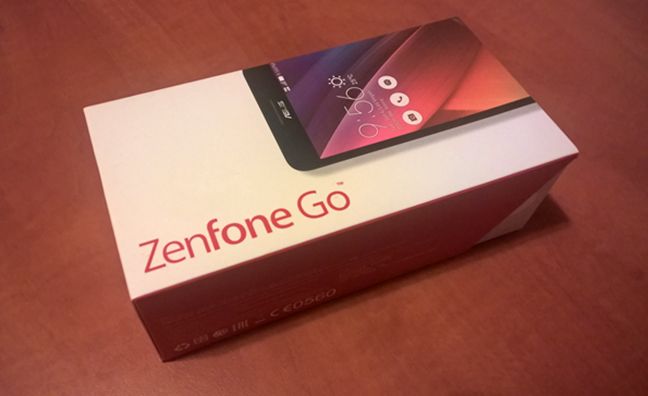
The ASUS ZenFone Go comes in the same packaging we've seen in the ZenFone family. It's a box with a silky finish that makes you think of a premium device. On the top of the box you can see the name of the device - ZenFone Go. The sides and bottom of the box hold little information about the features and specifications of the smartphone itself - you get some information about the manufacturer, the serial number of your specific device and some regulatory details.
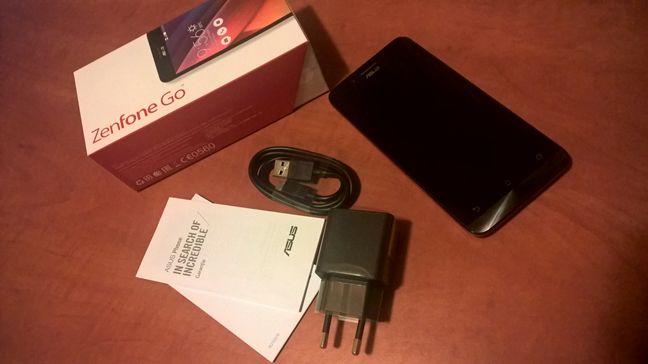
To get to the contents of the package you have to slide the smaller box that's inside the box that you see first. Inside you will find the ASUS ZenFone Go, its charger, a USB cable and its documentation (the warranty and the quick start guide).
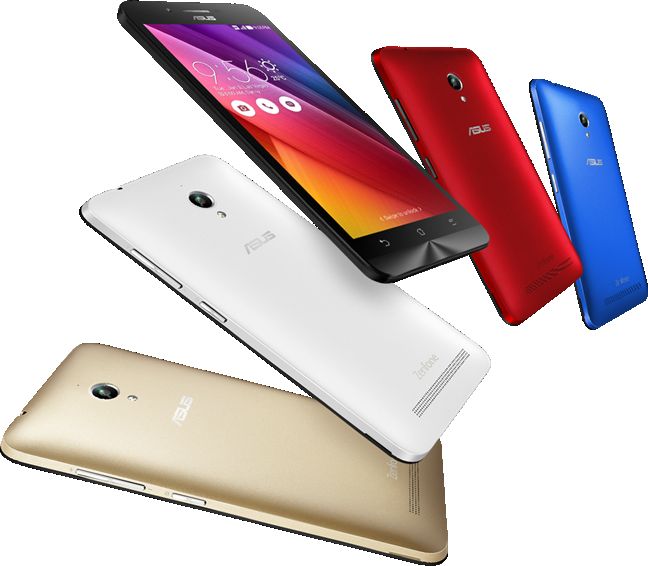
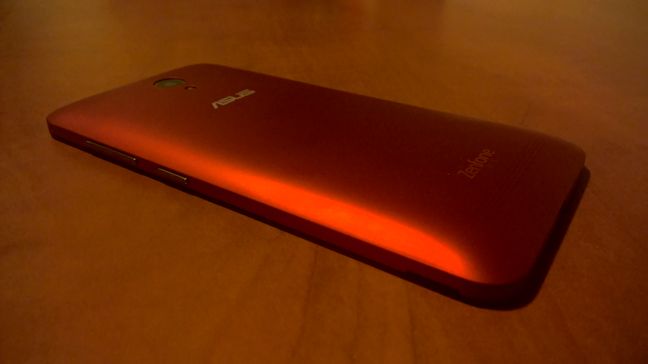
ASUS ZenFone Go is available in five different colors: black, white, blue, red and gold. The model we tested was the red one and, before going further, we'd like to say that red fits quite nicely with this smartphone.
The ASUS ZenFone Go comes with a 5 inch IPS display with a resolution of 1280x720 pixels and 294 ppi pixel density. It has a quad-core MediaTek M6580 processor clocked at 1.3 GHz, running alongside 2GB of RAM memory and either 8GB or 16GB of internal storage space, depending on the variant you have purchased. If the internal storage space seems too little, don't worry, as you can extend it with the help of a microSD card of up to 64 GB.
The main camera on the ASUS ZenFone Go has a n 8 megapixels sensor capable of taking pictures at resolutions of up to 3264 x 2448 pixels, using autofocus and the smartphone's built-in LED flash. The secondary camera on the front has a sensor of only 2 megapixels and it's quite clear that it's destined only for casual video chat apps like Skype.
In terms of communication options, the ASUS ZenFone Go offers wireless connectivity using the 802.11 b/g/n standards and a Bluetooth 4.0 chip. An interesting feature, especially for those in emerging markets, is the Dual SIM option. The ASUS ZenFone Go can work with two SIM cards simultaneously. However, none of them can connect to 4G networks. The first SIM is able to use 3G mobile networks, while the secondary SIM can only work with 2G.
The physical dimensions of the ASUS ZenFone Go are 144.5 x 71 x 9.98 mm (5.69 x 2.79 x 0.4 in) and weighs 135 grams (0.29 lbs), with its battery included. Speaking of which, the battery is based on Lithium and has a 2070 mAh capacity, which should be enough to last you for a day. But more on that later.
If you'd like even more details on the hardware specs of the ASUS ZenFone Go, you will find all of them on its official web page, here: ASUS ZenFone Go (ZC500TG) - Specifications.
The ASUS ZenFone Go doesn't have top of the line hardware specs, but that is to be expected from a budget device. However, its quad-core processor paired with 2GB of RAM memory should be enough to provide a decent user experience. Instead of the Intel processors we've seen on other ZenFone smartphones, ASUS decided to use a Mediatek CPU on this model. This has a direct effect on lowering the price of the smartphone.
Design and build quality
The ASUS ZenFone Go follows the design line of previous ASUS ZenFones. The slightly curved back and the circular finishing from beneath the capacitive buttons are two of the defining details of all the smartphones in the ZenFone family.
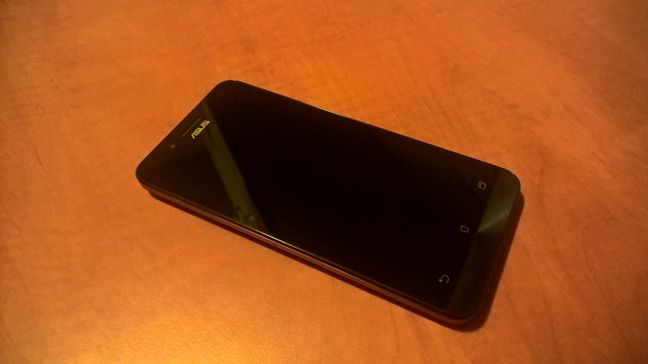
The front of the smartphone is mostly about its screen: a 5 inch display that uses IPS technology, so you get wide viewing angles, good contrast and natural colors. On top of the display sits the ASUS logo, the earpiece and the front camera, while on the bottom you get the three usual Android capacitive buttons (Back, Home and Recent Apps).
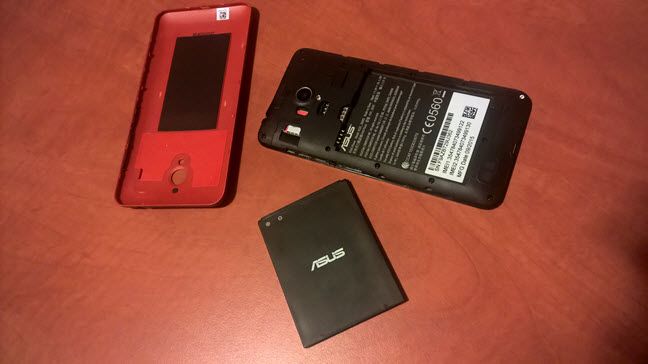
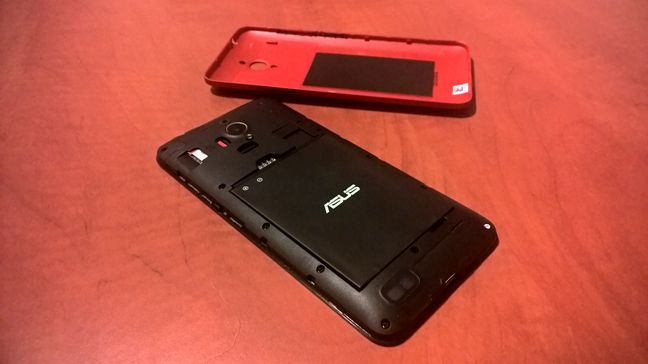
The ZenFone Go is 9.98 mm (0.4 in) thick, but this slightly large number diminishes on the sides of the smartphone, giving you the impression that this smartphone is slimmer than it actually is. The backplate is made of soft and rubber-like polycarbonate and it's detachable, unlike its bigger brothers from the ZenFone lineup. Another surprise is the fact that the battery is detachable, so replacing it with a spare is really easy.
To access the SIM cards slots, you'll have to remove the back cover of the smartphone. The primary SIM is available right away, to the top of the smartphone. To access the secondary SIM, you'll also have to remove the battery.
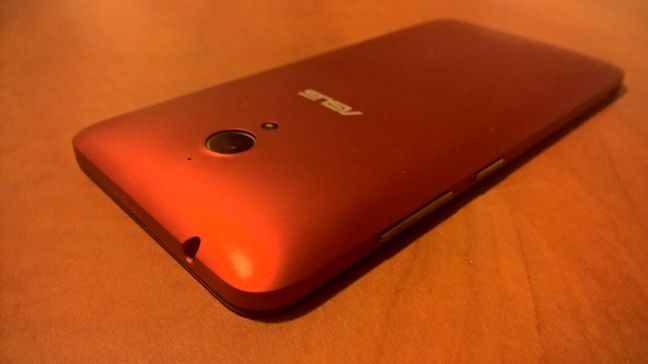
ASUS changed the location of the power button and the volume rocker on many of their devices and placed them on the back. However, it didn't do the same thing for the ZenFone Go, as you'll find all these buttons in their typical location from almost any Android smartphone: on the right side of the device. Their positioning will make them feel familiar to most Android users. Also, the texture of these buttons makes them easy to identify and use.
On the back of the ASUS ZenFone Go, on its upper area, you'll find the main camera accompanied by a simple LED flash and a dedicated microphone.
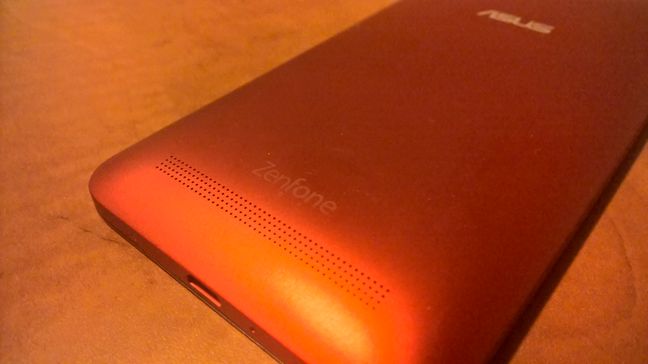
On the lower area of the back cover of the ZenFone Go, there is a wide audio grid for the smartphone's loudspeaker.
Even if ASUS ZenFone Go is among the most affordable devices of its kin, it still has most of the defining details of the ZenFone family, which is quite nice. This is a plus for a budget-friendly smartphone.
The smartphone experience on the ASUS ZenFone Go
The ASUS ZenFone Go is a budget smartphone. One direct consequence of that is that it doesn't support 4G mobile networks. It can only connect to 3G networks on its primary SIM card and to 2G networks on its secondary SIM card.
However, if the data connection speed is not a concern for you, you should know that we found this smartphone to work quite well when using regular 3G connections. In the geographical area where we tested this device, the network signal was strong on both SIM cards, and the conversations we had were of good quality.
However, we must say that the sounds on our end of the line were quite flat. It was like the people we spoke with all had the same voice loudness, neither high pitched, nor low-toned.
The audio quality when listening to music or watching videos is also decent. The rear loudspeaker is actually quite loud and doesn't distort sound too much. That is unless you push the volume to the max and you're listening to some noisy music. If you prefer using a headphone set, then you'll enjoy music at a different level. Because the smartphone doesn't bundle headphones, we used a set of headphones from another manufacturer, of average quality. That still made the music we played sound a lot better than when using the loudspeaker.
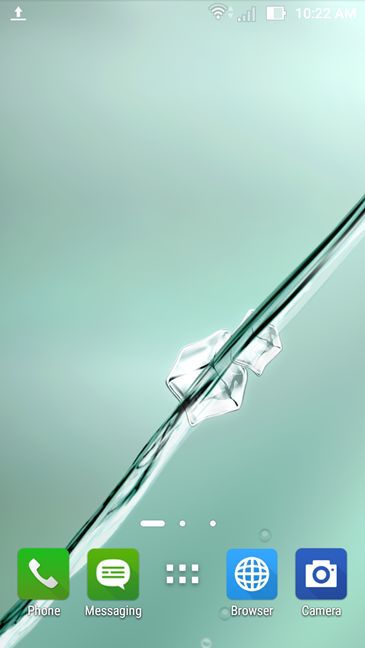
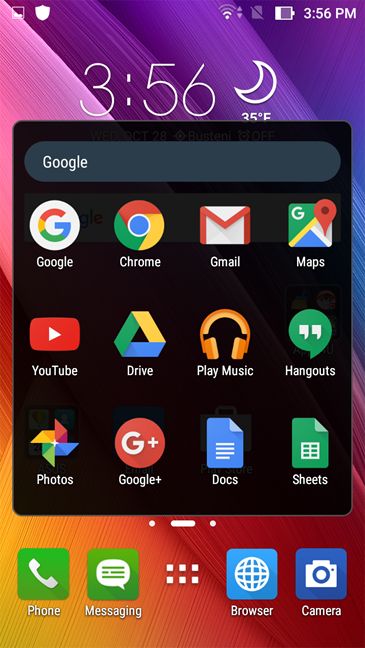
As for the operating system, ASUS ZenFone Go uses Android 5.1 Lollipop with ASUS' proprietary ZenUI on top. The ZenUI is a skin developed by ASUS that turns the standard Android experience into a simpler yet beautiful user interface.
The 2070 mAh lithium battery is not spectacular, but considering that the smartphone's hardware is also not too power hungry, it should be enough to keep your smartphone running for a day.
The ASUS ZenFone Go is a smartphone that manages to deliver a decent experience when it comes to its "phone" features. Phone calls are clear on both SIM cards, the mobile network signal seems to be stable and the audio quality should satisfy average users.
The camera experience on the ASUS ZenFone Go
The main camera of the ASUS ZenFone Go has 8 megapixels and is capable of shooting pictures at a maximum resolution of 3264 x 2448 pixels. This means that, if you want to take pictures at maximum details, you'll get them in an aspect ratio of 4:3. If you prefer wide images in an aspect ratio of 16:9, you'll have to set the camera to use a 6.2 megapixel, 3328 x 1872 pixels resolution. You should also know that the rear camera has autofocus and a regular LED flash, which can help in low light conditions. The ASUS ZenFone Go also offers a 2 megapixels fixed focus front camera.
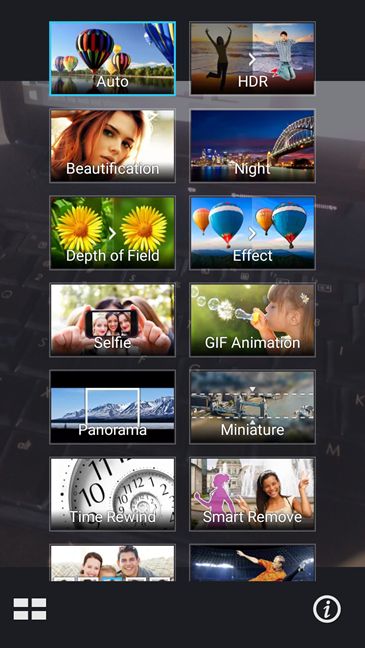
What we like about ASUS' smartphones is that they all have lots of options when it comes to the way you shoot photos. The ASUS ZenFone Go has 15 different photo modes, including HDR, Depth of Field, Panorama and Slow motion. Considering that we're talking about a budget smartphone, having this large array of camera options is great.
In the gallery below, we included a set of photos we took with the ASUS ZenFone Go. You'll see photos were taken outdoors, a few photos that we took indoors, with and without flash and some close-ups. All the photos were captured using this smartphone's auto settings and for a few we also used HDR.
When it comes to the video quality, the ASUS ZenFone Go is capable of capturing videos in Full HD resolution (1080p at 30fps) with stereo sound. However, you should know that, if you want to use image stabilization for videos, you will have to lower the resolution to 720p.
In order to get a glimpse on how videos look when recording moving objects, check our sample below.
The following video shows how the ASUS ZenFone Go handles more static recordings. It's a sample video in which we captured a static panorama while moving the smartphone.
The ASUS ZenFone Go doesn't have a spectacular camera but that is only natural, as we are talking about a budget-friendly device. Even so, this smartphone has enough qualities to make the average user happy. Just look at all the different photo modes available: you won't find HDR on too many smartphones with this price tag.
Android 5.1 Lollipop, ASUS ZenUI & Bundled apps
The ASUS ZenFone Go comes with Android 5.1 Lollipop and with ASUS' proprietary interface skin called ASUS ZenUI. We've seen this user interface on the ASUS smartphones we've previously tested and we like it. It's an elegant yet clean user interface that adds simplicity and beauty to the Android operating system. It's also very well optimized so that it doesn't slow down your device.
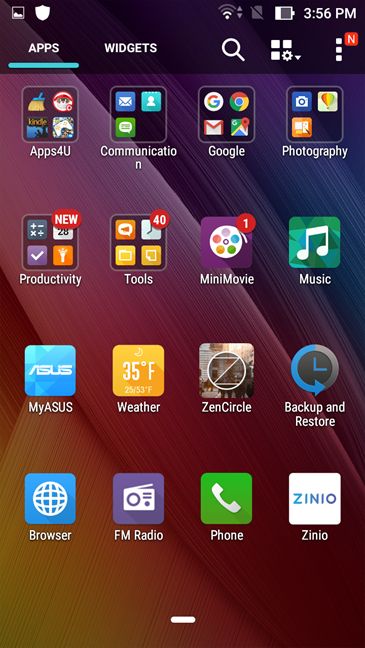
What we're starting to dislike though, is the fact that ASUS tends to bundle more and more apps on their devices. The ASUS ZenFone Go has no fewer than 52 apps preinstalled on it. That is too much in our view.
Not to mention the fact that some of the bundled apps are redundant. For instance, you have two music apps ( Music and Play Music ), two note-taking apps (Quick Memo and SuperNote) and even two built-in web browsers (Browser and Chrome).
Here are a few of the "non-Google" ASUS apps that you might find interesting enough to keep:
ASUS Support - Gives information about the Zen UI and support for any smartphone-related problems.
MyASUS - Offers access to 24/7 support from ASUS.
Do It Later - Helps you create and organize daily tasks, reminders, notes and other planning tools.
MiniMovie - It will create movies from the photos saved on your smartphone, which you can then share on social media.
Share Link - An app that will help you transfer files between your smartphone and a computer without needing to use a mobile connection.
ZenCircle - A social network that works by sharing smartphone created videos.
The ASUS ZenUI is a nice addition to the default Android 5.1 Lollipop interface. However, its elegance and simplicity is clouded by the huge number of bundled apps. We feel like ASUS exaggerated with the number of bundled apps. It's very likely that you will want to uninstall or disable many of them.
Performance in benchmarks
This is the last section of our review and maybe the most important one, at least for some of our readers. Let's run some benchmarks and see how well the ASUS ZenFone Go fares in terms of processing power:
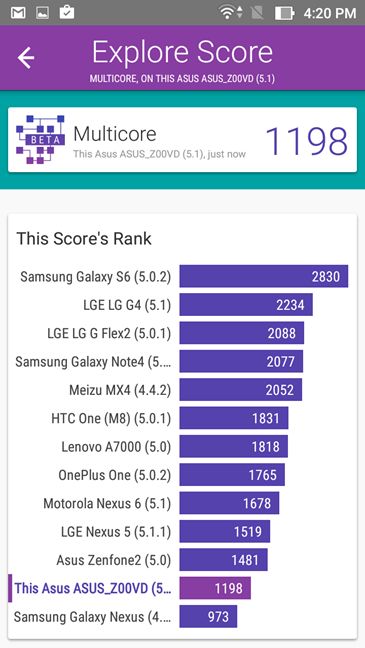
We'll start by measuring the CPU performance of the ASUS ZenFone Go, with the help of the popular benchmark app Vellamo. The first set of tests we used for this smartphone is called Vellamo Multicore and measures the processor performance when running multiple tasks simultaneously. The ASUS ZenFone Go managed to achieve a score of 1198 points. Even if it's not seen in the screenshot below, this score reveals a similar performance to that offered by a Samsung Galaxy S3, a similarly hardware powered device.
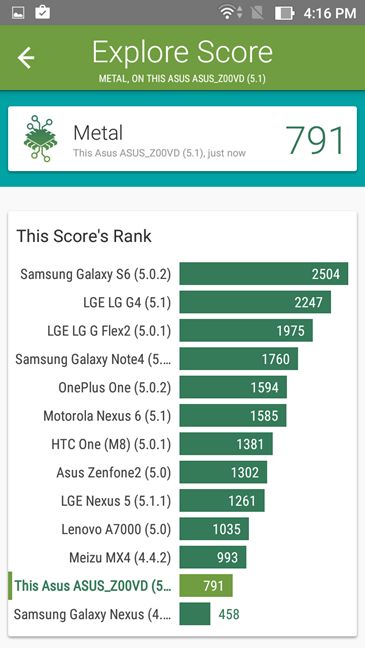
To measure the performance offered by the CPU in single task operations, we use Vellamo Metal. This set of tests shows how well a CPU handles apps that don't know how to use more than one core. There are many such apps in the Android ecosystem, so this is quite an important test. ASUS ZenFone Go got 791 points, which shows that it does better than the Samsung Galaxy S3.
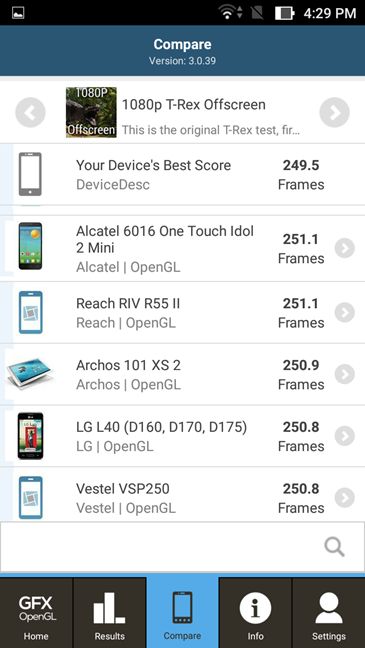
Another important performance aspect when assessing a device is its gaming performance. To measure it, we use GFXBench GL Benchmark. The tests we consider relevant in order to be able to correctly rank a device, are the Manhattan and T-Rex tests. We only take into consideration their offscreen versions, as that means they are run at a 1080p resolution, regardless of the native resolution of the tested device.
Unfortunately, we couldn't run the Manhattan test on the ASUS ZenFone Go, as its API is not supported by this smartphone. However, we were able to run the T-Rex test and the ZenFone Go managed to render 249.5 frames - a similar result to what you'd get from a Samsung Galaxy Ace. To all the gamers out there… this is a poor result and it means this smartphone is not something we'd recommend to you.
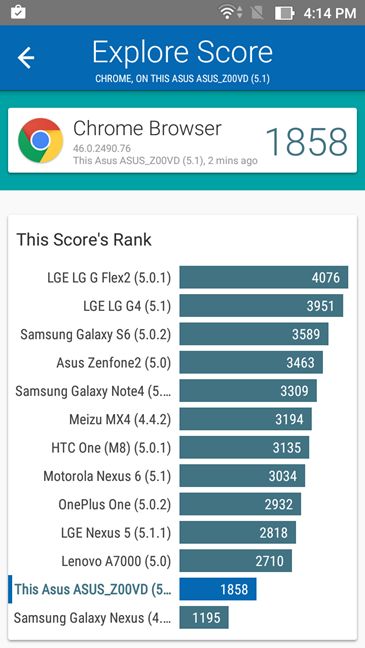
Next, we should also take a look at how this device fares in more mundane activities, like browsing the web. To measure its performance in this area, we tested the ASUS ZenFone Go with Vellamo Explore. It achieved a score of 1858 points, which is a good result. The old Samsung Galaxy S3 scores 1780 points in this test and the Xiaomi Redmi 2 scores 1670 points.
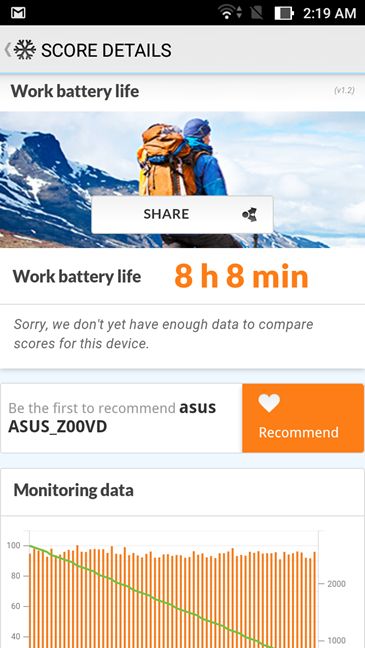
Finally, we tested the autonomy offered by the battery of the ASUS ZenFone Go. It lasted us for a day when we didn't run any benchmarks. 🙂 However, to get a better image, we also ran the Work battery life tests from PCMark. The results we got were good: 8 hours and 8 minutes. That means that the smartphone should have no problems lasting you for a day in normal conditions. That is, of course, if you don't run power hungry apps like benchmarks or video games.
All the benchmarks we ran show that the ASUS ZenFone Go is a smartphone that doesn't aim to convince you to buy it because it's powerful. It's a budget device and that shows. However, given its very low price tag, we can't say that we expected too much hardware power. It's just enough to keep your experience decent.
Product rating3/5
Verdict
The ASUS ZenFone Go is not a powerful piece of hardware and that shows in the benchmarks we ran. However, its price is so low that you can't really complain. It's enough to get its job done. We were not impressed by the camera quality. However, it compensates some of its flaws through the good software and the multitude of photo options. Another thing that we disliked is the large number of apps bundled with this smartphone and we can't really understand why ASUS bundles so many redundant apps. On the positive side, we like the design of the ASUS ZenFone Go. ASUS puts effort into making its budget devices attractive too. Finally, the decisive points in making the ASUS ZenFone Go a reasonably attractive smartphone are its Dual SIM feature, its display and, last but not least, its very low price. If you're looking for a decent smartphone and don't want to spend a lot of money, the ASUS ZenFone Go might be an option.
Jesus, intr-un final un review decent. Nu prea gasesti opinii dinspre partea Europei. Se pare ca se vinde ca painea calda prin India si Rusia mai degraba. In fine, multumesc pentru munca depusa. Daca este sa ma incadrez in buget, pe asta il cumpar. Este oricum un upgrade imens de la raposatul Allview P5 Mini pe care l-am detinut.
Ciprian Adrian Rusen ·
Thanks for the vote of confidence? If you want to try our Romanian content, try digitalcitizen.ro. 😉
Daniel ·
Oh right, I’m sorry. Thank you, I’ll do that right now. Didn’t hear about you guys until today so I thought this is your only website.








Discussion (3)
Jesus, intr-un final un review decent. Nu prea gasesti opinii dinspre partea Europei. Se pare ca se vinde ca painea calda prin India si Rusia mai degraba. In fine, multumesc pentru munca depusa. Daca este sa ma incadrez in buget, pe asta il cumpar. Este oricum un upgrade imens de la raposatul Allview P5 Mini pe care l-am detinut.
Thanks for the vote of confidence? If you want to try our Romanian content, try digitalcitizen.ro. 😉
Oh right, I’m sorry. Thank you, I’ll do that right now. Didn’t hear about you guys until today so I thought this is your only website.