



ASUS has started selling a new wireless router that can combine mobile internet connections with traditional broadband internet, with the help of a SIM card from your mobile operator. The router is named ASUS 4G-AC68U, and it has some impressive features, that make it very appealing. Lucky for us, we were the first in the world to test this new model. If you would like to know what this wireless router has to offer, read this detailed review:
ASUS 4G-AC68U AC1900: who is it good for?
ASUS 4G-AC68U is a good choice for the following types of users:
- People who want fast downloads on WiFi, and have a broadband internet connection available
- Small business owners who want features like Free WiFi Splash page and Captive portal, that allow them to give free WiFi to their guests while promoting their business, website or social media page
- Users who have only mobile internet coverage in their area and want to have their own WiFi, sharing one mobile internet connection
Pros and cons
There are several great things about the ASUS 4G-AC68U:
- Exceptionally fast downloads on WiFi, when using broadband internet connections
- It bundles features that are useful to small business owners, like the WiFi Captive Portal or Dual-WAN capabilities which can use mobile 4G or 3G internet connections alongside broadband internet connections
- This router is capable of delivering the best possible speed on 3G or 4G mobile connections
- It packs excellent security features, parental controls, and other useful extras
- Good signal strength and coverage, when using broadband internet connections
- It delivers true 1 Gbps Ethernet connections
There are some downsides to consider as well:
- If you use a mobile connection in Dual-WAN, wireless performance suffers quite a lot
- Configuring the mobile connection involves knowing and making a lot of settings
- This router takes a lot of time to boot and reboot
- The upload speed on wireless is lower than the average you get from other AC1900 routers
Verdict
ASUS 4G-AC68U is a wireless router that sounds great on paper. If you read its specifications, it sounds like a great choice for people who need to use mobile internet connections. ASUS 4G-AC68U works great on typical broadband internet connection. It delivers outstanding download speed on both WiFi bands (2.4 and 5 GHz). But, once you plug in a SIM card and start using a mobile internet connection, the quality of your user experience suffers a lot. ASUS needs to invest some quality time in bug fixing and improving the firmware of this router, so that it delivers on its promise of high-quality Dual-WAN connections, that mix mobile internet with wired internet connections. Luckily, we got in touch with ASUS and sent them details about our testing experience and the bugs that we encountered. This information will be used by ASUS for future firmware updates that improve the quality of their Dual-WAN experience.
Unboxing the ASUS 4G-AC68U AC1900 wireless router
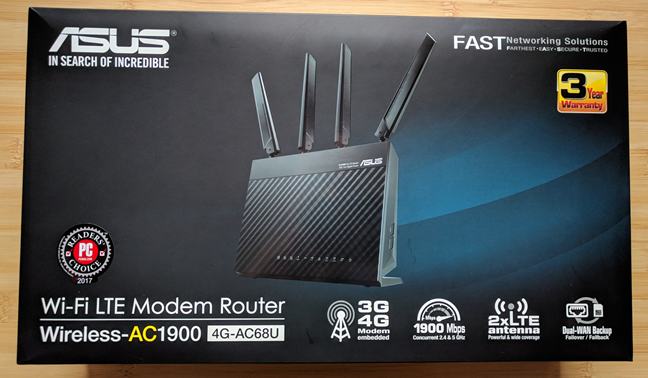
The ASUS 4G-AC68U AC1900 wireless router comes in a standard cardboard box, with a design that is similar to all other ASUS routers. On the front side of the box you can see a picture of the device, alongside a list of its most important characteristics.
When you unbox it, you find the following elements: the router itself with two antennas attached (these two are not removable), two separate removable antennas, the power adapter, an Ethernet cable, the warranty and the quick setup guide.
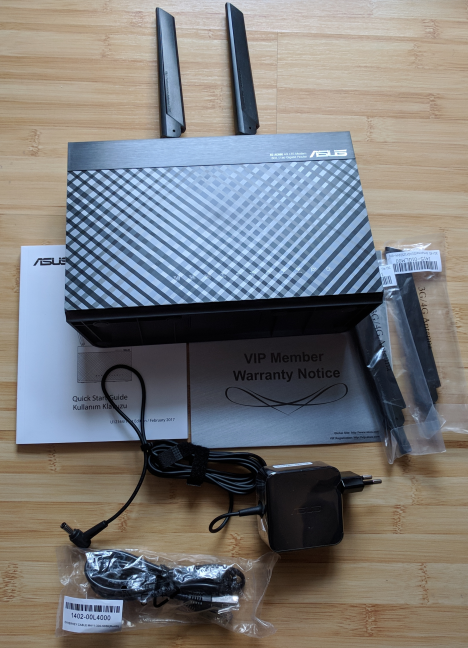
The unboxing experience offered by ASUS 4G-AC68U is quick and painless. The packaging contains all the accessories you need to set up and use this wireless router.
Hardware specifications and design
ASUS 4G-AC68U has a dual-core Broadcom BCM4709A0 processor running at 1 GHz, 256 MB of RAM and 128 MB of storage space for the firmware. It offers support for all the modern networking standards, including 802.11ac Wave 2, and it offers 3x3 MU-MIMO transfers. The maximum theoretical bandwidth is of 600 Mbps on the 2.4 GHz band and of 1300 Mbps on the 5GHz band, making this an AC1900 wireless router.
One unique feature about the ASUS 4G-AC68U router is that it comes with two detachable antennas that are used for cellular LTE connections. You plug in a micro SIM card from your mobile operator and you can use it on the router to give internet to your whole home or small business. The router can use 3G, 4G, LTE mobile connections, and offers a theoretical maximum bandwidth of 300 Mbps for such connections.
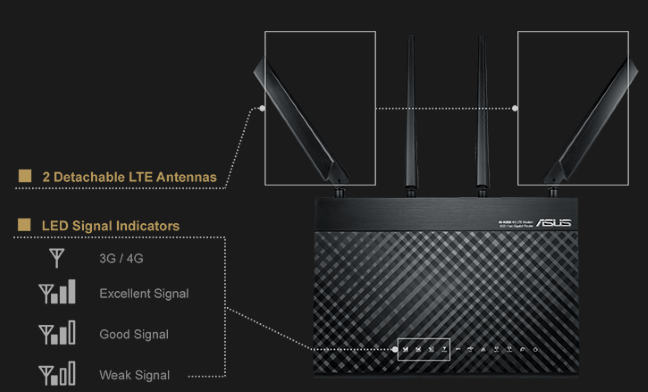
The router has a total of four external antennas and one internal. The two antennas in the middle and the internal one are not removable and they are reserved for broadcasting the WiFi signal in your home or business.

ASUS 4G-AC68U can be used on the following types of internet connections: mobile, automatic IP, Static IP, PPPoE, PPTP, and L2TP.
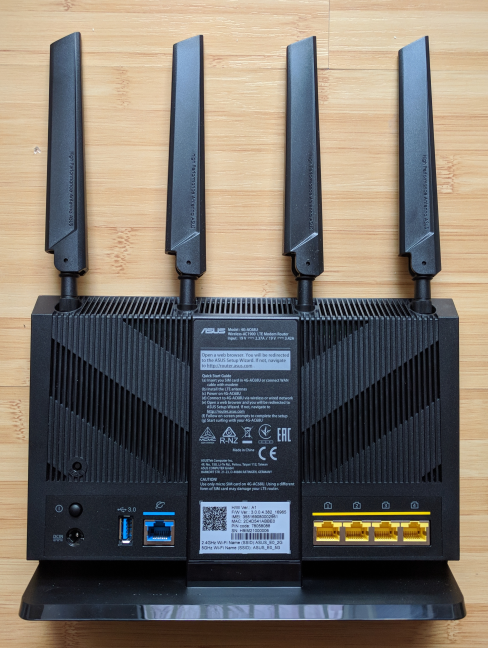
On the back side of the router you will find the following: the power button, the power jack, a USB 3.0 port, one Gigabit Ethernet port for connecting it to the internet, and four Gigabit Ethernet ports for network computers and devices.
On the bottom of the ASUS 4G-AC68U there is a cap that you can open and then you find a micro SIM port. You can use it to plug in a SIM and connect the router to a mobile operator.
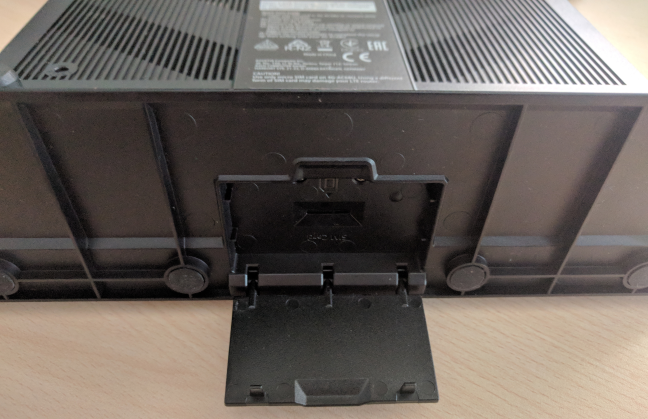
On the right side of the router there are two buttons: one for turning the WPS on and off and the other for the WiFi.
Regarding size, ASUS 4G-AC68U is 9.72 x 2.99 x 6.6 inches or 247 x 76 x 168 mm in width x depth x height. It also weighs 28 ounces or 795 grams. If you would like to read the official specifications of this product, go to this page: ASUS 4G-AC68U Specifications.
Setting up and using the ASUS 4G-AC68U AC1900 wireless router
The setup wizard for ASUS 4G-AC68U is short and easy to follow. You are first asked to change the default username and password, which is a good security precaution. Next, the wizard detects the type of your internet connection and asks for the necessary details. Once that is done, you can set the name and password for the two wireless bands that are broadcast by the router.
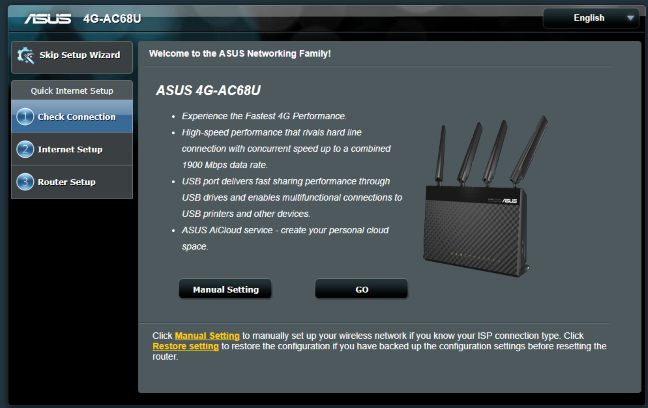
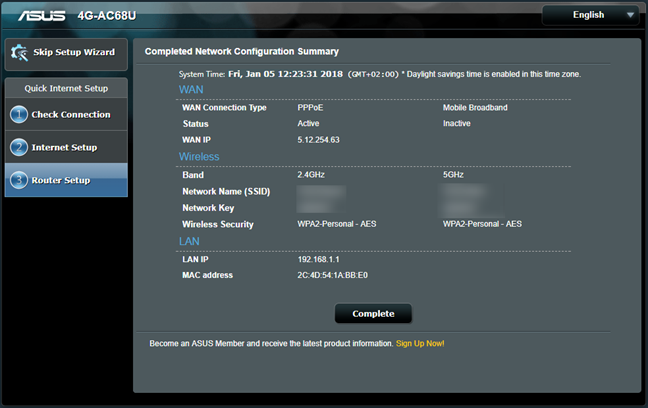
When the setup wizard is finished, you are shown a summary of your settings, and you can then load the administration user interface.
The user interface is the same as on many other ASUS routers. It looks good, it is well organized and finding your way is not difficult. We consider a positive the fact that ASUS has translated it into 19 languages, which you can see listed below.
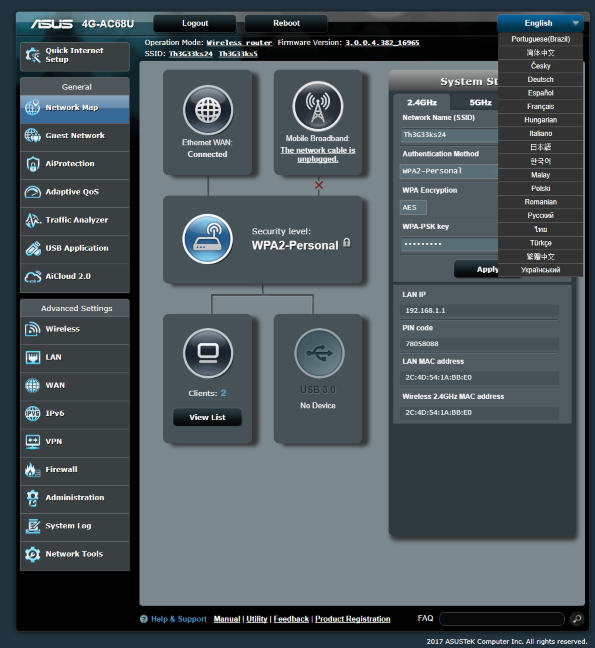
Another positive is the fact that help documentation is always at hand. If you don't understand a setting, move the mouse over it and, when it turns into a question mark, click on it. This displays a tooltip with more information about that setting. You also get links to FAQ documentation in several sections with settings.
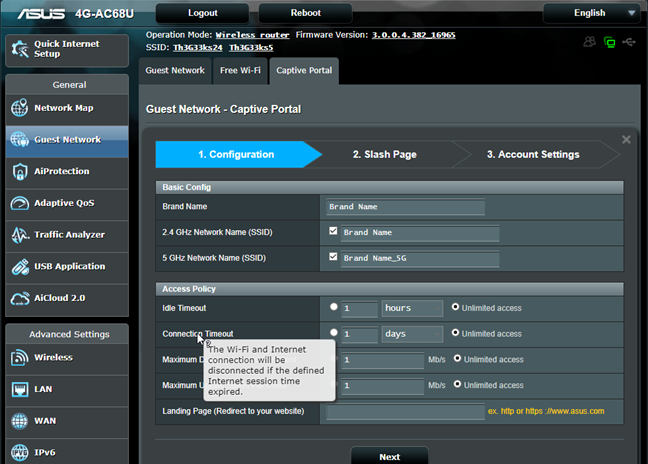
We connected ASUS 4G-AC68U to two types of internet connections:
- One broadband PPPoE internet connection of 1 Gbps for the download and 500 Gbps for the upload
- A mobile connection through a micro SIM. We connected to three different mobile operators in our area, using three different micro-SIM cards: Vodafone, Orange, and Telekom.
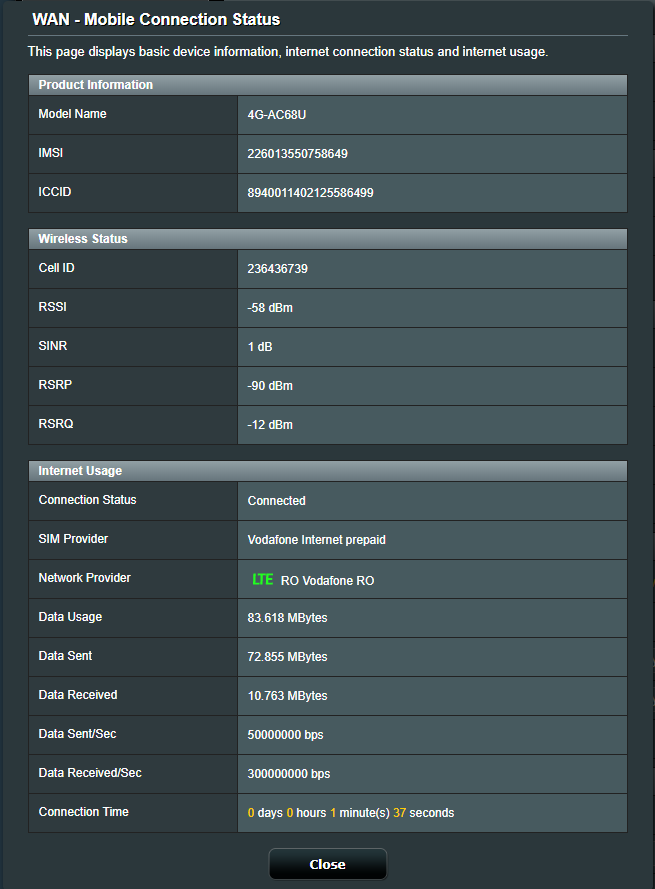
We used the router just with the PPPoE internet connection, only with a mobile connection and with both, and the Dual WAN feature activated. One thing we learned is that, in order to make sure that ASUS 4G-AC68U connects to your mobile operator, you should have the micro SIM card activated before using it on the router. Also, you should know your APN settings for connecting to the internet, because ASUS 4G-AC68U does not always have the best predefined APN settings for your SIM card. Also, connecting to your mobile operator takes a while, even though you have entered the correct settings. When you are done, you should see a status similar to the screen below.
One thing that you will not appreciate is how long this router takes to boot. When you change some important settings, ASUS 4G-AC68U needs to reboot in order to apply them. The process can take up to five minutes, and this can be frustrating, especially when you need to change more than one setting.
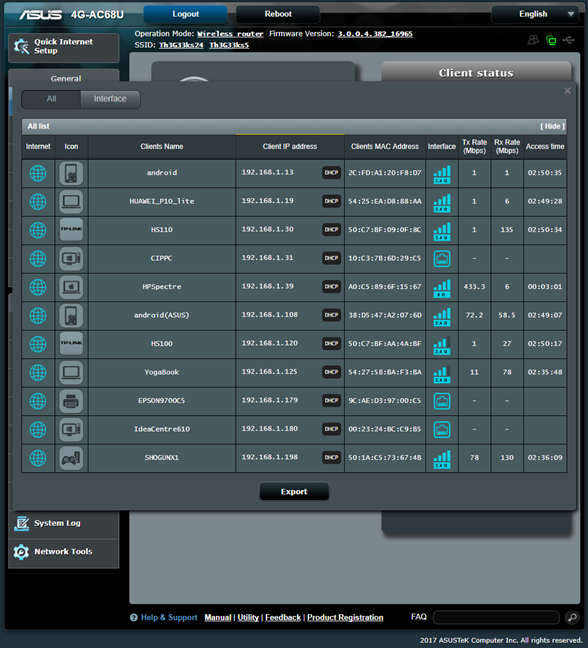
After we set up the router, we started connecting our device to the network. We used a total of twelve devices on the network, consisting of desktop computers, laptops, tablets, smartphones, an Xbox One console, a wireless printer, two smart plugs, and one smart bulb. You can see most of them listed below.
When we used just the broadband PPPoE internet connection, ASUS 4G-AC68U performed admirably. We enjoyed good wireless coverage, excellent download speed, and constant signal strength. When we activated the Dual WAN featured and introduced a mobile connection into the mix, our user experience suffered. The resource consumption on the ASUS 4G-AC68U router got higher and the router started to have sudden drops in performance. The signal strength would drop suddenly, for a couple of seconds, some devices would get a slower connection for a few minutes, and so on. When we tried enabling extra features like AiProtection, the performance would drop even lower, and wireless connectivity became rather problematic for most devices. This led us to conclude that either the hardware on the ASUS 4G-AC68U is underpowered for all the features that are bundled or the firmware needs further work, to improve stability when using mobile internet connections in Dual WAN.
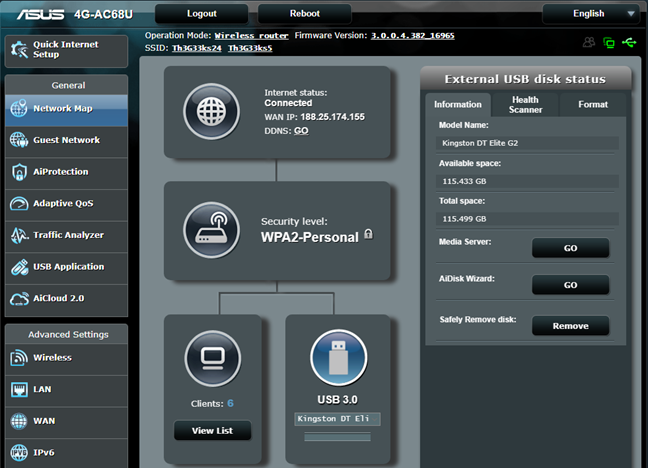
Hardware-wise, ASUS 4G-AC68U is a capable router that can deliver excellent wireless coverage. If you use it alongside a broadband internet connection, you get a high-quality user experience and excellent WiFi. When you turn on Dual-WAN and use also a mobile internet connection, the user experience starts to get sour.
If you would like to learn more about the real-life performance of this wireless router and our benchmarks, read the next page of this review.
Wireless network performance
Before sharing the data from our measurements, let's take a look at the apartment that was used in our testing and how it is set up. You can see that the router is placed in the living room. With most wireless routers, the signal strength is not that high in places like the Kitchen and the Medium balcony.
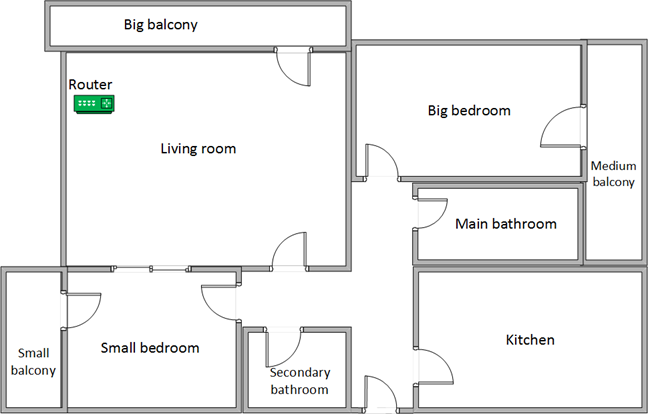
Our testing was done using a fast 1 Gigabit Internet connection that's capable of uploads on the internet of up to 500 Mbps. We used an HP Spectre 13 laptop for all our measurements and several software tools.
To get a better perspective of the performance offered by ASUS 4G-AC68U AC1900, we compared it with TP-LINK Archer C9 (a competing consumer oriented AC1900 wireless router) and with ASUS BRT-AC828 (another router from ASUS with business-oriented features).
NOTE: If you want to learn more about AC notations in networking devices, read this tutorial: What does AC1200, AC1900, AC3200 or more, mean and what's the difference?
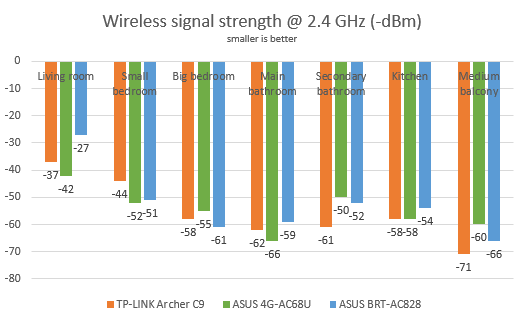
We started by evaluating the 2.4 GHz wireless network and measured the signal strength offered in each room, using a tool named inSSIDer. You can see how the signal strength evolved from room to room, on the 2.4 GHz band. ASUS 4G-AC68U offered decent signal strength in all rooms, without being the best router in this comparison.
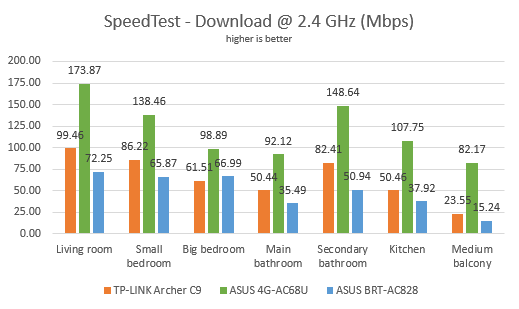
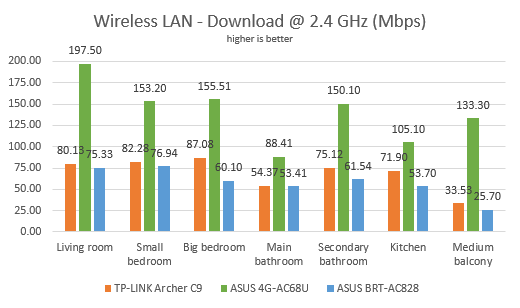
Next, we used SpeedTest to see how fast the internet connection is on the 2.4 GHz band. ASUS 4G-AC68U impressed us with incredibly fast downloads on the 2.4 GHz band.
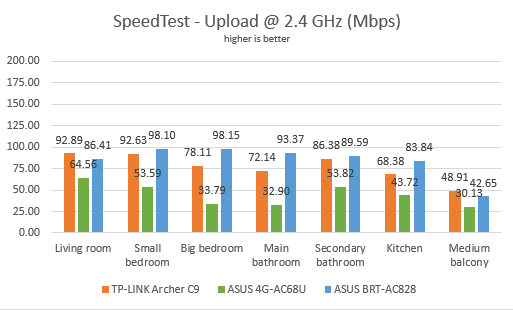
When measuring the upload speed, ASUS 4G-AC68U was the slowest of the bunch.
Continuing our measurements on the 2.4 GHz wireless network, we used the PassMark Performance test to transfer data between two computers connected to the network. Again, ASUS 4G-AC68U was outstanding when looking at the download speed.
Things changed again when measuring the upload speed on the 2.4 GHz band.
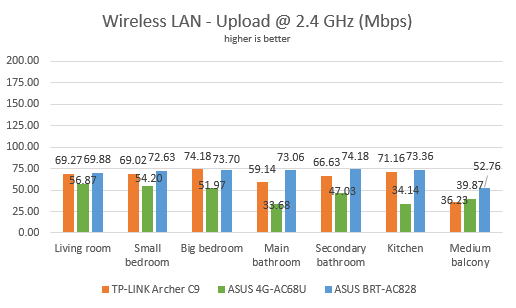
ASUS 4G-AC68U offers very fast downloads on the 2.4 GHz band. One of the fastest we have seen. However, the upload speed is lower than the average you get from other routers.
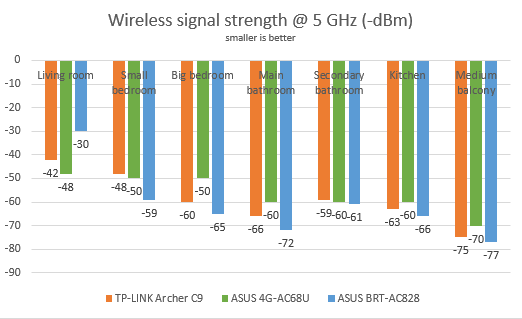
Next, we analyzed the performance offered by the 5GHz wireless network. First, we looked at the evolution of the signal strength, from room to room. The signal strength delivered by ASUS 4G-AC68U was generally good.
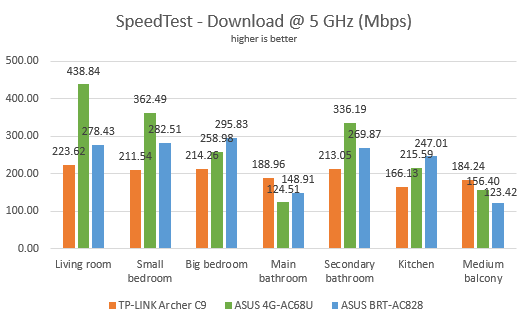
Then, we ran SpeedTest to see how fast the internet connection is on the 5GHz band. ASUS 4G-AC68U surprised us once again and delivered exceptionally fast downloads in some rooms.
The upload speed was again, below the average of other routers.
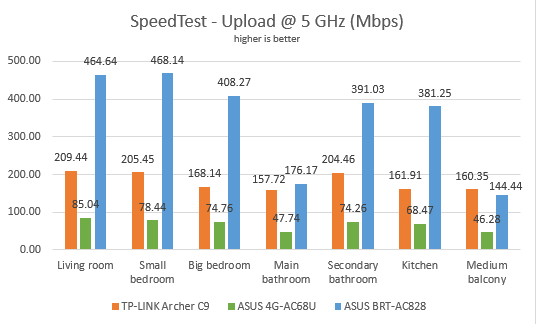
For the last measurements on the 5GHz wireless network, we used the PassMark Performance test to transfer data between two computers connected to the network. ASUS 4G-AC68U delivered very fast downloads in most rooms.
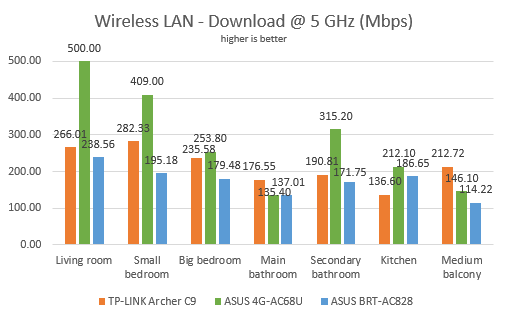
The upload speed was lower than the average in this test too.
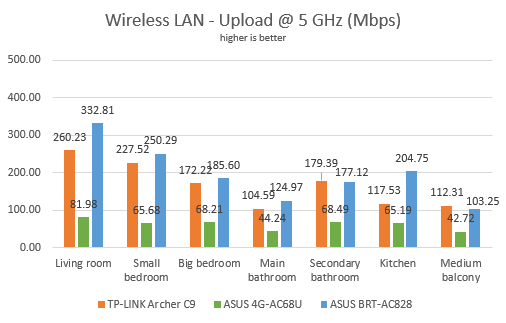
ASUS 4G-AC68U offers very fast downloads on the 5 GHz band, while the upload speed is lower than the average you get from other routers.
Cellular network performance
One of the distinctive features of the ASUS 4G-AC68U wireless router is the fact that it has a SIM slot for using mobile 4G or 3G internet connections. ASUS says that this router features the latest LTE Category 6 mobile broadband, which combines two cellular bands to give you internet download speeds of up to 300Mbps. However, such downloads speeds are theoretical. We wanted to see real-life results, and we took three SIM cards from three different providers: Vodafone, Orange, and Telekom. We are based in Bucharest, Romania, in an area with reasonably good 4G coverage. Therefore, we took each SIM one by one, connected the router to the appropriate mobile operator and then ran SpeedTest on a desktop computer that was connected to the router, using an Ethernet cable. On Vodafone we had the best speed: 39.4 Mbps for the download and 36.65 Mbps for the upload.

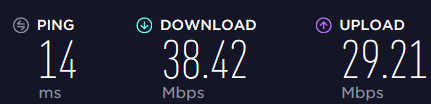
On Orange, we had relatively close results: 38.42 Mbps for the download and 29.21 Mbps for the upload.
On Telekom, we had much weaker results: 16.06 Mbps for the download and 6.06 Mbps for the upload. However, such low speeds are not the fault of the ASUS 4G-AC68U wireless router but of Telekom, which does not have the greatest coverage in our area.

After making these measurements on the ASUS 4G-AC68U wireless router, we took the same SIM cards and plugged them into an ASUS Zenfone 4 Selfie Pro smartphone, and ran the same tests with SpeedTest. On the smartphone, we had similar results on all three mobile operators. This confirms the fact that mobile internet connections are not very fast. They work on the ASUS 4G-AC68U wireless router but you may not want to use them as your main internet connection unless there's no alternative in your area.
The ASUS 4G-AC68U wireless router works well with mobile internet connections, made using a SIM card. However, don't expect amazing speeds, unless your mobile operator has excellent coverage in your geographical area. ASUS 4G-AC68U will not provide a faster connection than your smartphone has in the same area, using the same SIM card.
Wired network performance
In order to test the quality of the wired Ethernet connection, we used a desktop PC, equipped with an Intel Core i5 4460 processor, running at 3.20GHz, 16GB of RAM and a very fast Samsung 850 Pro 512GB SSD and a Lenovo Ideacentre 610s mini PC.
We measured the speed of the internet connection when using a 1 Gbps Ethernet cable, using SpeedTest. You can see that ASUS 4G-AC68U did not disappoint and delivered excellent speeds.
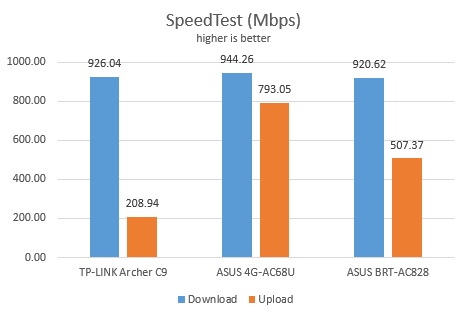
Then, we ran a network transfer between the two computers, using the PassMark Performance test. Again, ASUS 4G-AC68U performed admirably.
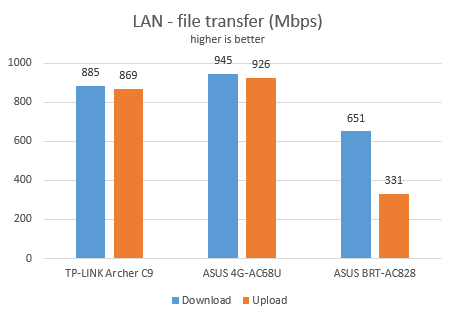
ASUS 4G-AC68U delivers true 1 Gbps Ethernet connections on its four Ethernet ports.
Extra features
ASUS 4G-AC68U bundles plenty of advanced features that most users will enjoy:
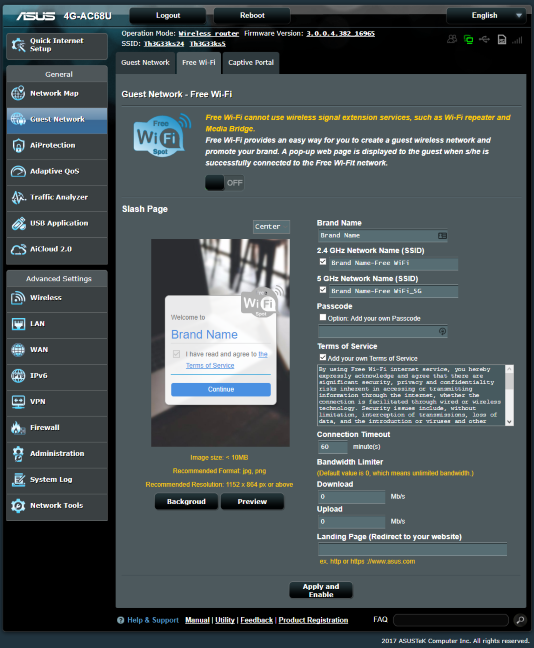
- Free WiFi Splash page and Captive portal - this feature is highly useful for businesses like cafes, restaurants, motels and so on. It allows users to give free WiFi to their guests while promoting their business, website or social media page.
- Guest Network - you can enable up to three wireless networks for each band, with individual security and access settings.
- AiProtection - a comprehensive security module made in collaboration with Trend Micro, that provides network antivirus protection, malicious site blocking, vulnerability protection, infected device prevention and blocking and a comprehensive Router Security Assessment tool which verifies where your router's settings are secure. It also includes a great parental controls feature that will be useful to families with children.
- Adaptive QoS - an intelligent QoS (Quality of Service) tool that you can use to analyze and prioritize network traffic efficiently.
- Traffic Analyzer - offers visual traffic statistics which give you a clear picture of how your network is used and by which devices.
- USB Applications - apps that are designed to work with all kinds of devices that you can connect to the router using USB: external hard disks, printers, and 3G or 4G dongles or modems.
- AiCloud 2.0 - a mobile app that keeps you connected to your data wherever and whenever you have an Internet connection. With it, you can access the folders shared in your home network from your Android or iOS smartphone or via a personalized URL
- Dual WAN - excellent for both small businesses and professionals who require always-on Internet connections. You can also use a dual WAN to improve the quality of your internet connection and get the best possible performance.
- IPv6 - modern support for IPv6 addresses that will soon become the norm, replacing IPv4.
- VPN - you can set the router to work as a VPN server, and you can also use it to turn your network-connected devices into VPN-enabled clients, without additional VPN software required.
- DDNS - a service that allows you to connect to the router from the internet, even if your internet provider gives you a dynamic public IP address.
- Network Tools - for analyzing the network and identifying what is wrong. They are useful when you need to troubleshoot problems.
Unfortunately, when making this review, the ASUS Router mobile app for Android and iOS is not compatible with this specific ASUS router, even though it works with other new routers from the same company. Hopefully, support will be added in a future version of this app.
The extra features that are bundled on ASUS 4G-AC68U are very useful to most users, both for small business and home users.
What is your opinion about ASUS 4G-AC68U AC1900?
Now you know our opinion about the ASUS 4G-AC68U wireless router and how it performed in our testing. Before closing this review, share your opinion about this device with us. Do you like what it has to offer? Are you considering buying it? If you already have it, what is your user experience so far? Comment below and let's discuss.
Discussion (5)
Hi, which firmware version did you use for this review? Seems like the latest firmware is from Jan 25th 2018
https://www.asus.com/se/Networking/4G-AC68U/HelpDesk_Download/
We used the firmware available at the date of our review, which was prior to Jan 25th, 2018.
Hello.
I think you might be interested in reading the web page at
https://forums.whirlpool.net.au/archive/2705808
which may show a later firmware version, and, could affect your perception of the router.
I am just looking at the possibility of using a two or more band 4G modem/router, and, investigating the possibilites…
Thanks again for another great review.
Would you recommend any other devices that are on the market that have a sim card slot ?
I’m afraid I haven’t tested any others. Sorry!