



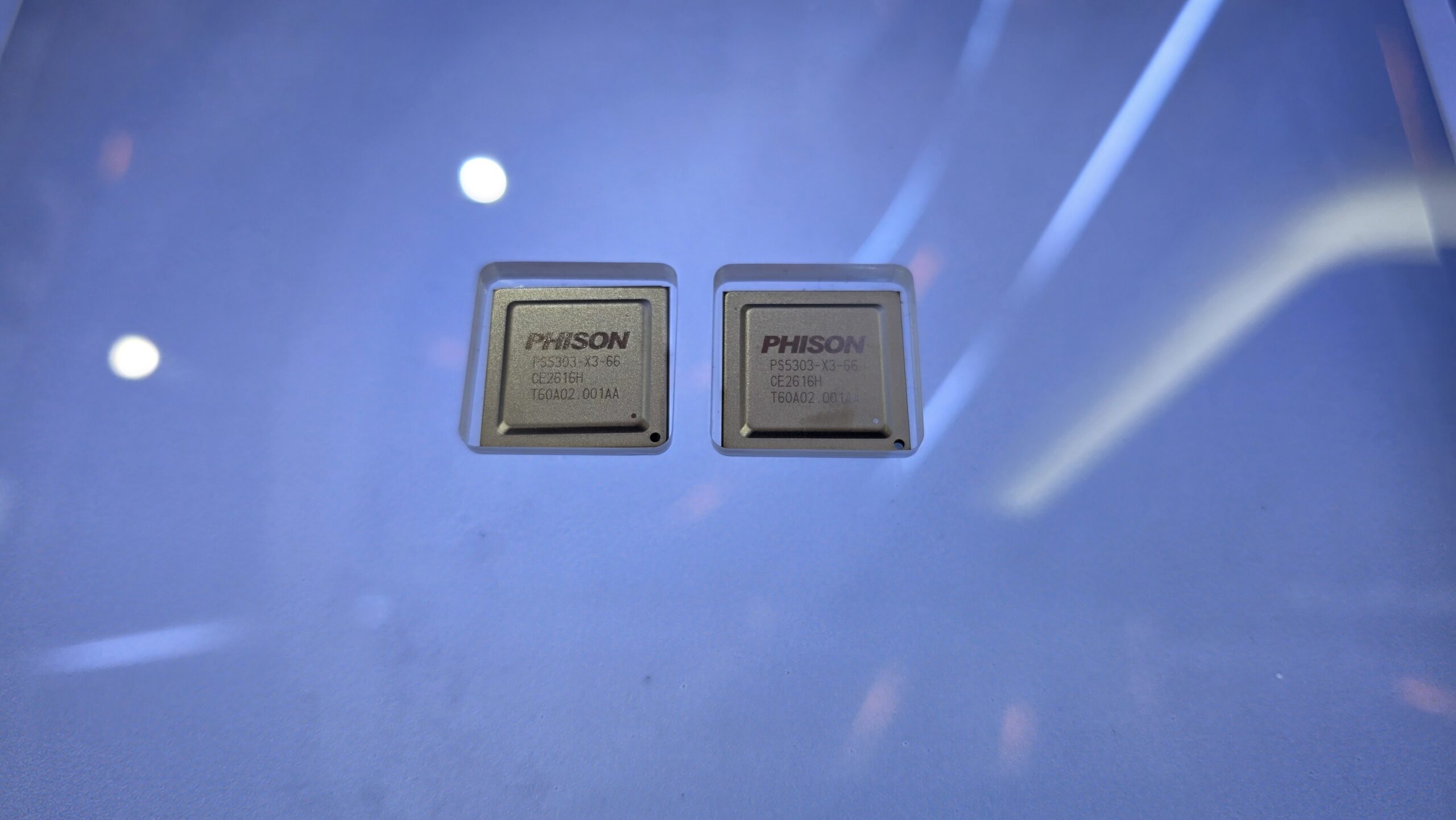
Phison has shown its next generation PCIe 6 SSD controller at Computex 2026, giving an early look at the storage hardware that will power future AI servers, enterprise systems, and high performance data centers. The new controller, called PS5303 X3 66, is designed to double transfer rates compared with today’s PCIe 5 drives while also improving efficiency.
The X3 controller supports PCIe Gen6 x4 and NVMe 2.3. Phison says it can reach up to 28GB per second in sequential read and write speeds. That is roughly twice what the fastest PCIe 5 SSDs can deliver today. Random performance is also very high, with up to 6.8 million IOPS.
This is not aimed at ordinary gaming PCs yet. PCIe 6 storage is being built first for enterprise platforms, AI infrastructure, cloud servers, and heavy data workloads. These are the environments where faster storage can help feed CPUs, GPUs, and accelerators with huge amounts of data.
PCIe 6 SSDs are being built for AI servers before consumer PCs
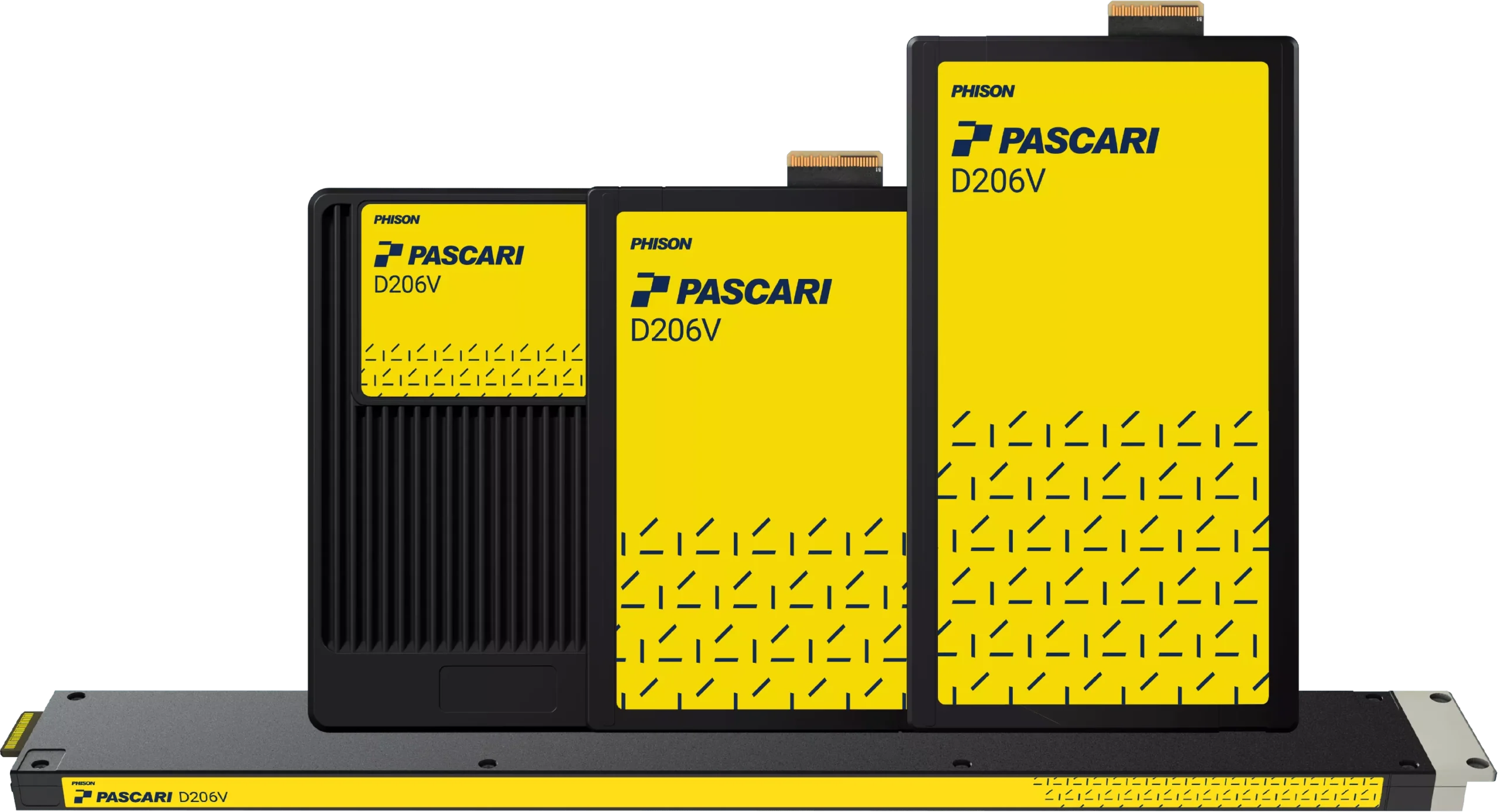
Phison also showed the first Pascari PCIe 6 SSDs using the new controller. These drives are expected to come in E3.S and E1.S form factors, which are common in modern servers because they offer better density and cooling than consumer M.2 drives.
| Feature | Phison PS5303 X3 |
|---|---|
| Interface | PCIe Gen6 x4 |
| Protocol | NVMe 2.3 |
| Form factors shown | E3.S and E1.S |
| Sequential speed | Up to 28GB per second |
| Random performance | Up to 6.8 million IOPS |
| Capacity support | Up to 2PB |
| Security support | TCG Opal 2.3, DOE, IDE, Caliptra, CNSA 2.0 |
| Target market | Enterprise, AI, and data center storage |
The controller can support up to 2PB of storage, which shows how far enterprise SSDs are moving beyond normal consumer capacities. For AI data centers, storage density matters because large models, training data, inference workloads, and enterprise datasets can require enormous pools of fast storage.
Efficiency is also a major part of Phison’s pitch. The company claims its fastest upcoming Gen6 SSDs can operate around 7W while offering much higher bandwidth than current drives. Phison also says its Gen5 SSDs can deliver 14.9GB per second while staying under 5W, which it frames as better efficiency than competing designs that may run closer to 7W or 8W.
That matters because data centers do not only care about raw speed. Power and heat are just as important. A drive that runs faster but consumes too much power can create cooling and density problems across large server deployments.
Phison is also preparing the wider PCIe 6 ecosystem, not just the SSD controller. The company showed retimer and redriver chips designed to keep high speed PCIe 6 signals stable. That includes the PS7261 PCIe 6 retimer and PS7161 linear redriver.
These components are important because PCIe 6 uses very fast signaling, and maintaining clean data transmission across motherboards, cables, and server backplanes becomes harder as speeds rise. Retimers and redrivers help extend signal reach and improve stability, which is critical for enterprise systems.
Phison also displayed an in house AI NPU chip called Topaz. The add in card uses a PCIe Gen6 x4 interface and includes eight Topaz NPUs. Each NPU is a quad core neural processor built on TSMC’s 6nm process and offers up to 40 TOPS. Together, the card can deliver up to 320 TOPS of AI compute, paired with LPDDR5 or LPDDR5X memory support.
This shows Phison is thinking beyond traditional SSD controllers. The company is positioning itself around future AI infrastructure, where storage, memory, PCIe connectivity, and local AI acceleration may become more tightly connected.
For normal desktop buyers, PCIe 6 SSDs are still far away. PCIe 5 drives are already more than fast enough for most games and everyday workloads, and many PCs cannot fully use their speed in real world tasks. Consumer PCIe 6 adoption will likely take years, especially because motherboards, CPUs, controllers, cooling, and pricing all need to mature.
Still, Phison’s demo matters because it shows where storage is heading. The next generation of SSDs will not only chase higher benchmark numbers. They will be designed to move massive datasets quickly and efficiently inside AI and enterprise systems.
PCIe 6 may not change gaming PCs soon, but it is already becoming a major part of the next data center hardware wave.



Discussion (0)
Be the first to comment.