



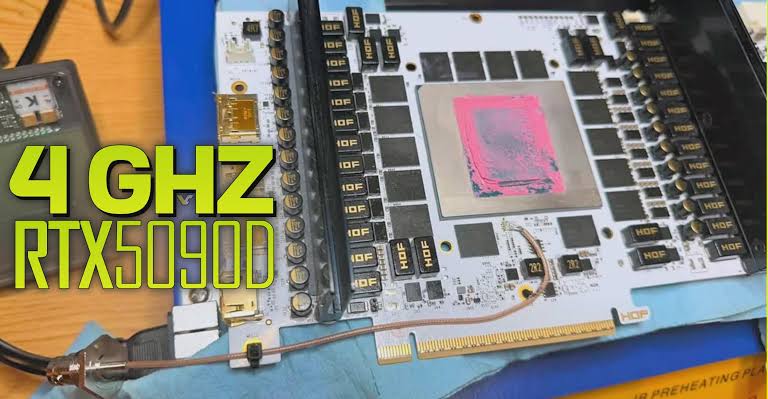
NVIDIA’s GeForce RTX 5090D has become the first Blackwell graphics card to reach a 4 GHz core clock, setting a new milestone for extreme GPU overclocking. The result was achieved by Greece based overclocking group Team OGS using a GALAX HOF OC Lab RTX 5090D and liquid nitrogen cooling.
The graphics card reached 4002 MHz during a GPUPI v3.3 32B benchmark run, where it completed the test in 35.377 seconds. That result placed Team OGS at the top of the benchmark leaderboard and improved on the previous record by more than a second.
The 4 GHz result is significant because Blackwell GPUs had previously stopped below that figure. The earlier highest reported RTX 5090D clock sat around 3.88 GHz, making the new run a noticeable jump for NVIDIA’s latest flagship class architecture.
GALAX HOF OC Lab Card Was Built for Extreme Tuning
The card used for the record was not a standard RTX 5090D. Team OGS used the GALAX HOF OC Lab variant, a model designed for extreme overclocking sessions rather than normal gaming systems.
It includes dual 16 pin power connectors and a heavily upgraded power delivery design with 36 phases. Those changes are important when pushing a GPU far beyond normal voltage and frequency limits.
| Component | Record setup |
|---|---|
| Graphics card | GALAX GeForce RTX 5090D HOF OC Lab |
| Cooling | Bitspower Strata LN2 GPU pot |
| Core clock | 4002 MHz |
| Memory clock | 1860 MHz |
| Benchmark | GPUPI v3.3 32B |
| Result | 35.377 seconds |
The test used liquid nitrogen cooling, which allows the GPU to run at temperatures far below anything possible with air or normal liquid cooling. This type of setup is only practical for short benchmark sessions and is not intended for everyday gaming PCs.
External Clock Board Helped Push the GPU Further
Team OGS replaced the card’s standard 27 MHz crystal with an external clock board from Elmor Labs. This hardware allows overclockers to bypass the normal onboard clock source and manually adjust the reference clock.
The external board was set to 28.7 MHz, representing a 6.3 percent increase over the stock frequency. That boost affected several GPU related clocks, including the graphics core and memory.
The RTX 5090D’s GDDR7 memory reached 1860 MHz during the record run, compared with a standard reference clock of around 1750 MHz. That placed effective memory speed close to 30 Gbps.
Extreme overclockers using the same type of external clock hardware have reportedly pushed GDDR7 memory to around 2400 MHz in other tests, which would equal roughly 38.4 Gbps. Those speeds are far beyond normal operating conditions and require very specialised tuning.
AMD Still Holds the Overall GPU Frequency Record
The RTX 5090D may now hold the highest Blackwell clock result, but NVIDIA does not hold the all time GPU frequency record.
AMD’s Radeon RX 9060 XT reportedly reached 4.769 GHz in a separate extreme overclocking session earlier this year. That means AMD still leads in raw peak GPU clock speed, even though the RTX 5090D is now the first Blackwell card to cross the 4 GHz line.
These records do not directly reflect gaming performance. They are mainly demonstrations of silicon quality, power delivery, cooling potential, and overclocking skill. Still, the result shows that NVIDIA’s Blackwell architecture has more frequency headroom than previous record attempts suggested.
For normal RTX 5090 owners, a 4 GHz overclock is not realistic. But for the competitive overclocking community, Team OGS has set a new target that others will now try to beat.



Discussion (0)
Be the first to comment.