



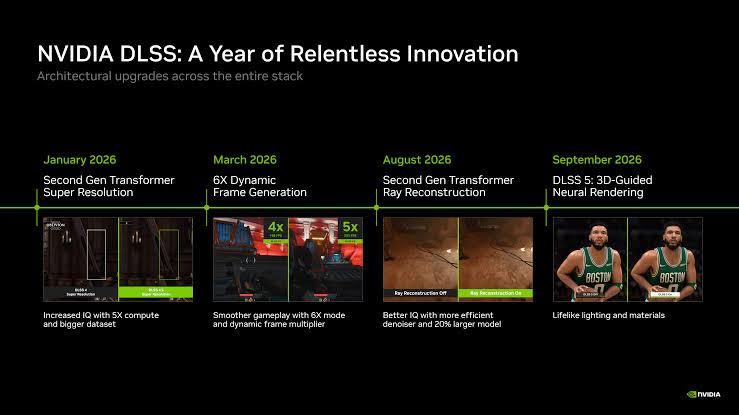
Nvidia is rolling out a major update for DLSS 5 that substantially reduces the performance cost of its neural rendering model while also lowering memory usage.
The October update is scheduled to launch on October 16 for GeForce RTX 5000 series graphics cards, RTX Spark laptops and GeForce Now. Nvidia says the revised model can deliver frame rate improvements of around 30% to 40% in NBA 2K27 while maintaining visual quality comparable to the original September release.
This comes only a little over a month after DLSS 5 officially debuted in NBA 2K27.
DLSS 5 Now Requires Much Less GPU Processing
The largest improvement is a reduction in the computational overhead associated with the AI model.
When DLSS 5 was first demonstrated in March 2026, Nvidia reportedly needed two RTX 5090 GPUs to run it. The company improved model performance by roughly five times before the technology launched commercially, and the latest update brings the total improvement to around 10 times compared with that original baseline.
Nvidia says the October version cuts GPU overhead in half compared with the September launch model.
The AI model itself has also been reduced by 24% to approximately 118 million parameters. At 4K resolution, VRAM consumption is said to fall by around 20%.
| DLSS 5 October improvement | Nvidia's claim |
|---|---|
| GPU overhead | Reduced by 50% |
| AI model size | Reduced by 24% |
| Model size | About 118 million parameters |
| 4K VRAM usage | Reduced by 20% |
| NBA 2K27 performance gain | Around 30% to 40% |
| Launch date | October 16, 2026 |
Those improvements are important because one of the main concerns surrounding DLSS 5 has been the amount of GPU performance consumed by its neural rendering system.
Reducing that cost means more of the GPU can be used to produce the game's actual frame rate while still retaining DLSS 5's visual enhancements.
Hogwarts Legacy and Where Winds Meet Are Getting DLSS 5
Nvidia is also expanding the number of supported games.
Hogwarts Legacy is scheduled to receive DLSS 5 on November 5.
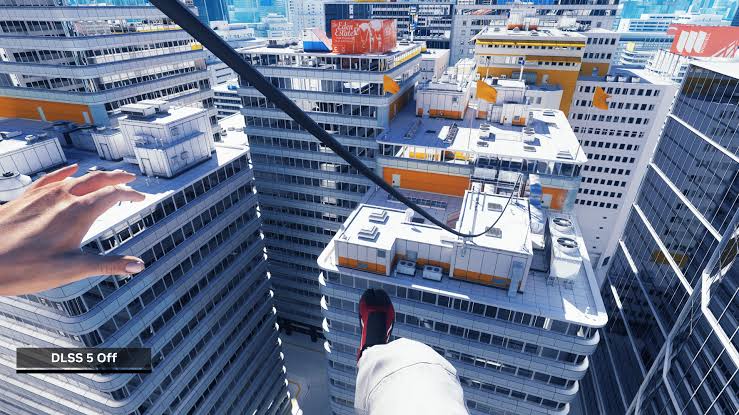
Where Winds Meet will also gain support, although Nvidia has not yet provided a specific release date beyond saying the update is coming in the near future.
DLSS 5 will additionally arrive in RTX Remix on October 23, opening the technology to older games receiving community made graphical upgrades through Nvidia's remastering platform.
The wider rollout remains limited primarily to newer Nvidia hardware for now.
RTX 4000 Support Is Still Planned
The October update initially targets RTX 5000 graphics cards rather than expanding DLSS 5 to older GeForce hardware.
Nvidia has previously indicated that it intends to work on RTX 4000 series compatibility after finishing performance tuning for RTX 5000 GPUs, but there is still no confirmed release date for that support.
The significantly lighter model could make that expansion easier, especially now that DLSS 5 requires considerably fewer GPU resources than it did at launch.
However, Nvidia has not confirmed whether every RTX 4000 model will eventually be supported or what performance level would be required.
Frame Generation Gets a Faster Preset C Mode
Nvidia is separately improving frame generation with a new performance focused option called Preset C.
The mode uses a lighter and faster algorithm designed to increase frame rates further. Nvidia claims an RTX 5060 can see gains of up to 35% when using the new preset.
Preset C can be selected through the frame generation override in the Nvidia app.
The additional performance may come with some compromises. Early reports cited in the supplied material suggest that Preset C can produce more visual artifacts or glitches in certain situations, although the severity may depend on the game and can vary between players.
That makes the mode potentially useful for players who prioritize higher frame rates, particularly on lower powered RTX hardware and laptops.
The October DLSS 5 update therefore focuses less on adding a completely new visual feature and more on making Nvidia's existing neural rendering technology practical on a wider range of systems. Cutting GPU overhead in half while reducing VRAM usage addresses two of the main technical limitations of the original implementation, although wider RTX 4000 compatibility remains one of the major unanswered questions.


Discussion (0)
Be the first to comment.