



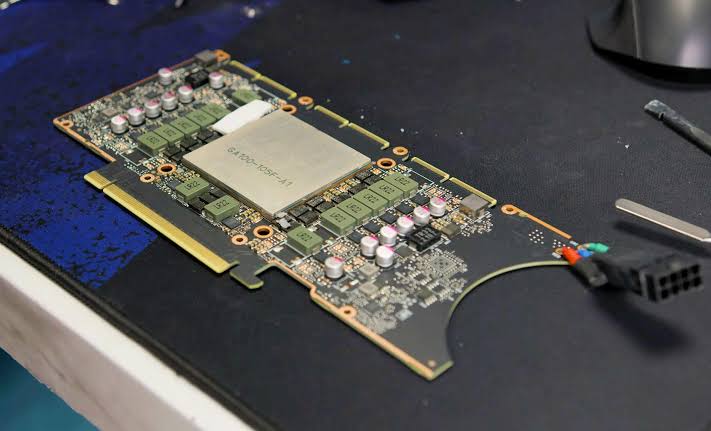
NVIDIA's old CMP 170HX mining card has suddenly become far more valuable after a new software tool reportedly unlocked significantly more of its hidden HBM2e memory and restored additional compute functionality.
The card originally launched in 2021 for cryptocurrency mining and was sold with only 8 GB or 10 GB of accessible memory. It uses a cut down version of NVIDIA's GA100 Ampere GPU, closely related to the silicon used in the A100 accelerator.
A new unlock method can reportedly expose as much as 64 GB on some 8 GB cards and up to 80 GB on certain 10 GB models. That discovery has triggered a rapid increase in second hand prices, with cards that recently sold for roughly $100 to $200 now appearing for more than $1,000.
CMP 170HX changes after the unlock
| Feature | Reported capability |
|---|---|
| Original VRAM | 8 GB or 10 GB |
| Maximum unlocked VRAM | Up to 64 GB or 80 GB |
| More reliable capacity | Often around 32 GB to 40 GB |
| Memory type | HBM2e |
| Memory bandwidth | Around 700 GB/s to 800 GB/s |
| AI compute support | Up to INT8 |
| Reported compute performance | Around 48 TOPS |
| PCIe interface | Limited to PCIe Gen 2 x4 |
| Recent used price | Around $1,200 to $2,000 in some listings |
The software reportedly restores full SM compute throughput and changes the memory configuration that had been restricted through firmware and other controls.
That makes the CMP 170HX much more interesting for local AI workloads, where available VRAM can matter more than gaming performance.
A card with 64 GB or 80 GB of HBM2e can load much larger AI models than most consumer GPUs, including newer high end cards with far less memory.
The full 64 GB or 80 GB is not guaranteed
The biggest limitation is that the result varies from card to card.
CMP 170HX boards were built using lower binned GA100 silicon, and some of the disabled memory stacks may have been turned off because they did not meet NVIDIA's original quality requirements.
As a result, unlocking the memory does not guarantee that every card can use its theoretical maximum capacity reliably.
Some 8 GB models reportedly reach 64 GB, while others are stable only at lower capacities. The same applies to the 10 GB versions, where 80 GB may be visible but not consistently usable.
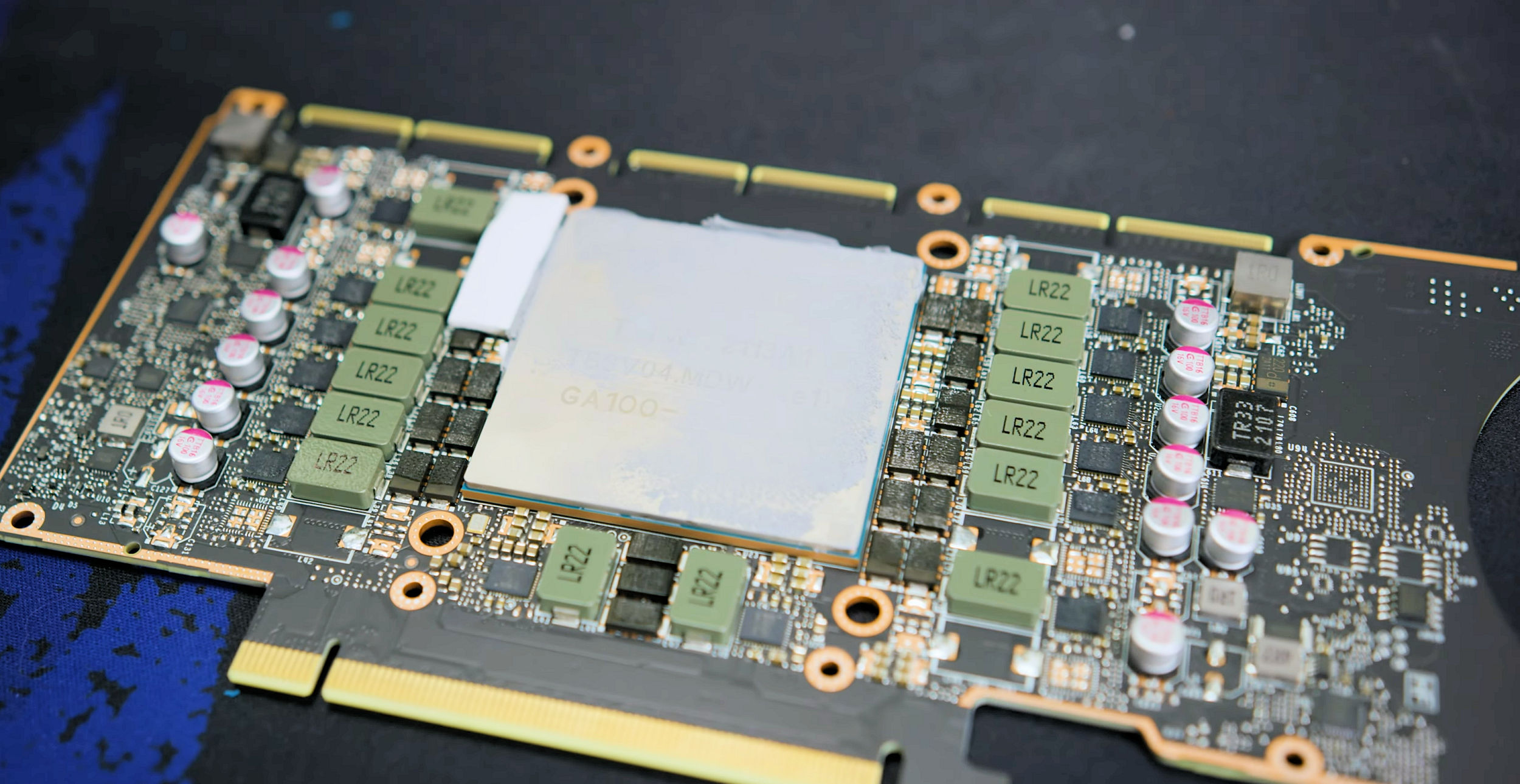
Memory stability and bandwidth can also differ depending on the quality of the HBM dies.
Reports suggest that 8 GB cards using Hynix memory may be more stable when expanded toward 64 GB, while some 10 GB Samsung based cards can expose 80 GB but experience reliability problems.
For practical use, 32 GB or 40 GB of stable VRAM may be a more realistic result on many boards.
AI workloads give the old mining card a second purpose
The CMP 170HX was not designed as a conventional graphics card.
It lacks normal 3D rendering functionality and was originally intended almost entirely for cryptocurrency mining. That made it much less useful after mining demand collapsed.
AI workloads have changed the situation because large language models and other compute applications do not necessarily require conventional display or gaming features.
The large potential HBM2e capacity makes the card interesting for enthusiasts running models locally, particularly when VRAM capacity is the main limitation.
However, its Ampere architecture lacks newer AI data formats such as FP8, FP6 and FP4 that are available on more modern accelerators.
That means a heavily unlocked CMP 170HX should not be expected to match an RTX 5090 or newer AI hardware simply because it has more memory.
PCIe bandwidth is another major limitation
The card's interface is also restricted.
The current configuration is reportedly limited to PCIe Gen 2 x4, which provides far less bandwidth than modern GPUs.
Some modifications may improve the interface, but these can require physical changes to the hardware and are not suitable for most buyers.
That limits the card's appeal for workloads that frequently move large amounts of data between system memory and GPU memory.
For models that can remain largely inside the card's HBM memory, the limitation may be less serious.
Prices have reacted immediately
The sudden increase in demand has had a dramatic effect on the second hand market.
Cards that could previously be found for roughly $100 to $200 are now being listed in the $1,200 to $2,000 range.
That price increase changes the value proposition considerably.
At $100, experimenting with a potentially unstable 64 GB accelerator could make sense for experienced AI enthusiasts. At more than $1,000, the risks become much harder to ignore.
Buyers have no guarantee that a particular CMP 170HX will unlock its full memory capacity, maintain stable bandwidth or behave reliably under sustained workloads.
The CMP 170HX has therefore become an unusual AI option rather than an obvious bargain. Its hidden HBM2e capacity can make it attractive for memory heavy workloads, but buying one now is effectively a hardware lottery, especially after prices increased by several times within a short period.



Discussion (0)
Be the first to comment.