


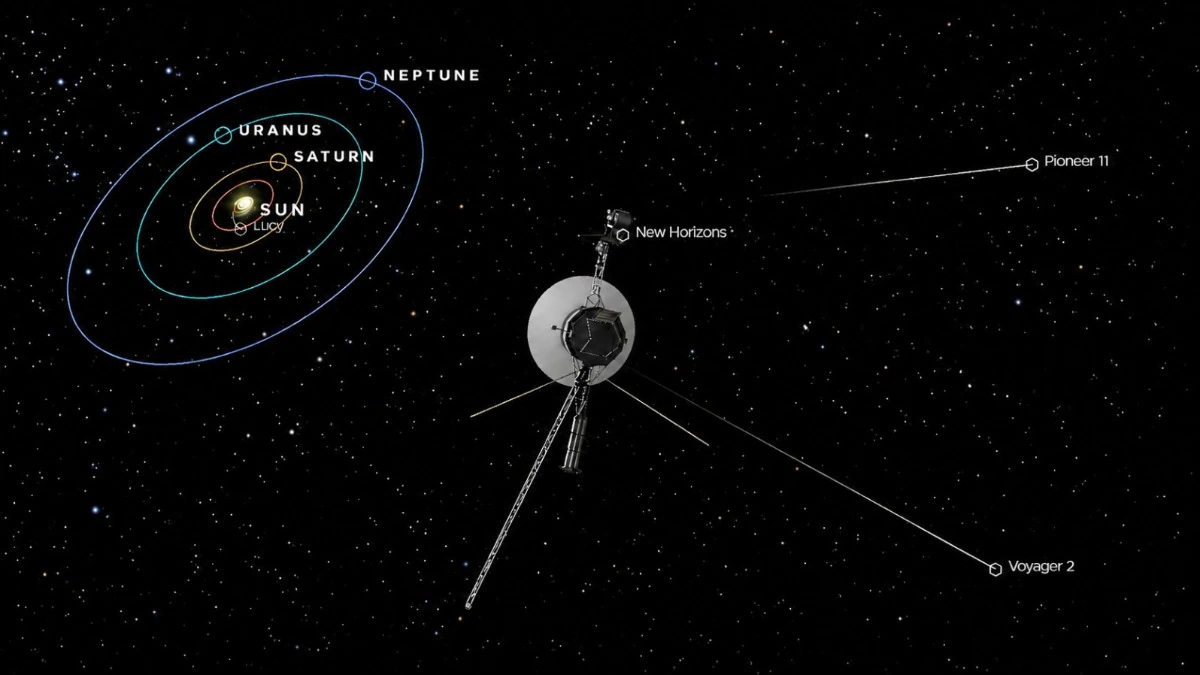
NASA's Voyager 1 spacecraft has reached a historic milestone, becoming the first human made object to travel one light day away from Earth. The achievement comes nearly 50 years after the spacecraft launched in September 1977.
Voyager 1 crossed the milestone on November 18, 2026, reaching a distance of approximately 16.094 billion miles, or 25.902 billion kilometers, from Earth.
At this distance, radio signals traveling at the speed of light take an entire day to reach the spacecraft. Any response requires another 24 hours to return, creating a communication delay of approximately 48 hours for a complete exchange.
The milestone also comes as NASA continues working to extend Voyager 1's operational life despite its aging nuclear power system and increasingly limited electricity supply.
Although the spacecraft has been traveling through interstellar space since 2012, its mission continues to provide scientists with an opportunity to study conditions beyond the region dominated by the Sun's solar wind.
Voyager 1 Is Now More Than 16 Billion Miles From Earth
Voyager 1 reached the one light day distance on November 18 at approximately 5:16 a.m. Eastern Time.
A light day represents the distance light travels through a vacuum in 24 hours, making it a measurement of distance rather than time.
Light travels at approximately 186,282 miles per second, covering around 16.1 billion miles in one day.
For comparison, sunlight takes approximately eight minutes and 20 seconds to reach Earth. Radio signals traveling between Earth and Neptune can take more than four hours, depending on the planets' relative positions.
Voyager 1 has traveled considerably farther than any planet in our solar system.
Its distance also makes it the most remote spacecraft ever launched by humanity.
The probe continues moving outward at approximately 38,000 miles per hour, meaning its separation from Earth will generally continue increasing as it travels through interstellar space.
NASA Now Needs About 48 Hours to Exchange Messages With Voyager 1
The increasing distance creates substantial challenges for engineers communicating with Voyager 1.
NASA uses its Deep Space Network, a collection of powerful radio antennas positioned around the world, to communicate with distant spacecraft.
At Voyager 1's current distance, a command transmitted from Earth requires approximately 24 hours to arrive.
If the spacecraft responds immediately, its reply takes another 24 hours to reach Earth.
Consequently, even a straightforward command and response can take about two days.
This makes troubleshooting particularly difficult because engineers cannot receive immediate confirmation that an instruction has worked.
Mission controllers must carefully prepare commands, account for the spacecraft's operating conditions, and wait for the returned signals before making additional decisions.
The communication delay will gradually increase as Voyager 1 continues moving farther away.
Voyager 1 Experiences a New Data Transmission Problem
The milestone has also coincided with another technical challenge.
NASA confirmed that Voyager 1 stopped transmitting science and engineering data on November 14, 2026.
Although the spacecraft's radio carrier signal remains detectable, mission controllers are not currently receiving the detailed information normally transmitted by its onboard systems.
Engineers believe the issue may involve the computer responsible for collecting and formatting data before transmission.
The continued presence of the carrier signal indicates that the spacecraft is still pointing its antenna toward Earth and that its radio transmitter remains operational.
NASA confirmed the one light day milestone using the detected signal and calculations based on the spacecraft's known trajectory.
Engineers are investigating the interruption, which follows a separate communications problem in October that temporarily prevented ground stations from detecting Voyager 1.
The latest issue has not been confirmed as a failure of the spacecraft's nuclear power system.
Voyager 1's Nuclear Battery Continues Losing Power
Voyager 1 relies on radioisotope thermoelectric generators, which convert heat produced by decaying plutonium into electricity.
Unlike conventional batteries, these generators can supply power for decades without requiring sunlight or recharging.
However, their electrical output gradually decreases as the radioactive material decays and the generating equipment ages.
NASA estimates that the Voyager spacecraft lose approximately four watts of available electrical power annually.
This decline has forced engineers to make difficult decisions about which instruments and onboard systems can remain operational.
Over the years, mission controllers have shut down equipment, modified power distribution, and switched to alternative hardware to conserve electricity.
Earlier in 2026, engineers replaced three operating devices with lower power alternatives, reducing electricity consumption while maintaining the thermal conditions required by the spacecraft.
These changes are intended to extend the mission's scientific capabilities for as long as possible.
NASA hopes to maintain useful scientific operations into 2027, although the continuing decline in available power and unexpected technical problems could affect that objective.
Voyager 1 Entered Interstellar Space in 2012
Voyager 1 launched on September 5, 1977, shortly after its twin spacecraft, Voyager 2.
Both missions were originally designed to study the outer planets, taking advantage of a favorable planetary alignment that allowed gravitational assists to reduce travel time.
Voyager 1 visited Jupiter and Saturn before continuing outward on a trajectory that eventually carried it beyond the Sun's heliosphere.
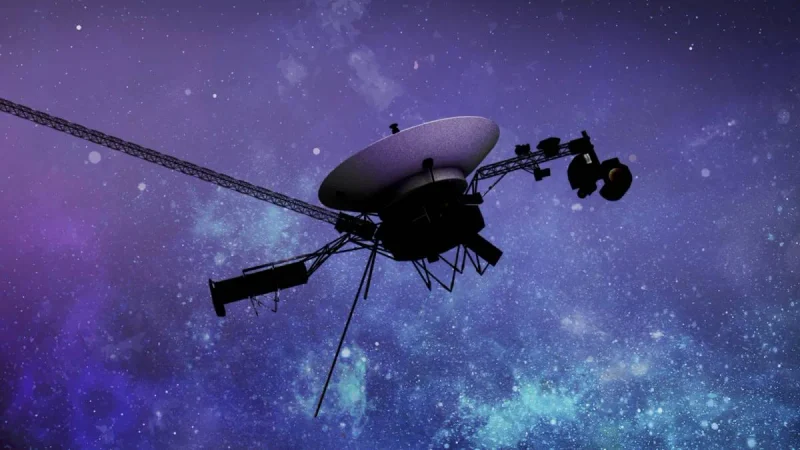
In 2012, it crossed the heliopause, the boundary separating the region dominated by the solar wind from the surrounding interstellar medium.
This made Voyager 1 the first spacecraft to enter interstellar space.
Voyager 2 followed in 2018 after completing additional encounters with Uranus and Neptune.
The spacecraft have provided valuable measurements of magnetic fields, charged particles, and other conditions beyond the heliosphere.
Their observations help scientists understand how the Sun interacts with the surrounding interstellar environment.
Voyager 2 Could Reach One Light Day in 2035
Voyager 2 remains closer to Earth than its twin, despite launching first.
Its longer route through the outer solar system allowed it to visit Uranus and Neptune, while Voyager 1 followed a faster outward trajectory.
Voyager 2 is currently approximately 20 light hours from Earth.
NASA estimates that it could reach the one light day milestone in November 2035.
However, the spacecraft's remaining electrical power may not be sufficient to maintain communications and scientific operations until then.
Both probes are approaching their 50th launch anniversaries in 2027, a remarkable achievement for missions originally designed around planetary encounters rather than decades of interstellar exploration.
Even after their power supplies can no longer support communications, Voyager 1 and Voyager 2 will continue traveling through space.
For now, engineers are concentrating on preserving the spacecraft's remaining capabilities and investigating Voyager 1's latest data transmission problem.
The November 18 milestone demonstrates how far the mission has traveled, while its continuing technical challenges show the difficulty of operating scientific equipment nearly half a century after launch.



Discussion (0)
Be the first to comment.