




Monster Hunter Wilds could run at up to 1440p in docked mode and target 40 FPS on Nintendo Switch 2, according to technical details reportedly discovered in the game’s latest update files.
The information has not been officially confirmed, so the final release may use different settings. However, the reported targets suggest CAPCOM is trying to push the new Nintendo hardware much further than the original Switch.
In docked mode, the game is expected to use dynamic resolution scaling between 1080p and 1440p. Handheld mode could operate between 720p and 864p, while a 40 FPS target may provide smoother gameplay on the portable display through Variable Refresh Rate support.
Monster Hunter Wilds is one of the most demanding games built on the RE Engine, making the Switch 2 version an important test of the system’s real performance limits.
Reported Switch 2 performance targets
The leaked configuration suggests that image quality and frame rate will change depending on whether the console is docked or used as a handheld.
| Mode | Reported resolution range | Reported frame rate |
|---|---|---|
| Docked | 1080p to 1440p dynamic | Up to 40 FPS |
| Handheld | 720p to 864p dynamic | Up to 40 FPS |
| Display support | VRR in handheld mode | Expected to improve smoothness |
| Upscaling | Likely NVIDIA DLSS | Not officially confirmed |
The 1440p figure should not necessarily be treated as the game’s native rendering resolution. Dynamic resolution means the internal image can change depending on scene complexity.
DLSS could then reconstruct the final image at a higher output resolution. This would allow the game to maintain stronger visual quality without rendering every frame at full 1440p.
Handheld mode may benefit most from 40 FPS
The reported 40 FPS target could be particularly useful in handheld mode.
Nintendo Switch 2’s internal display supports Variable Refresh Rate, allowing the screen to adjust its refresh timing to match fluctuating frame delivery. This can make performance between 30 FPS and 40 FPS feel smoother than it would on a fixed refresh display.
| Frame rate target | Practical effect |
|---|---|
| 30 FPS | Lower hardware demand but less responsive |
| 40 FPS | Smoother motion and lower input latency |
| 60 FPS | Best responsiveness but much harder to sustain |
| VRR support | Helps hide smaller frame rate fluctuations |
A stable 40 FPS mode can offer a useful middle ground between visual quality and responsiveness.
The same benefit may not apply in docked mode because the console reportedly does not support VRR through its docked output. That means uneven performance could be more noticeable on a television unless CAPCOM uses a stable frame rate cap.
Monster Hunter Wilds is a demanding technical challenge
The game places heavy demands on both the CPU and GPU.
Its large environments contain dynamic weather, large monsters, numerous effects, complex animation, and many background systems. These features have already caused performance challenges on PlayStation 5, Xbox Series X|S, and PC.
Bringing the same game to Switch 2 requires substantial optimisation.
| Technical challenge | Why it matters |
|---|---|
| Large open environments | Requires constant asset streaming |
| Multiple large monsters | Increases CPU and animation load |
| Dynamic weather | Adds visual and simulation demands |
| Complex effects | Places pressure on the GPU |
| High quality textures | Increases memory use |
| Online multiplayer | Adds network and CPU workload |
CAPCOM may need to reduce texture quality, shadow resolution, object density, effects, or draw distance to keep the game stable on Nintendo’s hardware.
The reported dynamic resolution system would also help by lowering the rendering load during demanding scenes.
CAPCOM has already shown strong Switch 2 optimisation
Street Fighter 6 demonstrated that CAPCOM can produce a capable Switch 2 port with good performance and visual quality.
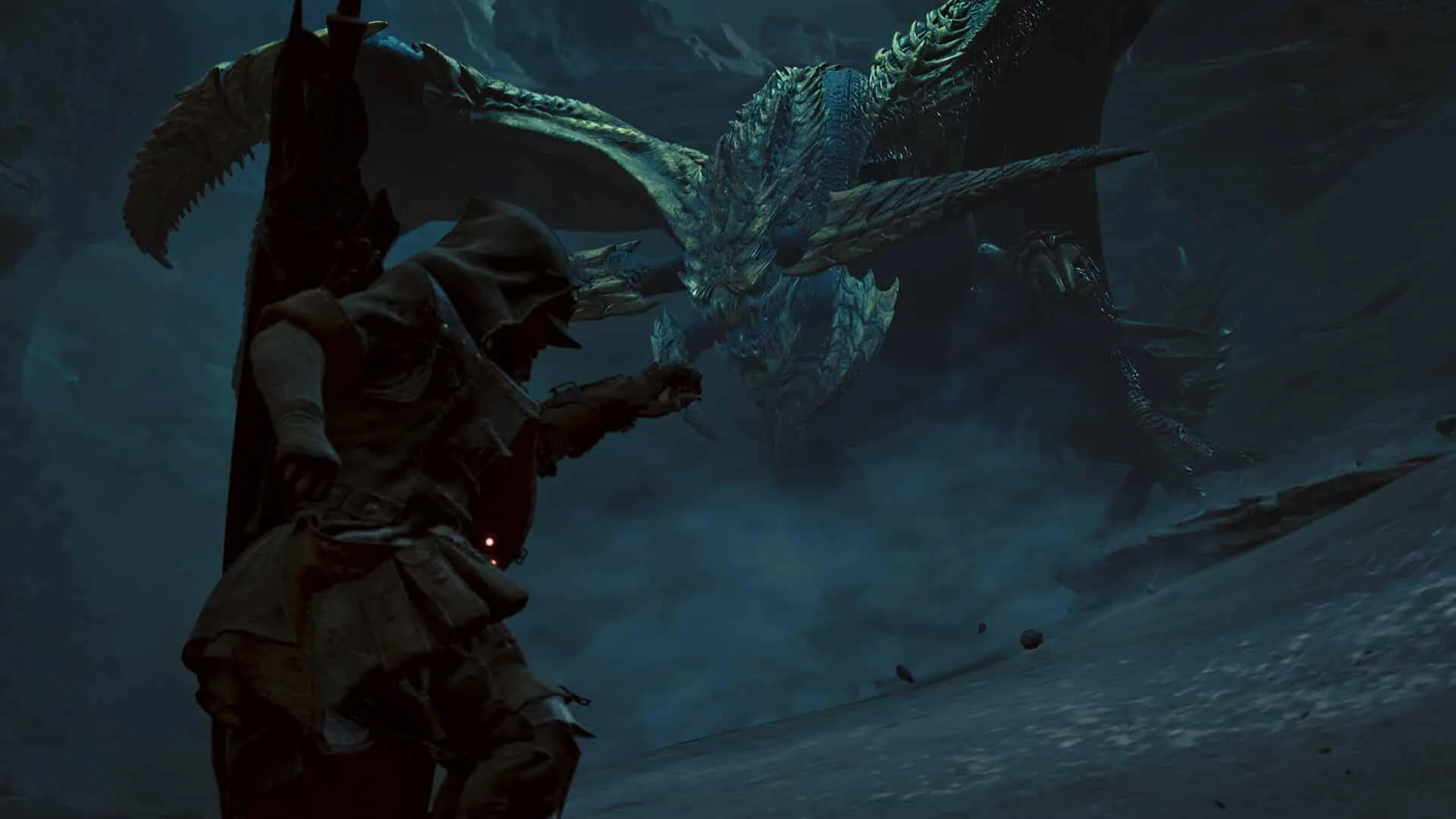
Monster Hunter Wilds presents a much harder challenge because it uses larger areas and more complex background systems. Dragon’s Dogma 2, another demanding RE Engine title, is also expected to test the hardware if its Switch 2 version moves forward.
A successful Monster Hunter Wilds port would show that the system can handle current generation open world games with careful optimisation and modern reconstruction technology.
The Switch 2 version may launch in a more complete state
The game’s original launch received criticism for performance issues and a limited endgame.
Since then, CAPCOM has added more monsters, revised progression, and expanded the endgame challenge. The upcoming Ascendance expansion is also expected to add further content.
This means Switch 2 players may receive a more refined version than the one released on other platforms at launch.
| Area | Likely Switch 2 advantage |
|---|---|
| Performance fixes | Benefits from later optimisation work |
| Endgame content | More complete than original launch |
| Monster roster | Additional content already available |
| Balance changes | Includes later adjustments |
| Expansion support | Could launch closer to Ascendance |
The final content package has not been confirmed, so it remains unclear whether every update and expansion will be included immediately.
Release timing remains unknown
Monster Hunter Wilds for Switch 2 was officially confirmed in June 2026 after earlier reports suggested it had been in development since late 2025.
The newly discovered settings may indicate that the port is progressing, but CAPCOM has not announced a release date.
The studio still needs to confirm the final performance modes, visual settings, download size, physical release format, and expansion support.
For now, the reported 1080p to 1440p docked range and 40 FPS target suggest an ambitious port. If CAPCOM can maintain acceptable image quality and stable performance, Monster Hunter Wilds could become one of the strongest demonstrations of what Nintendo Switch 2 can handle.



Discussion (0)
Be the first to comment.