



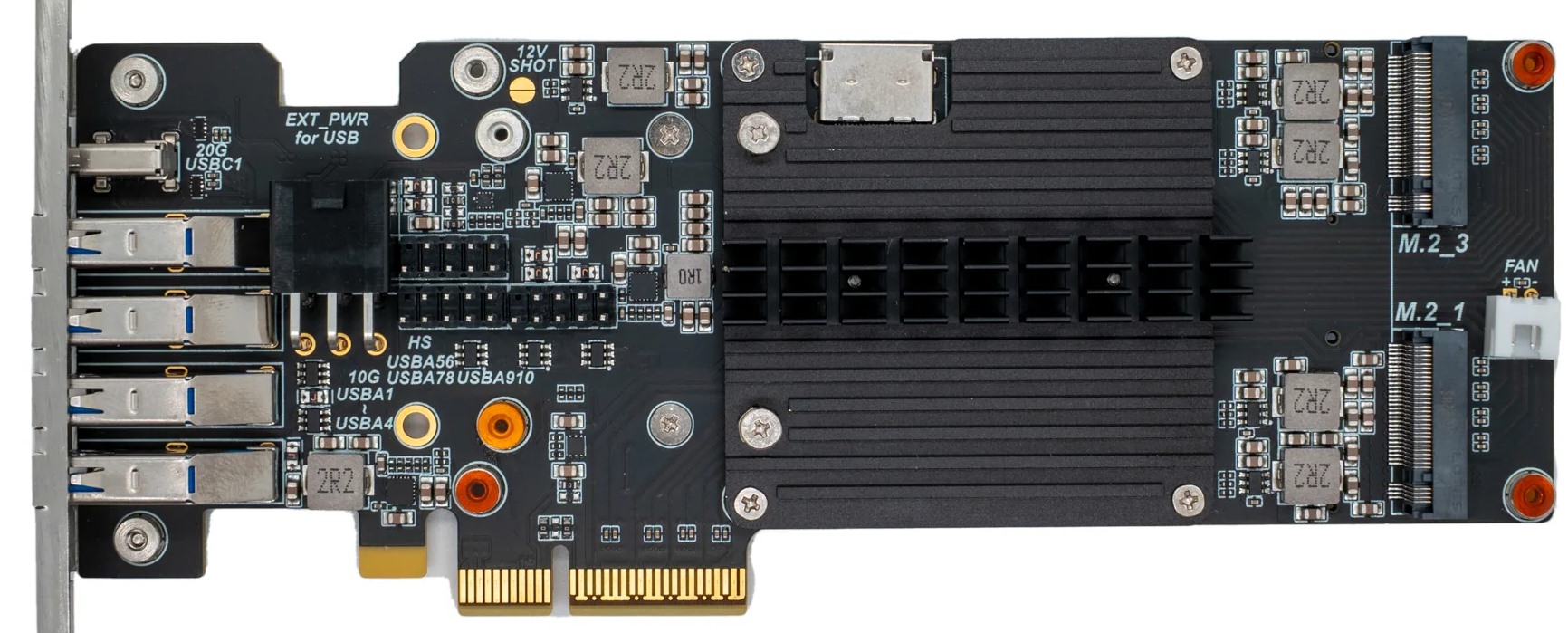
MINISFORUM has shown an unusual PCIe expansion card at Computex 2026 that uses an AMD B650 chipset to add more storage and external PCIe connectivity. The card is called PCIE TO 4, and it is designed to provide four M.2 slots, one OCuLink port, and one USB 3.2 Gen 2x2 Type C port through a single add in board.
The idea is different from a normal M.2 adapter. Instead of simply splitting PCIe lanes across multiple SSD slots, MINISFORUM is using AMD’s B650 chipset as the controller on the card itself. That makes the board act more like a small expansion platform, similar to what a motherboard chipset does inside a full PC.
This kind of product is becoming more interesting as compact PCs, mini workstations, and homelab systems become more popular. Many small systems have strong CPUs but limited internal expansion. A PCIe card with four M.2 slots and OCuLink support could help users add more storage or external PCIe devices without moving to a larger motherboard.
MINISFORUM showed the card at Computex with an active SSD cooling module. That is important because four NVMe drives can generate a lot of heat, especially if they are running at PCIe 4.0 speeds. A small fan and dedicated cooling structure should help keep drives stable during heavier workloads.
The B650 chipset gives the card more flexibility than a basic adapter
The most interesting part of the PCIE TO 4 card is the use of AMD’s B650 chipset. B650 is normally found on AM5 motherboards, but here it is placed directly on the PCIe card’s main PCB.
That design lets the card support several types of connectivity from one add in board. According to the reported details, the card includes four M.2 slots, one OCuLink connector, and one 20Gbps USB Type C port.
| Feature | MINISFORUM PCIE TO 4 |
|---|---|
| Controller | AMD B650 chipset |
| Expansion type | PCIe add in card |
| M.2 slots | Four |
| OCuLink | One port |
| USB | One USB 3.2 Gen 2x2 Type C port |
| Cooling | SSD cooling module with active fan |
| Platform support | AMD and Intel systems |
| Expected release | Third quarter of 2026 |
| Price | Not announced |
The card can reportedly connect up to two SSDs at PCIe 4.0 x4 speeds. If three or four SSDs are installed, the connection drops to PCIe 4.0 x2 per drive. That is an important tradeoff, but it is expected when multiple high speed devices share one expansion card.
For many users, PCIe 4.0 x2 per SSD will still be fast enough for general storage, game libraries, project files, backups, and lighter workstation use. For people who need every SSD running at full x4 bandwidth at the same time, a larger platform with more direct PCIe lanes will still be better.
OCuLink makes the card useful beyond storage
The OCuLink port gives the card more value than a normal multi SSD adapter. OCuLink has become popular in mini PC and enthusiast systems because it can carry PCIe signals externally. That makes it useful for fast external storage, expansion boxes, and some external GPU setups.
MINISFORUM already sells and promotes compact PCs, so this kind of card fits its broader strategy. The company can use it to give small systems more desktop like expansion, especially in cases where the main board does not have enough M.2 slots or external PCIe options.
The card is also said to work with both AMD and Intel platforms, which is one of the more unusual details. Since it uses an AMD B650 chipset, many people would expect it to be limited to AM5 systems. Instead, the card appears to function as a PCIe expansion device that can be installed in standard systems from both CPU vendors.
That could make it appealing to builders who want flexible storage expansion without being locked to one motherboard ecosystem. Compatibility will still need real world testing, especially across different BIOS versions, operating systems, and PCIe slot configurations.
Chipset based expansion cards are becoming a new niche
MINISFORUM is not alone in exploring this category. WisdPi has also launched an AMD Promontory 21 based expansion card with four M.2 slots and OCuLink. That shows a small but growing trend: motherboard chipsets are being used on PCIe cards to create compact I/O expansion platforms.
A year ago, products like this were mostly custom projects or enthusiast experiments. Now they are becoming commercial hardware. That shift makes sense because more users want dense NVMe storage, external PCIe connections, and compact systems that can still expand like larger desktops.
The main limitation will always be bandwidth. A single PCIe card cannot magically create unlimited lanes. If several SSDs, OCuLink devices, and USB devices are active at once, the host connection will decide how much total performance is available. Still, for many workloads, the flexibility may matter more than peak speed on every port.
MINISFORUM plans to release the PCIE TO 4 card in the third quarter of 2026. Pricing has not been announced, so it is too early to judge its value directly against WisdPi’s $199 card or other high end M.2 expansion boards.
For now, the card is another sign that PCIe expansion is getting more creative. Instead of simple adapters, companies are building small chipset based hubs for storage and external connectivity. For compact PC owners, homelab builders, and workstation users who need more M.2 slots, MINISFORUM’s PCIE TO 4 could become one of the more useful niche accessories of the year.



Discussion (0)
Be the first to comment.