



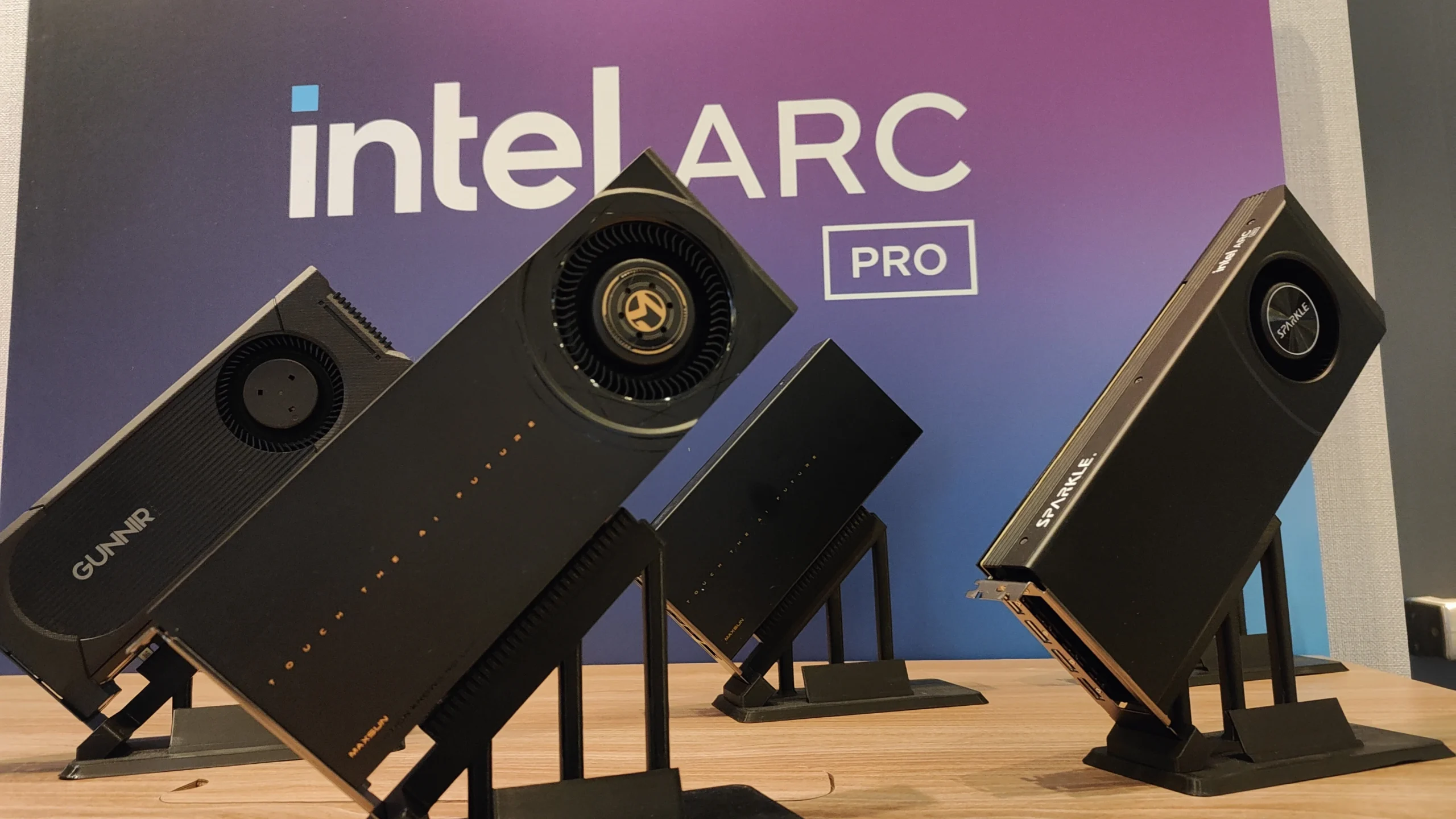
Maxsun’s Intel Arc Pro B70 32GB graphics card shows the biggest step yet for Intel’s Battlemage GPU lineup, delivering strong gains in AI, rendering, workstation tasks, and even gaming. The card is built for professional and prosumer workloads, but its performance also raises a clear question: why did Intel not release a gaming version of Big Battlemage?
The Arc Pro B70 is based on Intel’s larger BMG-G31 GPU, also known as Big Battlemage. It comes with 32 Xe2 cores, 256 XMX AI engines, 32 ray tracing units, and 32GB of GDDR6 memory on a 256 bit bus. The card offers 608GB per second of memory bandwidth and up to 367 INT8 TOPS for AI workloads.
At a starting price of $949, the Arc Pro B70 is not a mainstream gaming card. It is aimed at AI developers, creators, workstation users, and local inference workloads. Still, hands on testing shows that the GPU is fast enough to make Intel’s missing gaming variant feel like a missed opportunity.
Arc Pro B70 is built around AI and workstation performance
The Arc Pro B70 is designed for users who need a lot of VRAM without paying workstation GPU prices from Nvidia. Its 32GB of memory makes it useful for local AI models, large creative scenes, rendering, and professional software.
| Feature | Intel Arc Pro B70 |
|---|---|
| GPU | BMG-G31 Big Battlemage |
| Architecture | Xe2 |
| Xe cores | 32 |
| XMX AI engines | 256 |
| Ray tracing units | 32 |
| Memory | 32GB GDDR6 |
| Memory bus | 256 bit |
| Bandwidth | 608GB per second |
| AI performance | Up to 367 INT8 TOPS |
| Starting price | $949 |
| Power range | 160W to 290W depending on model |
Maxsun’s version uses a dual slot blower design with a vapor chamber cooler, 16 pin power connector, metal backplate, and a professional focused design. The card is clearly marketed toward AI users, with “Touch The AI Future” printed across the shroud.
The cooler also appears well suited for workstation use. Testing showed temperatures around 70 to 75 degrees Celsius under heavy load, with power draw sitting around 250W in many scenarios.
Big Battlemage brings large gains over Arc Pro B60
In synthetic and workstation tests, the Arc Pro B70 often pulls well ahead of the Arc Pro B60 Dual. In 3DMark, it was around 52 percent faster on average. In Blender, the lead grew to roughly 70 percent across tested scenes.
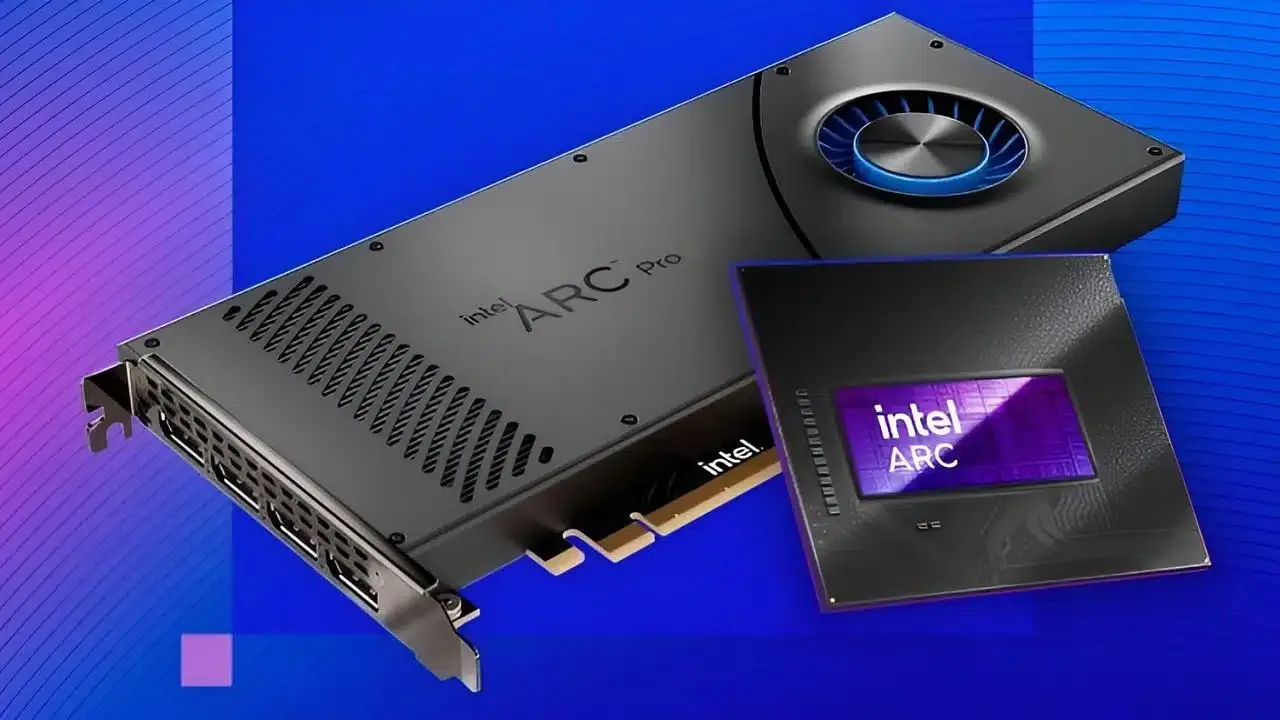
AI performance was also strong. In Geekbench AI and UL Procyon, the Arc Pro B70 showed clear gains over the Arc Pro B60 family. The card handled large language models such as Qwen, Gemma, Llama, and other local AI workloads smoothly, helped by its single GPU 32GB VRAM configuration.
That single large memory pool matters. Dual GPU cards may offer more total VRAM on paper, but not every workload benefits from split memory across two GPUs. For local AI work, a single 32GB GPU can be simpler and more useful.
Gaming performance makes the missing Arc B770 feel real
The surprise is gaming. Although the Arc Pro B70 is not sold as a gaming card, newer Arc Pro drivers allowed it to run games smoothly. In several tests, it outperformed the Arc B580 by around 35 to 45 percent and beat the older Arc A770 by even wider margins.
In Cyberpunk 2077, the B70 was roughly 40 percent faster than the B580 and more than 50 percent faster than the A770. In Forza Horizon 5, it showed strong leads at both 1080p and 4K. In Silent Hill 2 Remake and Doom: The Dark Ages, the newer Xe2 architecture also helped with ray tracing performance.
This is why the card feels important beyond the workstation market. The results suggest a gaming focused Big Battlemage GPU, possibly with 16GB of VRAM and a lower price, could have competed strongly against cards such as Nvidia’s RTX 5060 Ti 16GB or AMD’s Radeon RX 9070 series.
Intel did not release that product, likely because market conditions, AI demand, and workstation pricing made the Pro segment more attractive. But the performance is clearly there.
Intel’s driver progress is becoming harder to ignore
Intel’s Arc drivers were once the biggest concern around its graphics cards. Early Arc products had uneven game support and performance issues. The Arc Pro B70 testing shows how much progress Intel has made.
Games reportedly ran smoothly, with no major frame pacing or stuttering problems during testing. That matters because Intel’s hardware has often looked promising on paper, but drivers have needed time to catch up.
The Arc Pro B70 suggests Intel’s graphics team has reached a much stronger point. The card is not only good in AI and pro workloads. It is also stable enough in games to make a proper gaming version feel realistic.
Arc Pro B70 is one of Intel’s strongest prosumer GPU moves yet
The Maxsun Intel Arc Pro B70 is not cheap, but it offers a rare mix of 32GB VRAM, strong local AI performance, workstation capability, and surprisingly good gaming results under $1,000. Compared with far more expensive professional GPUs, its value is clear for users who need memory capacity and compute strength more than brand lock in.
The bigger story is what the card says about Intel’s graphics future. Big Battlemage looks powerful. The drivers are improving. AI workloads run well. Games run better than expected. The only disappointment is that regular gamers may not get a dedicated version of this GPU.
For creators, AI users, developers, and workstation buyers, the Arc Pro B70 looks like one of Intel’s most compelling GPU products so far. For gaming fans, it may be a glimpse of the Arc card Intel could have built next.



Discussion (0)
Be the first to comment.