



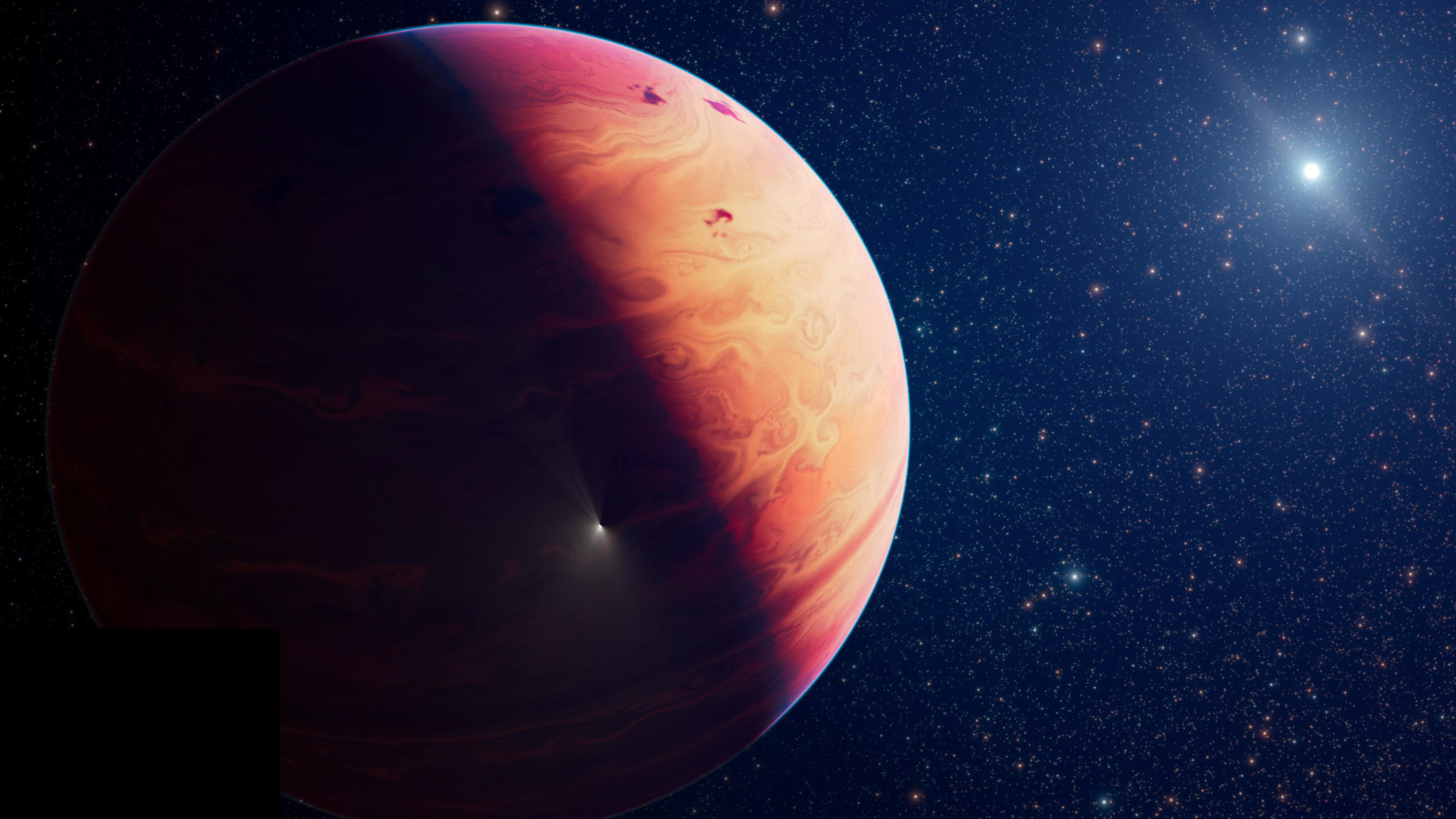
The James Webb Space Telescope has revealed that GJ504b, the distant world known as the Pink Planet, is surrounded by clouds likely made from vaporised salts. The finding gives astronomers their clearest look yet at one of the coldest and faintest planetary-mass objects ever studied directly.
GJ504b sits about 57 light-years from Earth and was first discovered in 2013. It has long stood out because of its unusual pink appearance and its uncertain identity. At roughly 25 times the mass of Jupiter, it sits near the dividing line between a giant planet and a brown dwarf.
The new observations suggest that its atmosphere contains water vapour, methane, carbon dioxide, ammonia, and other exotic chemicals. But the most important result is that scientists needed salt clouds in their models to explain the data properly.
The Pink Planet was too faint for ground telescopes
GJ504b is unusually cold for an object of its size. Its temperature is estimated at around 550 degrees Fahrenheit, or roughly 290 degrees Celsius.
That may sound extremely hot by Earth standards, but it is much cooler than most directly imaged worlds beyond our solar system. Many other objects studied through direct imaging are far hotter, with temperatures between 1,000 and 2,000 degrees Fahrenheit.
Its low temperature and faint light made the Pink Planet difficult to study from Earth. Astronomers spent years trying to gather detailed atmospheric data using ground-based telescopes, but the object remained too dim.
Webb changed that.
Using its advanced infrared instruments, the telescope was able to separate the faint light from GJ504b from the glare of its host star. The observations reportedly took only around two hours, giving scientists the first direct spectroscopic look at the object’s atmosphere.
Salt clouds solved a major atmospheric mystery
The first readings from Webb showed a complex mix of molecules. Researchers detected signs of water vapour, methane, carbon dioxide, ammonia, hydrogen sulfide, and carbon monoxide.
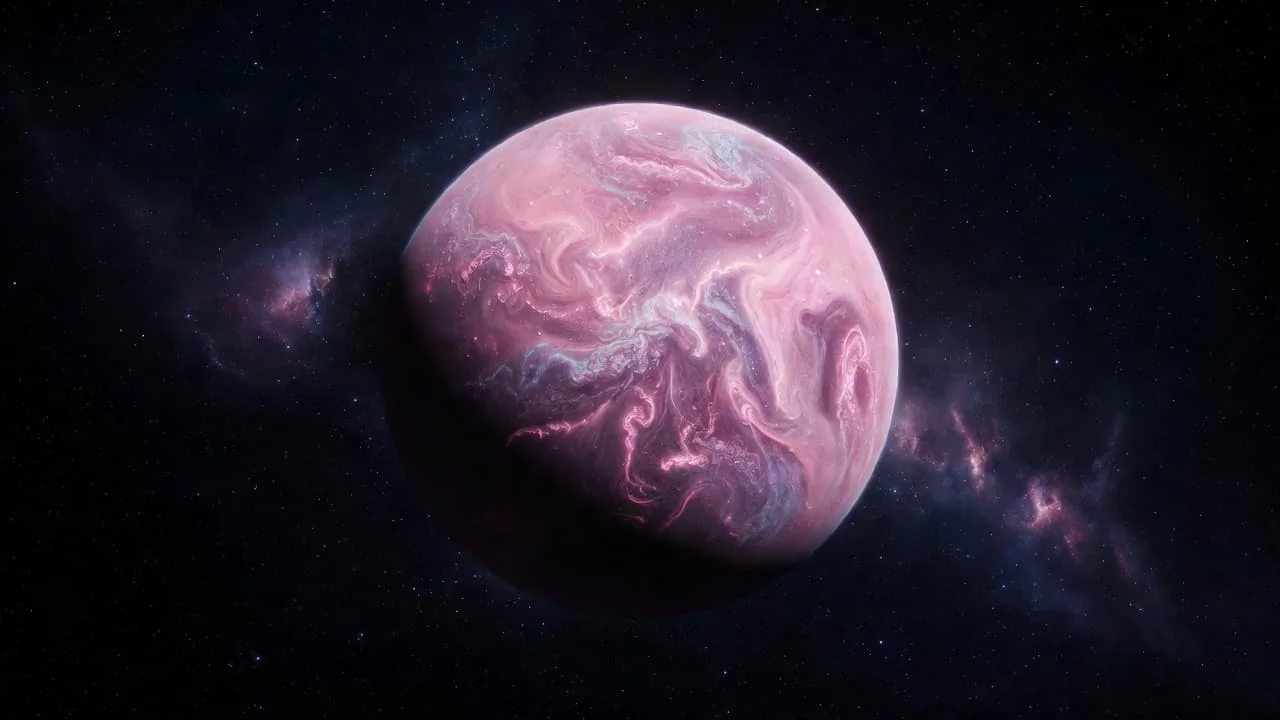
However, early atmospheric simulations produced results that did not make physical sense. The models could not explain how the detected chemicals were behaving without adding another major factor.
That missing factor was clouds.
| Atmospheric feature | Why it matters |
|---|---|
| Water vapour | Shows the atmosphere contains complex chemical activity |
| Methane | Common in colder giant planet atmospheres |
| Carbon dioxide | Helps researchers understand atmospheric composition |
| Ammonia | Often found in cooler gas giant environments |
| Salt clouds | Help explain why deeper chemical signatures appear muted |
| Heavy elements | May offer clues about how the object formed |
After testing different cloud types, researchers found that salt clouds matched the observations best. These clouds appear to scatter and block light from deeper layers of the atmosphere, making the spectrum finally align with physically realistic models.
The finding is important because it shows that clouds can strongly affect how astronomers interpret distant worlds.
GJ504b may be a planet or a brown dwarf
Scientists still cannot say with certainty whether GJ504b formed like a normal giant planet or collapsed from a gas cloud like a small star.
Its estimated mass places it in an uncertain range. It is too massive to be an ordinary Jupiter-like planet, yet it may still fall below the point where sustained hydrogen fusion would occur.
For now, astronomers describe it as a planetary-mass companion. The term reflects its uncertain origin while recognising that it orbits a star.
The new observations suggest that GJ504b may be unusually rich in heavier elements. That could support the idea that it formed in a planet-like process inside a disc of gas and dust. However, the evidence is not strong enough yet to rule out a brown dwarf origin.
Webb opens a new path for studying cold alien worlds
The biggest result may be what this means for future astronomy. Cold and faint worlds are among the hardest objects to study because their light is easily overwhelmed by the stars they orbit.
Webb has now shown that direct spectroscopy can work even for worlds that previous telescopes struggled to analyse.
This could help researchers study more distant gas giants, brown dwarfs, and other cold planetary companions in the future. It may also improve models for understanding giant planets closer to home, including Jupiter and Saturn.
GJ504b remains a strange and unresolved world, but its salty skies have given scientists a new clue about how complex alien atmospheres can be.



Discussion (0)
Be the first to comment.