



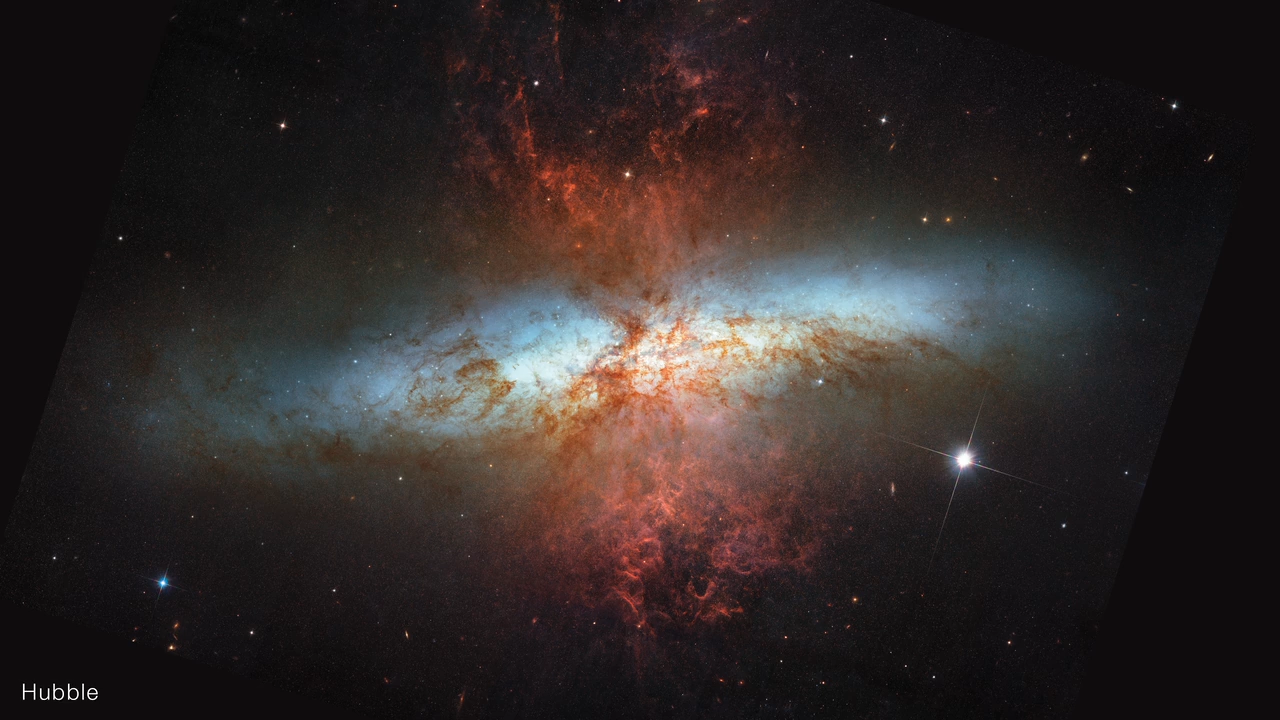
NASA’s James Webb Space Telescope has revealed about 16.5 million stars inside Messier 82, better known as the Cigar Galaxy, offering one of the clearest looks yet at a galaxy hidden behind thick clouds of dust. The new view shows how intense star formation is reshaping M82 while also pushing gas and dust away from the galaxy.
M82 sits around 12 million light years from Earth in the Ursa Major constellation. It earned its Cigar Galaxy name because of its long, narrow appearance, but its shape is only part of the story. The galaxy is currently going through a powerful starburst phase, forming stars at a much faster rate than the Milky Way.
Webb’s infrared instruments made the new observations possible. Visible light struggles to pass through the dense dust around M82’s central regions, but infrared light can reveal objects behind those clouds. This allowed Webb to detect millions of individual stars that had remained difficult to study in earlier images.
Webb Looks Through Dust That Hid Much of M82
The new image combines infrared observations from Webb with previous data from Hubble. Together, the two telescopes provide a more complete view of the galaxy’s structure.
Webb used its Near Infrared Camera during a 65 hour survey of M82. The observations show bright young stars scattered across the galaxy’s uneven disk, which appears distorted after an earlier interaction with another galaxy.
Astronomers believe M82’s unusual form and rapid star formation may be connected to a past gravitational encounter. Such events can compress gas inside a galaxy, creating the conditions needed for large numbers of stars to form in a relatively short period.
| M82 fact | Details |
|---|---|
| Common name | Cigar Galaxy |
| Official designation | Messier 82 |
| Distance from Earth | About 12 million light years |
| Location | Ursa Major constellation |
| Galaxy type | Starburst galaxy |
| New stars observed | Around 16.5 million |
| Main Webb instrument used | Near Infrared Camera |
The Galaxy Is Producing Stars at an Extreme Rate
M82 is creating new stars at a rate estimated to be about 10 times higher than the Milky Way. That makes it one of the most active nearby galaxies for studying how star formation works under extreme conditions.
The image also reveals enormous outflows above and below the galaxy’s disk. These structures are driven by powerful stellar winds and supernova explosions from massive young stars.
Closer to the disk, astronomers can see ionised hydrogen gas. Farther away, dust rich clouds spread into surrounding space. Those outflows are important because they carry material away from the areas where new stars are forming.
In time, that process could reduce the amount of gas available for future stellar growth.
M82’s Starburst Phase Will Not Last Forever
The Cigar Galaxy’s current activity is dramatic, but it is unlikely to continue indefinitely. M82 is using its gas supply quickly, while stellar winds and supernovae are pushing some of that material outside the galaxy.
Scientists expect this intense star forming period to last only a few hundred million years, which is short on a galactic timescale. Once its available gas is reduced, M82’s star formation rate could slow substantially.
Webb’s latest observations give astronomers a rare chance to study this process in detail. By seeing through M82’s dust, researchers can track the stars, gas, and outflows that shape a galaxy during one of its most active phases.



Discussion (0)
Be the first to comment.