



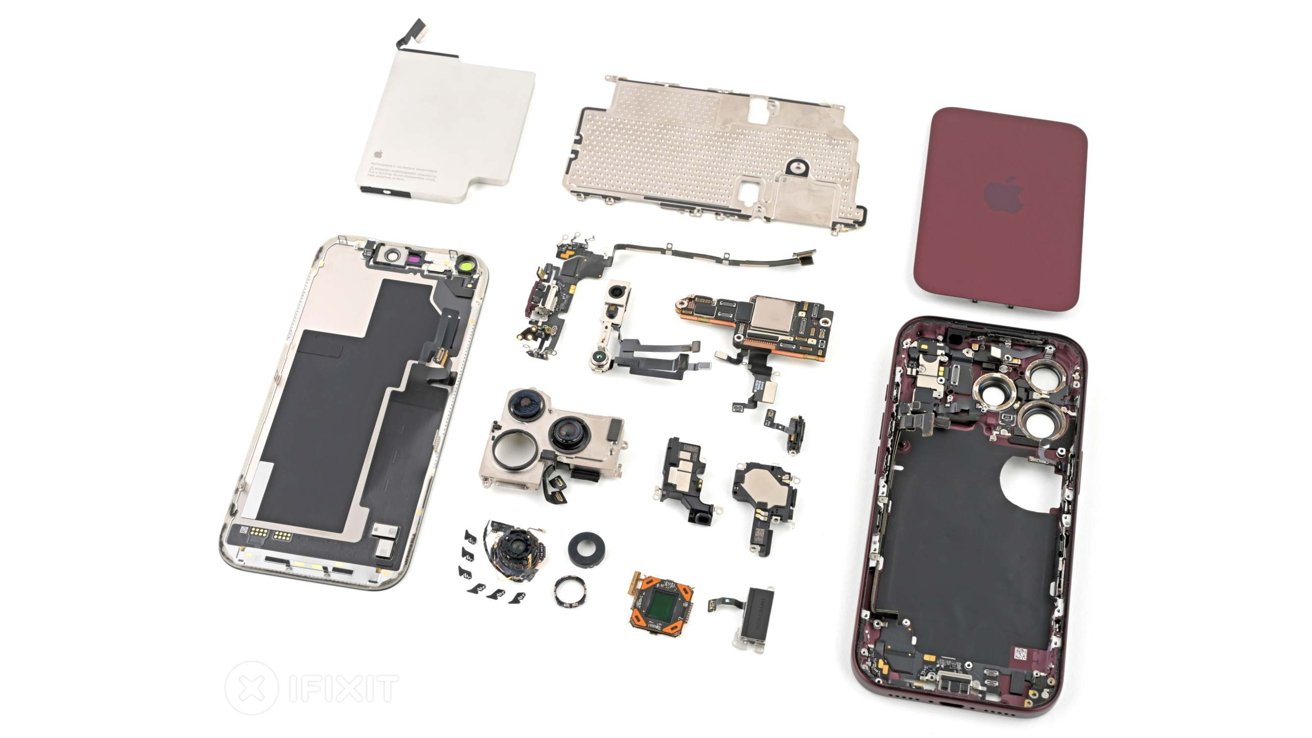
Apple’s iPhone 18 Pro and iPhone 18 Pro Max bring several internal engineering changes, including a redesigned thermal system and a more accessible camera module, but a teardown shows that some repairs remain difficult and potentially expensive.
The new phones use Apple’s A20 chip, built on a 2 nanometer manufacturing process. To manage heat from the processor, Apple has changed the internal layout and created a more direct path between the chip and a large vapor chamber that extends across much of the phone.
The teardown also highlights a new variable aperture camera system, which is modular but still difficult to repair at the component level.
A20 chip gets a more direct cooling path
One of the most important internal changes is the placement of the A20 processor.
Apple has positioned the system on chip on the outside of the logic board, allowing heat to move more directly into the vapor chamber.
That design should help the phone move heat away from the processor more efficiently during demanding workloads such as gaming, video processing and sustained camera use.
The vapor chamber itself covers a large portion of the internal body, giving the cooling system a much larger area for spreading heat.
| Component | Teardown finding |
|---|---|
| Processor | Apple A20 built on 2 nm process |
| Cooling | Large vapor chamber across much of the chassis |
| Logic board design | SoC positioned for more direct thermal transfer |
| Main camera | Modular and relatively accessible |
| Variable aperture | Uses six thin overlapping blades |
| Battery | Easy to remove after display access |
| Repairability score | Provisional 7 out of 10 |
The cooling design is one of the clearest signs that Apple is paying more attention to sustained performance rather than only peak processor speed.
Display removal remains the main repair obstacle
Opening the iPhone 18 Pro still requires a special pentalobe screwdriver.
The rear panel can be removed without too much difficulty, but that does not provide access to many of the important internal components.
For most repairs, technicians still need to enter through the front display.
That creates a major challenge because the screen is both fragile and tightly glued to the frame.
Removing it without damage requires careful handling, and the cost of replacing the display increases the financial risk of a repair attempt.
Once the display is removed successfully, access to several internal parts becomes easier.
Variable aperture camera is modular but difficult to repair internally
The iPhone 18 Pro introduces a variable aperture camera system.
Inside the camera assembly are six overlapping polymer composite blades. Each blade is extremely thin and works together to change the effective aperture of the camera.
The design allows the phone to control the amount of light reaching the sensor.
The camera module itself can be removed and replaced relatively easily once the display has been taken off.
Repairing the aperture mechanism inside the module is much more difficult.
The internal tolerances are extremely tight and adhesive is used throughout the assembly.
Because of that complexity, damage to the main camera may result in replacement of the entire camera module rather than repair of an individual aperture component.
That could make camera repairs expensive.
Battery replacement is simple only after difficult access
The battery presents a similar situation.
Once technicians reach it, the battery itself is straightforward to remove and replace.
The main problem is getting there.
Because the display must first be removed, the battery replacement process carries the same risk of damaging the screen or surrounding frame.
During four attempts to access the battery, the teardown team reportedly cracked a plastic frame component three times.
That suggests even a routine battery service can become complicated before the actual battery removal begins.
Repairability earns a provisional 7 out of 10
Despite the difficult display access and delicate internal structures, the iPhone 18 Pro and Pro Max received a provisional repairability score of 7 out of 10.
That score reflects the fact that several important components are modular and can be replaced individually.

The camera assembly and battery are both relatively accessible after the display is removed, which is better than designs where components are permanently integrated.
The main weakness is the initial access process.
A glued and expensive screen remains a significant obstacle for independent repair shops and people attempting repairs themselves.
The variable aperture system also shows how advanced smartphone hardware can create additional repair challenges even when individual modules are technically replaceable.
The teardown suggests that Apple has made meaningful progress in internal design, particularly with cooling and modular components, while still leaving some costly barriers for anyone trying to service the phone outside an authorized repair environment.



Discussion (0)
Be the first to comment.