



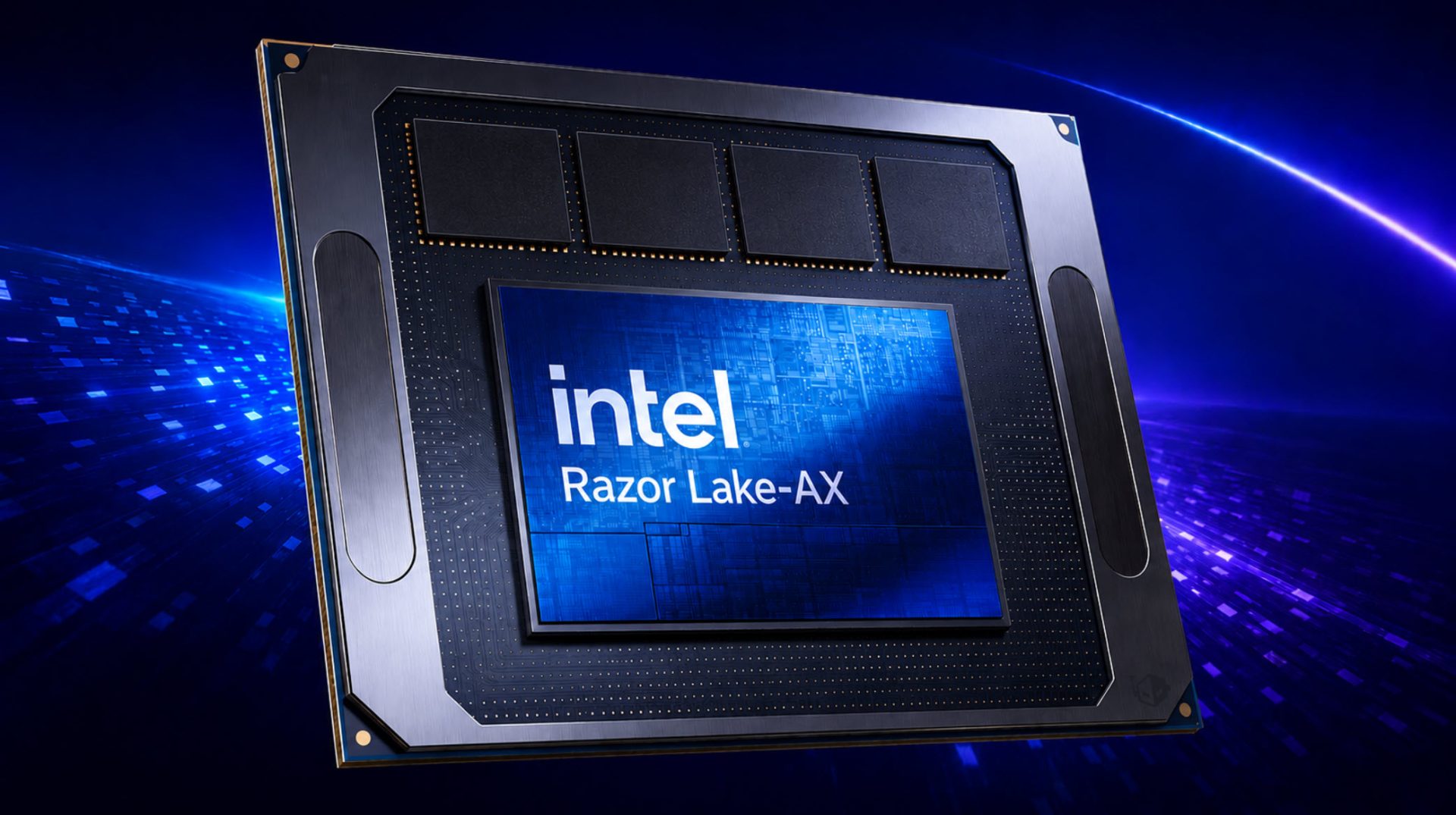
Intel’s upcoming Razor Lake AX platform has appeared in preliminary HWiNFO support, providing another sign that the company is developing a new high end SoC aimed at competing with AMD’s Halo class processors.
Razor Lake AX is expected to be a more ambitious design than the standard Razor Lake S, H and HX families. The AX variant is reportedly being developed for premium laptops and other mobile systems that need strong CPU, GPU and AI performance from a single package.
The platform is still years away. Current expectations place Razor Lake AX somewhere around 2028 to 2029, after Intel’s Nova Lake generation.
Razor Lake AX expected features
| Feature | Reported or expected detail |
|---|---|
| Product class | High end mobile SoC |
| CPU architecture | Griffin Cove P cores and Golden Eagle E cores |
| GPU architecture | Refined Xe3P Celestial or possible Xe4 Druid |
| Memory design | On package memory expected |
| Possible memory standard | LPDDR6 |
| Architecture approach | Unified memory oriented design |
| Target market | Premium laptops and AI PCs |
| Expected timing | Around 2028 to 2029 |
| Main competitor | AMD Halo class APUs |
The new HWiNFO entry is described as preliminary support, so it does not reveal full specifications. It does, however, indicate that software preparation for the platform has started.
Razor Lake AX follows the cancelled Nova Lake AX project
Intel had previously been expected to introduce a similar AX class processor under the Nova Lake family.
That product was reportedly cancelled, leaving Razor Lake AX as the next major candidate for Intel’s answer to AMD’s high performance Halo processors.
The AX branding is expected to distinguish these chips from conventional laptop and desktop products.
Rather than simply scaling up a standard mobile processor, Razor Lake AX is expected to combine a high CPU core count, a larger integrated GPU, embedded cache and additional controllers in a more complex SoC design.
That would put it closer to products designed for demanding gaming, AI and professional mobile workloads.
Intel could return to on package memory
One of the most significant reported features is the return of on package memory.
Intel previously used this approach with Lunar Lake, but later product families such as Arrow Lake and Nova Lake are not expected to follow the same design.
Razor Lake AX could bring the concept back using a newer memory standard such as LPDDR6.
On package memory can provide high bandwidth and tighter integration, which is particularly useful when the CPU, GPU and NPU all need fast access to the same memory pool.
That approach also fits the broader trend toward unified memory architectures in AI focused systems.
If Intel follows this design, Razor Lake AX could offer a large shared memory pool rather than relying only on traditional system memory configurations.
GPU architecture remains uncertain
The graphics portion of Razor Lake AX has not been confirmed.
Razor Lake itself is expected to follow Nova Lake and use newer Intel CPU architectures, while its integrated graphics could use either a refined version of Xe3P Celestial or the later Xe4 Druid architecture.
The final choice may depend on the platform’s launch timing.
Because Razor Lake AX is expected around 2028 or 2029, Intel has enough time to pair the chip with a newer graphics architecture than the one used in standard Nova Lake systems.
A larger integrated GPU would be essential if Intel wants the AX family to compete directly with AMD’s Halo products.
Standard Razor Lake and AX will likely use different platform designs
Standard Razor Lake products are expected to appear across desktop and mobile markets and maintain platform compatibility with Nova Lake in some segments.
Razor Lake AX will likely require a different design.
Its larger SoC, integrated graphics resources, cache, memory subsystem and controllers make it unsuitable for simply dropping into the same platform as conventional S, H or HX chips.
That means laptop makers would likely need dedicated motherboard and cooling designs for AX systems.
AMD remains the main target
AMD currently leads the Halo style PC SoC segment with Strix Halo, while Gorgon Halo is expected as a refresh and Medusa Halo is planned for a later generation.
Razor Lake AX appears intended to give Intel a direct response to that product category.
The timing could also place it near Intel’s reported Serpent Lake designs, which are expected to combine Intel x86 processing with NVIDIA RTX graphics technology.
For now, Razor Lake AX remains an early future product with many specifications still unconfirmed.
Its appearance in HWiNFO is nevertheless an important development because it suggests that Intel’s Halo class strategy has moved beyond early roadmap discussion and into active software preparation.



Discussion (0)
Be the first to comment.