Huawei is one of the most innovative tech companies in the world, but they're facing a political issue that seems insurmountable. They have been "Google-locked" by the USA, so they cannot use Google Mobile Services on any of their new smartphones. That's a pity, considering how great Huawei's smartphones proved to be in recent years. In this review, we're taking a look at the latest flagship Android smartphone from Huawei, namely the P40 Pro. It is one of the best and most beautiful Android smartphones we've tested, offering some of the best mobile hardware and cameras available. Do you want to know more about the Huawei P40 Pro, its strengths, and its drawbacks? If you do, read this review:
Huawei P40 Pro: Who is it good for?
The Huawei P40 Pro is a good choice for those who:
Want a beautiful premium smartphone
Desire one of the best camera smartphones
Want excellent performance, and battery life
Don't rely on using Google's services and apps
Pros and cons
We have many good things to say about the Huawei P40 Pro:
OLED display with a high resolution and fast refresh rate
Super cameras with Leica optics, 5x zoom, and excellent performance in any lighting conditions
Front camera with autofocus that shoots excellent selfies
3D face unlock also works in the dark
Support for the Wi-Fi 6 networking standard
Support for 5G mobile data connections
Fast wired data transfers through the USB 3.1 Type-C port
Wireless charging
There are also a few significant drawbacks:
The Huawei P40 Pro is Google-restricted. That means that you can't use Google's own apps (Play Store, Google Drive, Google Docs, Photos, etc.), as well as third-party apps that rely on Google Mobile Services, like Uber
It only supports NM SD cards
Its price feels too high considering that it lacks Google services
Product rating4/5
Verdict
The Huawei P40 Pro is one of the best Android smartphones that we have tested. It has a gorgeous design, powerful hardware inside, and superb cameras. It's not just a high-end device, but it is one of the best you can buy, if you're a photography enthusiast. When it comes to design, build quality, and hardware, the Huawei P40 Pro has everything we want from a premium smartphone. However, it also has one of the worst handicaps it could have: it's Google-blocked! That's a huge barrier to buying the Huawei P40 Pro for anyone who relies on Google's services and apps.
Unboxing the Huawei P40 Pro
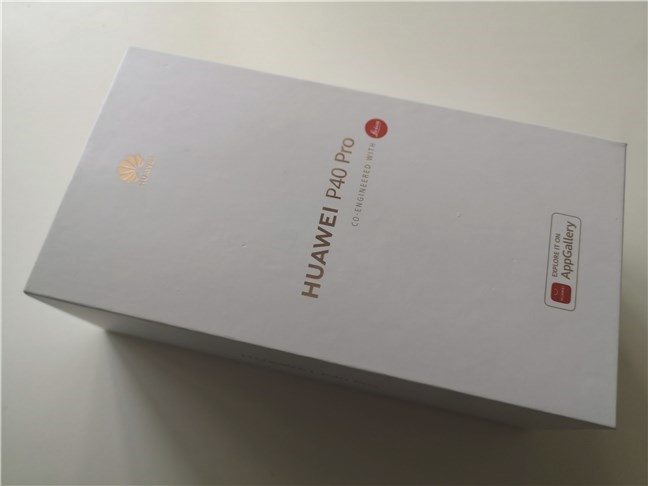
Huawei P40 Pro is a high-end smartphone, so its packaging looks like that of a premium device. However, it's also rather minimalist: a white box that features only a few details such as the name of the smartphone and the fact that it's been "co-engineered with Leica."
Huawei P40 Pro: The box
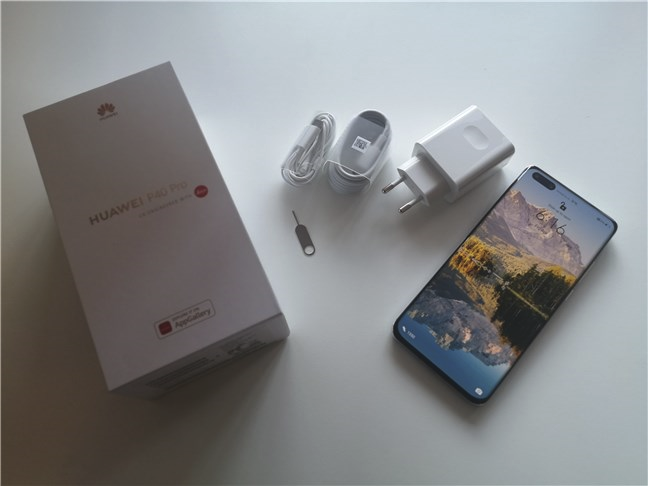
Inside the box, you find the Huawei P40 Pro smartphone, its charger, a USB Type-C cable, a pair of USB Type-C earphones, a protective transparent case (in some markets), an eject tool for the SIM tray, the quick start guide, and the warranty documents.
Unboxing the Huawei P40 Pro
We enjoyed unboxing the Huawei P40 Pro, and we like the fact that it bundles a protective case. However, if there's one thing missing from the box, that's a USB Type-C to 3.5mm audio adapter.
Design and build quality
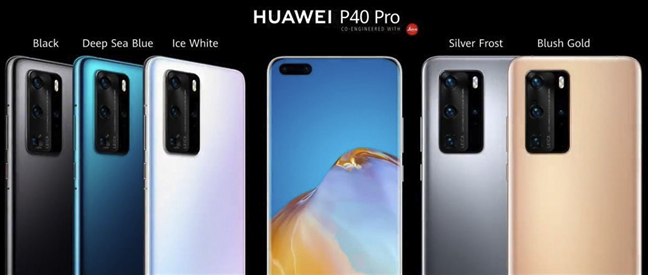
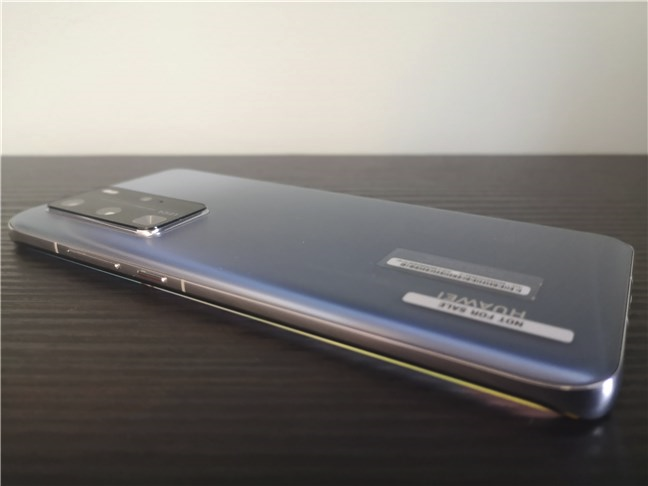
The Huawei P40 Pro is available in five different color variations: Silver Frost, Blush Gold, Deep Sea Blue, Ice White, and simple Black. All of the color editions look great in photos. The sample that we had for testing was the Silver Frost one. In non-fancy words, that's a matte gray paint job. We believe it looks great, and the matte finish also helps in hiding the inevitable fingerprints and smudges.
Color editions available for the Huawei P40 Pro
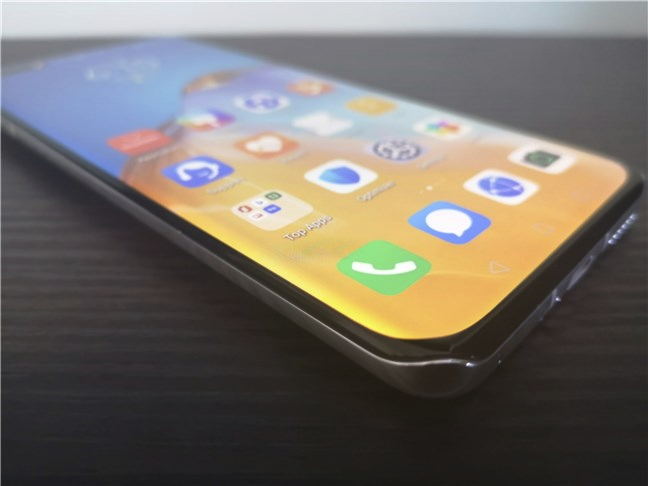
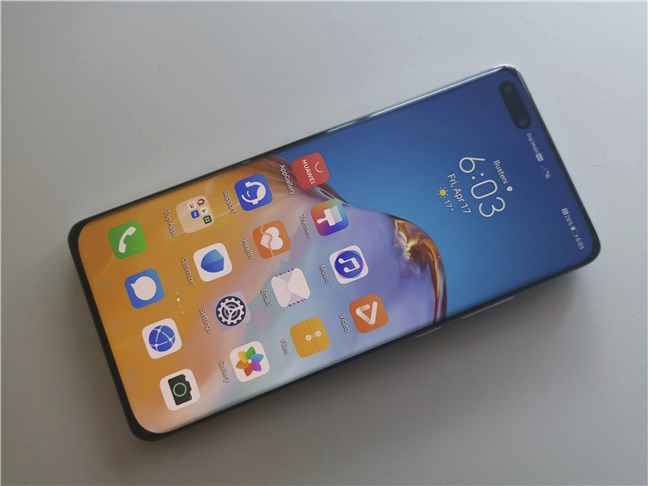
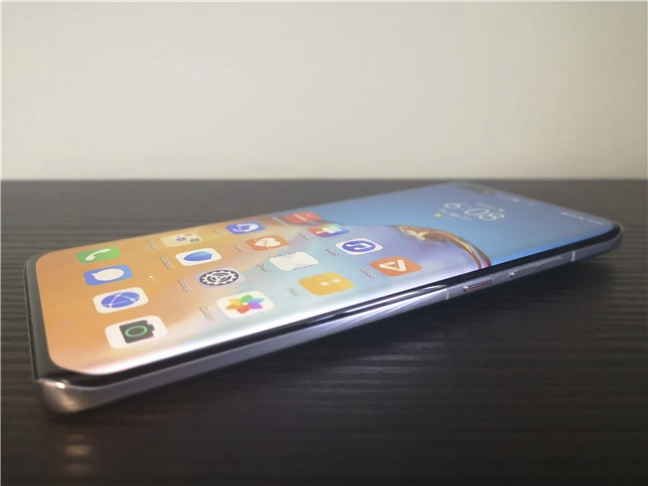
One thing that's new in terms of body design is what Huawei calls Overflow Display. The P40 Pro uses it: the screen fills the entire front of the phone and is curved on all sides, not just on the left and right. The metal frame that surrounds the screen is slightly raised on the corners, with a "wave" effect. Not only does it look great, but it might also toughen the smartphone and make it more resilient to bumps or drops on its corners.
The metal frame on the Huawei P40 Pro has a wave effect
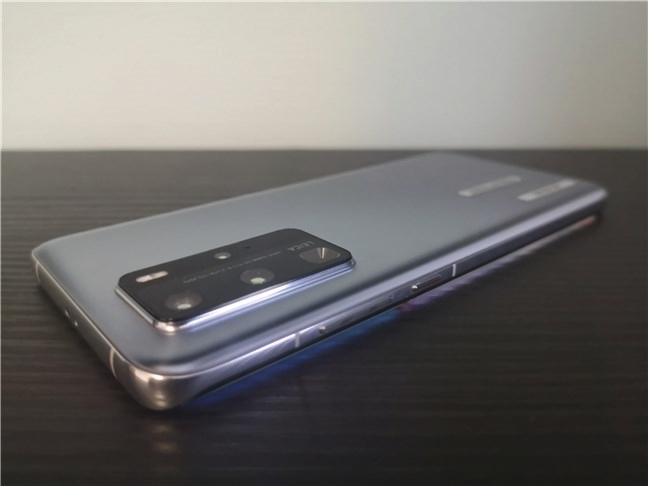
On its back, the Huawei P40 Pro is simple and rather minimalist. The only thing that drew our attention in the sea of matte gray glass was the large camera sector. Huawei chose to use a traditional design for the four cameras on the back. They are all found inside a rectangular shaped bump that, in our opinion, looks more elegant than round camera systems. Just like on any smartphone with advanced optics, the camera section on the P40 Pro is thicker than the rest of the phone's body. In other words, unless you use a protective case, the Huawei P40 Pro wobbles when you put it on a surface.
The main cameras system on the Huawei P40 Pro
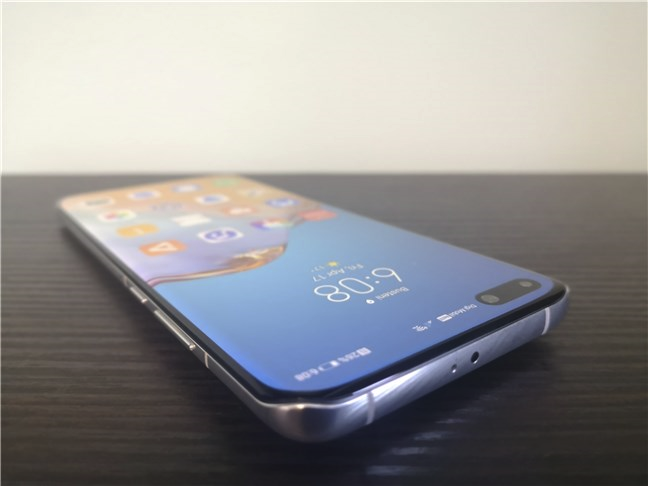
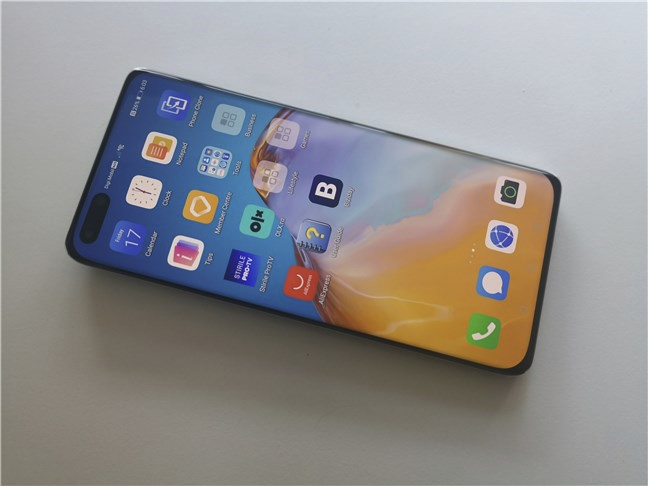
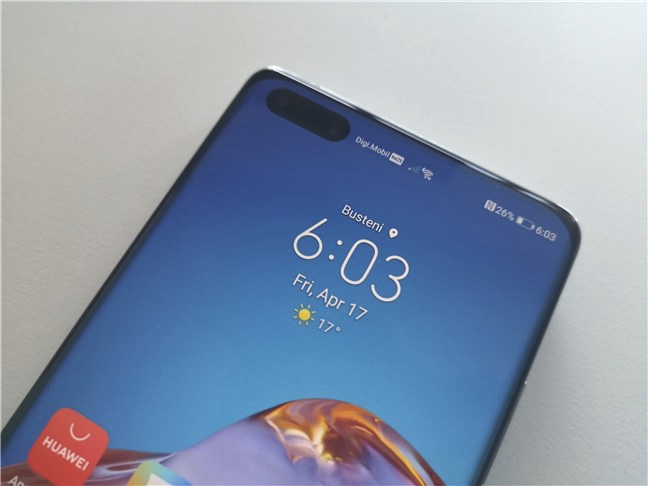
On the front, the screen has an elliptical hole at the top-left corner, where the selfie and the depth cameras are found. When we first saw that cutout, we did not like it. However, after a few days of using the phone, we got used to it and didn't bother us as much. That is probably because we found the benefits more important: the selfie camera has 32 megapixels and can autofocus, and the depth camera lets you use the face unlocking feature even in the dark.
Huawei P40 Pro has an edge-to-edge display
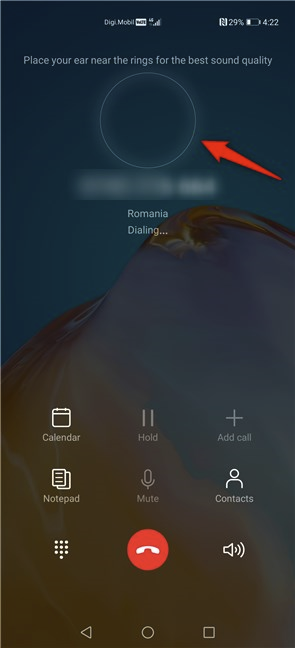
The Huawei P40 Pro has no ear speaker, as it produces sounds by vibrating its top area of the screen. That means that there is no need for an additional hole in the display's surface and also lets the screen go from edge to edge.
Huawei P40 Pro delivers in-call audio by vibrating its display
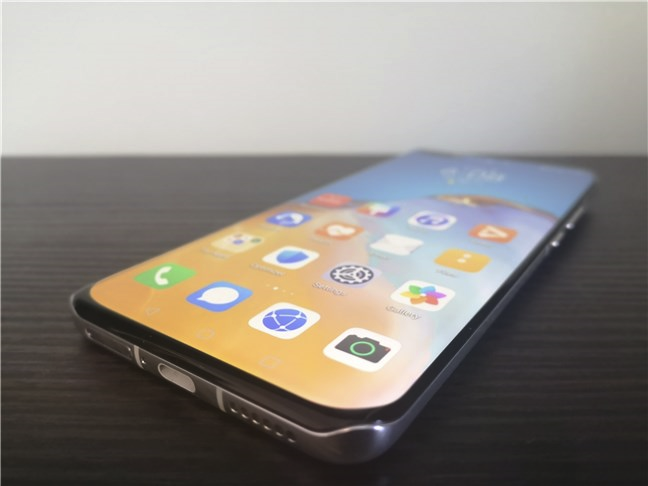
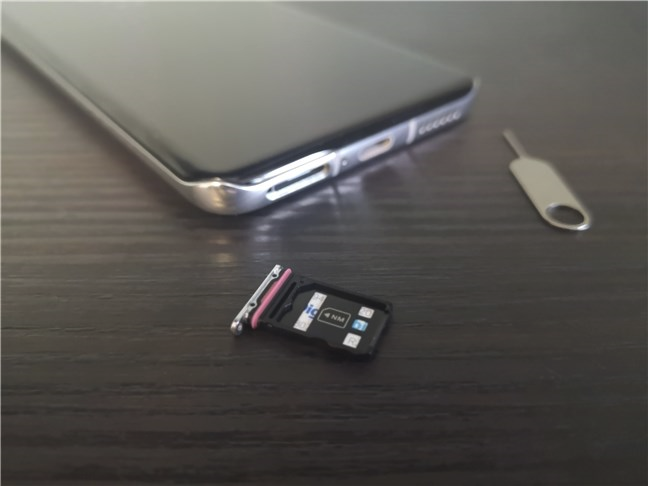
There's only one loudspeaker on the P40 Pro, so no stereo. It is found on the bottom edge of the smartphone, together with the USB 3.1 Type-C port, a microphone, and the SIM tray.
Huawei P40 Pro: SIM and NM SD cards tray, USB 3.1 Type-C port, and loudspeaker
The power button and the volume rocker are in their tried and tested position, on the upper-right edge of the smartphone. Thanks to the rather narrow screen width, the physical buttons are easy to reach and press, unless you have very short fingers.
Huawei P40 Pro: The power button and volume rocker
On the top edge of the Huawei P40 Pro, there's an infrared transmitter and another microphone, used for video recording but also for noise canceling.
Huawei P40 Pro: the IR blaster and a microphone
Huawei P40 Pro holds an IP68 certification. IP means Ingress Protection and classifies electronic devices according to how well protected they are against dust, water, and other accidents that can do damage. The digit 6 from the IP68 grade held by the P40 Pro translates into complete protection against dust, and the digit 8 means that the smartphone can survive unharmed even if it is immersed in water as deep as 1.5 meters, for up to 30 minutes.
In terms of design and beauty, the Huawei P40 Pro looks stunning. It is an outstanding piece of technology that draws anyone's attention from the first glance. The matte gray color of the sample we tested looks super, the rectangular shape of the main camera system is elegant, and the edge to edge display is splendid. There aren't many high-end smartphones to compete with the Huawei P40 Pro in terms of aesthetics, and we are sure that Venus, the goddess of beauty, would approve of this smartphone. 🙂
Hardware specifications
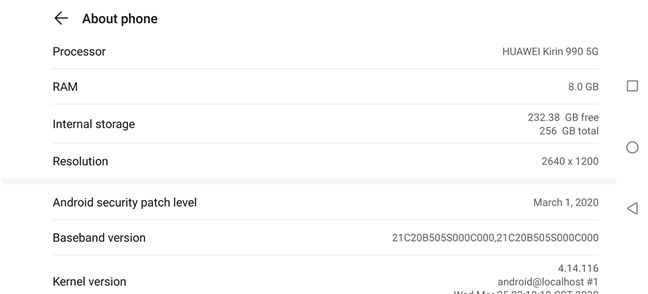
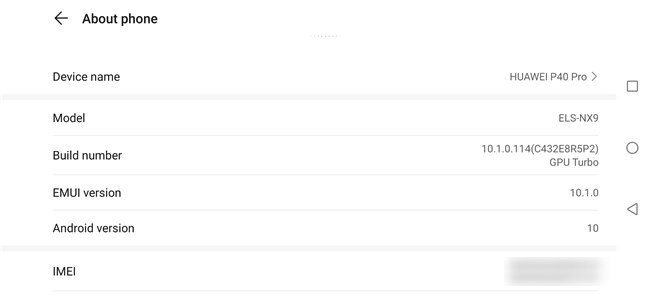
The hardware of the Huawei P40 Pro is top-notch from start to end. For starters, it features an octa-core Huawei Kirin 990 5G processor, with two Cortex-A76 cores running at 2.86 GHz, two Cortex-A76 cores running at 2.36 GHz, and four Cortex-A55 cores with a frequency of 1.95 GHz. Additionally, the graphics power is delivered by a Mali-G76 chip with no more no less than sixteen cores. To be able to deliver outstanding photography experiences, the P40 Pro also includes a dual-core NPU (Neural Processing Unit), which gives it the ability to identify the subjects and automatically adjust the settings for the cameras.
Huawei P40 Pro: About phone
Regarding memory and storage, the Huawei P40 Pro is very generous: 8 GB of RAM and 256 GB of internal flash storage space. Furthermore, if you need even more storage, the P40 Pro also lets you add an NM SD card with a top capacity of 256 GB. If you're wondering what NM means, it is an acronym for Nano Memory, a type of SD card developed by Huawei that is as small as a nano-SIM card and fits in its special place from the SIM tray, on the opposite side of the SIM card. The NM SD card is sold separately by Huawei.
Huawei P40 Pro: the SIM and NM SD card tray
The display uses an OLED panel with an impressive refresh rate in the smartphone world: 90 Hz. It has a resolution of 2640 x 1200 pixels, a diagonal length of 6.58 inches, and a pixel density of about 441 Pixels Per Inch (ppi).
Huawei P40 Pro: OLED display and 90Hz refresh rate
All in all, the most exciting things about the Huawei P40 Pro are its cameras. On the back, Huawei P40 Pro has a quad-system camera powered by Leica optics, each of the cameras coming with really impressive specs: 50 MP Ultra Vision camera (wide-angle, f/1.9 aperture, OIS), 40 MP Cine Camera (ultra-wide angle, f/1.8 aperture), 12 MP SuperSensing telephoto camera (f/3.4 aperture, OIS), and 3D depth-sensing camera. The camera system has autofocus, OIS (Optical Image Stabilization) and AIS (Artificial Intelligence Stabilization), 5x (lossless) optical zoom, LED flash, support for panorama photography, and HDR.
Huawei P40 Pro: Cameras are co-engineered with Leica
On its front, in a cutout on the screen, the P40 Pro features a dual-camera system: 32 MP selfie camera (f/2.2 aperture) and a depth camera that's also used for infrared face unlocking.
Huawei P40 Pro: the front cameras are found inside an elliptical cutout
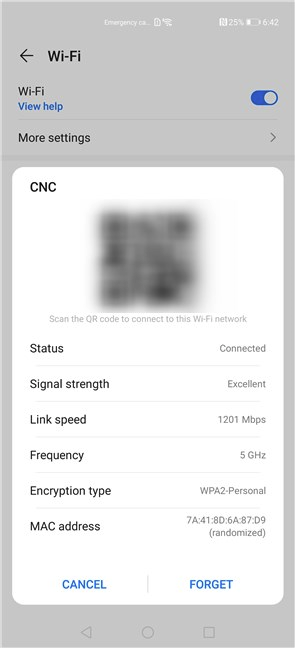
Huawei P40 Pro supports the new Wi-Fi 6 networking standard, 2 x 2 MIMO, and can theoretically reach download and upload speeds of up to 2.4 Gbps, if you are using a Wi-Fi 6 router.
Huawei P40 Pro support Wi-Fi 6, 802.11ax
As for proximity wireless connections, the P40 Pro comes with Bluetooth 5.1 and also NFC. It also has several useful sensors that support infrared face recognition, optical fingerprint, accelerometer, gyroscope, proximity, compass, and an infrared blaster. For the wired connections, the Huawei P40 Pro comes with a USB 3.1 Type-C port, but the cable included in the box is USB 2.0, so you need to buy a USB 3.1 cable separately if you want the highest data transfer speeds. Also, there is no 3.5mm audio jack on the phone, so you can only use USB Type-C headphones.
The Huawei P40 Pro uses a non-removable Li-Po 4200 mAh battery and offers wireless charging support. In terms of size and weight, the P40 Pro is large but not too heavy: 6.23 x 2.86 x 0.35 inches (158.2 x 72.6 x 9 mm), and 7.37 oz (209 grams).
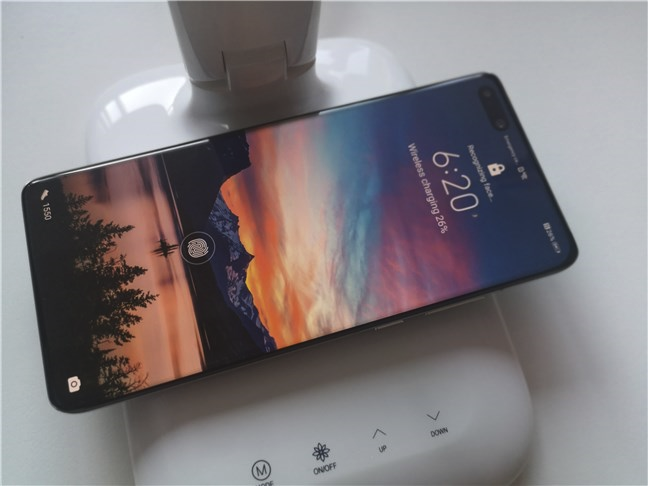
Huawei P40 Pro supports wireless charging
For all the official specifications of this smartphone, visit this webpage: Huawei P40 Pro Specifications.
If you want to know more about the experience offered by the Huawei P40 Pro, the software on it, as well as how fast it proved to be in the benchmarks we ran, read the second page of this review.
The smartphone experience on the Huawei P40 Pro
I had the Huawei P40 Pro to test for about a week, during which I used it daily as my primary phone. The user interface used by Huawei is smooth and never lags, no matter what you do. Performance is top notch, apps open almost instantly and run fluently. There is no slowness to complain about. The phone calls are also excellent, and the audio quality is worthy of a premium smartphone. I've used the Huawei P40 Pro both with 4G VoLTE and VoWiFi enabled, and did not notice any change in quality or call drops. Both I and the people to whom I've spoken enjoyed high-quality conversations and heard the other side well.
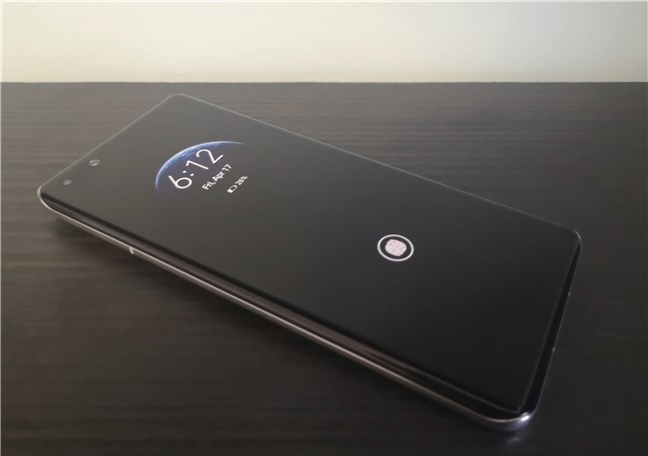
Unlocking the Huawei P40 Pro is another thing that's worth praise. The under the screen optical fingerprint reader is one of the fastest I've used, and, in 90% of the cases, it instantly identifies your fingerprint. Also, the face unlock feature is brilliant: not only that, it is fast, and it also works in the dark. And by dark, I mean complete darkness, like during the night with all the lights out. The face unlocking still works, thanks to the infrared camera found on the front of the smartphone.
Huawei P40 Pro: The fingerprint reader is under the display
Regarding the battery life, in my experience, the Huawei P40 Pro can easily last you for two days in a row in a moderate usage scenario. Still, if you're playing resource-intensive games for hours or watching movies, the battery gets drained by the end of the day.
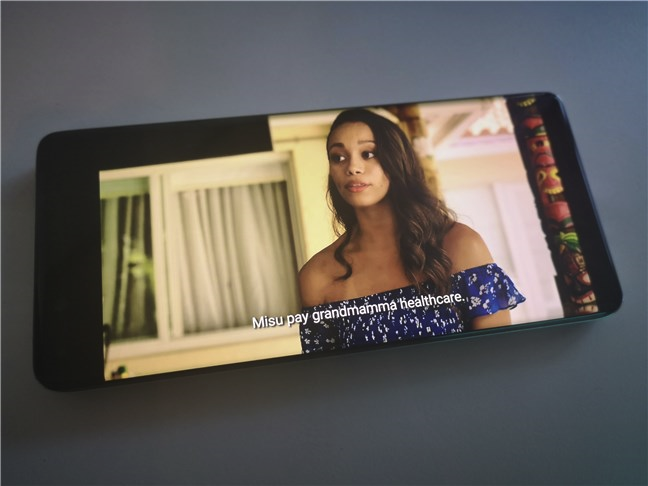
On the same subject, I also played Fortnite on the Huawei P40 Pro, and it ran very well, with no framerate drops or lags. Also, watching movies on Netflix or videos on YouTube are truly enjoyable activities on the P40 Pro. The screen looks stunning, in terms of brightness, contrast, and color reproduction. However, for the experience to be complete, I recommend a pair of headphones because the only loudspeaker found on the Huawei P40 Pro doesn't do justice to the sound effects in movies.
Watching movies on the Huawei P40 Pro
The same recommendation goes for those of you who like to listen to music on their smartphones. Spend some money on a pair of earphones with USB Type-C or connect your wireless Bluetooth headphones to the P40 Pro, and you're going to enjoy much better audio quality.
Using the Huawei P40 Pro smartphone is a delight in terms of speed, connectivity, audio, and video quality. Both the user interface and the apps run fast and fluently. The display is gorgeous, and the battery life is excellent.
The camera experience on the Huawei P40 Pro
The camera system on the Huawei P40 Pro promises to be exceptional. Is that true in real life? Does this smartphone manage to offer photography and video experiences that are so spectacular as it promises? The answer is definitely a big Yes.
The Huawei P40 Pro has four main cameras on its back and two on its display. The smartphone camera systems were co-engineered with Leica, and the result is outstanding. For starters, let's review the main cameras of the P40 Pro:
One 50 megapixels main camera called Ultra Vision Camera: 23mm wide-angle, f/1.9 aperture, OIS (Optical Image Stabilization), omnidirectional PDAF (Phase Detection Auto Focus).
A second main 12 MP camera used for telephotography. It has an f/3.4 aperture, 125 mm angle, PDAF, OIS, and can optically zoom up to 5x.
The third main camera has 40 megapixels, f/1.8 aperture, 18mm ultra-wide angle, and PDAF.
A fourth main camera that's used for depth sensing. This is called a ToF (Time of Flight) camera and measures the distance between the smartphone and the subject.
On the front side, in the elliptical cutout of the display, the Huawei P40 Pro comes with a dual-camera system:
A 32 MP selfie camera with autofocus, f/2.2 aperture, and a 26mm wide-angle.
Another depth-sensing camera (ToF) that is also used for infrared face recognition.
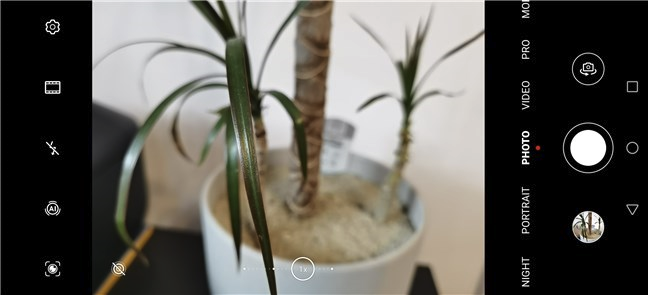
Huawei's Camera app is well designed and easy to use. All the main modes are readily available at the bottom of the screen, and reaching the mode you want is straightforward. The only thing that's not so well-thought is the zoom control bar, as it is not easy to adjust the zoom with only one hand.
The Camera app from the Huawei P40 Pro
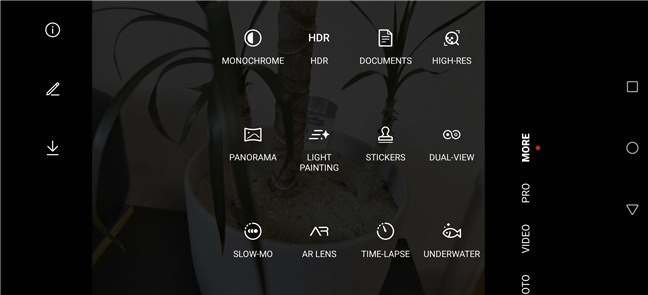
The Camera app from the Huawei P40 Pro includes the same Master AI software that we've seen on previous Huawei smartphones. It can automatically identify different photo scenes and automatically adjust the camera settings to deliver high-quality photographs. You also have access to a Pro mode that you can use if you want to manually adjust the photo settings.
Additional shooting modes available on the Huawei P40 Pro
Regarding the quality of the photos that the Huawei P40 Pro shoots, we only have good things to say. No matter the lighting conditions, the photos we took were superb. That applies to both day and night photos. The Huawei P40 Pro excels when it comes to camera prowess, and, according to DXOMark, which specializes in testing smartphone cameras, this smartphone is the best in the world. We agree, as all the photos we've shot have vivid and realistic colors, excellent contrast and dynamic range, and incredible details.
If you are curious to see the photos we have taken with the Huawei P40 Pro and check their quality on your own, feel free to browse through the gallery below. We've shot photos outdoors, in good lighting conditions, as well as inside under artificial lighting. You are also going to see a few selfie portraits, and some closeups of toys, so be gentle! 🙂
The smartphone can record videos in up to 4K resolution at 3840 x 2160 pixels, and up to 60 frames per second, both using its rear cameras and the selfie camera. Furthermore, the videos are stabilized using OIS (Optical Image Stabilization) and AIS (Artificial Intelligence Stabilization), which means that they don't shake even if your hand is not very steady. To help you get an idea of the high quality of the videos recorded in 4K by the Huawei P40 Pro, here is a sample that we filmed of a panorama:
Also, here's another sample video with more movement:
If you like slow-motion videos, you should know that the Huawei P40 Pro can film such videos too: either in 720p resolution at 7680 frames per second, or in 1080p at 960 fps.
Finally, we also have to mention a video feature that took us by surprise on the Huawei P40 Pro. It's called Dual-View, and it is a video recording mode that uses two of the rear cameras simultaneously to film videos that let you watch both the larger picture and the zoomed-in center of the view. It is an interesting mode that we'd have loved to test on a mountain trip, but couldn't do so because our country is on lockdown. However, here's a sample, so you know what to expect:
The Huawei P40 Pro has the best cameras that we've seen on a smartphone. Both the photos and the videos that you shoot with the P40 Pro are of the highest quality, exceptional regardless of the lighting conditions in which you take them.
Android 10.1, EMUI 10.1, and bundled apps, but no Google
The Huawei P40 Pro runs on the latest Android 10.1 operating system, with the company's own EMUI user interface on top. EMUI is an excellent interface that offers plenty of options and settings to customize how your smartphone works. The launcher is fast and stable and never lagged or crashed.
Huawei P40 Pro comes with Android 10.1
Unfortunately, due to the fact that Huawei is no longer permitted to use Google's apps and services, the P40 Pro suffers in terms of usability. Sure, the company offers its own AppGallery store, and you can also use third-party app stores such as APKPure to get the apps you need or want. However, that excludes any Google apps such as Gmail, Google Drive, Play Store, or Google Photos. Even if you do sideload Google Play Services or other Google apps, they just don't work. The ban is so strong that, when we tried sideloading some of the apps from Google, our Huawei P40 Pro started to misbehave occasionally, so we had to remove those apps to get it working well again.
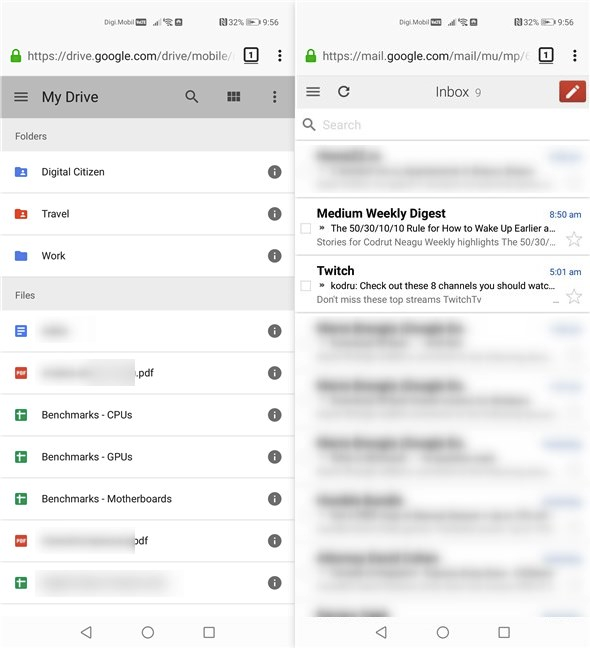
If you are using any of Google's services or apps on a daily basis, buying the Huawei P40 Pro is a no-go. The only viable alternative that we've found to keep on using Google's services was to do it from the web browser. If you're OK with that, or if you're not entrenched into Google's ecosystem, then the Huawei P40 Pro is an excellent Android device in every other aspect.
Huawei P40 Pro: Using Google Drive and Gmail in a web browser
As for the apps that are preinstalled on the Huawei P40 Pro, there are many, so you should only keep the ones you find useful. Here is the list:
AppGallery - is a reinterpretation of the Play Store on Huawei's part. You have to connect to your Huawei account (or create one first), and then you can access a curated store of apps recommended by Huawei.
AR Measure - uses the smartphone's cameras to let you measure physical objects. The app can be useful in certain situations.
Bing - an app from Microsoft that lets you run searches on the internet using Microsoft's Bing search engine.
Clock - an app that shows you the time and also gives you access to a stopwatch and a timer.
Calculator - a simple and easy to use calculator.
Calendar - lets you manage your time and schedule events.
Compass - a simple compass app that tells you the cardinal points.
eBay - the app for the popular online marketplace.
Email - an email app that lets you connect email accounts from Gmail, Hotmail, Yahoo, Exchange, or other similar services.
Facebook - the official app of the Facebook social network. If you do not want it, you can remove it.
Files - a file manager for Android that's easy to use and can come in handy.
Flashlight - the app does what its name implies, and it can be useful at times.
Gallery - useful for browsing through your photos, as well as editing them. This is Huawei's reinterpretation of the Google Photos app.
Health - provides information about health activities such as the steps you have taken or the calories you have burned.
Member Center - a Huawei app that you can use to claim rewards and offers from Huawei, as well as read the latest news from the company.
Microsoft News - a useful app for getting news from the world or from your region, if it's supported.
Mirror - while a mirror is not always at hand, your smartphone is, and you can use it to see how awesome you are.
Music - a music player that lets you enjoy your stored music, but also gives you streaming access to Huawei's music library. Unfortunately, you can't search in the streaming library, so functionality is quite limited. Also, apparently, the music available varies depending on the region of the world you're living in. Still, considering that streaming is free, it is a nice touch.
Netflix - the app of the popular movie service bearing the same name.
Notepad - a simple note-taking app.
Office - Microsoft's Office app for Android, which combines Word, Excel, and PowerPoint. It is a useful and well made app that we recommend to everyone.
Optimizer - cleans your smartphone of junk files, cache, and malware, showing details about the mobile data you used, the app permissions you gave, and so on. The antivirus is powered by Avast.
Phone Clone - lets you move data, such as contacts, call logs, messages, calendar events, Wi-Fi, multimedia files, app data, browser, and content owned by you, from an old device to your new smartphone, via Wi-Fi.
Smart Remote - this app lets you add remote controls that use the infrared port on your smartphone to control various home appliances such as your TV, air conditioner, set-top box, DVD player, projector, and so on.
Support - a support app that provides you with customer care services. You can use it to find information such as the nearest service center, read the warranty policy, check your warranty status, read the manuals, and so on.
Recorder - a basic voice recorder that can be useful when you need this type of app.
Themes - a portal for discovering and installing themes, wallpapers, and text styles. Some of them are free, some of them are paid.
Tips - shows you tips on how to get the most out of your new smartphone.
Translator - is an app developed by Microsoft that lets you translate voice and text in real-time.
Trip.com - the app of a travel service. If you are not interested in using it, you can remove it with ease
Video - a movie player and editor that lets you watch the video clips stored on your smartphone, as well as edit them using basic tools.
Wallet - with it, you can store credit or debit card details and use them to buy stuff.
Weather - gives you the weather forecast for your area or for the places you specify.
Although the Huawei P40 Pro uses the latest Android 10.1, and the EMUI user interface is good, the lack of Google's apps and services is extremely restrictive for people who rely on Google. If you are one of them, just like us, you're going to be quite disappointed by the user experience. However, this is not such a significant drawback as long as you are not using Google's services or if you're OK with relying on the web browser to access them.
Performance in benchmarks
The hardware specifications of the Huawei P40 Pro smartphone are more than impressive. How does it compare to other Android smartphones? We can find the answer using benchmarks:
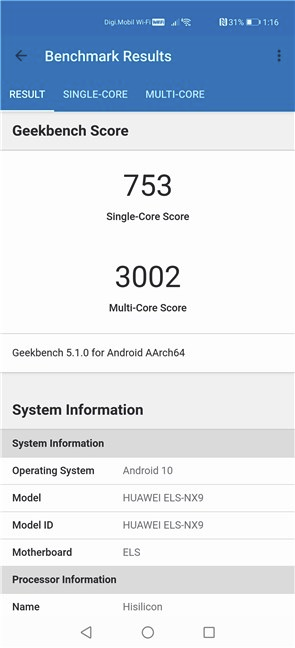
To see how powerful the processor on the Huawei P40 Pro is, we first ran Geekbench. It got a score of 753 points in the Single-Core tests and a 3002 Multi-Core Score. These are top-notch results. The Single-Core score is similar to that of the Samsung Galaxy S10 and OnePlus 7T. The Multi-Core result places the P40 Pro close behind the Samsung Galaxy S20 5G and rather far ahead of the OnePlus 7T, for instance.
Huawei P40 Pro: Benchmark results in Geekbench
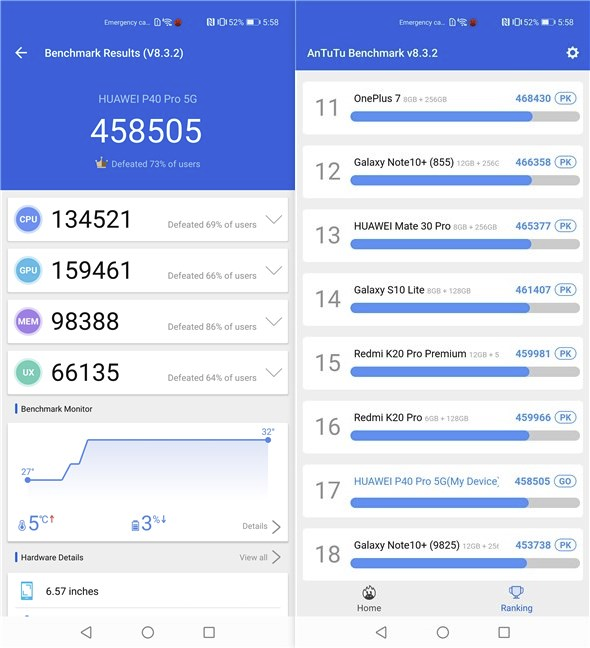
In the AnTuTu Benchmark, the Huawei P40 Pro scored 458505 points. That's better than 73% of AnTuTu's users. Although it is not in the top 10 Android smartphones, it is still a very powerful device. While that result is close to a Samsung Galaxy Note 10+, the smartphone is not as powerful as the OnePlus 7T and doesn't even come close to the Samsung Galaxy S20 Ultra 5G that tops the ranking ladder at 562262 points.
Huawei P40 Pro: Benchmark results in AnTuTu
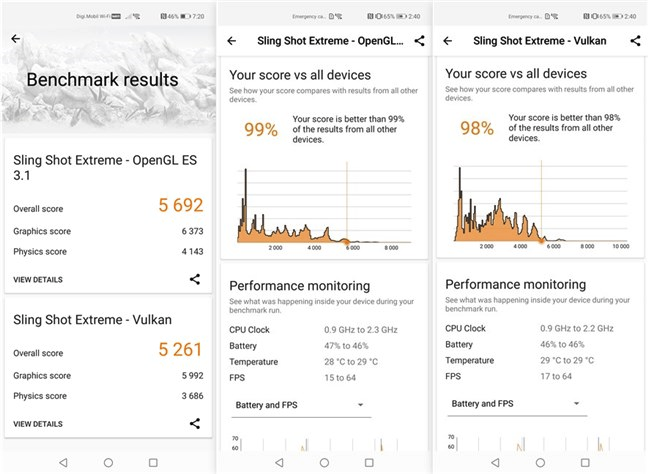
Next, we ran a few gaming benchmarks. We started with 3DMark's Sling Shot Extreme tests. The Huawei P40 Pro got 5692 points in Sling Shot Extreme - OpenGL ES 3.1 and 5261 points in Sling Shot Extreme - Vulkan. Both scores are good, close to those of the OnePlus 7 or the Samsung Galaxy Note 10. Still, they're lower than what you get from the OnePlus 7T or a Samsung Galaxy S20 smartphone.
Huawei P40 Pro: Benchmark results in 3DMark
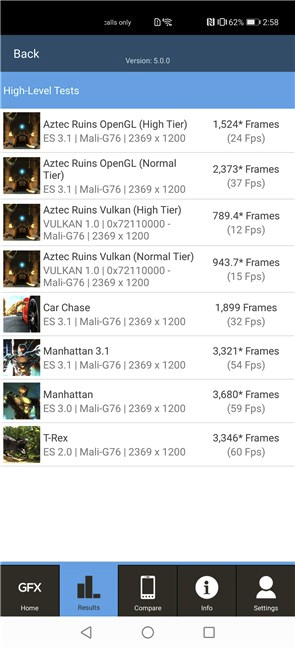
In GFXBench, we ran the on-screen tests, as they're the ones that evaluate graphics quality on the full resolution of the smartphone's screen. Huawei P40 Pro managed to get 24 fps in the Aztec Ruins OpenGL High Tier test and 37 fps in the Normal Tier. Using Vulkan, it reached 12 fps in the Aztec Ruins High Tier test and 15 fps in the Normal Tier. These results show that the GPU chip is quite powerful and that it can handle even demanding games. It also tells us that the P40 Pro is comparable with the Samsung Galaxy Note 10 (Adreno edition). In less demanding games, the P40 Pro should do very well: in our benchmarks, it managed to render 32 fps in the Car Chase test, 54 fps in Manhattan 3.1, and 60 frames per second in the T-Rex test (for older games).
Huawei P40 Pro: Benchmark results in GFXBench
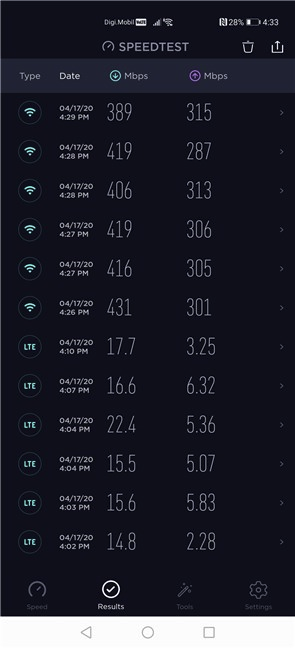
I also wanted to see how fast the Huawei P40 Pro is on the internet. For that, I used SpeedTest to measure the download and upload speed both when using my mobile data subscription and using a Wi-Fi connection. In the screenshot below, you can see the measured speeds both on 4G LTE and Wi-Fi. The 4G LTE speeds were very poor not because of the smartphone, but because my mobile phone operator has a poor infrastructure in the area where I tested the Huawei P40 Pro.
Huawei P40 Pro: Benchmark results in Speedtest over Wi-Fi 6 and 4G LTE
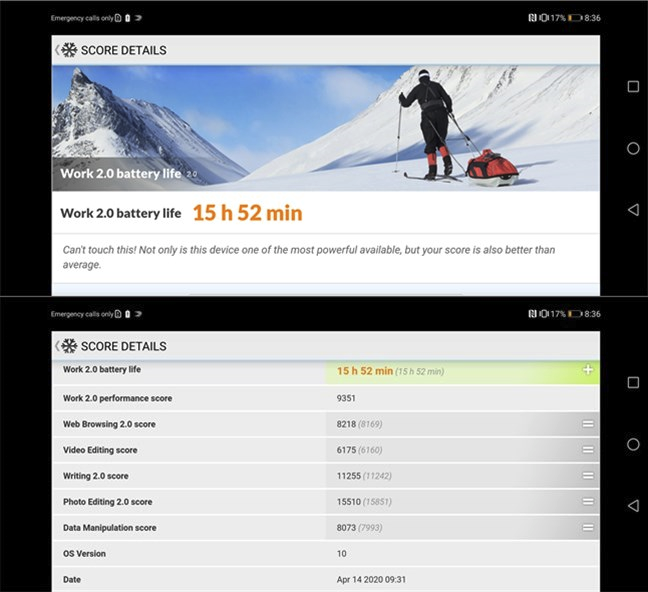
You're probably also interested in the battery life. That's why we ran PCMark's Work 2.0 battery life test. The Huawei P40 Pro managed to run for almost 16 hours, which is an extraordinary result.
Huawei P40 Pro: Battery benchmark results in PCMark
After running all the benchmarks, we have come to the conclusion that the Huawei P40 Pro is quite an impressive Android smartphone. It is very powerful, although not in the top 10, and manages to deliver excellent performance and also long battery life.
Do you like the Huawei P40 Pro?
Now you know what the Huawei P40 Pro has to offer and the inconveniences that come with it. Are you ready to leave Google for the best smartphone cameras in the world? Would you pay the premium price that Huawei asks for this beautiful and powerful Android smartphone? Or are you so entrenched into Google's services that you can't imagine using a smartphone without them? Use the comments below to share your opinion.














Discussion (0)
Comments are closed.