Do you want to lose weight? Want to learn more about your body? Do you have to count your carbs because you are managing a chronic disease like diabetes? Want to make sure you are eating macronutrients in the correct ratios? Food logging solves all these and even more. I know this because I have been doing food logging for almost a year. In this article, I am going to share how anyone can log their food using a popular, free, mobile application named MyFitnessPal, which works on all major mobile platforms: Android, iOS and Windows Phone.
Why Choose MyFitnessPal & Not Another App?
I chose MyFitnessPal mainly due to its large user base. I knew the database of foods that is created by both their staff and their user base would be its main value. Especially in today's world, where many of the foods we eat or the ingredients we buy are packaged.
To be honest, I did not do a thorough comparison among multiple applications when I started using it. Just like I did not start with food logging, but with calorie counting. My main drive to keep using it was that while my needs evolved, it was able to support them.
One of the biggest advantages that I see in using this particular app is its huge database of UPC barcodes and associated foods. Even in Romania, most of the supermarket-available ingredients or foods can be found in its database, which is amazing!
The application is available for all the major mobile operating systems: iOS, Android, Windows Phone and Blackberry. That is, in addition to the web interface that lets you access it from any browser. In terms of design it's not the most user friendly application ever made but it does its job well.
What Can You Do With The App?
What can you do with MyFitnessPal? You can do several things:
Count calories or any type of macronutrient, for that matter.
Plan meals and enter them before eating in order to see what their footprint on your daily targets would be. You can use this to modify your meal choices if they don't help you enough to achieve your goals.
Print your food log to show it to your doctor. One of my friends' wife is pregnant and currently doing that in order to make sure that she is eating optimally, in order to maximize her chances of having a happy, healthy baby.
Track your drinking habits (both water and alcohol); For example, some people are drinking too little water, while others are drinking too much (alcohol, sodas, or even diet sodas which tend to contain non-trivial amounts of sodium)
Personally, I have used it to lose weight and optimize my eating habits, both in terms of the number of meals and of the breakdown of my calorie consumption: less sugar, fat and sodium, more protein and fiber.
Entering Your First Item In MyFitnessPal
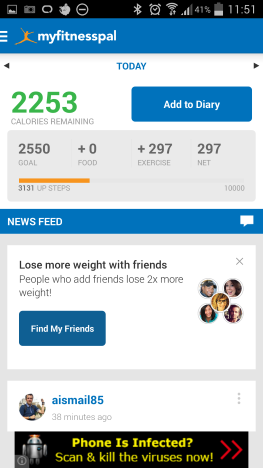
My advice is start simple, with adding a packaged food that you have handy. After you've installed the app and logged in, you will be greeted by the Home screen. It contains an overview of your current day, such as the number of calories burned so far, and the number of calories eaten, plus a newsfeed of all your friends' activity.
MyFitnessPal, log food, calories, how to
They say that people who have a support system (have added friends on this platform) lose weight 2 times more than others. Of course, weight loss is not the only purpose of people who start using it, but it is one of the more important ones.
Tapping "Add to Diary" will take you to a screen where you can choose your meal. There will be 4 predefined meals by default (Breakfast, Lunch, Dinner and Snacks), which tend to be sufficient for 90% of the people. However, I have seen interesting variations such as "Breakfast No. 2", or "Lunch Left-Overs" user-defined meals. The only limitation is that you can only have a total of 6 meals maximum.
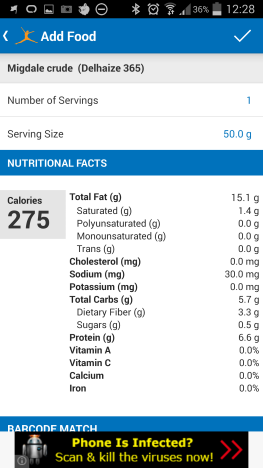
By using the "Add By Barcode" option, after scanning the item you choose, you are presented with a screen where you can alter the quantity of the food, while being shown nutritional information such as the number of calories or the fat content.
MyFitnessPal, log food, calories, how to
Once you figure out how much you ate or you are going to eat (how to do that is a complicated discussion in itself), you will be able to choose the meal where to log this food.
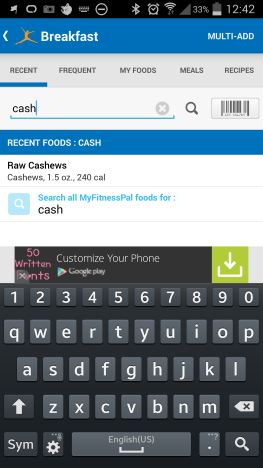
It's quite convenient, as you carry your smartphone with you everywhere anyway. For foods that don't have a barcode on them, there is a comprehensive database to be searched (over 4 million items) using a keyword.
MyFitnessPal, log food, calories, how to
After having introduced your first food entry, you can start building your food log for the whole day, item by item.
How Can You Save Time?
When I tell people about what I'm doing, most of the time the first remark that I hear is "Doesn't it take a lot of time/energy?". To be quite honest, compared to the benefit, no. But there are some quick tips that will speed up your food logging.
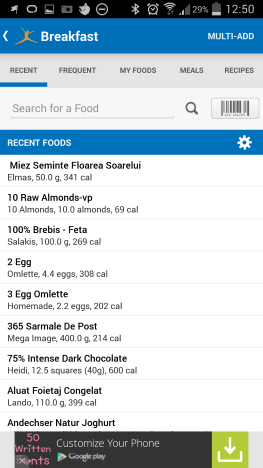
First off, MyFitnessPal will show you by default a list of the most recently used items.
MyFitnessPal, log food, calories, how to
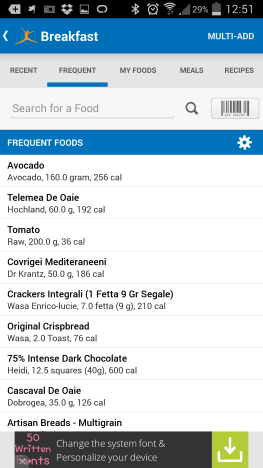
Also, once you start logging your food, you'll notice that you tend to eat the same things frequently. The "Frequent foods" screen is very useful then.
MyFitnessPal, log food, calories, how to
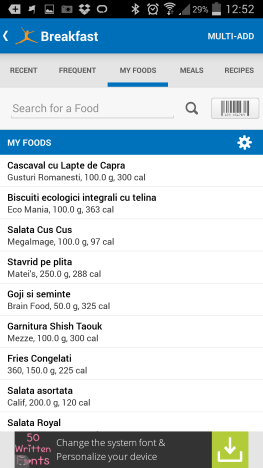
Some of the times you won't find the food you are looking for in the database. So you need to create your own food, by specifying information such as the name, serving size, or the number of calories. You will be able to see these foods in a dedicated list in the "My Foods" section.
MyFitnessPal, log food, calories, how to
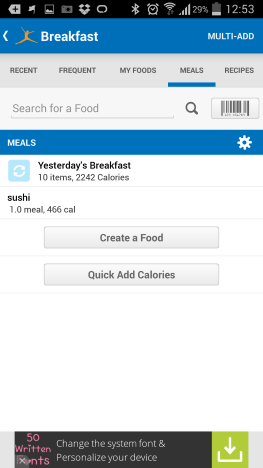
If you have a favourite meal (let's say, sushi), and you eat the same set of multiple foods over and over again, you can save an existing meal and add it later by using the "Saved Meals" section.
MyFitnessPal, log food, calories, how to
Last but not least, people who cook at home are able to create a custom food based on their own recipe. It provides you with a way to specify the individual ingredients, as well as the serving size.
If you always break down complex foods into their basic ingredients, you will actually work with a very small set of entries to put in your food log, and the recent foods tab will be even more helpful.
All of these tips allow me to do most of my food logging in under 5 minutes per day, while deriving terrific benefit from it.
How Often Do You Need To Log Your Food?
Ideally, you need to log after every meal. Yes, you heard me! Some people even log it beforehand to plan their meals.
Having gaps in the data makes it much less valuable. I noticed this while working with my clients from ProgrammerFitness.com, in order to help them tweak their lifestyle. Days with gaps of data usually cover periods of the year when you do not want to log because it's too much, or you are too busy. Because the human body always has a delayed reaction (but you don't know by how much), the gaps in the food log will have an effect later on, but you will not be able to trace it back to the missing food data.
I have met people with a very good memory and disciplined eating habits who can log them only once a day. The truth is, however, it's quite difficult to do it accurately. If you make a 10% mistake each day because of forgetting to log everything that you've eaten, that mistake can lead to much more on the longer term. For example, in the months when I was losing weight, 10% could have easily been the difference between staying at the same weight or progressing.
I now have more than 7 months of continuous data, and I can say that it's very helpful to not have gaps in your food log.
How Do You Check How Your Day Has Been?
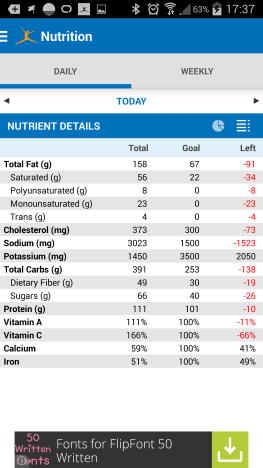
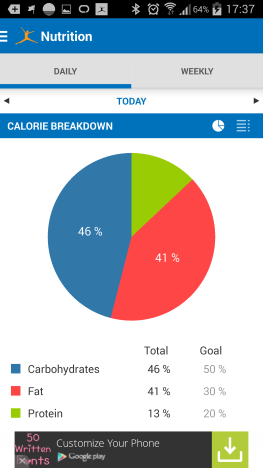
It depends on the purpose for which you are using MyFitnessPal. But all major metrics can be checked in the "Nutrition Tab".
MyFitnessPal, log food, calories, how to
Examples of questions that can be answered from the nutrition tab:
Are my macro ratios correct? The USDA recommends that people eat 20-35% of calories from fat, 45-65% from carbs and 10-35% from protein.
Am I eating enough fiber?
Am I eating too much sodium?
Am I eating too many sugars?
Am I eating too much cholesterol?
MyFitnessPal, log food, calories, how to
Frequently Asked Questions
Let's discuss some questions that I was frequently asked by others when showing them how to use MyFitnessPal:
Does MyFitnessPal work offline?
Partially, yes. You can add foods that are in the frequent items/recent foods and other similar lists: your foods, saved meals and your recipes. In order to perform a search, either by using the UPC barcode, or a keyword, you need to be online.
What happens if I don't know how to log a dish?
Some good practices are to search for similar foods, or even to break the dish down into ingredients. It's a tough to solve this problem though.
Is all the information in MyFitnessPal correct? It seems to me like this hamburger has too little or too many calories.
No, of course not. Not all the information in their database is correct. This is the cost of having more user-generated content rather than a restricted set of entries controlled only by the company making the app. They have a thumbs up mechanism in the web interface for you to say that an item is correct and you can also create a duplicated item with correct information assigned to it.
Where does the number of calories left come from? How is it computed?
When you sign up for MyFitnessPal, you specify a target weight goal. Based on a mathematical model that's taking into account how much less you need to eat, how big you are right now and your activity levels, it will compute a daily allowance. You can also set individual goals for macronutrients ratios (e.g. how much of your protein to eat from fats), but those are for more advanced users.
What else can you log with MyFitnessPal in addition to food?
You can also log the water intake and your physical exercise, by searching it in their database and equating it to a number of burned calories.
Conclusion
MyFitnessPal is a free, easy-to-use mobile app that allows you to keep a log of your daily food intake. It is useful in a wide variety of situations, such as losing weight or improving your diet.
It has a large database that makes it easy to find any type of food, especially when you use the barcode scanner feature. I have used it successfully for the past year, and managed to lose 50 pounds with its help and with a wearable device named BodyMedia Link.
Andrei Ismail is an experienced software engineer with startup experience under his belt and a PhD in Artificial Intelligence. He has lost 50 pounds in 6 months and is currently working on a fitness coaching program for geeks, available at WEIGHT LOSS FOR ENGINEERS.
I waded through all kinds of information though probably accurate, interesting, explanatory it did not, that I found at least, answer the simple question “how do I add a food item to a meal?”, with a simple answer. How to do this is so very clear on my laptop and so very unclear in my mobil app.
Jolley ·
This is my first one look one your blog and it is really helpful one read for me.
Ciprian Adrian Rusen ·
Happy to hear that. Thanks! I hope that you will visit us again. 😀





Discussion (3)
I waded through all kinds of information though probably accurate, interesting, explanatory it did not, that I found at least, answer the simple question “how do I add a food item to a meal?”, with a simple answer. How to do this is so very clear on my laptop and so very unclear in my mobil app.
This is my first one look one your blog and it is really helpful one read for me.
Happy to hear that. Thanks! I hope that you will visit us again. 😀