



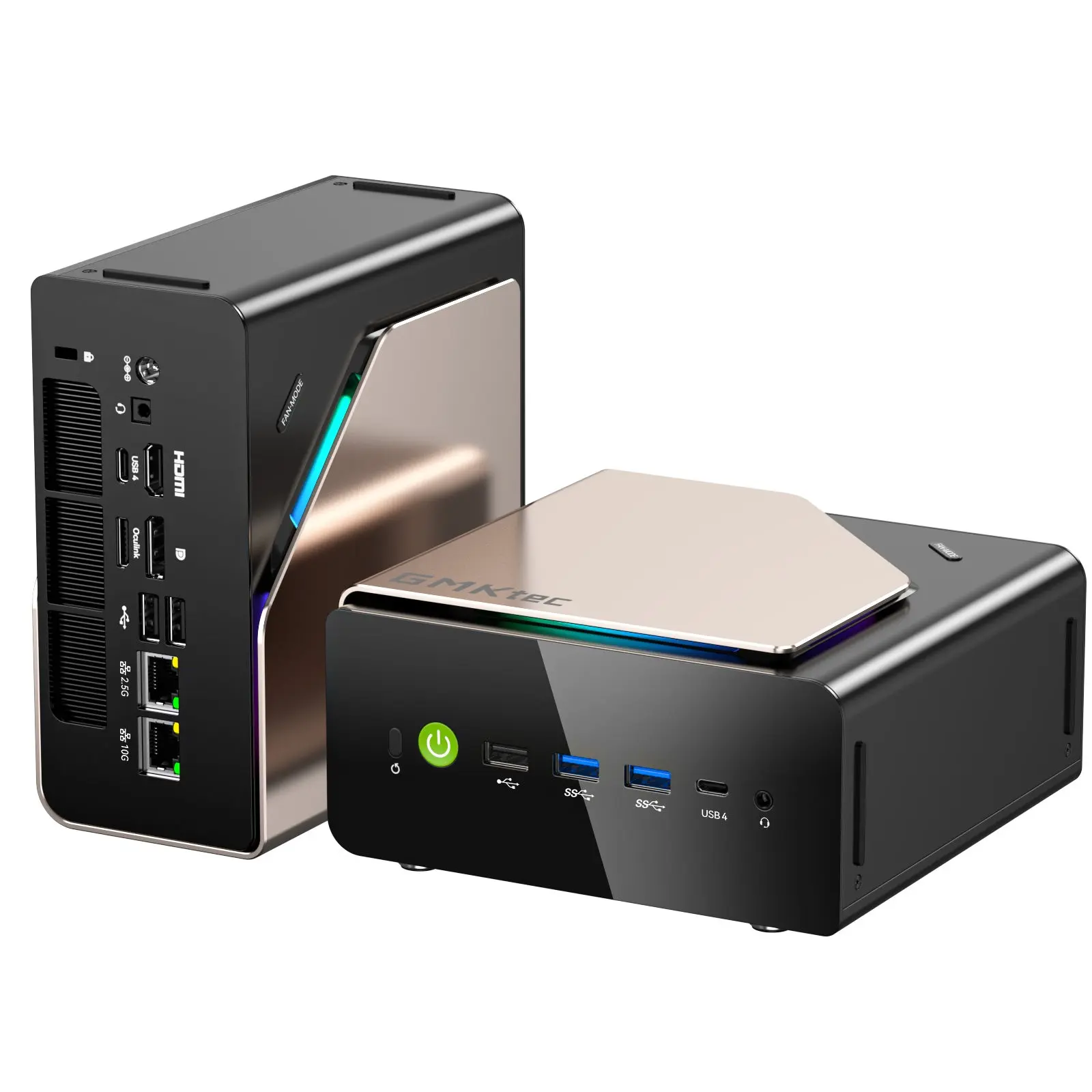
The GMKtec EVO T2S is a premium mini PC built around Intel’s Core Ultra X7 358H processor, 64GB of LPDDR5X memory, and the Arc B390 integrated GPU. It targets demanding productivity, local AI, gaming, content creation, and multitasking workloads in a compact chassis.
The reviewed configuration includes a 1TB PCIe 4.0 SSD and costs $2,099. That price places it in the same range as some Ryzen AI Max systems, including GMKtec’s own EVO X2, so the EVO T2S needs more than a small size to justify its position.
Its strongest points are broad connectivity, low noise, strong CPU performance, efficient integrated graphics, and useful local AI capability. The main limitations are soldered memory and a price that is difficult to ignore.
GMKtec EVO T2S specifications
The Core Ultra X7 358H is part of Intel’s Panther Lake family. It uses 16 cores and 16 threads, combining four Cougar Cove performance cores, eight Darkmont efficiency cores, and four low power cores.
The performance cores boost up to 4.8GHz, while the chip carries a base power rating of 25W and a maximum turbo power of 80W. GMKtec limits the tested system to 60W during operation.
| Component | GMKtec EVO T2S |
|---|---|
| Processor | Intel Core Ultra X7 358H |
| CPU layout | 4 P cores, 8 E cores, 4 low power cores |
| Maximum CPU clock | 4.8GHz |
| Graphics | Intel Arc B390 |
| GPU cores | 12 Xe cores |
| GPU clock | Up to 2.50GHz |
| NPU | Intel NPU5 |
| NPU performance | Up to 50 TOPS |
| Combined AI performance | Around 180 TOPS |
| Memory | 64GB LPDDR5X 8533MT/s |
| Storage | 1TB PCIe 4.0 SSD |
| Expansion | Two M.2 slots, up to 8TB each |
| Price | $2,099 |
The Arc B390 integrated GPU is based on Intel’s Xe3 architecture and supports modern APIs, updated ray tracing hardware, and XeSS Multi Frame Generation.
Memory is soldered, so the 64GB configuration cannot be upgraded. Storage remains flexible, with two M.2 slots supporting drives up to 8TB each.
GMKtec also plans an 853GB AI-focused storage option using a Phison aiDAPTIV+ SSD intended for local language model workloads.
Connectivity is one of its best features
The EVO T2S offers a stronger port selection than many compact PCs.
The front includes USB Type A, USB4, audio, power, and reset controls. The rear adds a second USB4 port, HDMI, DisplayPort, OCuLink, dual Ethernet, and additional USB connections.
| Connection | Availability |
|---|---|
| USB4 | Two 40Gbps ports |
| Ethernet | 2.5GbE and 10GbE |
| Display outputs | HDMI and DisplayPort |
| External GPU support | OCuLink |
| Audio | Front and rear 3.5mm ports |
| Storage expansion | Two M.2 slots |
| Security | Kensington lock slot |
The inclusion of OCuLink makes the system more flexible for gaming or professional graphics work. You can connect an external GPU with less overhead than many USB based solutions.
Dual Ethernet is also valuable for network storage, local servers, content workflows, and high speed file transfers.
Design and internal cooling
The chassis uses a dual tone design with a metallic champagne coloured top and a combination of plastic and aluminium elsewhere.
Three exhaust areas help move heat out of the compact frame. Rubber feet also allow the system to stand vertically.
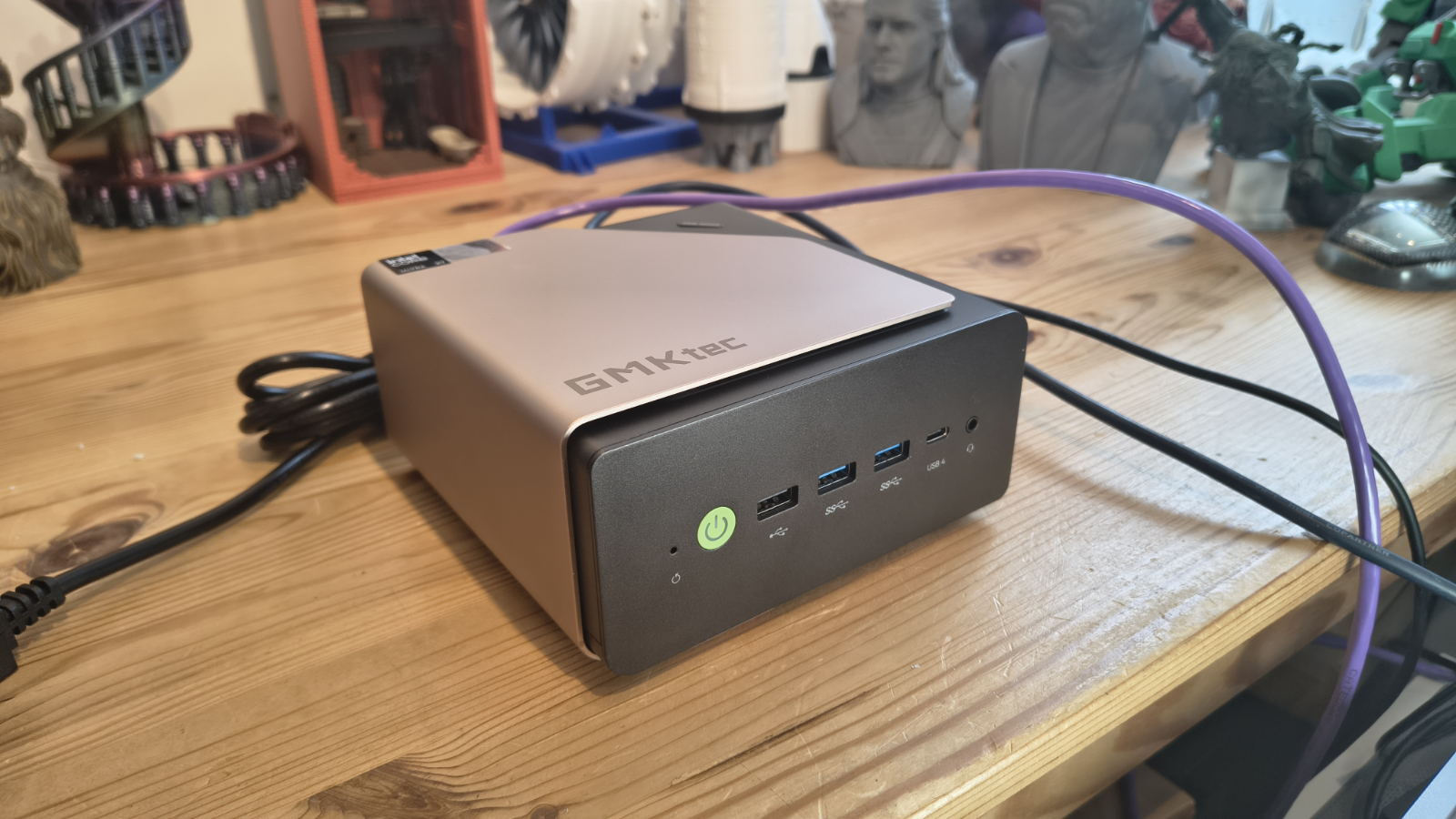
Inside, the EVO T2S uses two fans. A 92mm fan cools the storage and rear side of the motherboard, while a blower style cooler handles the processor.
The only user upgradeable hardware is storage. Access requires removing four screws from the bottom panel.
GMKtec includes a 148.2W power adapter, an HDMI cable, and basic documentation.
BIOS includes several power modes
The BIOS provides more tuning controls than earlier GMKtec models.
Three preset modes are available:
| Power mode | Target power |
|---|---|
| Quiet | 35W |
| Balanced | 45W |
| High Performance | 54W |
Although the BIOS allows higher values to be entered, settings above 60W return to 60W after restart.
The BIOS also includes controls for processor power management, turbo behaviour, memory information, wake on LAN, USB boot, and other advanced options.
CPU performance competes with larger systems
The Core Ultra X7 358H performs surprisingly close to the older Core Ultra 9 285H despite using fewer performance cores and lower clock speeds.
In 3DMark CPU Profile, the EVO T2S scored 9,819 in the maximum thread test, compared with 10,207 for the EVO T1 using the Core Ultra 9 285H.
Its Blender results were also competitive. The EVO T2S scored 118 samples per minute in the Monster scene, compared with 120 for the older Core Ultra 9 system.
| Benchmark | EVO T2S result |
|---|---|
| CPU-Z single core | 759.8 |
| CPU-Z multi core | 8,927.3 |
| Cinebench 2024 single core | 123 |
| Cinebench 2024 multi core | 1,096 |
| Cinebench 2026 single core | 501 |
| Cinebench 2026 multi core | 4,429 |
| Geekbench 6 single core | 2,945 |
| Geekbench 6 multi core | 16,655 |
Geekbench 6 was a particularly strong result, where the EVO T2S slightly exceeded the Core Ultra 9 285H in both single and multi core performance.
Office performance was also excellent. The system led the comparison in Word and performed strongly in Excel and PowerPoint.
AI workloads are a major strength
The EVO T2S combines its CPU, Arc B390 GPU, and NPU5 to deliver around 180 TOPS of total AI compute.
In UL Procyon AI Text Generation, it achieved a score of 1,701, with an average time to first token of 0.36 seconds and output speed of 41.04 tokens per second.
| AI workload | EVO T2S result |
|---|---|
| Geekbench AI CPU single precision | 3,931 |
| Geekbench AI CPU half precision | 1,732 |
| Geekbench AI CPU quantised | 7,678 |
| Geekbench AI GPU single precision | 19,189 |
| Geekbench AI GPU half precision | 47,821 |
| Geekbench AI GPU quantised | 60,112 |
| Procyon text generation | 1,701 |
| Stable Diffusion 1.5 | 9.645 seconds per image |
The system can also run local language models through LM Studio and GMKtec’s preloaded software.
Smaller models performed well, with Llama 3.2 1B reaching 67.63 tokens per second. GPT OSS 20B reached 33.36 tokens per second, while several 4B to 8B models remained above 20 tokens per second.
Larger models between 30B and 45B were usable, although moving toward 60B and 70B models becomes more difficult.
GMKtec includes its own AI PC software, Claw agent tools, and access to models such as Qwen, DeepSeek, and Llama. These applications may be useful for some buyers, although others may prefer a cleaner Windows installation.
Arc B390 delivers a major graphics upgrade
The Arc B390 is the most important hardware improvement over the previous EVO T1.
In 3DMark Speed Way, the EVO T2S scored 956, nearly double the 489 result of the Arc 140T system. Steel Nomad showed an even larger improvement, with the B390 reaching 1,627 compared with 835 for the previous generation.
| 3DMark benchmark | Arc B390 score |
|---|---|
| Speed Way | 956 |
| Steel Nomad | 1,627 |
| Port Royal | 4,121 |
| Time Spy | 7,550 |
| Fire Strike | 14,445 |
| Night Raid | 47,726 |
The Radeon 8060S remained faster overall, particularly in heavy graphics workloads, but the Arc B390 used less power during gaming.
Its average GPU power draw was close to 20W, compared with roughly 35W to 40W for the Radeon 8060S in the same comparison.
1080p gaming performance is strong
The EVO T2S handled modern games well at 1080p with medium or high settings and upscaling.
Cyberpunk 2077 reached 87.88 FPS using the Medium preset and Balanced upscaling. With frame generation, performance increased to 172.42 FPS.
| Game | Settings | Average performance |
|---|---|---|
| Cyberpunk 2077 | 1080p Medium, Balanced upscaling | 87.88 FPS |
| Cyberpunk 2077 | With frame generation | 172.42 FPS |
| Forza Horizon 5 | 1080p Medium, Quality upscaling | 116 FPS |
| F1 24 | 1080p High, Balanced upscaling | 115 FPS |
| F1 24 | With frame generation | 180 FPS |
| Horizon Zero Dawn | 1080p Favor Quality | 71 FPS |
| Metro Exodus | 1080p High, RT Normal | 52.57 FPS |
| The Callisto Protocol | 1080p Medium | 78.7 FPS |
| Borderlands 4 | 1080p High | 48.12 FPS |
| Borderlands 4 | With frame generation | 77.35 FPS |
The largest improvement appeared in Borderlands 4, where older integrated GPUs struggled to reach 30 FPS even with frame generation. The Arc B390 reached more than 48 FPS before frame generation.
1440p gaming is possible with XeSS
The system also produced playable 1440p results when paired with upscaling and frame generation.
Cyberpunk 2077 reached 87.51 FPS using ray tracing at High with XeSS Quality and frame generation. Doom: The Dark Ages reached 66 FPS, while Death Stranding 2 reached 77 FPS.
| Game | 1440p settings | Average FPS |
|---|---|---|
| Cyberpunk 2077 | RT High, XeSS Quality and frame generation | 87.51 |
| Doom: The Dark Ages | High, XeSS Balanced | 66 |
| Death Stranding 2 | High, XeSS Quality and frame generation | 77 |
| F1 24 | Ultra High, XeSS Quality | 73 |
| Forza Horizon 6 | Ultra, XeSS Balanced | 48 |
| Forza Horizon 5 | Ultra, XeSS Quality | 61 |
| Horizon Zero Dawn | Ultimate Quality | 59 |
| Resident Evil Requiem | High, XeSS Quality | 56 |
| The Callisto Protocol | Maximum, FSR Quality | 61.99 |
The integrated GPU consumed around 20W to 22W during these 1440p tests.
That efficiency is one of the system’s clearest advantages, although frame generation results should not be treated as equal to native rendering because visual quality and input latency can differ.
Emulation performance is capable
The EVO T2S was also tested with the RPCS3 PlayStation 3 emulator.
Demon’s Souls and God of War III ran at 1440p with unlocked frame rates near 60 FPS. GPU power remained around 10W to 15W, while total package power stayed below 40W.
This makes the system useful for emulation, especially when combined with its strong CPU and modern graphics drivers.
Power, temperature, and noise
Idle package power measured around 6W. The system reached 54W under its sustained power target and 60W at peak PL2.
| Measurement | EVO T2S |
|---|---|
| Idle package power | 6W |
| Peak PL1 | 54W |
| Peak PL2 | 60W |
| Peak PL4 | 125W |
| Idle temperature | 46°C |
| Gaming temperature | 64°C |
| Peak temperature | 87°C |
The 87°C peak is high but remained below the 97°C result recorded by the previous EVO T1.
Gaming temperature was more comfortable at 64°C, and noise output remained low during testing.
Price is the main problem
The reviewed EVO T2S costs $2,099 with 64GB of LPDDR5X memory and a 1TB SSD.
That places it close to Ryzen AI Max systems with stronger graphics and larger local AI potential. GMKtec’s EVO X2 with a Ryzen AI Max+ 395 and 64GB of memory costs around $2,000.
The EVO T2S makes a stronger case for buyers who value Intel’s software ecosystem, XeSS, ray tracing support, low graphics power use, dual USB4, dual Ethernet, and OCuLink.
| Strengths | Limitations |
|---|---|
| Strong CPU performance | Very high price |
| Capable Arc B390 graphics | Memory cannot be upgraded |
| Useful local AI performance | Ryzen AI Max alternatives cost similar amounts |
| Low gaming power use | Preloaded AI apps may be unnecessary |
| Dual USB4 and dual Ethernet | Only storage is upgradeable |
| OCuLink support | 1TB storage feels limited at this price |
| Quiet operation | Higher speed LPDDR5X option is unavailable |
The EVO T2S is a powerful and balanced mini PC. It handles office work, local AI, content creation, emulation, and modern gaming better than many earlier compact systems.
Its biggest achievement is the Arc B390, which delivers a large performance increase while remaining efficient. The Core Ultra X7 358H also performs well enough to compete with higher positioned processors in several workloads.
The difficult part is value. At $2,099, buyers must decide whether the small chassis, Intel software support, extensive connectivity, and low power graphics are more important than the stronger GPU and AI capabilities available from similarly priced Ryzen AI Max systems.



Discussion (0)
Be the first to comment.