



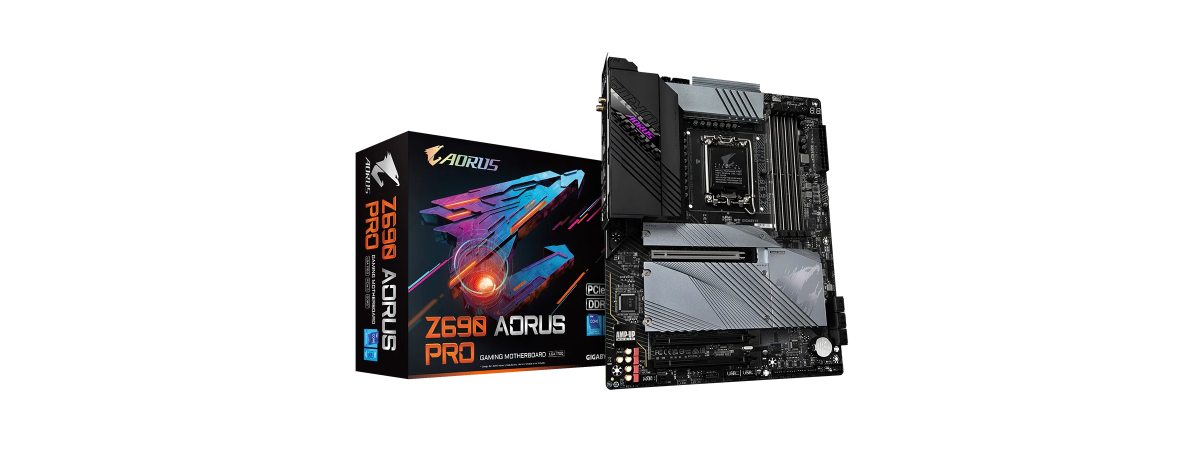
One of the first manufacturers that released Z690 motherboards to accompany Intel’s Alder Lake processors is Gigabyte. And one of the most interesting models they have in stores right now is the Gigabyte Z690 AORUS Pro, a mid-range option with a lot of features and excellent technical specifications. We’ve tested it for a couple of days, and, in this review, we’re going to tell you everything we found about it so that you can make an informed decision on whether you should buy it. Without further ado, let’s begin:
![Verdict]()

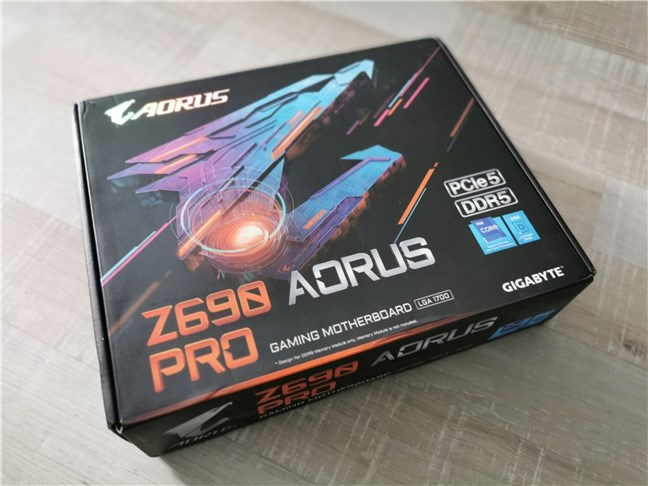
 The box of the Gigabyte Z690 AORUS Pro
Opening the box reveals the motherboard and its bundled accessories. Unfortunately, we received a testing sample, so it’s likely that not everything was in the box. However, we did find the user manual, some screws, SATA cables, as well as some RGB and ARGB cables and connectors. Theoretically, you should also get a Wi-Fi antenna, as the motherboard includes wireless connectivity.
The box of the Gigabyte Z690 AORUS Pro
Opening the box reveals the motherboard and its bundled accessories. Unfortunately, we received a testing sample, so it’s likely that not everything was in the box. However, we did find the user manual, some screws, SATA cables, as well as some RGB and ARGB cables and connectors. Theoretically, you should also get a Wi-Fi antenna, as the motherboard includes wireless connectivity.
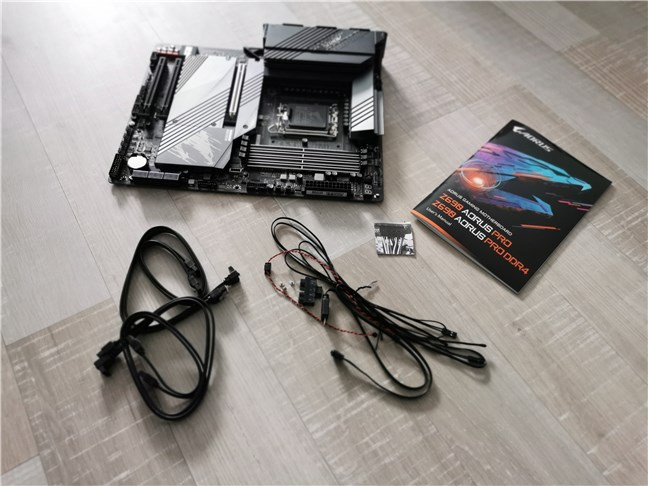 Gigabyte Z690 AORUS Pro: What’s inside the box
When we unboxed the Gigabyte Z690 AORUS Pro, the first thing we noticed was that this is a good-looking motherboard overall.
Gigabyte Z690 AORUS Pro: What’s inside the box
When we unboxed the Gigabyte Z690 AORUS Pro, the first thing we noticed was that this is a good-looking motherboard overall.
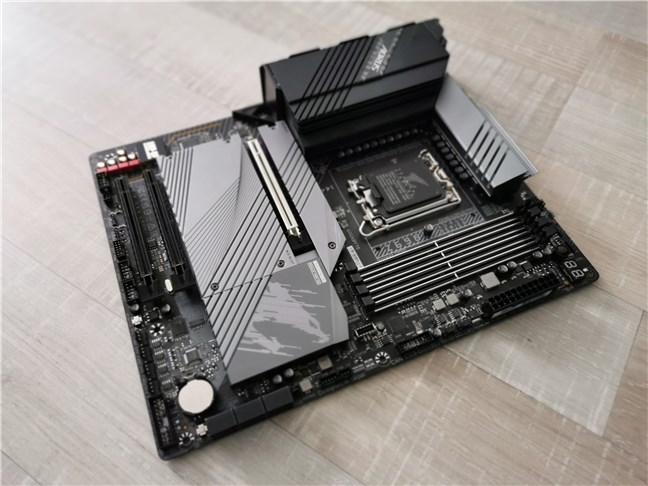 A view of the Gigabyte Z690 AORUS Pro
On the hardware side, one of the things that draw attention is the passively cooled, high-quality VRM (Voltage Regulator Module). It’s able to deliver up to 90A, which means that you can overclock your processor without fear. 🙂
The processor takes its power from the motherboard via a standard 24-pin ATX main power connector found on the top-right side and also from two additional (one 8-pin and one 4-pin) connectors located in the top-left corner of the mainboard.
A view of the Gigabyte Z690 AORUS Pro
On the hardware side, one of the things that draw attention is the passively cooled, high-quality VRM (Voltage Regulator Module). It’s able to deliver up to 90A, which means that you can overclock your processor without fear. 🙂
The processor takes its power from the motherboard via a standard 24-pin ATX main power connector found on the top-right side and also from two additional (one 8-pin and one 4-pin) connectors located in the top-left corner of the mainboard.
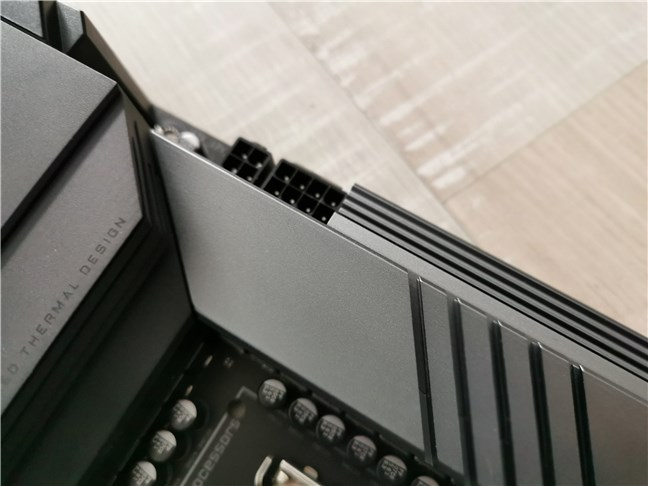 VRM and CPU power connectors
Because it’s designed for Intel Alder Lake processors, or 12th generation Core CPUs if you prefer, the motherboard uses the new LGA1700 socket. Which means that, when publishing this review, the options you have are Intel Core i9-12900K and KF, Intel Core i7-12700K and KF, or Intel Core i5-12600K and KF. However, coming spring of 2022, Intel should launch other processor models.
VRM and CPU power connectors
Because it’s designed for Intel Alder Lake processors, or 12th generation Core CPUs if you prefer, the motherboard uses the new LGA1700 socket. Which means that, when publishing this review, the options you have are Intel Core i9-12900K and KF, Intel Core i7-12700K and KF, or Intel Core i5-12600K and KF. However, coming spring of 2022, Intel should launch other processor models.
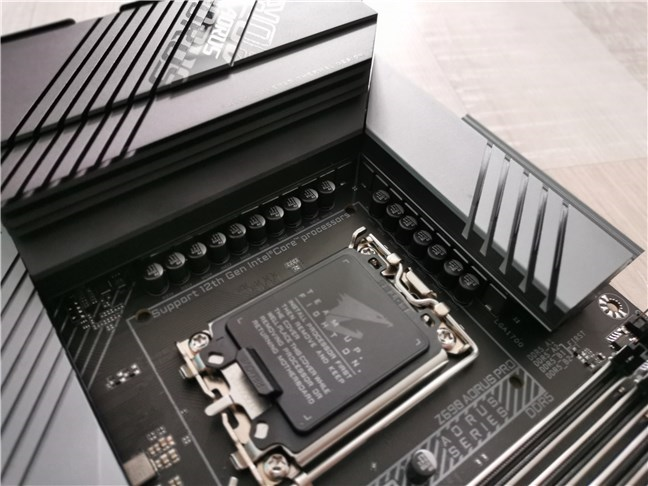 The processor slot on the Gigabyte Z690 AORUS Pro
One of the best things about Intel’s new CPU lineup is that, besides DDR4, they also support DDR5 RAM. The Gigabyte Z690 AORUS Pro motherboard works with the faster DDR5. There are four DDR5 DIMM slots on it, able to fit up to a maximum capacity of 128GB. The mainboard supports XMP 3.0 which, depending on the RAM modules you use, lets you easily set their speed at up to 6200MHz. And you can take that even further by overclocking your RAM if you want.
The processor slot on the Gigabyte Z690 AORUS Pro
One of the best things about Intel’s new CPU lineup is that, besides DDR4, they also support DDR5 RAM. The Gigabyte Z690 AORUS Pro motherboard works with the faster DDR5. There are four DDR5 DIMM slots on it, able to fit up to a maximum capacity of 128GB. The mainboard supports XMP 3.0 which, depending on the RAM modules you use, lets you easily set their speed at up to 6200MHz. And you can take that even further by overclocking your RAM if you want.
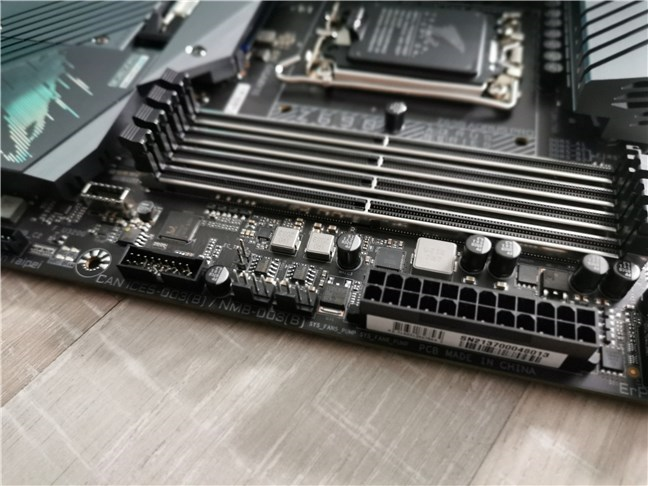 Headers and ATX power connector
Being based on the Z690 chipset, the motherboard also supports PCIe 5.0, though only for the graphics card slot (x16). However, there are also two PCIe 3.0 slots at the bottom of the mainboard, beneath the gray plate that covers some of the M.2 slots. Speaking of which, all the M.2 drives you connect can work in PCIe 4.0 x4 mode.
Headers and ATX power connector
Being based on the Z690 chipset, the motherboard also supports PCIe 5.0, though only for the graphics card slot (x16). However, there are also two PCIe 3.0 slots at the bottom of the mainboard, beneath the gray plate that covers some of the M.2 slots. Speaking of which, all the M.2 drives you connect can work in PCIe 4.0 x4 mode.
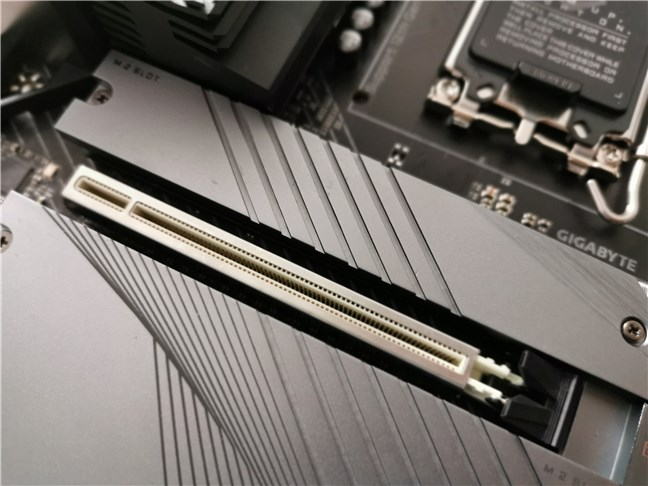 PCI Express 5.0 x16 slot for the graphics card
The network connectivity options on the Gigabyte Z690 AORUS Pro are excellent. For wired connections, we get an Intel I225-V chip supporting speeds of up to 2.5Gbps, and for wireless, we get up to 2.4Gbps connections via an Intel Wi-Fi 6 AX200 chip!
The Gigabyte Z690 AORUS Pro also delivers high-quality audio. It’s equipped with a Realtek ALC4080 CODEC that has an excellent 120 dB SNR (Signal-To-Noise ratio) for playback and 110 dB SNR for recording. Strangely though, Gigabyte opted to mount only two jacks on the motherboard: one stereo output and one microphone input. However, the SPDIF OUT port supports audio rendering in 7.1 surround mode if you want it.
PCI Express 5.0 x16 slot for the graphics card
The network connectivity options on the Gigabyte Z690 AORUS Pro are excellent. For wired connections, we get an Intel I225-V chip supporting speeds of up to 2.5Gbps, and for wireless, we get up to 2.4Gbps connections via an Intel Wi-Fi 6 AX200 chip!
The Gigabyte Z690 AORUS Pro also delivers high-quality audio. It’s equipped with a Realtek ALC4080 CODEC that has an excellent 120 dB SNR (Signal-To-Noise ratio) for playback and 110 dB SNR for recording. Strangely though, Gigabyte opted to mount only two jacks on the motherboard: one stereo output and one microphone input. However, the SPDIF OUT port supports audio rendering in 7.1 surround mode if you want it.
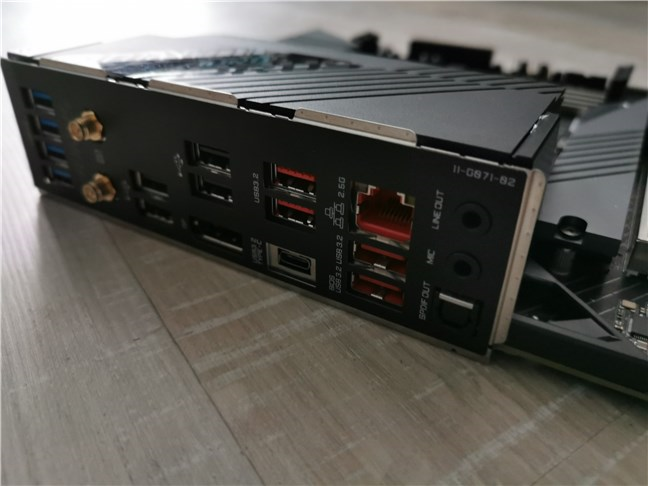 The input/output panel on the Gigabyte Z690 AORUS Pro
To continue with connectivity options, on the I/O panel, you also get plenty of USB and other types of ports: one USB Type-C port with USB 3.2 Gen 2x2 support, four USB 3.2 Gen 2 Type-A ports (the red ones), four USB 3.2 Gen 1 ports, four USB 2.0 ports, two SMA antenna connectors (2T2R), and one DisplayPort.
Then, there are all the internal input/output connectors and headers found on the motherboard. The list is long, but you might want to know what’s on the menu, so here it is: one CPU fan header, one water cooling CPU fan header, four system fan headers, two system fan/water cooling pump headers, two addressable LED strip headers, two RGB LED strip headers, one front panel header, one front panel audio header, one USB Type-C header with USB 3.2 Gen 2x2 support, one USB 3.2 Gen 1 header, two USB 2.0/1.1 headers, one noise detection header, two Thunderbolt add-in card connectors, one Trusted Platform Module header, and two temperature sensor headers. Additionally, the motherboard also has a few built-in buttons and jumpers, as follows: a power button, a reset button, a Q-Flash Plus button, a reset jumper, and a Clear CMOS jumper.
The input/output panel on the Gigabyte Z690 AORUS Pro
To continue with connectivity options, on the I/O panel, you also get plenty of USB and other types of ports: one USB Type-C port with USB 3.2 Gen 2x2 support, four USB 3.2 Gen 2 Type-A ports (the red ones), four USB 3.2 Gen 1 ports, four USB 2.0 ports, two SMA antenna connectors (2T2R), and one DisplayPort.
Then, there are all the internal input/output connectors and headers found on the motherboard. The list is long, but you might want to know what’s on the menu, so here it is: one CPU fan header, one water cooling CPU fan header, four system fan headers, two system fan/water cooling pump headers, two addressable LED strip headers, two RGB LED strip headers, one front panel header, one front panel audio header, one USB Type-C header with USB 3.2 Gen 2x2 support, one USB 3.2 Gen 1 header, two USB 2.0/1.1 headers, one noise detection header, two Thunderbolt add-in card connectors, one Trusted Platform Module header, and two temperature sensor headers. Additionally, the motherboard also has a few built-in buttons and jumpers, as follows: a power button, a reset button, a Q-Flash Plus button, a reset jumper, and a Clear CMOS jumper.
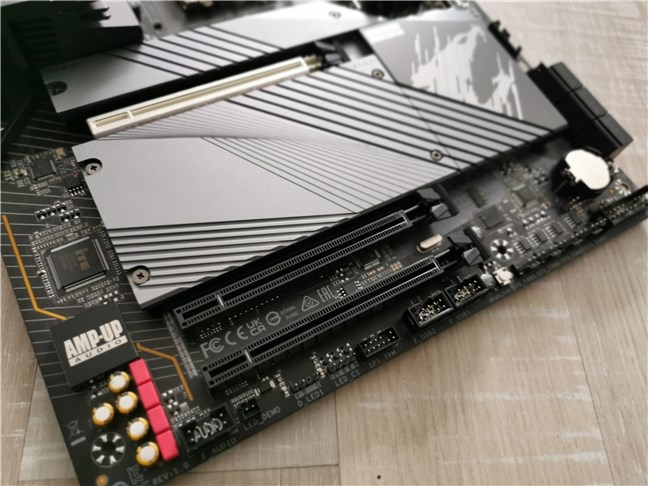 M.2 slots under a heat plate and additional PCIe slots
If you want more details about the features and technical specs of this motherboard, check its official webpage, here: Gigabyte Z690 AORUS Pro Specification.
The Gigabyte Z690 AORUS Pro is a full-featured motherboard that offers almost everything you need in terms of hardware and options if you want to build a powerful PC using an Alder Lake processor, DDR5, and fast SSDs. Overall, we appreciate the build quality a lot. But regarding the way it looks, we would have preferred a completely black paint on it, including the heat spreaders. In our opinion, that would’ve been better, allowing for a full-black build, considering that there are practically no built-in RGB lights on it.
Read the next page of this review to see how the Gigabyte Z690 AORUS Pro motherboard performed in benchmarks with an Intel Core i7-12700K processor and how it compares to the premium ASUS ROG Maximus Z690 Extreme motherboard.
M.2 slots under a heat plate and additional PCIe slots
If you want more details about the features and technical specs of this motherboard, check its official webpage, here: Gigabyte Z690 AORUS Pro Specification.
The Gigabyte Z690 AORUS Pro is a full-featured motherboard that offers almost everything you need in terms of hardware and options if you want to build a powerful PC using an Alder Lake processor, DDR5, and fast SSDs. Overall, we appreciate the build quality a lot. But regarding the way it looks, we would have preferred a completely black paint on it, including the heat spreaders. In our opinion, that would’ve been better, allowing for a full-black build, considering that there are practically no built-in RGB lights on it.
Read the next page of this review to see how the Gigabyte Z690 AORUS Pro motherboard performed in benchmarks with an Intel Core i7-12700K processor and how it compares to the premium ASUS ROG Maximus Z690 Extreme motherboard.
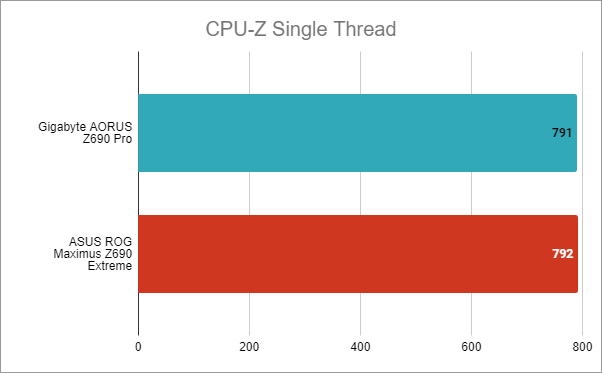
 Gigabyte Z690 AORUS Pro: Benchmark results in CPU-Z Single Thread
In the Multi-Thread test from CPU-Z, which aims to evaluate the multi-core performance, we got 9300 points with the Gigabyte Z690 AORUS Pro and 9299 points on the Gigabyte Z690 AORUS Pro. Again, these are practically identical results.
Gigabyte Z690 AORUS Pro: Benchmark results in CPU-Z Single Thread
In the Multi-Thread test from CPU-Z, which aims to evaluate the multi-core performance, we got 9300 points with the Gigabyte Z690 AORUS Pro and 9299 points on the Gigabyte Z690 AORUS Pro. Again, these are practically identical results.
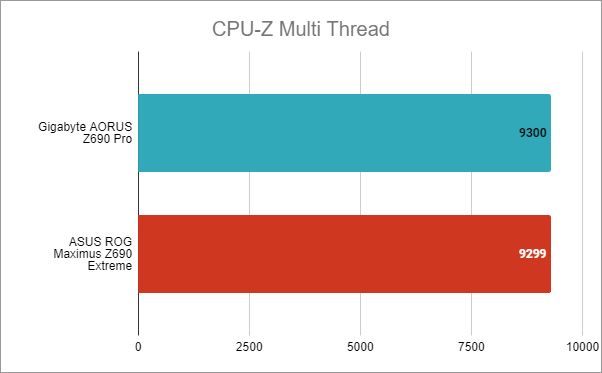 Gigabyte Z690 AORUS Pro: Benchmark results in CPU-Z Multi Thread
In Cinebench R23, which is an excellent benchmark if you want to know how fast your computer is at rendering jobs, we got a score of 22032 points with Gigabyte Z690 AORUS Pro, which is only slightly less than with the ASUS ROG Maximus Z690 Extreme, with which we got 22128 points.
Gigabyte Z690 AORUS Pro: Benchmark results in CPU-Z Multi Thread
In Cinebench R23, which is an excellent benchmark if you want to know how fast your computer is at rendering jobs, we got a score of 22032 points with Gigabyte Z690 AORUS Pro, which is only slightly less than with the ASUS ROG Maximus Z690 Extreme, with which we got 22128 points.
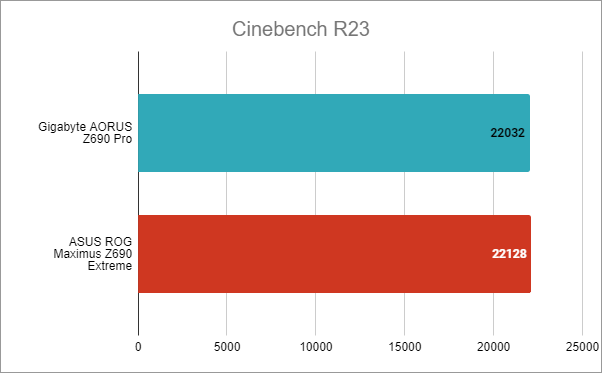 Gigabyte Z690 AORUS Pro: Benchmark results in Cinebench R23
In Blender, another rendering benchmark, we chose to use two scenes: bmw27 and classroom. Here, the shorter the time needed to render, the faster the computer. With the Gigabyte Z690 AORUS Pro the jobs were done in 6.8 minutes, and with the ASUS ROG Maximus Z690 Extreme, in 6.9 minutes. As it appears, Gigabyte’s motherboard is a bit faster, but still, we would say they’re identical, as the results are inside the margin of error for this type of benchmark.
Gigabyte Z690 AORUS Pro: Benchmark results in Cinebench R23
In Blender, another rendering benchmark, we chose to use two scenes: bmw27 and classroom. Here, the shorter the time needed to render, the faster the computer. With the Gigabyte Z690 AORUS Pro the jobs were done in 6.8 minutes, and with the ASUS ROG Maximus Z690 Extreme, in 6.9 minutes. As it appears, Gigabyte’s motherboard is a bit faster, but still, we would say they’re identical, as the results are inside the margin of error for this type of benchmark.
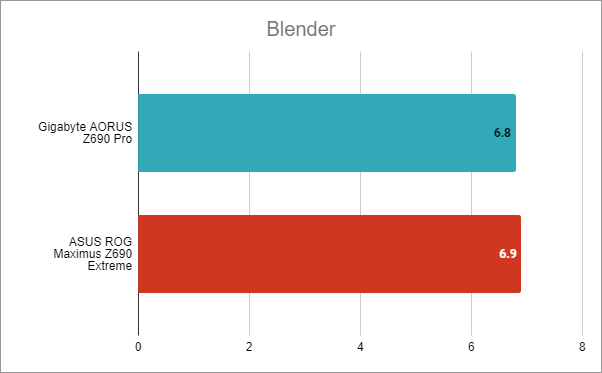 Gigabyte Z690 AORUS Pro: Benchmark results in Blender
Next, we moved on to a benchmark that assesses the performance of computers in real-life situations: PCMark 10. By real-life situations, we mean daily activities like browsing the internet, video conferencing, app start-up times, productivity, and digital content creation. Using the Gigabyte Z690 AORUS Pro motherboard, we got 8528 points, while using the ASUS ROG Maximus Z690 Extreme we got 8517 points. Again, these results show that the two motherboards offer practically the same performance.
Gigabyte Z690 AORUS Pro: Benchmark results in Blender
Next, we moved on to a benchmark that assesses the performance of computers in real-life situations: PCMark 10. By real-life situations, we mean daily activities like browsing the internet, video conferencing, app start-up times, productivity, and digital content creation. Using the Gigabyte Z690 AORUS Pro motherboard, we got 8528 points, while using the ASUS ROG Maximus Z690 Extreme we got 8517 points. Again, these results show that the two motherboards offer practically the same performance.
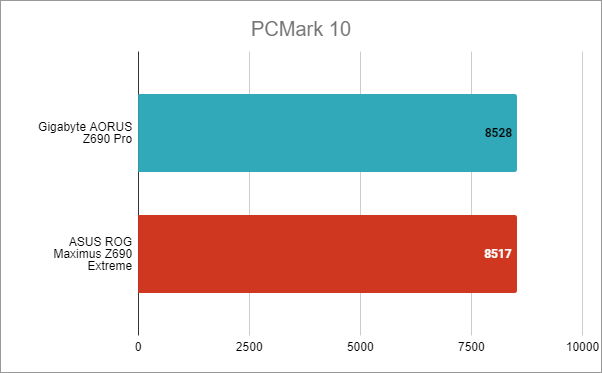 Gigabyte Z690 AORUS Pro: Benchmark results in PCMark 10
To get into a bit more detail about the web browsing experience, we also ran the JetStream 2 benchmark in Google Chrome. Here, we got a surprising result, as the Gigabyte Z690 AORUS Pro managed a slightly better score than the premium ASUS ROG Maximus Z690 Extreme. It was faster by about 6%!
Gigabyte Z690 AORUS Pro: Benchmark results in PCMark 10
To get into a bit more detail about the web browsing experience, we also ran the JetStream 2 benchmark in Google Chrome. Here, we got a surprising result, as the Gigabyte Z690 AORUS Pro managed a slightly better score than the premium ASUS ROG Maximus Z690 Extreme. It was faster by about 6%!
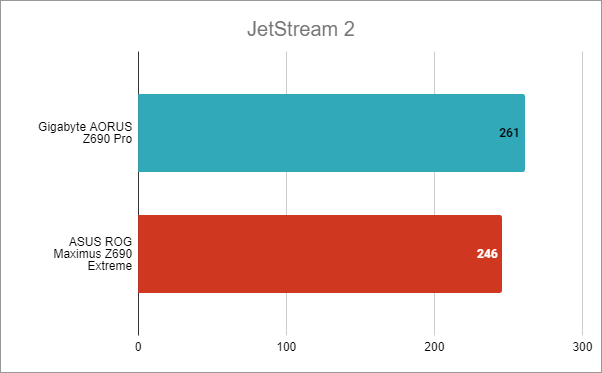 Gigabyte Z690 AORUS Pro: Benchmark results in JetStream 2
As the Gigabyte AORUS Z690 Pro is a motherboard targeted at gamers, we had to also run some gaming benchmarks. We started with Shadow of the Tomb Raider, in which both motherboards rendered more than 200 frames per second (1080p resolution, lowest graphics quality). Still, the Gigabyte mainboard managed a slightly higher fps.
Gigabyte Z690 AORUS Pro: Benchmark results in JetStream 2
As the Gigabyte AORUS Z690 Pro is a motherboard targeted at gamers, we had to also run some gaming benchmarks. We started with Shadow of the Tomb Raider, in which both motherboards rendered more than 200 frames per second (1080p resolution, lowest graphics quality). Still, the Gigabyte mainboard managed a slightly higher fps.
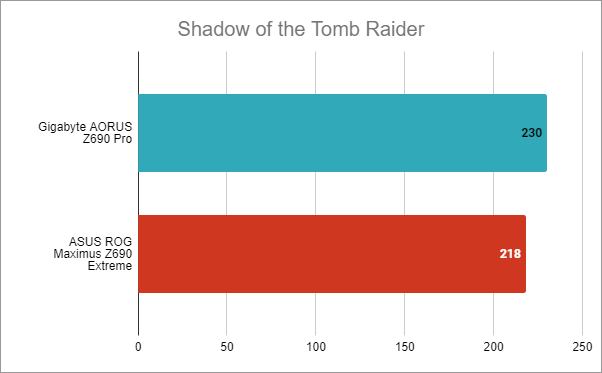 Gigabyte Z690 AORUS Pro: Benchmark results in Shadow of the Tomb Raider
In Metro Exodus, a game that’s very demanding in terms of hardware resources, using the lowest visuals possible, the fps was above 200 with both motherboards. And, just like in Shadow of the Tomb Raider, Gigabyte’s mainboard managed a few frames more!
Gigabyte Z690 AORUS Pro: Benchmark results in Shadow of the Tomb Raider
In Metro Exodus, a game that’s very demanding in terms of hardware resources, using the lowest visuals possible, the fps was above 200 with both motherboards. And, just like in Shadow of the Tomb Raider, Gigabyte’s mainboard managed a few frames more!
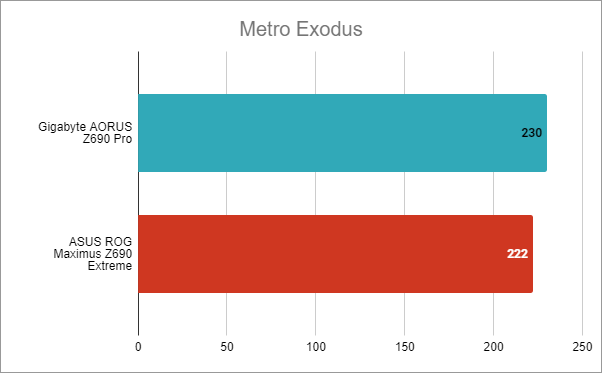 Gigabyte Z690 AORUS Pro: Benchmark results in Metro Exodus
In Assassin’s Creed Valhalla, also using the lowest visuals quality and in 1080 resolution, on both motherboards, we got a similar number of frames per second(168 with the AORUS Pro and 166 with the Maximus Extreme).
Gigabyte Z690 AORUS Pro: Benchmark results in Metro Exodus
In Assassin’s Creed Valhalla, also using the lowest visuals quality and in 1080 resolution, on both motherboards, we got a similar number of frames per second(168 with the AORUS Pro and 166 with the Maximus Extreme).
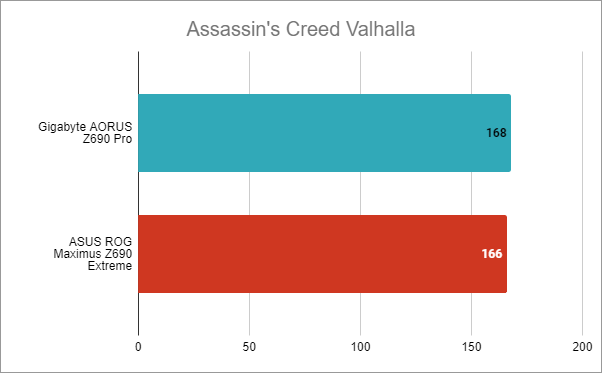 Gigabyte Z690 AORUS Pro: Benchmark results in Assassin's Creed Valhalla
Even if the benchmarks for motherboards are not that illustrative for their performance, as the results are greatly impacted by the likes of the processor, RAM, SSD, or graphics card you use, they’re still useful to get an idea of what to expect. And, as we’ve seen, the Gigabyte Z690 AORUS Pro is an amazing mid-range motherboard that can easily compete even with premium Z690 motherboards.
Gigabyte Z690 AORUS Pro: Benchmark results in Assassin's Creed Valhalla
Even if the benchmarks for motherboards are not that illustrative for their performance, as the results are greatly impacted by the likes of the processor, RAM, SSD, or graphics card you use, they’re still useful to get an idea of what to expect. And, as we’ve seen, the Gigabyte Z690 AORUS Pro is an amazing mid-range motherboard that can easily compete even with premium Z690 motherboards.
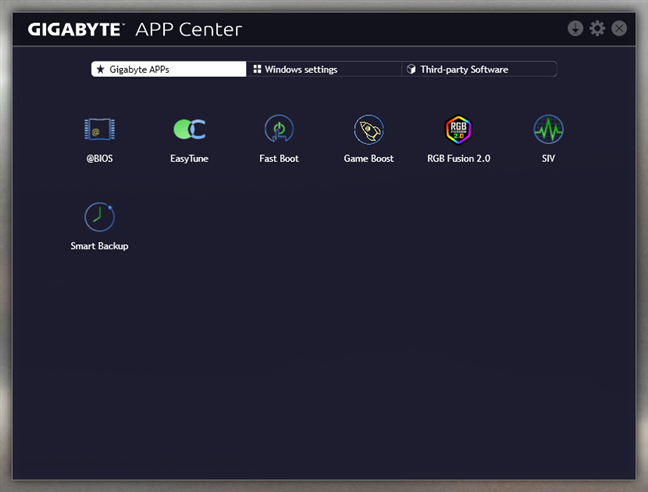
 Gigabyte APP Center
The tools you can install and access from Gigabyte’s APP Center are as follows:
Gigabyte APP Center
The tools you can install and access from Gigabyte’s APP Center are as follows:
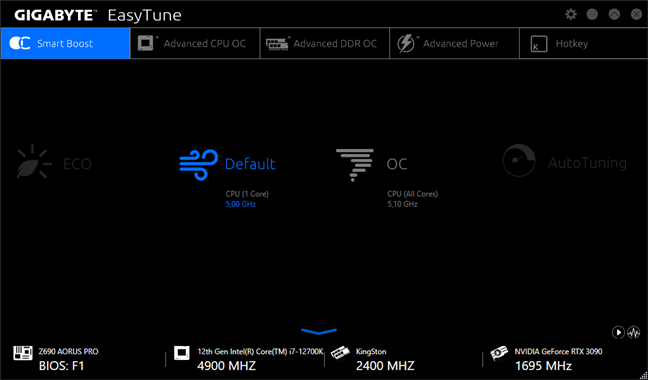
 Gigabyte EasyTune
We appreciate the fact that Gigabyte doesn’t preinstall apps or other software that you may or may not want. The Gigabyte APP Center is useful, although its looks are rather spartan and old-school, and some of the tools it offers can come in handy if you want to customize the way your PC works.
Gigabyte EasyTune
We appreciate the fact that Gigabyte doesn’t preinstall apps or other software that you may or may not want. The Gigabyte APP Center is useful, although its looks are rather spartan and old-school, and some of the tools it offers can come in handy if you want to customize the way your PC works.
Gigabyte Z690 AORUS Pro: Who is it good for?
The Gigabyte Z690 AORUS Pro is an excellent motherboard if:- You want a full-featured Z690 motherboard
- You need a motherboard that offers excellent performance
- You want to pay a reasonable price for a mid-range mainboard
Pros and cons
In our opinion, the best things about the Gigabyte Z690 AORUS Pro are these:
- It’s based on Intel’s excellent Z690 chipset
- It offers support for PCI Express 5.0 (GPU) and PCI Express 4.0 (M.2)
- It’s compatible with DDR5 RAM
- It can fit plenty of fast M.2 drives, as well as SATA drives
- It has a generous selection of USB ports
- It comes with high-speed Ethernet and Wi-Fi 6
- Its build quality is excellent
- The VRM can deliver up to 90A of power (great for overclocking)
Verdict
Gigabyte’s Z690 AORUS Pro is one of the best choices you could make when assembling a new desktop computer with one of Intel’s 12th generation processors. It has all the features you need, its technical specifications are top-notch, and the price is reasonable. Benchmarking it showed that the performance you get from this motherboard is similar to that of much pricier options, so our conclusion can be only one: the Gigabyte Z690 AORUS Pro is a best buy and an excellent choice for gamers, as well as professionals and computer enthusiasts in general.Unboxing the Gigabyte Z690 AORUS Pro motherboard
Gigabyte’s AORUS Z690 Pro is a mid-range motherboard designed to work with Intel’s latest 12th generation processors, which you find out immediately after you receive it if you look at the features and specs printed on its box. Speaking of which, the package looks good, it’s made of rigid cardboard and features a Sci-Fi design with a stylized cyber-eagle picture on its top side.Hardware specifications and design
The Gigabyte Z690 AORUS Pro is a motherboard targeted at gamers who are looking for something mid-range but full-featured and with a reasonable price. That is to say that this motherboard is one of the few reasonably-priced models based on the Z690 chipset you can get at the time of this review. At a price of about 330 USD, it gives you plenty of options and features. Let’s start with the design, as that’s the first thing you see when you receive it. The motherboard uses black as the primary color, but most of its heatsinks are gray. The PCB and the I/O panel are painted black, contrasting with the lighter shades of gray on the top VRM heatsink and the plate covering the M.2 slots. Although there are RGB headers on it, the mainboard itself doesn’t have built-in RGB LEDs. The only thing that lights up by default is the small Aorus text on the plate covering the I/O panel.Gigabyte Z690 AORUS Pro - Benchmark results
We tested the Gigabyte Z690 AORUS Pro motherboard using these hardware and software components:- Processor: Intel Core i7-12700K
- Cooler: ASUS ROG Ryujin II 360
- Memory: Kingston FURY Beast DDR5 RAM (2 x 16GB, 4800MHz)
- Graphics Card: ASUS TUF Gaming GeForce RTX 3090
- Storage: Kingston KC3000 SSD (2TB, PCI-Express 4.0)
- Monitor: ASUS ROG Strix XG32VQ Curved Gaming Monitor (2560 x 1440 resolution, at 144Hz)
- Power Supply Unit: ASUS ROG Thor 850W Platinum
- Operating System: Windows 11 Pro Version 21H2 Build 22000.348
Software bundled with the Gigabyte Z690 AORUS Pro
Gigabyte doesn’t force you to install any of its software. However, immediately after you install Windows, you’re asked whether you want to download and install its APP Center. It’s a program that looks rather classic, but which you may want to get, as it lets you access some useful tools. The APP Center behaves much like a central hub from which you can update the drivers for your motherboard, quickly access some Windows settings, and install Gigabyte’s tools and some third-party software.- @BIOS: an app that allows you to update the motherboard’s UEFI BIOS, either using the firmware you already got from Gigabyte’s support website or by downloading it directly from the company’s servers.
- EasyTune: lets you adjust various features and settings for the motherboard, like the fans speed, processor and memory overclocking, power options, and hotkeys.
- Fast Boot: allows you to decrease the boot time of your computer.
- Game Boost: helps you optimize manually selected games or apps by closing other processes and freeing up memory.
- RGB Fusion 2.0: controls the lighting effects of the LED strips and other devices connected to the motherboard.
- SIV: or System Information Viewer lets you see details about your system, and monitor hardware components such as the processor and memory, as well as create alerts for when temperatures reach specified levels.
- Smart Backup: allows you to create backups of your files or partitions and easily recover them when you have to.
- Norton Internet Security: a security solution that includes an antivirus and a firewall, for which you get a trial version for 90 days.

Discussion (0)
Comments are closed.