



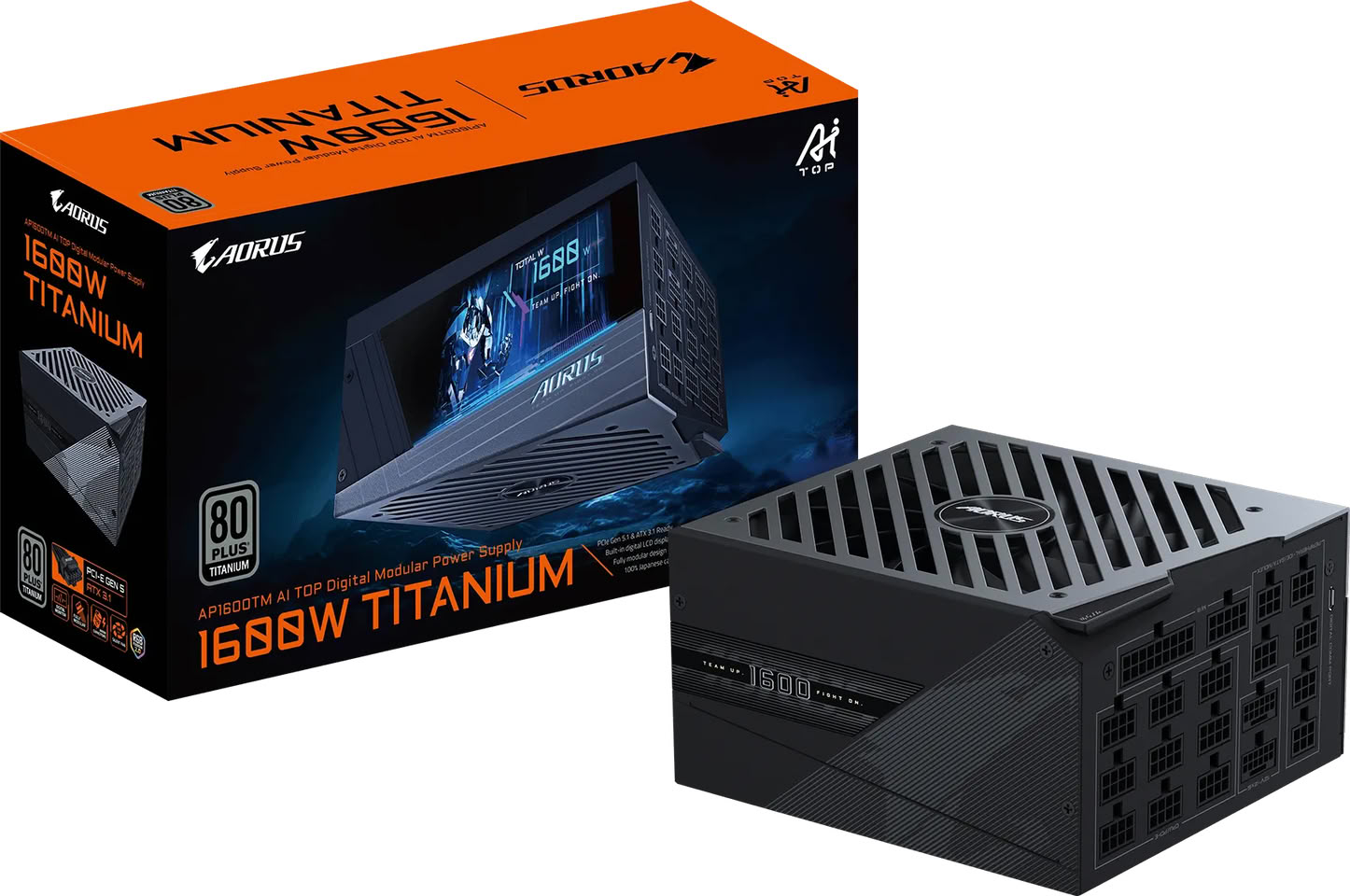
GIGABYTE has introduced the AORUS P1600W 80 Plus Titanium Modular PCIe 5.1 AI TOP, a high capacity power supply designed for demanding gaming systems, professional workstations, and local AI computers using multiple graphics cards.
The unit provides 1600W of total output and supports two graphics cards drawing up to 600W each through native 16 pin connections. It can also power as many as four GPUs using additional adapter cables, although each card is then limited to a maximum of 300W.
Despite carrying the AI TOP name, the power supply does not include an AI processor or an automatic AI based power management feature. The branding instead identifies it as part of GIGABYTE’s hardware range intended for sustained local AI workloads.
Two 600W GPUs or four 300W cards
The AORUS P1600W includes two native 16 pin to 16 pin PCIe power cables. Each connection can deliver up to 600W to a compatible graphics card.
GIGABYTE also provides two cables that combine dual 8 pin connectors into one 16 pin output. These additional cables make a four GPU configuration possible, but the available power for each card is lower.
| GPU configuration | Maximum supported power |
|---|---|
| Two GPUs using native 16 pin cables | Up to 600W per GPU |
| Four GPUs using all supplied connections | Up to 300W per GPU |
| Total PSU capacity | 1600W |
The four GPU claim therefore does not mean the power supply can operate four cards at the full 600W limit. Four GPUs drawing 600W each would require far more than the unit’s total output before accounting for the processor, memory, drives, cooling, and other system components.
This configuration is more suitable for several lower powered accelerators or graphics cards rather than four top end gaming GPUs running at maximum power.
Compact chassis uses GaN components
The power supply measures 150 by 160 by 86 mm, making it shorter than many other models offering similar capacity.
GIGABYTE uses gallium nitride MOSFETs to improve power density. These components allow the company to fit the 1600W design into a relatively compact enclosure while leaving additional internal space for cooling.
| Specification | Details |
|---|---|
| Model | AORUS P1600W AI TOP |
| Total output | 1600W |
| Certification | 80 Plus Titanium |
| Standards | ATX 3.1 and PCIe 5.1 |
| Dimensions | 150 by 160 by 86 mm |
| Power rail | Single 12V rail |
| Capacitors | Japanese capacitors |
| Cooling fan | 140 mm double ball bearing fan |
| Cabling | Fully modular |
The unit also uses a digital power design and Japanese capacitors, both of which are common in premium power supplies intended for high load systems.
Built in display shows power and temperature data
One of the most visible features is the integrated Edge View colour LCD.
The screen can display real time power output, current, internal temperature, and fan speed. This can be useful in multi GPU systems where power consumption may reach four digit figures under sustained workloads.
| LCD reading | Purpose |
|---|---|
| Power output | Shows current PSU load |
| Current | Displays electrical draw |
| Temperature | Helps monitor internal heat |
| Fan speed | Shows cooling activity |
The display is intended for system monitoring rather than interactive entertainment. It does not run games or applications.
System information can also be viewed through GIGABYTE’s AI TOP Utility. The software allows power supply consumption to appear alongside other hardware data while running local AI models or other demanding workloads.
Titanium efficiency and high power excursion support
The AORUS P1600W complies with the ATX 3.1 and PCIe 5.1 standards.
GIGABYTE says it can handle power excursions reaching three times the rated GPU load and twice the total system load for brief periods. These temporary spikes are important for modern graphics cards, which can draw considerably more than their average power rating for short intervals.
Its 80 Plus Titanium certification specifies efficiency of up to 94 percent at a typical load.
Higher efficiency reduces the amount of electricity converted into waste heat, although the exact result will depend on the system load and local input voltage.
| Feature | Claimed capability |
|---|---|
| Typical efficiency | Up to 94 percent |
| GPU power excursion | Up to three times GPU load |
| Total system excursion | Up to twice system load |
| Compliance | ATX 3.1 and PCIe 5.1 |
A 1600W capacity does not mean the unit constantly consumes 1600W. It only draws the amount required by the connected components, with additional losses determined by efficiency.
Cooling includes a dust removal mode
Cooling is provided by a 140 mm double ball bearing fan.
The fan supports semi passive operation, allowing it to stop or run more slowly during lighter workloads. This should reduce noise when the system is not using a large amount of power.
A reverse rotation function can briefly spin the fan in the opposite direction during startup or through the control software. The purpose is to remove accumulated dust from inside the power supply.
This feature may reduce dust buildup, but it does not replace regular system cleaning, especially in computers using several graphics cards.
AI TOP is a platform label rather than an AI feature
The AI TOP name could suggest that the power supply includes dedicated artificial intelligence hardware, but that is not the case.
The branding connects the product to GIGABYTE’s range of components intended for local AI development and inference. These systems may use several GPUs for large models or other compute workloads that require sustained power delivery.
The PSU itself focuses on capacity, efficiency, monitoring, and multi GPU connectivity.
| AI TOP feature | Included |
|---|---|
| Dedicated AI processor | No |
| AI controlled power management | No |
| Monitoring through AI TOP Utility | Yes |
| Validation for local AI systems | Yes |
| Multi GPU power support | Yes |
This distinction matters because the power supply does not change its output using machine learning. It remains a conventional premium PSU with software monitoring and branding aimed at AI workstations.
Pricing and availability remain unconfirmed
GIGABYTE has not announced a retail price or confirmed when the AORUS P1600W will become available in the United States or Europe.
Its 1600W output, Titanium certification, modular design, integrated display, and multi GPU support suggest that it will compete in the premium power supply market.
The unit is unlikely to be necessary for a typical gaming PC using one graphics card. It is more relevant to systems with flagship GPUs, powerful processors, several accelerators, or sustained local AI workloads.
For builders planning a four GPU system, the most important limitation is the 300W maximum per card in that configuration. The power supply can provide two full 600W GPU connections, but its four GPU support is intended for cards with lower individual power requirements.



Discussion (0)
Be the first to comment.