



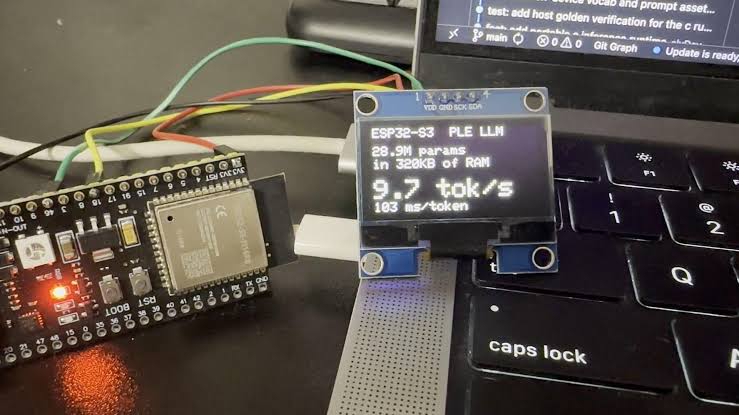
A PC enthusiast has built a local AI cluster from discarded laptop hardware, showing that large language models do not always require expensive modern GPUs.
The system uses several Lenovo ThinkPad L380 motherboards from 2018, each fitted with an Intel Core i5 8250U processor, 32 GB of DDR4 memory and an NVMe SSD.
Despite the modest hardware, the cluster can run an 80 billion parameter Mixture of Experts model at around four tokens per second.
DIY AI cluster hardware and performance
| Component | Configuration |
|---|---|
| Laptop boards | Lenovo ThinkPad L380 |
| CPU | Intel Core i5 8250U |
| CPU cores | 4 |
| CPU threads | 8 |
| Memory per node | 32 GB DDR4 2400 |
| Storage | NVMe SSD |
| Networking | Dual 2.5 GbE USB adapters per node |
| Main model | Qwen 3 Next 80B A3B |
| Active parameters | Around 3 billion per token |
| Performance | Around 4 tokens per second |
| Smaller model result | Nearly 10 tokens per second |
The project relies on multiple systems working together rather than one large accelerator.
It is not competitive with modern GPU based AI hardware, but the result shows how far local inference can be pushed using inexpensive recycled components.
Mixture of Experts makes the 80B model practical
The key to the system is the type of AI model being used.
Qwen 3 Next 80B A3B contains around 80 billion parameters overall, but only about 3 billion parameters are active while generating each token.
This Mixture of Experts design significantly reduces the amount of computation required during inference.
That makes it possible for a group of older CPUs to process a model that would otherwise be impractical on this type of hardware.
The cluster reaches roughly four tokens per second with the 80B model.
That is far slower than commercial cloud AI services, but it is fast enough for experimenting with a local chatbot or other text based tasks.
Three nodes perform better than four
The builder originally prepared four laptop motherboards, but the full setup did not provide the best performance.
Network communication between systems became a bottleneck.
Adding the fourth node increased the amount of data that had to move across the network enough that overall inference became slower.
As a result, the final configuration uses three nodes.
Each node is connected through two USB 2.5 Gigabit Ethernet adapters.
One network handles communication between the AI nodes while another provides general network connectivity.
The unusual result highlights one of the challenges of distributed inference. Adding more processors does not automatically increase performance if communication overhead grows faster than the available computing power.
Smaller models run considerably faster
The cluster was also tested with less demanding models.
Qwen 3 30B reportedly reaches just under 10 tokens per second.
Qwen Coder 30B performs at close to nine tokens per second.
Those speeds are more practical for interactive local use.
They also demonstrate how choosing the right model can be more important than simply selecting one with the largest parameter count.
A smaller or sparse model can often produce a much better balance between capability and response speed on limited hardware.
Old Core i5 CPUs handle all inference
The Core i5 8250U was introduced in 2017 and was designed primarily for thin laptops.
It has four CPU cores with eight threads, a base clock of 1.6 GHz and boost frequencies reaching up to 3.4 GHz.
The laptop firmware limits sustained power to around 25 watts, preventing the processors from maintaining their highest clock speeds during heavy workloads.
Running AI inference entirely on these CPUs is therefore much slower than using current GPUs or dedicated AI accelerators.
Still, combining their memory and processing resources allows the cluster to handle models that would not fit comfortably on one of the systems alone.
llama.cpp splits the model across several machines
The project uses llama.cpp rather than simpler local AI applications.
That software provides the flexibility needed to divide model workloads across separate computers.
A custom framework was also created to coordinate the cluster, with coding assistance used during development.
The result keeps all AI processing local.
Prompts and generated data do not need to be sent to an external cloud service, providing greater privacy and removing recurring inference fees.
Electricity remains the main ongoing operating cost.
The project is not a practical replacement for a modern GPU workstation, but that is not its main purpose.
It demonstrates that old laptop motherboards, inexpensive networking hardware and commodity DDR4 memory can still be useful for local AI experimentation. With suitable sparse models and carefully managed distributed inference, hardware that might otherwise become electronic waste can run surprisingly capable language models.



Discussion (0)
Be the first to comment.