


Researchers have reportedly discovered hidden hardware signatures in several Chinese artificial intelligence models, suggesting that companies including DeepSeek, Moonshot AI, MiniMax and Inclusion AI may have used NVIDIA's advanced Blackwell GPUs during the early stages of model training.
The findings come from an analysis by Unemployment Labs, which examined publicly available AI model weights to identify patterns associated with different GPU architectures.
According to the research, individual model initialization processes may have involved clusters containing approximately 3,000 to 4,500 NVIDIA Blackwell GPUs.
The researchers also estimated that the combined hardware associated with the analyzed models could range from 7,000 to 22,000 GPUs, depending on how the training infrastructure was shared and utilized.
However, the findings do not establish where the hardware was located, how the companies obtained access to it or whether any US export restrictions were violated.
Researchers Identified GPU Architectures Through AI Model Weights
The investigation focused on the numerical parameters used by AI models to process information and generate responses.
Before training begins, these parameters are initialized using numerical values produced by a random number generator.
The resulting arrangement can depend on the processing architecture responsible for generating those values.
Researchers claim that certain patterns remain detectable even after a model has undergone extensive training.
By examining these patterns, the team attempted to determine which GPU architecture was used during initialization.
The analysis compared signatures associated with NVIDIA's Hopper and Blackwell processors.
One example involved DeepSeek V4 Flash, where the researchers reported a stronger match with Blackwell's 148 streaming multiprocessor configuration than with Hopper's 132 streaming multiprocessor configuration.
This suggests that the model's initial weights may have been generated using Blackwell hardware.
However, identifying the hardware involved in initialization does not necessarily prove that the entire training process used the same GPUs.
Chinese AI Models May Have Used Up to 22,000 Blackwell GPUs
The investigation examined 24 AI model cases, including 11 checkpoints captured before their weights had undergone training modifications.
These initial checkpoints provide more direct information about the hardware used to generate starting parameters.
The researchers identified possible Blackwell signatures in models associated with several Chinese AI developers.
The estimated total hardware footprint ranged from 7,000 to 22,000 GPUs across the analyzed models.
The upper estimate assumes that the companies did not reuse the same Blackwell clusters for different training operations.
If the same hardware was shared between models or reused across separate training runs, the actual number of physical GPUs could be considerably lower.
The estimates also depend on factors including GPU utilization, training schedules and the efficiency of the underlying infrastructure.
Findings Raise Questions About Access to Restricted NVIDIA Hardware
NVIDIA's most advanced Blackwell AI accelerators are subject to US export restrictions affecting China.
These controls have become an important issue as Chinese technology companies expand their AI computing capabilities.
However, access to restricted computing hardware does not necessarily require physical possession of the processors.
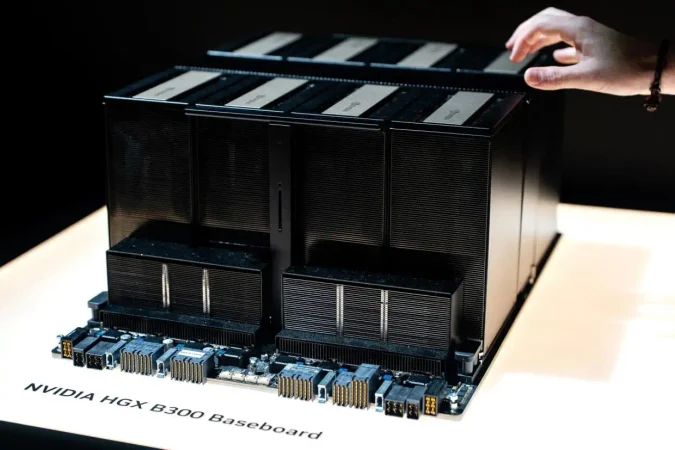
Companies may be able to use computing infrastructure located in other countries through remote services.
US authorities have also examined restrictions involving overseas subsidiaries and other arrangements that could provide access to controlled hardware.
The research therefore raises questions about how Chinese AI developers might be accessing advanced computing resources.
Nevertheless, the investigators explicitly cautioned that their technical findings do not demonstrate unlawful activity.
They could not determine whether the identified GPUs were physically located in China or elsewhere.
Some AI Models Leave No Detectable GPU Fingerprints
The researchers also acknowledged limitations in their analysis.
Certain AI architectures can conceal or eliminate the patterns used to identify initialization hardware.
For example, the team reported that it could not identify a reliable GPU fingerprint in DeepSeek V4.1 Flash.
Similar difficulties were encountered with Meituan's LongCat 2.0.
Some Alibaba Qwen3 models reportedly had their weights initialized using conventional processors rather than GPUs, leaving no identifiable GPU initialization signature.
These examples illustrate why the absence of a detectable fingerprint cannot establish which hardware was used during subsequent training.
The technique appears most useful when model weights preserve enough information about their original numerical arrangement.
While the findings suggest that some Chinese AI laboratories may have accessed NVIDIA Blackwell hardware, the results remain dependent on the researchers' methodology and assumptions.
Independent confirmation would be necessary to establish the actual GPU configurations and infrastructure used by the companies involved.

Discussion (0)
Be the first to comment.