




Chinese DDR5 memory based on CXMT chips is continuing to improve, with new demonstrations showing speeds of up to 9000 MT/s and tighter timings at more practical 6000 MT/s frequencies.
The latest results show how much progress CXMT based DDR5 has made compared with earlier modules that struggled to move beyond 6400 MT/s. Motherboard makers and memory vendors have been improving BIOS support, signal tuning and compatibility, helping newer kits reach higher speeds and lower latency.
CXMT DDR5 now reaches 9000 MT/s
| Test | Configuration | Result |
|---|---|---|
| High speed test | Ryzen 7 9800X3D, 48GB iGame Shadow II | 9000 MT/s |
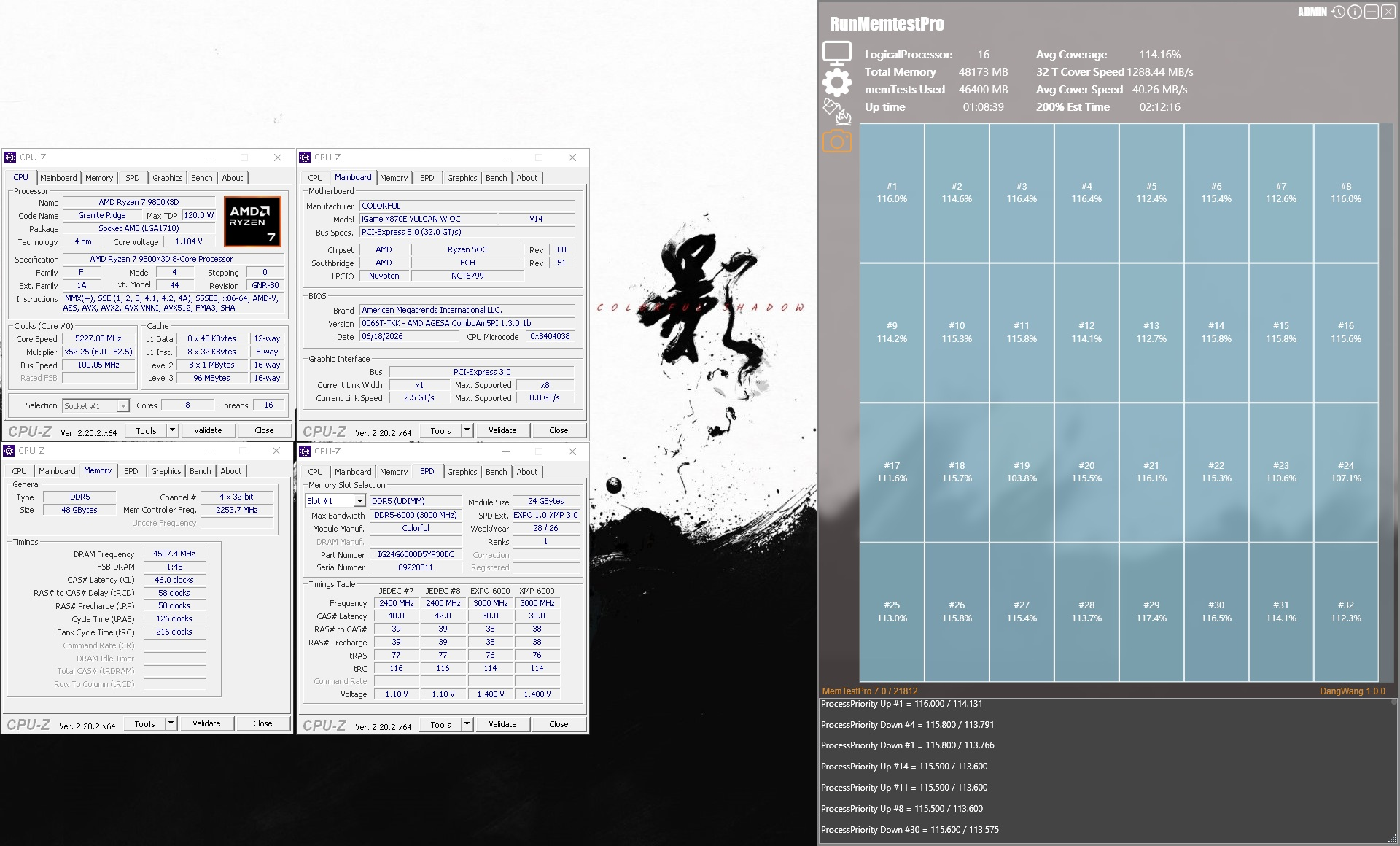
| Timings at 9000 MT/s | CL46 58 58 126 216 | Stable in RunMemtestPro |
| EXPO test | Ryzen 5 9600X, same 48GB kit | 6000 MT/s at 1.4V |
| Timings at 6000 MT/s | CL30 38 38 76 144 | Stable |
| AIDA64 read | 6000 MT/s setup | 58.7 GB/s |
| AIDA64 write | 6000 MT/s setup | 81.1 GB/s |
| AIDA64 copy | 6000 MT/s setup | 54.7 GB/s |
| AIDA64 latency | 6000 MT/s setup | 76.6 ns |
Colorful used its X870E Vulcan W OC motherboard for the demonstrations. The board has a dual DIMM design aimed at memory overclocking, while the iGame Shadow II kit used a 24GB x 2 configuration with CXMT DRAM and a standard EXPO profile of up to 6000 MT/s.
With a Ryzen 7 9800X3D, the memory reached 9000 MT/s at CL46 58 58 126 216 and completed RunMemtestPro with an average coverage figure of 114.6%.
A second test with a Ryzen 5 9600X focused on tighter timings rather than maximum frequency. The same memory kit ran at 6000 MT/s and 1.4V using CL30 38 38 76 144 timings. It recorded 58.7 GB/s read, 81.1 GB/s write and 54.7 GB/s copy speeds in AIDA64, with latency measured at 76.6 ns.
ASUS is also showing CL28 and CL30 results
Colorful is not the only vendor improving support for CXMT based DDR5.
ASUS has also demonstrated Chinese memory kits operating at CL28 and CL30 timings at 6000 MT/s and above across AMD and Intel motherboards. The tested configurations include 16GB x 2, 24GB x 2 and mixed 16GB and 24GB setups.
This is important because earlier domestic DDR5 kits often traded latency for lower cost and availability. Many products were commonly sold around DDR5 6000 CL36, while tighter CL30 and CL28 configurations were more closely associated with premium Hynix based kits.
The latest tuning work suggests that gap is narrowing.
Availability remains CXMT’s main advantage
CXMT memory is becoming more relevant as shortages affect global DRAM supply.
The supplied report notes that CXMT based DDR5 can now cost about the same as products using chips from established global suppliers. Its main advantage is availability, particularly in China, where domestic memory remains easier to source in some cases.
That advantage may not last indefinitely. CXMT has also been signing longer term agreements with Chinese AI companies, which could eventually put more pressure on its commodity DRAM supply.
For now, though, the move from earlier 6400 MT/s limits to 9000 MT/s demonstrations, along with stable CL28 and CL30 configurations around 6000 MT/s, shows that CXMT based DDR5 is becoming a much stronger alternative for mainstream and enthusiast systems.



Discussion (0)
Be the first to comment.