



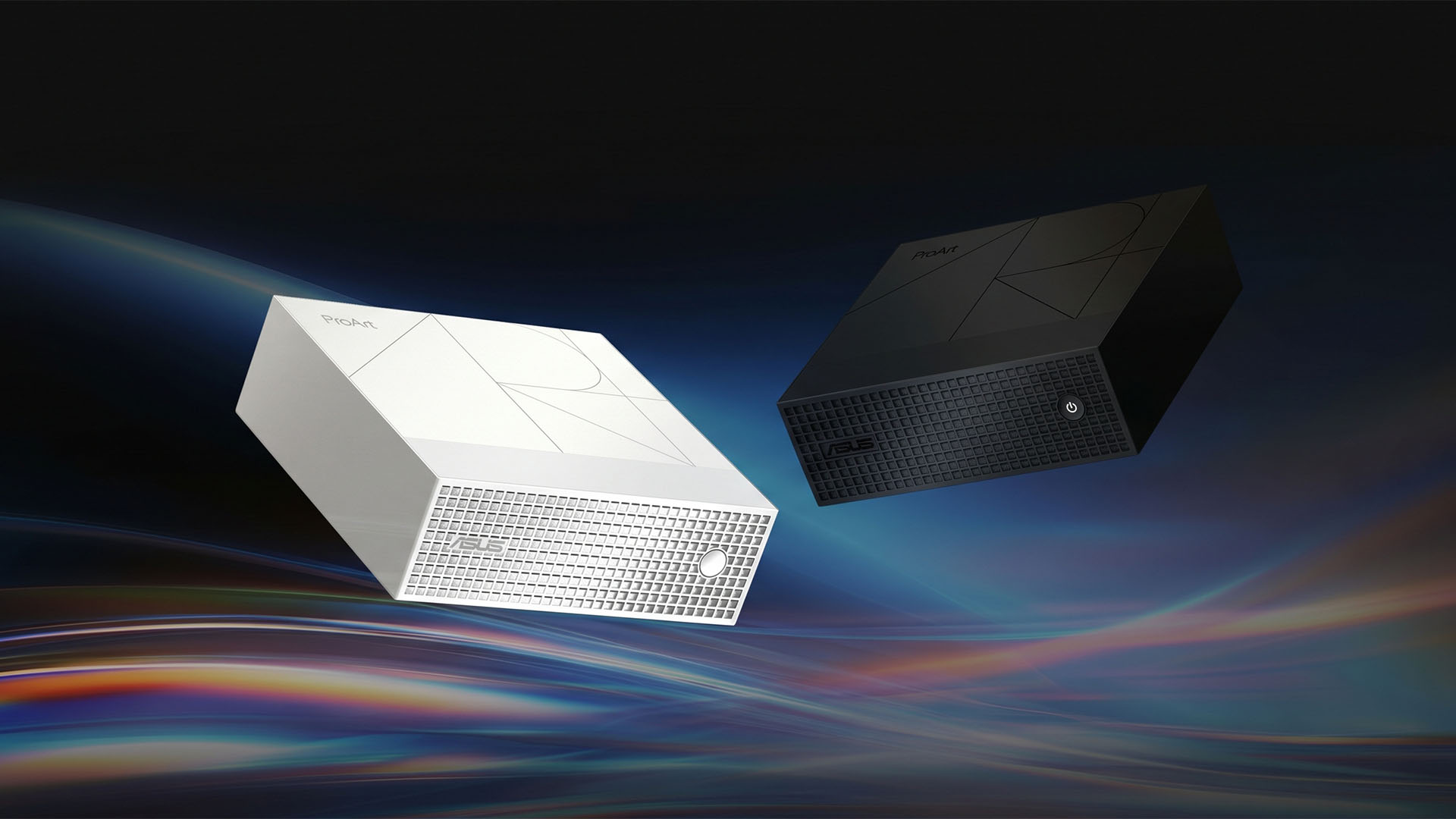
ASUS is positioning its new ProArt GR1X mini PCs as compact systems capable of handling demanding creative, AI and gaming workloads, with the company claiming more than 100 FPS gaming performance at 1440p while keeping the RTX Spark platform within a 140W power limit.
The systems use NVIDIA's RTX Spark platform, which combines a Grace 20 core CPU with a Blackwell GPU featuring 6,144 CUDA cores in its higher configuration. ASUS is also offering up to 128 GB of unified memory, giving the GR1X enough capacity for large local AI models and professional workloads.
The company says the machine can run models with as many as 120 billion parameters, work with context windows reaching one million tokens, and handle 3D scenes using around 90 GB of memory.
Gaming is another major part of ASUS's marketing, although the company's performance claim leaves some important details unanswered.
ASUS Claims More Than 100 FPS at 1440p
ASUS says the ProArt GR1X can deliver more than 100 FPS in AAA games at 1440p.
However, the available information does not specify whether that figure represents native resolution performance or relies on NVIDIA technologies such as DLSS upscaling and Multi Frame Generation.
That distinction matters because RTX Spark is based on NVIDIA's Blackwell architecture and supports advanced frame generation technologies.
| ProArt GR1X feature | Details |
|---|---|
| CPU | NVIDIA Grace 20 core CPU |
| GPU | NVIDIA Blackwell GPU with up to 6,144 CUDA cores |
| Unified memory | Up to 128 GB |
| AI performance | Up to 1 petaflop FP4 |
| Gaming claim | 1440p at more than 100 FPS |
| Power limit | 140W |
| Ray tracing | Fourth generation RT cores |
| Cooling | Dual fans and four heat pipes |
| Display support | Up to four 4K displays |
| AI model support | Up to 120 billion parameters |
The GR1X also supports DLSS and Multi Frame Generation, which could make the 100 FPS figure much easier to reach.
Blackwell supports Multi Frame Generation with interpolation of up to 6x, while DLSS 4.5 is designed to improve both image reconstruction and overall performance.
Without a breakdown of rendering resolution, frame generation settings or tested games, the 100 FPS figure should therefore be treated as a platform capability claim rather than a measure of native 1440p performance.
RTX Spark Brings Blackwell Features to a Mini PC
The ProArt GR1X uses the same RTX Spark platform appearing in a new generation of premium laptops.
The Blackwell GPU brings fourth generation ray tracing cores along with NVIDIA's latest DLSS technologies, while the shared memory architecture allows both graphics and AI workloads to access a large memory pool.
ASUS is also highlighting professional applications including Unreal Engine, Unity, Adobe software and Blender.
That makes the system more than a gaming focused mini PC.
Its combination of GPU resources, unified memory and AI acceleration is aimed at creators, developers and professionals who want workstation class capabilities in a smaller desktop chassis.
140W Power Limit Keeps Cooling Relatively Compact
One of the more notable parts of the design is its 140W power target.
A lower power envelope reduces the amount of cooling hardware required compared with a traditional high performance desktop containing a separate CPU and graphics card.

ASUS uses two fans with 109 blades each, 57 wide cooling fins and four heat pipes to manage heat.
The compact thermal design also allows the system to remain relatively small while supporting sustained professional workloads.
The company is presenting this efficiency as one of the advantages of the RTX Spark platform.
Gaming Performance Still Needs Independent Testing
The ProArt GR1X appears capable of delivering strong gaming performance, but ASUS has not yet provided enough detail to determine exactly how its 1440p 100 FPS figure is achieved.
Earlier demonstrations of games such as Alan Wake 2 and PRAGMATA have shown RTX Spark running demanding titles smoothly, but detailed benchmarks remain limited.
DLSS and Multi Frame Generation are likely to play a major role in reaching the advertised frame rates.
For players comfortable using those technologies, that may not be a problem. The larger question is how the system performs without aggressive upscaling or frame interpolation.
Until independent benchmarks are available, the ProArt GR1X looks like a powerful and efficient mini PC on paper, but its native gaming performance remains one of the main unanswered questions.


Discussion (0)
Be the first to comment.