



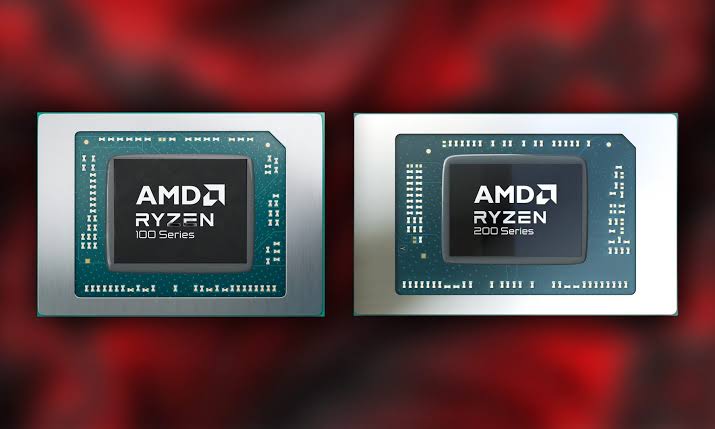
AMD has quietly added 11 new processors to its Ryzen 200 and Ryzen 100 series, giving OEMs more Zen 4 based options for laptops and compact PCs. The additions appear to be part of AMD’s continued effort to keep older and current mobile platforms active while shifting toward a simpler naming structure.
The new chips are based on Hawk Point and use AMD’s 4nm process with RDNA 3 integrated graphics. That makes the naming a little confusing, especially in the Ryzen 100 series, where some existing processors were associated with older Zen 3 Plus designs. The new entries, however, are listed with Zen 4 architecture and Radeon 700M graphics, which places them closer to AMD’s more recent mobile CPU families.
AMD has added seven processors under the Ryzen 200 series and four under the Ryzen 100 series. These include Ryzen 3, Ryzen 5, Ryzen 7, and Ryzen 9 models, covering 4 core, 6 core, and 8 core configurations. The chips are likely aimed at OEM laptop makers and mini PC vendors rather than standalone retail buyers.
The new Ryzen 200 and Ryzen 100 chips give OEMs more flexible Hawk Point options
The Ryzen 200 series now includes new chips such as the Ryzen 7 253 and Ryzen 7 249, both offering 8 cores and 16 threads with Radeon 780M graphics. AMD has also added Ryzen 5 models with Radeon 760M graphics, along with lower tier models that combine Zen 4 and Zen 4c cores and use Radeon 740M graphics.
The Ryzen 100 series additions include the Ryzen 9 180, Ryzen 7 165, Ryzen 7 155, and Ryzen 5 125. These chips also use Zen 4 and RDNA 3 graphics, despite the lower series branding.
| Processor | Architecture | Cores and threads | Base and boost clock | Integrated graphics |
|---|---|---|---|---|
| Ryzen 7 253 | Zen 4 | 8 cores, 16 threads | 3.6GHz to 4.9GHz | Radeon 780M |
| Ryzen 7 249 | Zen 4 | 8 cores, 16 threads | 3.1GHz to 4.9GHz | Radeon 780M |
| Ryzen 5 225 | Zen 4 | 6 cores, 12 threads | 4.1GHz to 4.8GHz | Radeon 760M |
| Ryzen 5 224 | Zen 4 | 6 cores, 12 threads | 3.3GHz to 4.8GHz | Radeon 760M |
| Ryzen 7 217 | Zen 4 plus Zen 4c | 6 cores, 12 threads | 3.0GHz to 4.8GHz | Radeon 740M |
| Ryzen 5 216 | Zen 4 plus Zen 4c | 6 cores, 12 threads | 2.9GHz to 4.7GHz | Radeon 740M |
| Ryzen 3 205 | Zen 4 plus Zen 4c | 6 cores, 8 threads | 3.8GHz to 4.6GHz | Radeon 740M |
| Ryzen 9 180 | Zen 4 | 8 cores, 16 threads | 3.6GHz to 4.9GHz | Radeon 780M |
| Ryzen 7 165 | Zen 4 | 6 cores, 12 threads | 3.3GHz to 4.7GHz | Radeon 760M |
| Ryzen 7 155 | Zen 4 | 6 cores, 12 threads | 3.0GHz to 4.7GHz | Radeon 740M |
| Ryzen 5 125 | Zen 4 | 4 cores, 8 threads | 3.0GHz to 4.3GHz | Radeon 740M |
The lineup gives AMD more room to serve different laptop price points without needing an entirely new platform. OEMs can use these chips in mainstream notebooks, budget systems, and mini PCs that need modern CPU cores and capable integrated graphics without moving to newer and more expensive designs.
The Radeon 700M graphics are also important. The Radeon 780M remains a strong integrated graphics option for thin laptops and compact PCs, while the Radeon 760M and 740M can cover lower price tiers. For casual gaming, media use, and everyday productivity, these iGPUs should be useful enough for systems that do not include a separate GPU.
The naming is still the weak point. A buyer looking at Ryzen 100 and Ryzen 200 models may not immediately understand which chips use Zen 4, which use mixed Zen 4 and Zen 4c cores, and how they compare with older Ryzen mobile processors. That puts more responsibility on OEMs to market these machines clearly.
For AMD, the move makes practical sense. The company can keep Hawk Point active, support more system designs, and give partners a wider list of processors to use in 2026 laptops and mini PCs. The chips may not be headline products, but they could appear in many affordable systems over the coming months.



Discussion (0)
Be the first to comment.