



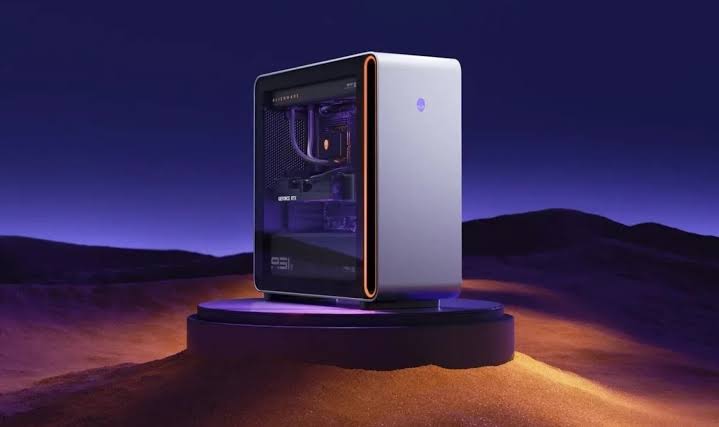
Alienware’s latest Area 51 desktop combines AMD’s Ryzen 7 9850X3D processor with NVIDIA’s GeForce RTX 5090, targeting players who want top level gaming performance without building a PC themselves.
The reviewed configuration costs $5,899, while the wider product range starts at $4,049. That places the system firmly in the premium category, but the price includes some of the fastest consumer hardware currently available, a large cooling system, and a chassis designed around standard components.
Alienware has moved away from the more restrictive internal layouts used in some of its earlier desktops. The current Legend 3 design uses an industry standard motherboard format and power supply, making the system easier to understand and potentially simpler to maintain.
The desktop is still very large, and expansion options are limited once the graphics card is installed. However, its cooling, build quality, clean software setup, and gaming hardware are clear strengths.
The Ryzen 7 9850X3D is built for high frame rates
The Ryzen 7 9850X3D includes eight processor cores, a maximum boost clock of 5.6 GHz, and 96 MB of L3 cache. AMD’s additional cache is particularly useful in games, where it can reduce delays between the processor and frequently accessed data.
Alienware pairs the processor with 64 GB of DDR5 6400 memory in the reviewed system. That is more than most current games require and also provides enough capacity for streaming, content creation, and other demanding tasks.
The processor runs on an Alienware designed motherboard using AMD’s X870E chipset. It supports PCI Express 5.0 for the graphics card and primary storage slot, along with two rear USB 4 ports operating at up to 40 Gbps.
A 1500 watt Platinum rated power supply provides power to the system. The motherboard uses the ATX12VO standard, which supplies lower voltage power more efficiently than traditional desktop designs, although the format remains less common in the wider PC market.
| Component | Reviewed configuration |
|---|---|
| Processor | AMD Ryzen 7 9850X3D |
| Processor cores | 8 |
| Maximum boost clock | 5.6 GHz |
| L3 cache | 96 MB |
| Graphics card | NVIDIA GeForce RTX 5090 |
| Graphics memory | 32 GB GDDR7 |
| System memory | 64 GB DDR5 6400 |
| Primary storage | 2 TB PCI Express 5.0 SSD |
| Power supply | 1500 watt Platinum rated |
| CPU cooling | 360 mm liquid cooler |
The RTX 5090 leaves little room for extra expansion cards
The GeForce RTX 5090 is the central graphics component in the reviewed model. It includes 32 GB of GDDR7 memory and uses a large cooler that occupies three motherboard slots.
The card connects through a full PCI Express 5.0 x16 slot. However, the motherboard’s remaining expansion options are modest, with only one PCI Express 4.0 x2 slot and one PCI Express 3.0 x1 slot.
That limitation may matter to buyers who need capture cards, professional audio hardware, high speed networking cards, or other internal devices. For a gaming focused system, it is less serious because the desktop already includes strong networking, storage, and graphics hardware.
The motherboard provides three M.2 storage slots. Two support PCI Express 4.0 drives, while the primary slot supports a faster PCI Express 5.0 SSD. Alienware allows configurations with up to 12 TB of solid state storage.
The case also includes two 2.5 inch drive trays and one tool free 3.5 inch bay. Power and data cables are already routed, so adding extra SATA drives should be straightforward.
Cooling is quiet, effective, and designed around positive pressure
Alienware uses a 360 mm liquid cooler in the reviewed configuration, although a 240 mm version is also available. The larger cooler places three 120 mm fans above the radiator.
Two large 200 mm fans draw air through narrow openings along the front sides of the case. Additional fans at the bottom and top also bring cool air inside, while warm air exits through the rear.
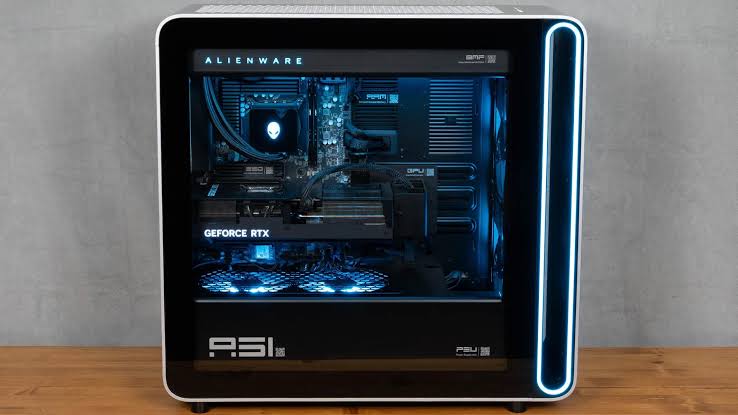
This creates positive pressure inside the chassis. Since incoming air passes through filtered areas, the design can reduce the amount of dust entering through unsealed gaps.
The cooling system helps explain the size of the case. The Area 51 takes up considerable desk or floor space, but the larger internal volume gives the processor and graphics card room to operate without excessive fan noise.
Both side panels can be removed after unlocking the case. One side uses tempered glass to display the components, while the other provides access to cables and storage bays.
Internal cable management is especially clean. Most cables pass through dedicated channels behind the motherboard area, leaving the visible section organised and unobstructed.
Connectivity covers modern displays, networking, and external storage
The rear panel includes four USB C ports. Two support USB 4 at up to 40 Gbps, while the other two provide speeds of up to 10 Gbps.
There are also several USB 2.0 ports for keyboards, mice, and other basic accessories, along with one USB A port operating at 5 Gbps.
Network connectivity includes 2.5 Gbps Ethernet, Wi Fi 7, and Bluetooth 5.4. Audio connections include analog output, line input, and optical output.
The RTX 5090 provides three DisplayPort 2.1b connections and one HDMI 2.1b port. These outputs are suitable for high refresh rate 4K monitors and other demanding display configurations.
The top front section includes two USB A ports at 5 Gbps, two USB C ports at 10 Gbps, and separate headset and microphone connections.
Alienware’s Area 51 is expensive and larger than many gaming desktops, while its limited internal expansion may disappoint some buyers. Its main strengths are strong cooling, clean assembly, modern connectivity, standardised internal parts, and extremely powerful gaming hardware.
For players who do not want to source individual components or assemble a high end system, the Area 51 offers a polished alternative built around AMD’s leading gaming processor and NVIDIA’s fastest consumer graphics card.



Discussion (0)
Be the first to comment.