


Free Apex Neural Rendering Adds Frame Generation to Older NVIDIA, AMD and Intel GPUs
Apex Compute has introduced Apex Neural Rendering (ANR), a free and open source graphics technology designed to bring AI based frame generation to a wide range of GPUs, including older models that do not support NVIDIA's latest DLSS features.
The company claims ANR can deliver better image quality and faster frame generation than NVIDIA DLSS while consuming less graphics memory.
Unlike DLSS, which is restricted to compatible NVIDIA hardware, ANR is designed to work across NVIDIA GeForce, AMD Radeon and Intel Arc graphics cards.
The technology is still under development, with frame generation currently available. Its planned Super Resolution and Ray Reconstruction features have not yet been released.
Although the initial performance claims appear promising, independent testing will be needed to determine how well ANR performs across different graphics cards and games.
ANR Supports Older GeForce GTX Cards and AMD Radeon GPUs
One of ANR's main advantages is its broad hardware compatibility.
Apex Compute says its technology supports graphics cards released several years ago, potentially giving owners of older gaming PCs access to newer rendering features.
The supported hardware includes:
| Manufacturer | Supported GPU families |
|---|---|
| NVIDIA | GeForce RTX 20, 30, 40 and 50 series |
| NVIDIA | GeForce GTX 16 series |
| AMD | Radeon RX 5000, 6000, 7000 and 9000 series |
| AMD | Steam Deck GPU |
| Intel | Arc A and B series |
This compatibility could be particularly useful for people using GPUs such as the GTX 1650 or RTX 3060.
While NVIDIA supports DLSS Super Resolution on older RTX graphics cards, some newer frame generation features remain restricted to more recent generations.
ANR aims to make similar capabilities available across a wider range of hardware.
However, support for a GPU family does not guarantee identical performance or image quality across every model.
Apex Compute Claims Lower Latency and VRAM Usage Than DLSS
Apex Compute has published benchmark results comparing ANR against NVIDIA DLSS on a GeForce RTX 5090 at 4K resolution.
According to the company's figures, ANR produces generated frames faster while requiring substantially less graphics memory.
| Benchmark | ANR | NVIDIA DLSS |
|---|---|---|
| 2X frame generation processing time | 1.01ms | 1.26ms |
| 4X frame generation processing time | 0.61ms | 0.82ms |
| Memory usage | 214MB | 562MB |
The figures suggest that ANR could offer efficiency advantages in the tested configuration.
Apex Compute has also advertised performance improvements of up to 2.4 times compared with DLSS.
However, the published figures do not clearly establish how that maximum improvement was calculated.
The comparisons were also performed using NVIDIA's high end RTX 5090 rather than older graphics cards, where performance characteristics could differ considerably.
Super Resolution and Ray Reconstruction Are Still in Development
Apex Compute plans to offer three major graphics technologies under the ANR platform.
Frame generation is already available, while Super Resolution and Ray Reconstruction remain under development.
Super Resolution is intended to reconstruct higher resolution images from lower resolution rendering, potentially improving gaming performance.
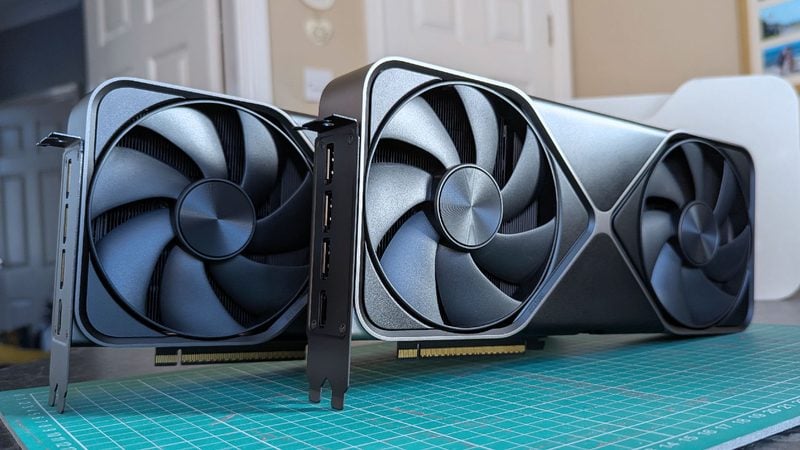
Ray Reconstruction is designed to improve the visual quality of ray traced effects.
According to Apex Compute, both technologies are currently undergoing model training.
The company has also published visual comparisons suggesting improvements in clarity and reduced ghosting compared with DLSS.
However, those demonstrations have not yet been independently verified across a representative selection of games and hardware.
ANR Is Available Free Through GitHub
Apex Neural Rendering can currently be downloaded free of charge from GitHub.
Its open source availability should make it easier for developers and hardware enthusiasts to examine the implementation and conduct independent performance testing.
The most important questions concern how effectively ANR operates on older GPUs, whether it maintains consistent frame pacing and how its generated frames affect visual quality during fast movement.
Compatibility with existing games will also be important in determining its practical usefulness.
For now, ANR provides an interesting new option for PC gamers who want frame generation capabilities without being restricted to the latest NVIDIA graphics cards.
Its broader impact will become clearer once independent benchmarks are available and the remaining rendering features are released.

Discussion (0)
Be the first to comment.