


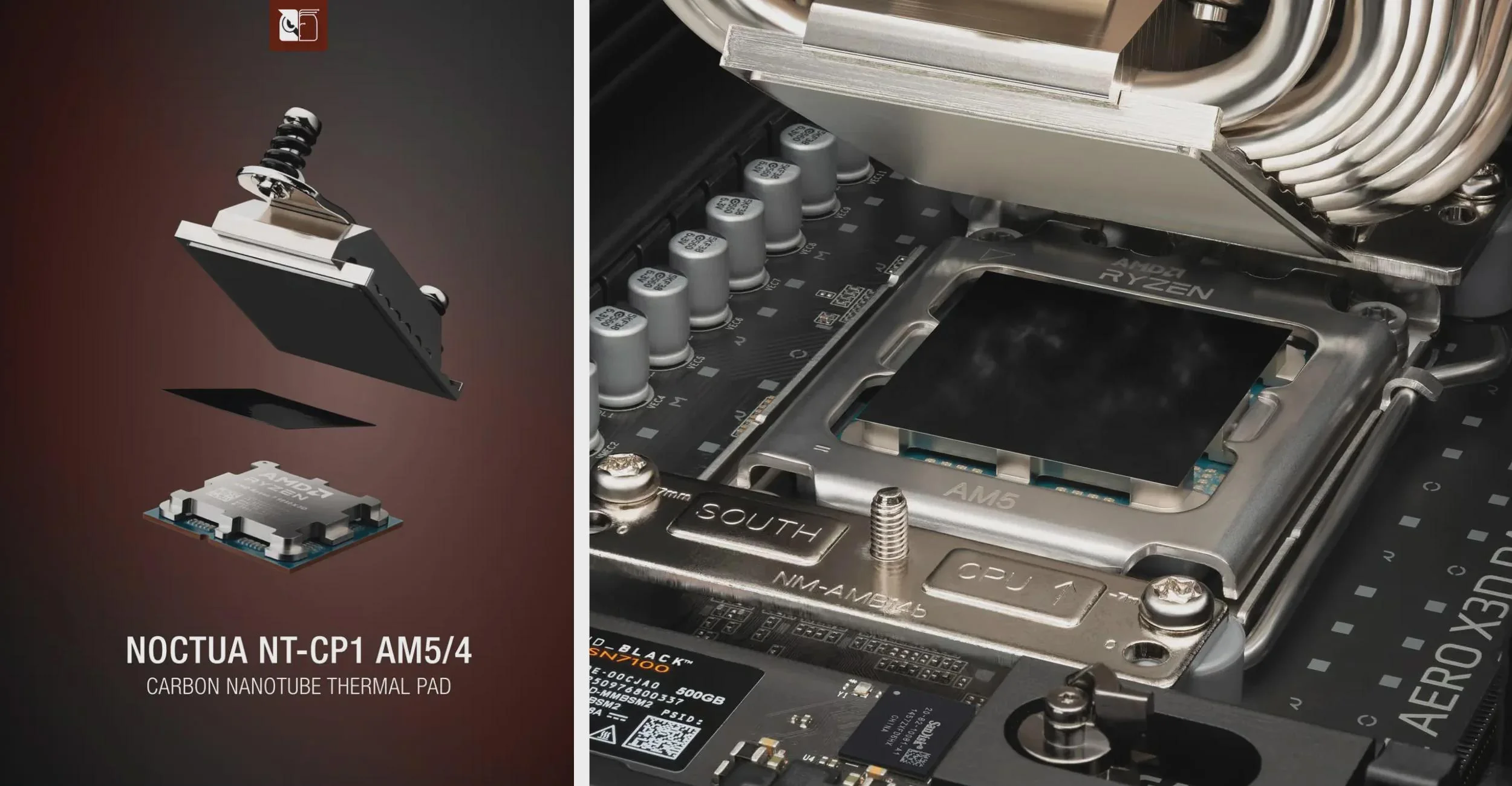
Noctua has introduced the NT-CP1 AM5/4, a new carbon nanotube thermal pad designed to provide stable CPU cooling performance for several years without the maintenance commonly associated with conventional thermal paste.
Priced at $24.95, the thermal pad is compatible with AMD AM4 and AM5 processors and uses a specialized material developed in collaboration with Carbice.
The NT-CP1 is intended for PC builders who want a convenient thermal interface that does not require spreading paste or periodic replacement.
According to Noctua, the pad can maintain consistent thermal performance over thousands of heating and cooling cycles, making it suitable for systems expected to operate for extended periods.
However, its main advantage is long term stability rather than a guaranteed improvement in CPU temperatures compared with high quality thermal paste.
Noctua NT-CP1 Uses Carbon Nanotubes Instead of Thermal Paste
The NT-CP1 uses vertically aligned carbon nanotubes to transfer heat between the processor's heat spreader and the CPU cooler.
These nanotubes are supported by an aluminum structure, while a nanoscale polymer coating helps keep the pad positioned correctly during installation.
The thermal pad measures 33 × 33mm and has a thickness of approximately 90 microns.
Its dimensions are specifically designed for AMD's AM4 and AM5 processor platforms.
Unlike conventional thermal paste, which fills microscopic gaps between two surfaces through a viscous compound, the NT-CP1 uses a solid material that gradually adapts to surface imperfections.
Noctua claims this design helps maintain reliable thermal contact without the drying or deterioration that can affect some conventional compounds over time.
Thermal Performance Could Improve After Repeated Heating Cycles
One of the more unusual characteristics of the NT-CP1 is how its thermal performance reportedly changes during initial use.
According to Noctua, the carbon nanotube structure gradually conforms to microscopic irregularities on the processor and cooler surfaces.
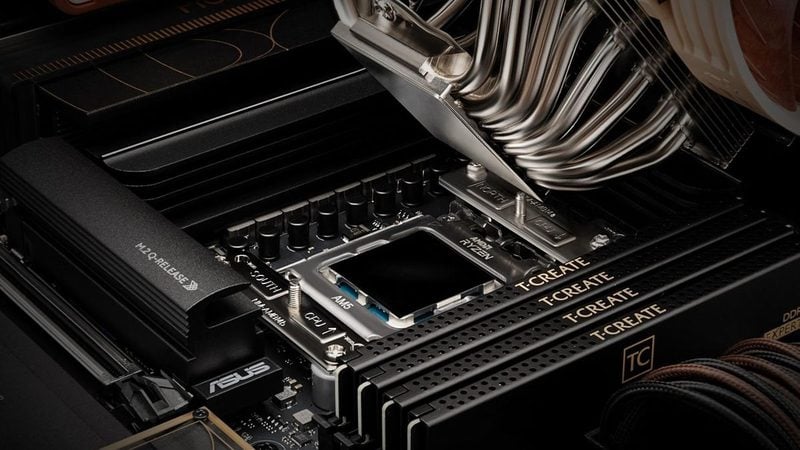
This process occurs over the first few hundred to several thousand thermal cycles.
As the material settles into these imperfections, thermal contact can improve rather than deteriorate.
Once the initial settling period is complete, Noctua claims the pad can maintain stable cooling performance for several years.
The company describes the product as a maintenance free thermal interface, although its long term performance claims will require independent testing over extended periods.
NT-CP1 Offers Easier Installation but Costs More Than Thermal Paste
Noctua has designed the NT-CP1 for straightforward installation without the need to apply or spread a thermal compound.
The process involves removing the protective film, positioning the pad on the processor and removing the remaining protective layer before installing the cooler.
This approach could appeal to PC builders who want to avoid handling thermal paste.
However, the $24.95 price makes the NT-CP1 considerably more expensive than many traditional thermal compounds.
| Specification | Noctua NT-CP1 |
|---|---|
| Product type | Carbon nanotube thermal pad |
| Compatibility | AMD AM4 and AM5 |
| Dimensions | 33 × 33mm |
| Thickness | 90 microns |
| Core material | Vertically aligned carbon nanotubes |
| Structural support | Aluminum |
| Installation | Precut pad with protective layers |
| Price | $24.95 |
A tube of conventional thermal paste can often be used for multiple CPU installations, whereas the NT-CP1 is intended as a single installation thermal interface.
For people who frequently replace processors or coolers, traditional paste may remain the more economical option.
However, the NT-CP1 could be useful for systems where long term reliability and reduced maintenance are more important than initial cost.
Noctua's latest product therefore offers an alternative approach to CPU cooling, particularly for AMD Ryzen owners who want consistent thermal performance without regularly reapplying thermal paste.

Discussion (0)
Be the first to comment.