




007 First Light will target 60 FPS on PlayStation 5, PlayStation 5 Pro, and Xbox Series X, but Xbox Series S will be limited to 30 FPS at launch. IO Interactive explained the performance targets during a new Digital Foundry interview focused on the studio’s Glacier engine and how it has been upgraded for the upcoming James Bond game.
The game launches on May 27 for PC, PlayStation 5, Xbox Series X, and Xbox Series S. Players who preorder will be able to play one day early through the free Deluxe upgrade. A Nintendo Switch 2 version is also planned later.
IO Interactive says Series S lacks the RAM and GPU headroom needed for 60 FPS at launch
On base PlayStation 5 and Xbox Series X, 007 First Light will offer a 60 FPS Performance mode and a 30 FPS Quality mode. PlayStation 5 Pro will effectively run the Quality mode visual profile at 60 FPS, helped by Sony’s new PSSR 2.0 upscaling. Other console versions use AMD FSR 3.1.5 instead.
Xbox Series S is the only current console limited to 30 FPS at launch. IO Interactive points to the console’s 10GB RAM pool and lower GPU headroom as the main reasons. The studio says the game’s systems are expensive and always active, including real time global illumination, volumetrics, dense crowds, advanced streaming, and stronger AI presentation.
| Platform | Launch target |
|---|---|
| PlayStation 5 | 60 FPS Performance mode and 30 FPS Quality mode |
| PlayStation 5 Pro | Quality mode visual profile at 60 FPS |
| Xbox Series X | 60 FPS Performance mode and 30 FPS Quality mode |
| Xbox Series S | 30 FPS Quality mode at launch |
| PC | Scales by hardware, with shader compilation on first boot |
| Nintendo Switch 2 | Coming later, performance not detailed |
IO also shared resolution targets. On PS5 Pro, the game targets 1440p internally and upscales to 4K at 60 FPS. On base PS5, Quality mode also uses 1440p upscaled to 4K at 30 FPS, while Performance mode drops to 1080p internal rendering before upscaling. Xbox Series X is expected to match the base PS5 profile.
The studio has modernized Glacier significantly for 007 First Light. The engine now uses fully real time global illumination instead of the simpler bounce lighting used in HITMAN. It also adds new volumetric systems, including IO’s in house Smolder technology, clustered lighting, better shadow management, improved crowds, and more advanced AI behavior. Animation has also been upgraded with motion matching, improved facial animation, full body interactions, and motion warping for combat and cinematic transitions.
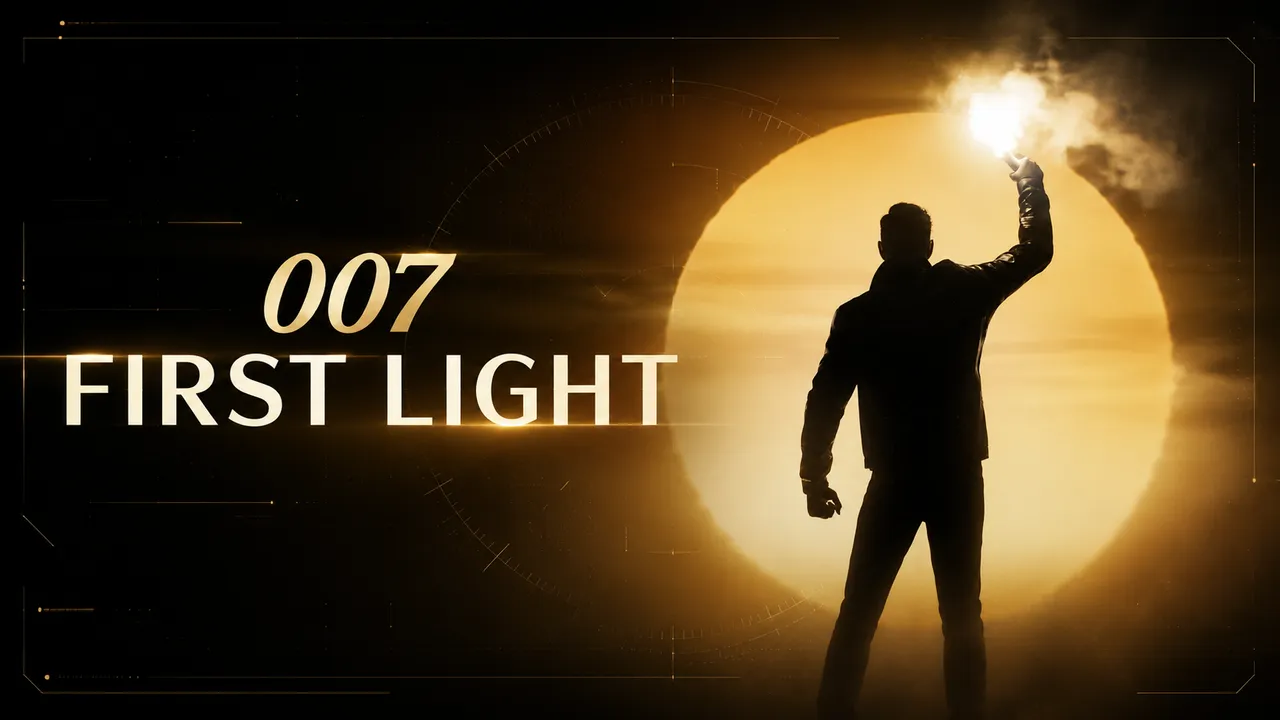
Another major change is dynamic brick streaming, which lets IO load and unload larger mission spaces in real time. That means 007 First Light can support larger areas without relying as heavily on fixed level loading. The studio says the engine is built around scalability, so features such as clustered lighting, order independent transparency, Smolder, and global illumination were designed to scale across platforms from the start.
On consoles, IO is also using a frame graph architecture and aggressive async compute to keep the GPU busy. On PlayStation hardware, the studio says it can run up to four async compute pipelines in parallel. This helps overlap tasks such as lighting and volumetrics instead of forcing everything to run in a more wasteful order.
For PC, IO says shader compilation happens when the game first boots and should usually take only minutes, or possibly less than a minute on powerful systems. Path tracing is still planned, but it will arrive after launch in a summer update rather than being available on day one.
The main takeaway is that IO Interactive is pushing Glacier much further than it did with HITMAN, but that also raises hardware demands. PS5, PS5 Pro, and Xbox Series X are getting 60 FPS options, while Series S owners will have to start at 30 FPS unless a future patch improves the situation.
Discussion (0)
Be the first to comment.