




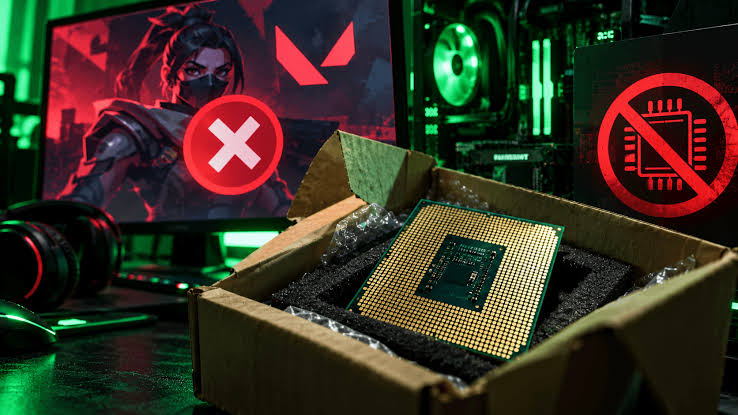
A German PC gamer says a second hand AMD Ryzen 7 5800X3D caused an immediate Valorant ban because the processor had allegedly been blacklisted by Riot Games' Vanguard anti cheat system under its previous owner.
The CPU itself reportedly worked without any problems. The issue appeared only after the buyer launched Valorant, which had worked normally with the system's previous processor.
According to the buyer, Riot support said the processor had been associated with a hardware ban issued on August 12. The buyer says the used chip was not purchased until September 21.
| Detail | Information |
|---|---|
| CPU | AMD Ryzen 7 5800X3D |
| Purchase type | Used |
| Marketplace | Kleinanzeigen |
| Game affected | Valorant |
| Anti cheat | Riot Vanguard |
| Previous hardware ban date | August 12 |
| Buyer purchase date | September 21 |
| CPU condition | Reportedly working normally |
| Riot response | Hardware restriction reportedly not removed |
Valorant stopped working after the CPU swap
The buyer reportedly purchased the Ryzen 7 5800X3D through Kleinanzeigen, a German online classifieds marketplace.
From a hardware perspective, there was no obvious problem with the processor.
The system worked, and the CPU itself apparently passed normal use without signs of damage or instability.
The problem appeared when Valorant was launched.
The game immediately removed the player from access, even though Valorant had worked normally with the system's previous processor.
That led the buyer to contact Riot support.
Riot reportedly linked the CPU to an earlier ban
According to the buyer's account, Riot support said the processor's identifier or serial number had been blacklisted as part of an earlier Vanguard hardware ban.
That ban was reportedly issued on August 12.
The buyer says the processor was not acquired until September 21, creating a clear time gap between the original restriction and the second hand purchase.
This would mean the new owner inherited a problem tied to hardware that had previously been used by someone else.
The supplied report does not include Riot's support messages directly, so these details remain based on the buyer's account.
Other components may have been blacklisted too
The situation reportedly became more serious after the used CPU was installed.
The buyer claims that additional components inside the PC, including the motherboard and storage drive, later appeared on Vanguard's blacklist as well.
That means simply reinstalling the old processor may no longer fix the problem.
Riot reportedly declined to manually remove the restriction.
If accurate, the case suggests that a banned component could potentially contribute to a broader hardware fingerprint once installed inside a new system.
It is unclear how Vanguard identified the exact CPU
The most unusual part of the story is how Vanguard could identify one physical Ryzen 7 5800X3D.
A conventional CPU hardware ID normally identifies a model or family rather than uniquely identifying one individual processor.
That raises questions about what Riot is actually using to build its hardware fingerprint.
The report suggests that Vanguard could rely on additional system identifiers, Trusted Platform Module information, or a combination of several hardware characteristics.
Riot has not publicly explained the mechanism involved in this specific case.
Because of that, it cannot be confirmed from the supplied material that the processor's serial number alone was responsible for the ban.
Vanguard can restrict access based on hardware
Riot describes Vanguard as security software made up of a user mode client and a kernel mode driver.
The system can restrict access to Riot games when a PC appears to be configured in a way that supports or facilitates cheating.
Hardware bans are designed to make it harder for banned players to simply create a new account and immediately return.
This case, however, shows a potential problem with that approach when hardware is later sold to an unrelated buyer.
A component can be physically healthy while still carrying a hidden history that cannot be identified through normal testing.
Used hardware buyers cannot easily detect this problem
Second hand PC components already come with familiar risks.
A processor may have been heavily overclocked, poorly cooled, damaged, or subjected to unusual voltage settings.
Those problems can sometimes be discovered through stress testing and visual inspection.
An anti cheat hardware restriction is different.
There may be no physical sign that the component was ever associated with cheating or a previous ban.
That makes the problem particularly difficult for used hardware buyers because a normal benchmark or stability test would not reveal it.
The case raises questions for the second hand market
The supplied report presents this as an unusual individual case rather than evidence of a widespread problem affecting used Ryzen processors.
Still, it highlights a complication that buyers and sellers may increasingly need to consider.
If anti cheat systems permanently associate hardware with previous violations, ownership changes can create difficult situations for legitimate buyers.
In this case, the Ryzen 7 5800X3D reportedly worked exactly as expected as a processor.
The problem was not performance or reliability, but the possibility that its previous history inside another PC followed it into a new system.


Discussion (0)
Be the first to comment.