



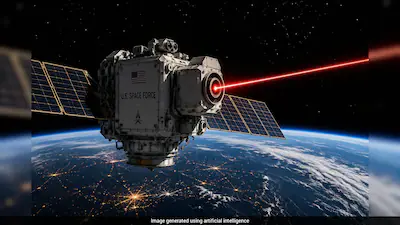
The United States has publicly confirmed that it already operates space control weapons in orbit, marking a more explicit acknowledgment of military capabilities that had previously remained largely classified or discussed in broader defensive terms.
Secretary of the Air Force Troy Meink made the disclosure during the 2026 Air, Space and Cyber Conference in National Harbor, Maryland. In an official Department of the Air Force account published on September 15, Meink said the Air Force and Space Force must prepare for rapidly evolving threats and confirmed the existence of on orbit space control weapons.
The precise capabilities of these systems remain undisclosed. Officials have not publicly said whether they use electronic warfare, directed energy, physical interception, or another method.
That distinction matters because the phrase "space control weapon" can cover a broad range of systems designed to protect friendly space assets, disrupt hostile capabilities, or help maintain access to orbital infrastructure.
Details of the deployed systems remain classified
Meink's announcement confirmed that operational hardware exists but did not provide technical specifications, numbers, orbital locations, or deployment histories.
The disclosure appears intended to make the existence of the capability public without revealing information that could reduce its military usefulness.
| Program or capability | Publicly stated status |
|---|---|
| On orbit space control weapons | Already deployed |
| Technical design | Not publicly disclosed |
| Operational details | Classified |
| Collaborative Combat Aircraft | At least 500 planned in service by 2032 |
| FQ 42 | Named Vengeance |
| FQ 44 | Named Fury |
| Mass Modular Aircraft | Under development |
| Space Based Interceptors | Development being accelerated |
The announcement came as part of a wider discussion about how the Air Force and Space Force are adapting to technologies including artificial intelligence, autonomous aircraft, and new space systems.
Meink said the services face rapidly changing technology and adversaries that are moving quickly to employ it.
Autonomous aircraft are another major part of the modernization plan
The Air Force is also expanding its use of autonomous and semi autonomous combat aircraft.
Meink confirmed that the service intends to have at least 500 Collaborative Combat Aircraft in operation by 2032. Two systems in this program have been officially named the FQ 42 Vengeance and FQ 44 Fury.
The wider CCA program is intended to provide combat aircraft that can work alongside crewed fighters. The Air Force has described the systems as a way to increase reach, awareness, and survivability while reducing the need to assign every mission to a crewed aircraft.
The department is also developing Mass Modular Aircraft, a category of lower cost uncrewed aircraft intended to provide long range combat capability while being cheaper and more replaceable than conventional high end fighters.
Space is becoming a more explicit combat domain
The confirmation of deployed space control systems reflects the growing military importance of satellites and orbital infrastructure.
Modern armed forces depend heavily on space systems for navigation, communications, missile warning, reconnaissance, targeting, and other functions. Protecting those systems while being able to counter hostile capabilities has therefore become an increasingly important part of defense planning.
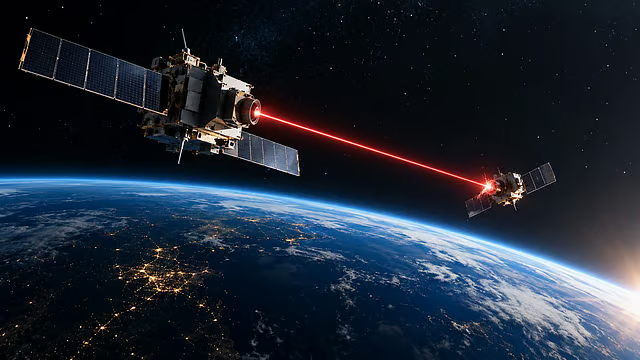
The U.S. Space Force has also been expanding programs focused on space superiority, surveillance, and tracking. Recent service announcements describe continued growth in combat forces and new systems intended to provide persistent awareness of activity in orbit and airborne threats.
One related effort is Space Based Airborne Moving Target Indication, which is designed to track airborne targets from space. The Department of the Air Force is also accelerating work on space based interceptor concepts as part of broader missile defense planning.
The public confirmation does not reveal what the deployed orbital weapons can do or how many exist. What has changed is the level of acknowledgment. The United States is now openly stating that operational space control weapons are already in orbit, while keeping their design and missions classified.


Discussion (0)
Be the first to comment.