


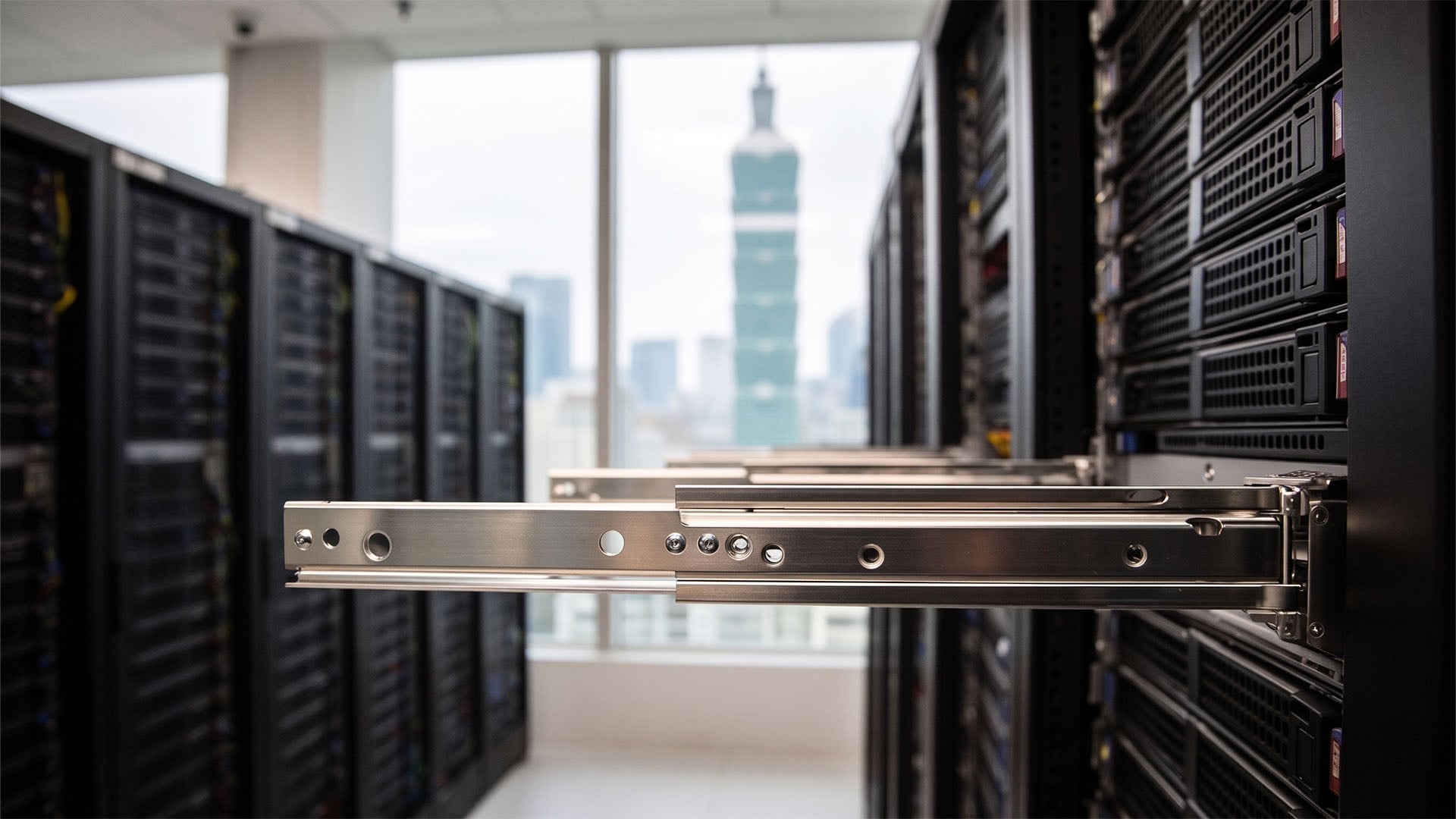
Taiwanese manufacturer King Slide Works, originally known for producing precision drawer slides for household furniture, has become a major supplier of mechanical components used in advanced AI server racks.
The company reportedly holds between 70% and 90% of the market for precision slide rails used in high end AI servers, benefiting from growing demand for powerful computing infrastructure.
These components allow technicians to extend heavy server equipment from racks for maintenance without damaging the hardware.
Although slide rails appear relatively simple, modern AI servers require extremely precise engineering because of their weight, cooling requirements and high equipment costs.
King Slide's position in this specialized market has reportedly helped it achieve unusually high profit margins, while the company continues investing in additional manufacturing capacity.
AI Server Racks Require Extremely Precise Mechanical Components
The mechanical principles behind server slide rails are similar to those used in kitchen drawers.
Both rely on metal tracks and ball bearings to allow equipment to move smoothly.
However, high performance AI servers place considerably greater demands on these components.
According to the reported specifications, a pair of server rails can measure just 6.1mm thick while supporting equipment weighing more than 40kg when fully extended.

Each rail assembly may contain over 100 individual components, with manufacturing tolerances as tight as 0.02mm.
These requirements become increasingly important as server manufacturers introduce larger and heavier computing systems.
Nvidia's Blackwell GB200 architecture, for example, requires substantial cooling infrastructure, including liquid cooling equipment and coolant pipes.
As a result, manufacturers must produce thinner mechanical rails without compromising their strength or reliability.
A mechanical failure could damage computing equipment worth hundreds of thousands of dollars, making component quality an important consideration for data center operators.
King Slide Reportedly Achieved an 87.4% Gross Margin
King Slide's specialized manufacturing capabilities have also translated into strong financial performance.
Figures cited in the report indicate that the company achieved a gross margin of 87.4% during the second quarter of 2026.
Individual rail kits reportedly sell for less than $100, despite supporting server systems that can contain millions of dollars worth of equipment.
Several factors help explain the company's position.
| Metric | Reported figure |
|---|---|
| Estimated market share | 70% to 90% |
| Rail thickness | 6.1mm |
| Supported server weight | Over 40kg |
| Manufacturing tolerance | 0.02mm |
| Components per rail assembly | Over 100 |
| Patents held | Approximately 3,750 |
| Q2 2026 gross margin | 87.4% |
| Planned capital expenditure | Over $600 million |
The company reportedly holds around 3,750 patents covering manufacturing techniques, specialized tooling, surface treatments and locking mechanisms.
These patents, combined with its production experience, make it difficult for competitors to develop comparable products quickly.
King Slide Plans More Than $600 Million in Manufacturing Expansion
King Slide has reportedly approved over $600 million in capital expenditure to construct what is expected to become the world's largest server rail manufacturing facility.
The investment reflects expectations of continued demand from AI infrastructure projects.
However, the company faces competition from another Taiwanese manufacturer, Nan Juen, which has reportedly entered Nvidia's GB200 supply chain.
As AI server installations expand, suppliers of mechanical components are becoming increasingly important to the broader semiconductor and data center industries.
King Slide's reported market position illustrates how specialized manufacturing companies can benefit from AI infrastructure spending without producing processors, memory chips or other electronic components.



Discussion (0)
Be the first to comment.