



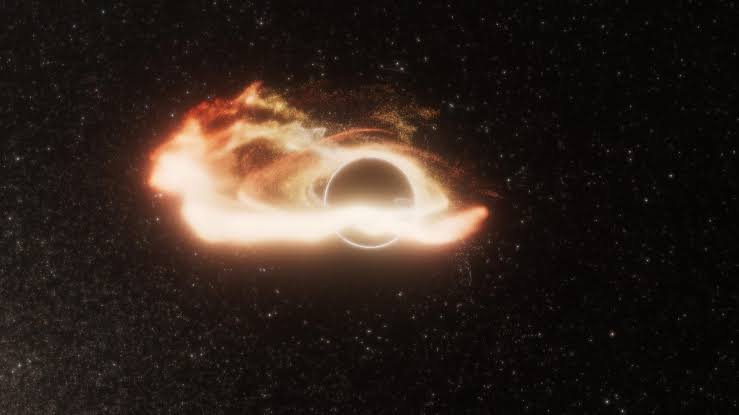
Astronomers have observed a supermassive black hole destroying a star more than 30,000 light years from the center of its host galaxy, offering rare evidence that large black holes can wander far beyond galactic cores.
The event occurred in the galaxy WISEA J014656.04-152214.7, located about 750 million light years from Earth in the constellation Cetus. The black hole is estimated to have a mass roughly one million times greater than the Sun.
Supermassive black holes are usually found near the centers of galaxies. Their strong gravity influences nearby stars, gas, and dust. This discovery is unusual because the black hole was located far from the central region, where astronomers normally expect to find one.
Researchers believe the black hole may have been pushed away from the center during an earlier galactic merger. When galaxies collide, their central black holes can interact in complex ways. In some cases, one may be thrown into a wide orbit or forced into the outer region of the merged galaxy.
Because black holes do not produce visible light on their own, a wandering object like this can remain hidden until it interacts with nearby matter.
A passing star revealed the hidden black hole
The black hole became visible after a star moved too close and was destroyed by extreme tidal forces.
Gravity pulled more strongly on the side of the star nearest the black hole than on the opposite side. This difference stretched the star and eventually tore it apart in an event known as a tidal disruption.
Some of the star’s material formed a hot disk around the black hole. The event also produced a powerful jet moving at very high speed.
At its brightest, the eruption produced light equal to about 10 billion Suns. For a short period, it became bright enough to outshine the entire galaxy around it.
| Observation | Key detail |
|---|---|
| Distance from Earth | About 750 million light years |
| Distance from galactic center | More than 30,000 light years |
| Black hole mass | Around one million solar masses |
| Gas temperature | About 30,000 degrees Celsius |
| Peak brightness | Roughly 10 billion times the Sun |
| Event type | Tidal disruption event |
| Host galaxy | WISEA J014656.04-152214.7 |
Artificial intelligence helped find the event
The event was first detected in data collected by the Zwicky Transient Facility at Palomar Observatory in California.
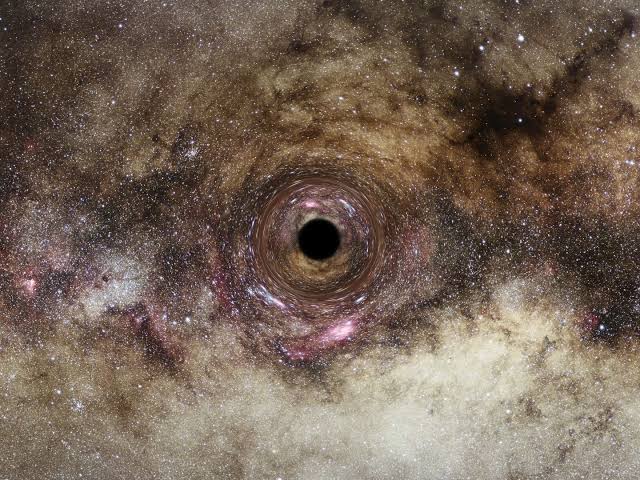
Wide field surveys record hundreds of thousands of temporary changes in brightness every night. Most are linked to known events such as exploding stars, variable stars, or activity near galactic centers.
An artificial intelligence system developed by researchers identified an unusual light pattern consistent with a tidal disruption event. The location made it especially interesting because it appeared far from the galaxy’s center.
Further observations measured the temperature of the glowing material at roughly 30,000 degrees Celsius, or about 54,000 degrees Fahrenheit.
The combined data allowed scientists to confirm that the light came from a star being destroyed by an off center black hole.
The discovery may change where astronomers search
Until recently, many searches for tidal disruption events focused on the central regions of galaxies. That strategy made sense because most known supermassive black holes sit near galactic cores.
This observation shows that astronomers may also need to study the outer regions of galaxies. Other wandering black holes could be present but remain invisible because they have not encountered a nearby star.
Future observatories will be able to monitor much larger sections of the sky with greater sensitivity. They may identify more unusual flashes and help researchers estimate how common displaced black holes are.
A larger collection of these events could also improve understanding of how galaxies merge and how their central black holes interact. The location of a wandering black hole may preserve evidence of a collision that happened millions or billions of years earlier.
The star involved in this event was destroyed, but its final moments revealed an object that would otherwise have remained hidden. The discovery provides the strongest confirmed example so far of a tidal disruption event occurring far from a galactic center.



Discussion (0)
Be the first to comment.