



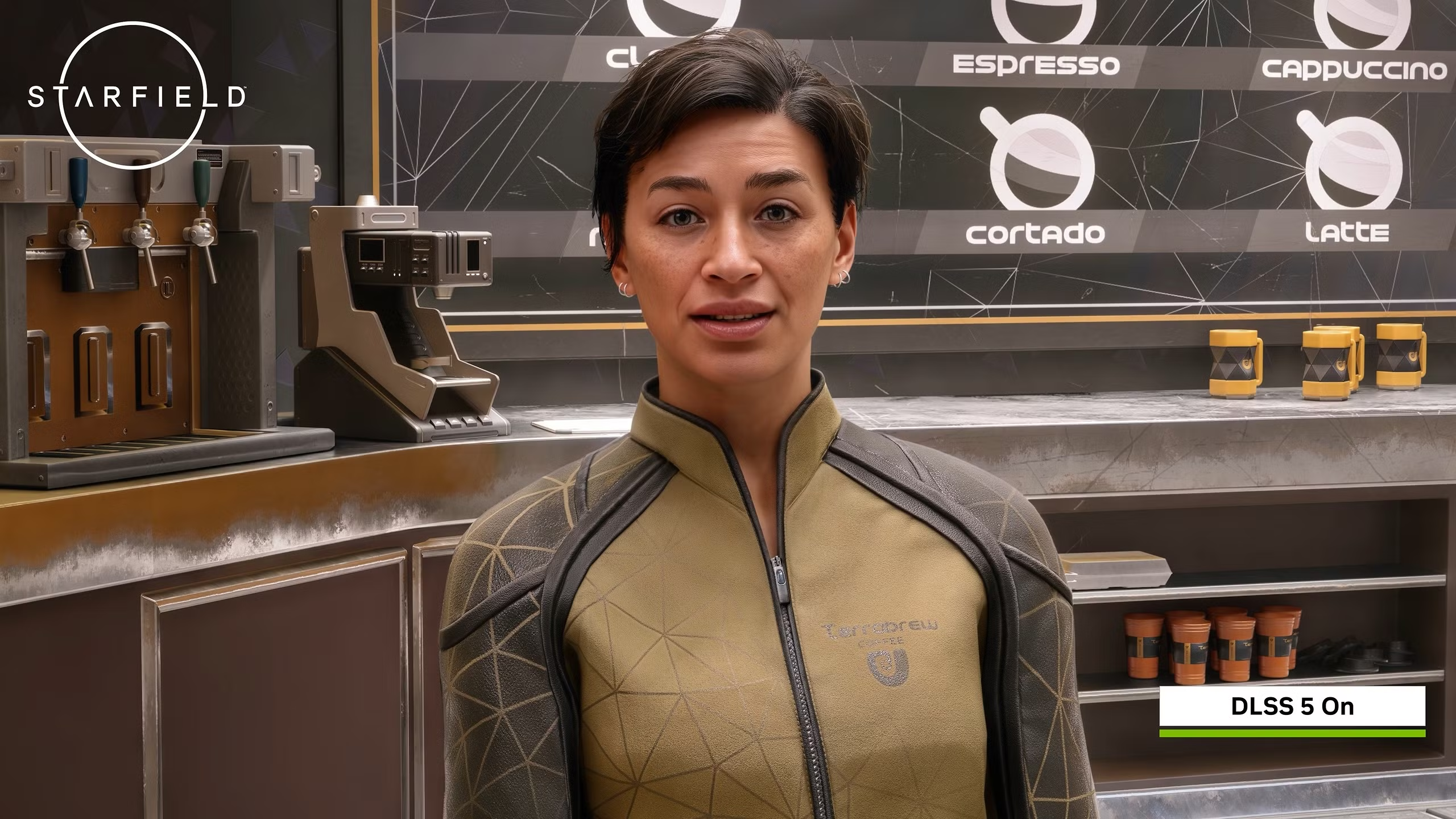
Roblox has revealed an ambitious new technology called Roblox Reality, designed to dramatically upgrade visuals using AI—similar in concept to NVIDIA’s DLSS 5, but with a completely different approach.
The idea: turn simple graphics into photorealistic visuals
At its core, Roblox Reality uses AI to:
- Reconstruct lighting, textures, and materials
- Add detail on top of simpler game graphics
- Output a photorealistic video stream (up to 2K/60 FPS)
Instead of rendering everything traditionally, the system enhances visuals after the fact using AI.
A hybrid system: game engine + AI model
Roblox Reality splits the workload into two parts:
1. Game engine (cloud)
- Handles gameplay logic
- Physics, collisions, player movement
- Acts as the “source of truth”
2. AI model (“Super Upsampler”)
- Runs on powerful cloud GPUs
- Generates visuals like:
- Lighting
- Textures
- Fluid effects
- Secondary motion
This separation allows Roblox to keep gameplay accurate while upgrading visuals independently.
The big difference from DLSS 5
While both aim for AI-enhanced graphics, they work very differently:
| Feature | Roblox Reality | DLSS 5 |
|---|---|---|
| AI location | Cloud / edge servers | Local GPU |
| Input data | Full 3D spatial data | 2D frame data |
| Device support | Any device (cloud-based) | RTX GPUs only |
| Integration | Built into Roblox engine | Works across many engines |
| Output | Video stream | Rendered frame |
Why this matters
- Roblox Reality has deeper access to game data, which can improve accuracy
- DLSS 5 has lower latency, since it runs locally
Each approach solves a different problem.
The biggest advantage: works on any device
Because the heavy AI work runs in the cloud:
- Phones
- Low-end PCs
- Tablets
…could all potentially display high-end visuals without powerful hardware.
That’s a huge advantage for Roblox, which has a massive casual audience across devices.
The trade-off: latency
Cloud-based rendering comes with a downside:
- Higher latency compared to local rendering
For fast-paced games, this could be noticeable. But Roblox is betting that:
- Its audience is more tolerant of slight delays
- Visual upgrades are worth the trade-off
Still early—and not ready yet
There are still major challenges:
- Scaling to millions of players
- Managing server costs
- Keeping latency low
There’s also no release timeline yet.
The bigger picture: AI is changing how games are rendered
Roblox Reality shows a broader shift happening in gaming:
- Traditional rendering → AI-assisted rendering
- Local hardware → cloud + hybrid systems
- Fixed visuals → dynamic, generated visuals
It also proves NVIDIA isn’t the only company exploring this space.
The takeaway: ambitious, but experimental
Roblox Reality is not just a graphics upgrade—it’s a different way of building games:
- Offload visuals to AI
- Keep gameplay logic separate
- Deliver high-end visuals to low-end devices
If it works, it could:
- Lower the barrier to high-quality game development
- Expand what Roblox creators can build
- Change expectations for visual quality across platforms
But it’s still early—and the biggest question remains:
can it scale without sacrificing performance or responsiveness?
Discussion (0)
Be the first to comment.