



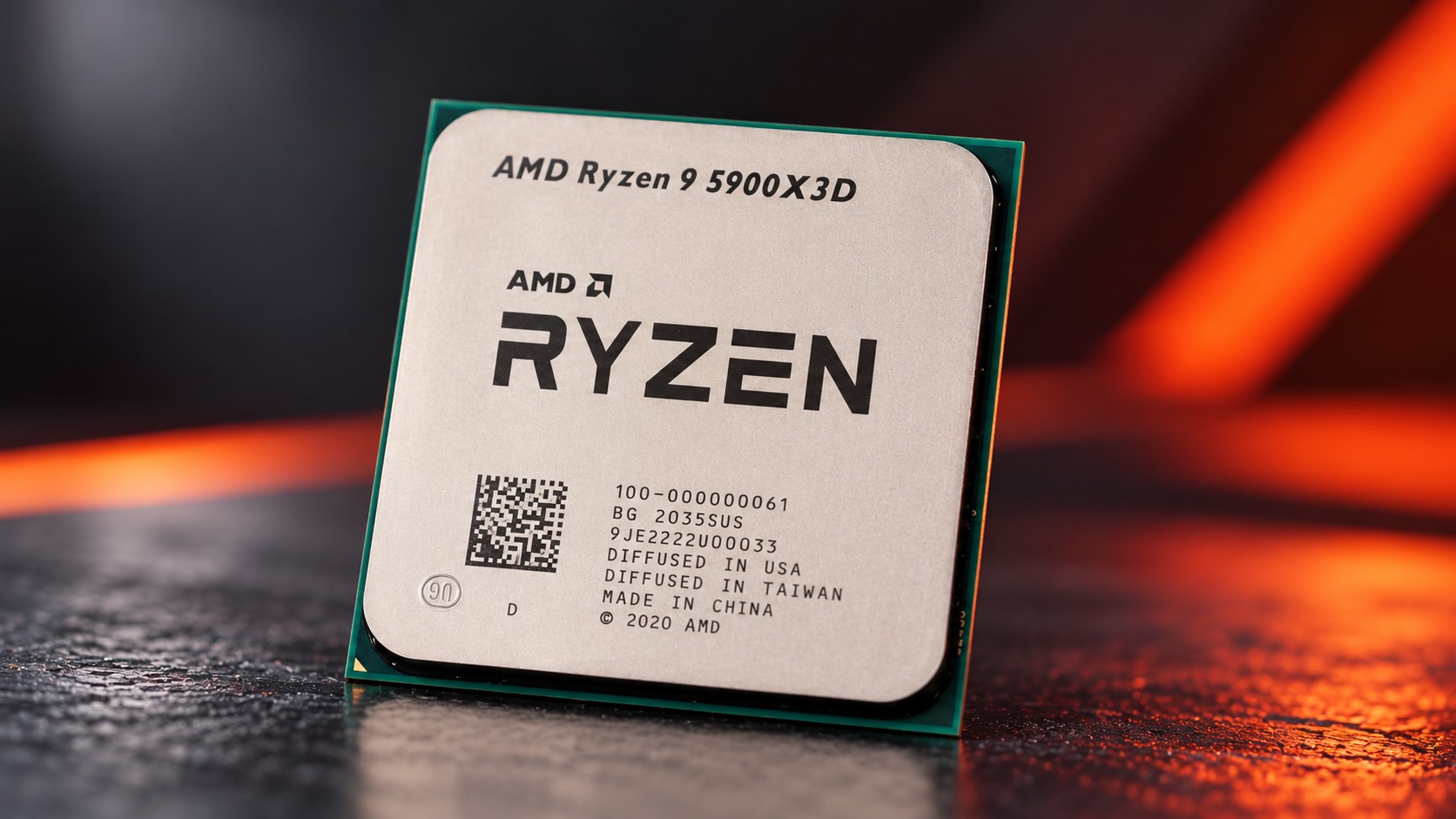
A rare engineering sample of AMD’s unreleased Ryzen 9 5900X3D has appeared online with a different cache configuration than the version previously shown by AMD.
The processor reportedly features 12 cores, 24 threads, and 128MB of total L3 cache. That is lower than the 192MB configuration associated with earlier Ryzen 9 5900X3D samples, but the newly surfaced chip also appears to run at noticeably higher clock speeds.
The sample was detected in CPU monitoring tools including CPU Z, where it reportedly reached around 4.65GHz, while another utility showed approximately 4.73GHz.
| Specification | Reported engineering sample |
|---|---|
| Processor | Ryzen 9 5900X3D |
| Architecture | Zen 3 |
| Socket | AM4 |
| Cores / Threads | 12 / 24 |
| Total L3 cache | 128MB |
| Cache arrangement | 32MB + 96MB |
| 3D V Cache CCDs | One |
| Reported clock | Around 4.65GHz to 4.73GHz |
| TDP shown | 105W |
| Retail status | Unreleased |
Only one CCD appears to have 3D V Cache
The most interesting part of the sample is its cache layout.
AMD’s earlier unreleased Ryzen 9 5900X3D design was associated with 192MB of total L3 cache.
Because the Ryzen 9 5900X3D uses two CCDs, that configuration would require both chiplets to carry additional 3D V Cache.
Each CCD would effectively provide 96MB of L3 cache, producing a total of 192MB.
The newly discovered engineering sample is different.
It reportedly contains 128MB of total L3 cache through a 32MB plus 96MB arrangement.
That suggests only one CCD contains the additional 3D V Cache chiplet, while the second CCD remains in its standard configuration.
The sample may represent a later design
The person who shared the processor claims it carries a later engineering sample identifier and stepping.
That could indicate the chip was developed after the earlier dual cache version shown publicly.
The report suggests this may have been a more mature configuration and possibly closer to what AMD was considering for a commercial launch.
However, AMD never released the Ryzen 9 5900X3D, so there is no confirmation that this exact design was intended for retail production.
The processor remains an engineering sample rather than an officially announced product.
Clock speeds appear higher than earlier samples
Another important difference is frequency.
The newly surfaced Ryzen 9 5900X3D reportedly reached around 4.65GHz in CPU Z and approximately 4.73GHz in another monitoring application.
Earlier information about the dual 3D V Cache version indicated boost clocks around 4.4GHz.
The difference could be significant because early generations of X3D processors generally had more limited frequency headroom.
The extra cache chiplet can make voltage and thermal management more difficult, which may restrict maximum operating clocks.
Using 3D V Cache on only one CCD could potentially have allowed AMD to maintain higher frequencies on the processor.
The supplied material presents this as a possible explanation rather than a confirmed reason for the design change.
AMD considered higher end Zen 3 X3D processors
AMD had previously shown unreleased Ryzen 9 5950X3D and Ryzen 9 5900X3D processors.
Both chips were based on the Zen 3 architecture and used two CCDs.
Those designs were eventually cancelled, leaving AMD to focus its AM4 X3D lineup on other models.
The company ultimately released processors including the Ryzen 7 5800X3D, Ryzen 7 5700X3D, Ryzen 5 5600X3D, and Ryzen 5 5500X3D.
The Ryzen 9 models never reached retail.
The new sample shows AMD experimented with different layouts
The appearance of the 128MB sample suggests AMD tested more than one approach for its high end Zen 3 X3D processors.
The earlier known design placed 3D V Cache on both CCDs.
This engineering sample appears to use the technology on only one CCD.
That change would reduce total cache from 192MB to 128MB but may have provided better frequency behavior.
It also shows that AMD was still experimenting with how to balance cache capacity and clock speed before cancelling the product.
The processor is unlikely to have any direct impact on current AMD products, but it offers a rare look at the development work behind the company’s early X3D strategy.
For collectors and hardware enthusiasts, the unusual cache layout makes this Ryzen 9 5900X3D engineering sample especially interesting because it represents a configuration that never reached the consumer market.



Discussion (0)
Be the first to comment.