



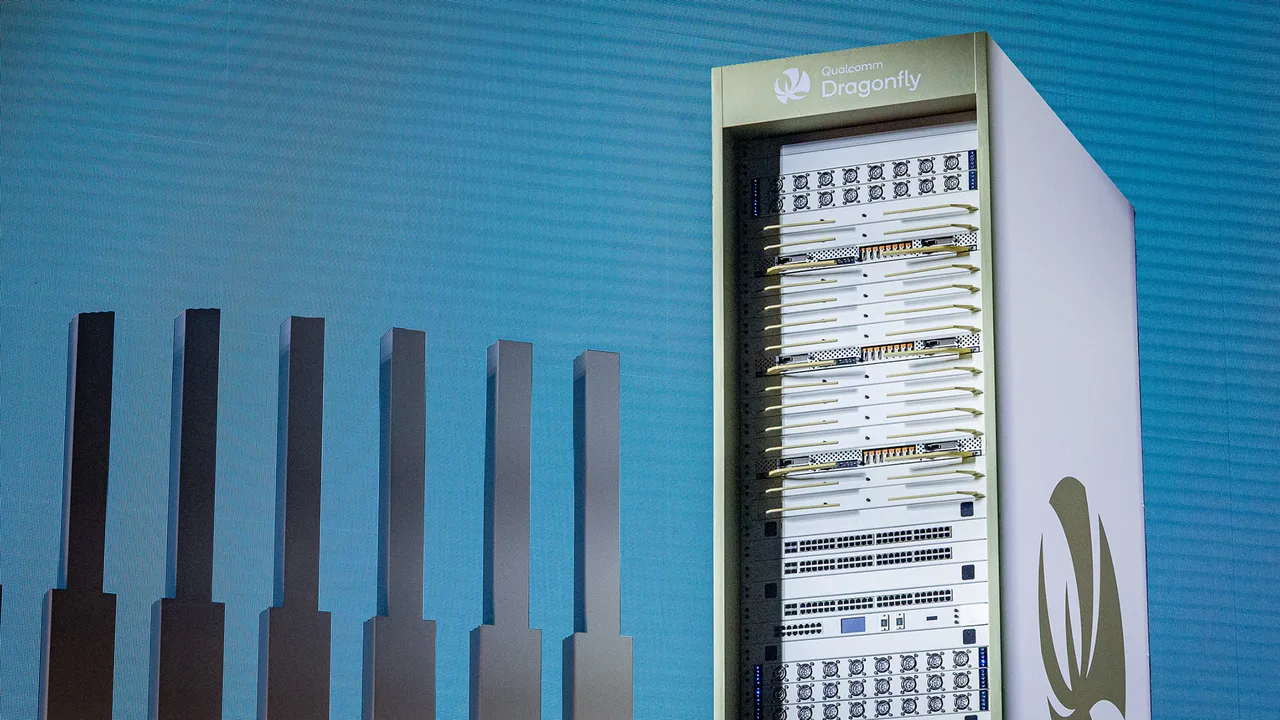
Qualcomm has announced the Dragonfly C1000, its first server CPU designed for AI data centers and large scale cloud workloads. The company says the chip will use its custom Oryon CPU architecture, exceed 250 cores, reach clock speeds above 5GHz, and aim for leading single core performance when commercial systems arrive in 2028.
The Dragonfly C1000 is part of Qualcomm’s broader push into AI infrastructure. Instead of focusing only on AI accelerators, the company wants to provide processors that can manage the general purpose and orchestration work surrounding large AI deployments.
That includes hosting services, managing data movement, coordinating accelerators, handling low latency requests, and supporting interactive AI applications. Qualcomm believes those workloads need more efficient CPUs as AI clusters become larger and more complex.
Dragonfly C1000 Will Use a Multi Chiplet Design
Qualcomm says the C1000 will use a multi chiplet design, allowing the processor to scale core counts, input and output capacity, and memory resources. The main CPU chiplet is expected to feature more than 250 cores.
The company is also promising frequencies above 5GHz, which would be unusually high for a server processor with such a large number of cores. Qualcomm claims the chip will deliver single threaded performance leadership, though it has not yet shared independent benchmarks or direct comparisons against competing products.
| Dragonfly C1000 Feature | Qualcomm’s Claim |
|---|---|
| CPU architecture | Custom Oryon design |
| Core count | More than 250 cores |
| Clock speed | Above 5GHz |
| Connectivity | More than 2TB per second of PCIe Gen 7 bandwidth |
| Memory expansion | Optional HBC memory support |
| Cooling options | Air and liquid cooled servers |
| Availability | Expected in 2028 |
The processor will reportedly include PCIe Gen 7 and CXL connectivity, giving it access to fast storage, networking hardware, memory expansion, and external accelerators. Qualcomm says the platform will support next generation AI systems, including its own Dragonfly accelerator products.
Qualcomm Is Targeting Agentic AI and General Purpose Workloads
The company plans to divide the Dragonfly CPU portfolio into several categories. One will focus on agentic AI orchestration and low latency interactive services. Another will target general purpose cloud workloads, while a third design will act as a head node processor for AI accelerator clusters.

This approach reflects a growing change in the data center market. GPUs remain essential for AI training and inference, but CPUs are still needed to run operating systems, prepare data, manage networking, control accelerators, and handle the many services surrounding a large AI platform.
Qualcomm also says the C1000 can use optional HBC memory technology to increase memory capacity and effective bandwidth. The processor will include reliability and security features such as ECC memory correction, fault isolation, and error recovery.
The Server CPU Market Will Be Far More Competitive by 2028
The Dragonfly C1000 will enter a difficult market. AMD is preparing Zen 6 based EPYC Venice processors, Intel is developing future Xeon platforms, and NVIDIA is expanding its own server CPU roadmap with Vera and later designs.
Arm based server CPUs are also gaining attention as cloud companies look for better efficiency and lower operating costs. Qualcomm will need to prove that its Oryon architecture can perform well across real enterprise workloads, not only in selected AI tasks.
The company already has a multigeneration agreement with Meta for future Dragonfly data center CPUs, which could provide an important early customer relationship. Still, the C1000 remains two years away from commercial availability.
Qualcomm’s claims are ambitious, particularly around 250 plus cores, 5GHz clocks, and single core leadership. Until working hardware and independent testing arrive, the Dragonfly C1000 should be viewed as an early roadmap announcement. But it shows Qualcomm is serious about competing for a place in the next generation of AI data centers.



Discussion (0)
Be the first to comment.