



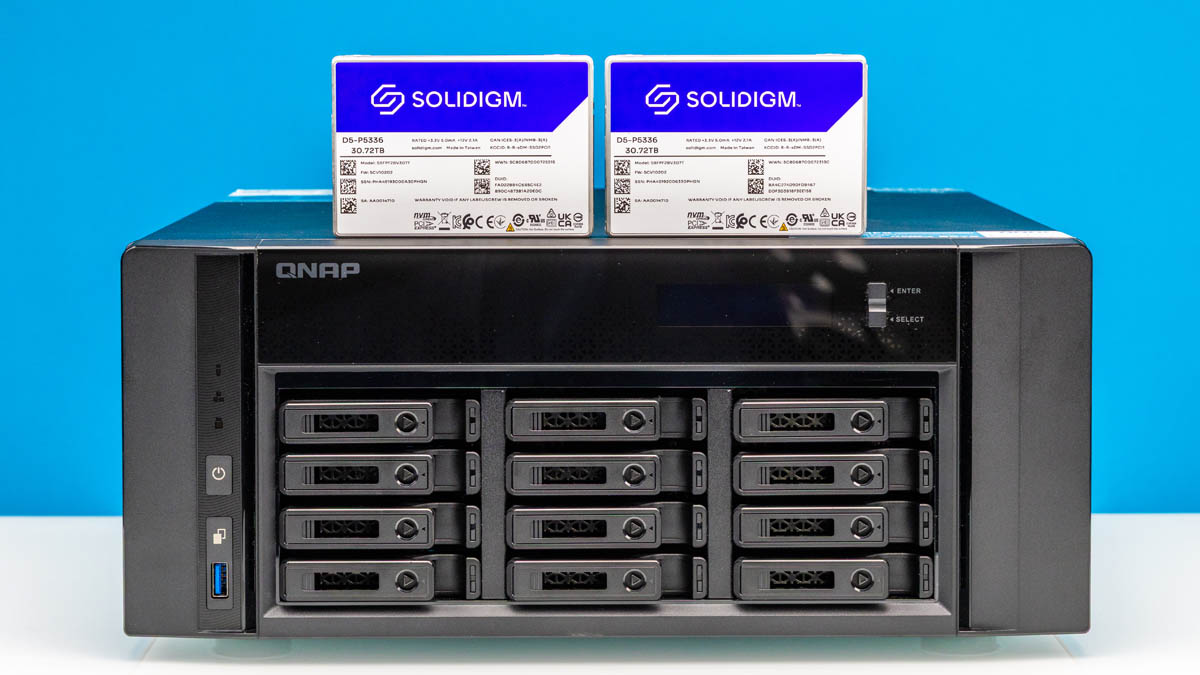
QNAP has introduced the QAI h1290FX, a new edge AI NAS built for local AI work, storage heavy workflows, and on premise deployments. The interesting part is the hardware pairing. It uses an older AMD EPYC 7302P processor from the Zen 2 era, but can be equipped with NVIDIA’s much newer RTX PRO 6000 Blackwell GPU with 96GB of VRAM.
The system is aimed at workloads such as LLM inference, RAG, document search, private AI assistants, image generation, and other local GenAI tasks. In simple terms, it is a storage server that can also run serious AI workloads without sending sensitive data to the cloud.
QNAP is focusing on local AI and private data
The CPU is not new, but it still has 16 cores and 32 threads, which is enough for storage management, containers, virtualization, and general server work. The GPU is where most of the AI performance comes from.
QNAP offers two GPU paths. The RTX PRO 4500 Blackwell with 32GB VRAM is aimed at smaller models up to around 30B parameters. The RTX PRO 6000 Blackwell with 96GB VRAM is meant for larger 70B plus models and heavier local inference.
| Feature | QNAP QAI h1290FX |
|---|---|
| CPU | AMD EPYC 7302P with 16 cores and 32 threads |
| GPU options | RTX PRO 4500 Blackwell or RTX PRO 6000 Blackwell |
| Max GPU memory | 96GB VRAM |
| Storage | 12 U.2 NVMe or SATA SSD bays |
| Networking | Dual 25GbE and dual 2.5GbE |
| Expansion | Optional 100GbE cards and JBOD storage |
| Warranty | Five years |
The all flash storage design is important. AI workloads often need fast access to large datasets, embeddings, documents, and model files. With 12 U.2 NVMe or SATA SSD slots, the system is built to keep data close to the AI hardware instead of depending on slower external storage.
QNAP also supports Docker and LXD, with a built in AI app center and easier GPU allocation. That should make it more approachable for teams that want to run AI tools locally without building every container workflow from scratch.
The company also shared performance results using the RTX PRO 6000 Blackwell model. In Ollama, QNAP reports up to 90 tokens per second on gpt oss 120b using around 63GB VRAM, 24 tokens per second on DeepSeek R1 70B using around 41GB VRAM, and 172 tokens per second on Qwen3 8B using around 7GB VRAM.
The pricing puts this firmly in business territory. The system starts at $8,999 for the 64GB model, rises to $13,499 for 128GB, and reaches $15,999 for the 256GB version. RAM modules and several expansion cards are sold separately.
The old CPU choice may look strange beside a new Blackwell GPU, but it makes sense for this kind of box. Most AI acceleration happens on the GPU, while the CPU handles server tasks. Using an older EPYC platform may also help QNAP control cost and keep the system stable for NAS workloads.
The QAI h1290FX is not for normal home storage. It is for businesses that want local AI, fast storage, private data handling, and high capacity networking in one device. The main appeal is control. You can build AI assistants, RAG search, and model serving inside your own infrastructure instead of relying fully on cloud services.


Discussion (0)
Be the first to comment.