



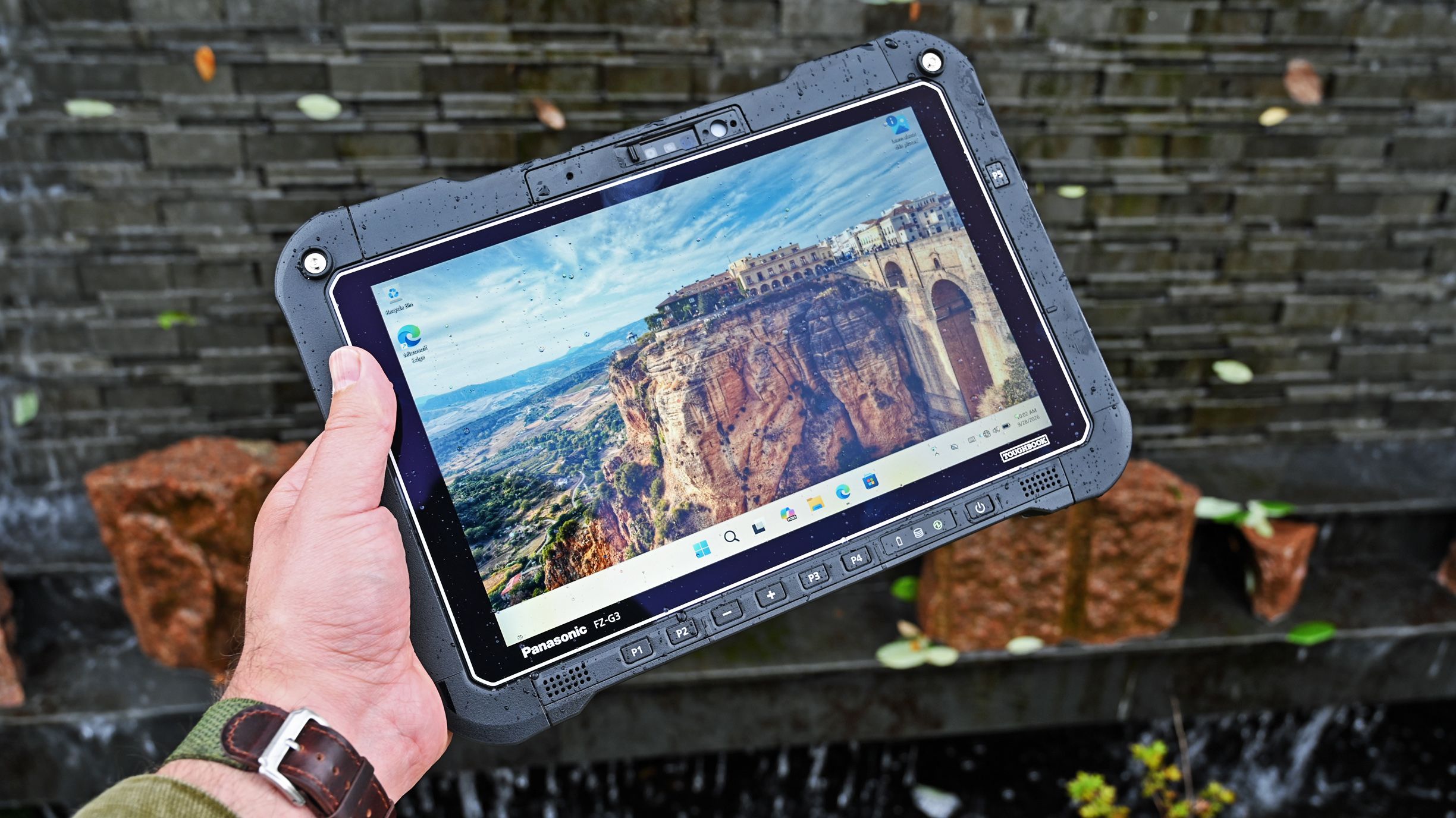
Panasonic is expanding its rugged TOUGHBOOK lineup with two new fully rugged 2 in 1 systems designed to do much more than survive drops, rain, dust, and extreme temperatures.
The new TOUGHBOOK 34 and TOUGHBOOK G3 are being positioned as AI capable edge computers for police vehicles, military operations, emergency response, utilities, warehouses, and other demanding environments. Panasonic demonstrated the systems handling local AI workloads, drone reconnaissance data, and vehicle fleet information without depending entirely on cloud connectivity.
The TOUGHBOOK 34 replaces the TOUGHBOOK 33, while the smaller G3 succeeds the G2.
| Feature | TOUGHBOOK 34 | TOUGHBOOK G3 |
|---|---|---|
| Display size | 12.4 inches | 10.1 inches |
| Main use | Vehicles, command centers, information heavy work | Portable field work |
| Processor options | Core Ultra 5 335H, Ultra X7 368H | Core Ultra 5 335H, Ultra X7 368H |
| Local AI | Built in NPU | Built in NPU |
| Expansion | xPAK modules | xPAK modules |
| Connectivity | Modern wireless and cellular support | 5G, Wi Fi 7, Bluetooth 5.4 |
| Rugged focus | Rain, dust, vibration, temperature extremes | Compact rugged field use |
Core Ultra processors bring local AI processing
One of the biggest upgrades is the move to Intel's latest Core Ultra platform.
Both systems can be configured with Core Ultra 5 335H or Ultra X7 368H processors, which include onboard NPUs for AI acceleration. Panasonic is using that hardware to position the devices as local AI systems that can process data even when an internet connection is unavailable.
That is particularly important for military and government work.
Panasonic said personnel operating aboard ships or in tactical environments may intentionally work without network connectivity for security reasons. Local AI processing can still allow them to search technical, medical, or tactical information directly on the device.
For these workloads, the NPU is less about consumer AI features and more about keeping critical processing available when cloud services cannot be reached.
TOUGHBOOK can act as a drone intelligence terminal
Panasonic demonstrated the new systems working alongside tactical reconnaissance drones.
The company showed how platforms such as Teledyne FLIR ION series drones can send imagery and reconnaissance information to a TOUGHBOOK, where the data can be recorded, analyzed, and processed locally.
Separate controls still handle the drone itself, while the TOUGHBOOK becomes the analysis and information terminal.
Panasonic also says the devices support unmanned systems control and UAV ground control applications for federal customers.
This gives the systems a role beyond that of a conventional rugged laptop, especially in environments where field teams need to analyze sensor data without sending it to remote servers.
Police fleets can use AI to query vehicle data
Another demonstration focused on law enforcement vehicles.
Through Panasonic's TOUGHCommand ecosystem, agencies can connect vehicle systems to a TOUGHBOOK and collect information such as VIN numbers, mileage, fuel levels, vehicle speeds, maintenance records, and diagnostic fault data.
Panasonic's Command Intelligence features then allow fleet managers and IT teams to ask questions about that data using natural language.
Instead of manually searching through large databases, staff can query the system directly.
For organizations running hundreds or thousands of vehicles, that could turn the TOUGHBOOK into a centralized fleet management and command platform.
TOUGHBOOK 34 uses a larger 12.4 inch screen
The TOUGHBOOK 34 is designed for people who spend more time inside vehicles or command environments.
It uses a 12.4 inch display with a 3:2 aspect ratio, replacing the 12 inch panel found on the older generation.
Panasonic says the new dimensions and scaling allow more information to remain visible with less scrolling, which can help with command software and information dense applications.
The company has also added improved glove and rain touch support.
Workers can switch between standard and glove touch modes through programmable controls, allowing the display to remain usable without requiring heavy protective gloves to be removed.
TOUGHBOOK G3 stays compact for field work
The G3 continues with a smaller 10.1 inch form factor.
That makes it easier to carry into ambulances, disaster areas, utility sites, warehouses, and other environments where portability matters more than maximum screen size.
Panasonic gave one example where emergency services could use the larger TOUGHBOOK 34 for vehicle based command and dispatch work while using the G3 in ambulances for patient care.
The G3 display also offers brightness adjustment from 2 to 1,000 nits, supporting both low light conditions and outdoor visibility.
Modular xPAK system remains a major feature
Both systems continue to support Panasonic's xPAK modular expansion system.
Customers can change hardware modules depending on the job instead of replacing the entire computer.
Available options include barcode scanners, USB ports, serial connections, smart card readers, fingerprint readers, and networking hardware.
A warehouse worker could install a scanner, while a utility technician might prioritize GPS or networking.
Vehicle technicians could add older serial connections for diagnostics.
The modules can also be changed locally, which is useful for government systems containing sensitive data that organizations may not want to send away for hardware reconfiguration.
Connectivity receives a major upgrade
The G3 also receives significant wireless improvements compared with the previous G2.
Panasonic moves from optional 4G LTE to modern 5G support, upgrades Wi Fi 6 to Wi Fi 7, and moves Bluetooth from version 5.1 to 5.4.
The systems also support broader private cellular network deployments.
These changes are particularly relevant for emergency services, utilities, and government teams working across private 5G networks or areas with specialized connectivity requirements.
Panasonic is turning rugged PCs into edge computers
Panasonic's main change with the TOUGHBOOK 34 and G3 is not simply better ruggedness.
The company increasingly sees these systems as secure, connected edge computers capable of handling AI and operational data directly in the field.
They can analyze drone feeds, manage police fleets, support first responders, connect over private networks, and continue processing information when cloud access is unavailable.
Thirty years after the first TOUGHBOOK arrived, Panasonic is keeping the same rugged design philosophy while giving the devices a much broader role in field computing.



Discussion (0)
Be the first to comment.