



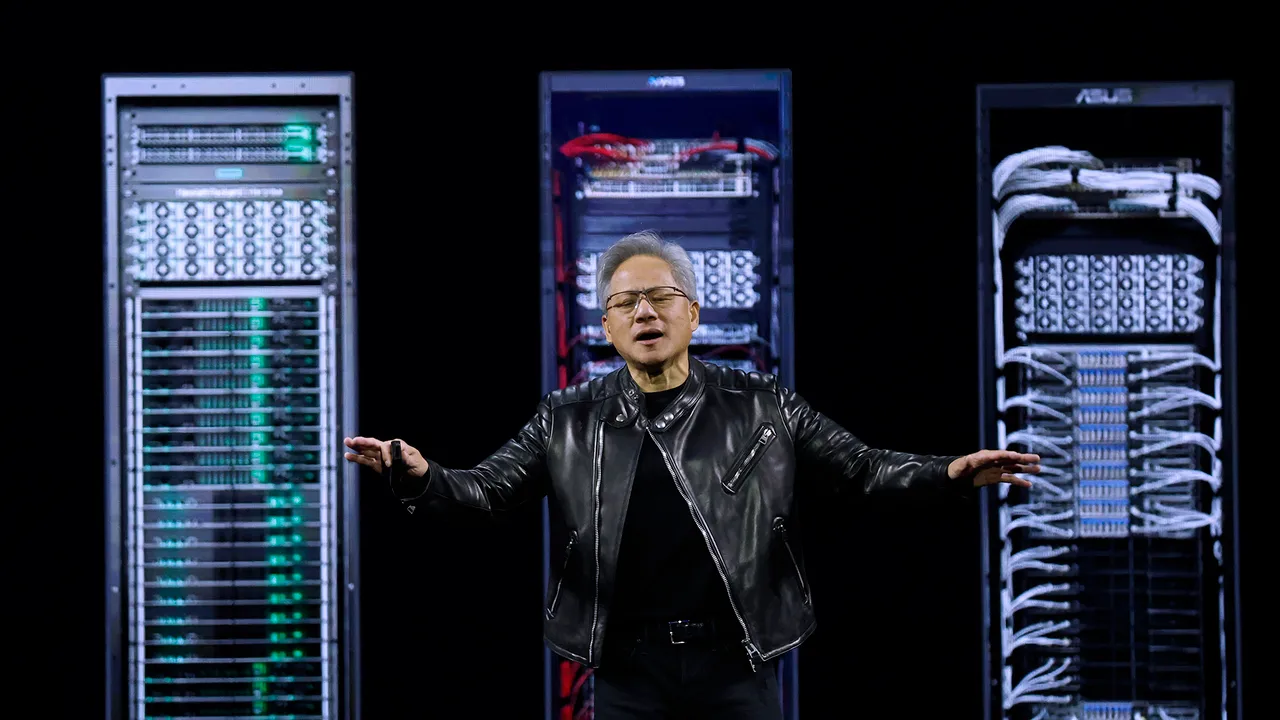
NVIDIA has become the top revenue leader in the data center Ethernet switching market, marking another major expansion beyond graphics cards and AI accelerators. The company reportedly generated $2.1 billion in Ethernet switching revenue during the first quarter of 2026, helping it capture 21.5% of the global market.
The wider data center Ethernet switch market reached a record $15.4 billion in the quarter, up 39.8% from the same period a year earlier. Much of that growth is tied to the rapid construction of AI data centers, where companies need faster networking hardware to connect huge numbers of GPUs, storage systems, and servers.
NVIDIA’s rise reflects how AI infrastructure is changing. The company is no longer only supplying the processors that train and run AI models. It is also becoming a larger supplier of the networking technology needed to keep those systems working together efficiently.
Spectrum X Is Helping NVIDIA Expand Beyond GPUs
NVIDIA’s Ethernet business grew 192.7% year over year, according to the reported figures. The strongest driver is its Spectrum X networking platform, which combines Ethernet switches, BlueField data processing units, and LinkX cables for large AI clusters.
AI workloads need much more than powerful GPUs. Thousands of accelerators often have to exchange data at extremely high speeds, and a weak network connection can slow down the entire system. This is why networking has become one of the most important parts of modern AI data centers.
Spectrum X is designed to provide an integrated approach, giving companies hardware that works closely with NVIDIA’s GPUs and AI software stack.
| Market Detail | Reported Figure |
|---|---|
| Global Ethernet switch revenue | $15.4 billion |
| Year over year market growth | 39.8% |
| NVIDIA Ethernet revenue | $2.1 billion |
| NVIDIA market share | 21.5% |
| NVIDIA year over year growth | 192.7% |
| Hyperscaler and enterprise revenue | $10 billion |
| Hyperscaler and enterprise growth | 61% |
The results suggest that major cloud providers and enterprise customers are spending heavily on systems built specifically for AI workloads. These deployments need high bandwidth, lower network delays, and more reliable data movement than traditional business servers.
Faster 800G Networking Is Becoming More Important
Demand for faster 400G and 800G Ethernet switches is also rising quickly. In the first quarter of 2026, 800G hardware represented 35.8% of total data center Ethernet revenue, while 200G and 400G switches accounted for another 34.1%.
Together, those high speed products made up around 70% of global data center Ethernet switch revenue. That shows how quickly companies are moving beyond older networking equipment as AI clusters become larger and more demanding.
The Americas saw the strongest regional growth, with revenue rising 49.7% year over year. Europe, the Middle East, and Africa followed with 32.2% growth, while the Asia Pacific region grew 25.9%.
NVIDIA’s AI Strategy Is Becoming More Complete
NVIDIA’s dominance in AI GPUs has already made it one of the most important companies in the data center market. Its growing position in networking gives it another way to benefit from AI investment.
For companies building AI infrastructure, buying GPUs, networking equipment, cables, software, and data processing hardware from one supplier can simplify deployment and reduce compatibility concerns. That integrated approach appears to be helping NVIDIA gain ground against established networking vendors.
However, the rapid growth also raises the stakes for competitors. Companies such as Broadcom, Cisco, Arista Networks, Marvell, AMD, and Intel are all competing for a share of the expanding AI infrastructure market.
NVIDIA’s lead in Ethernet switching shows that the AI boom is creating opportunities far beyond GPUs. As data centers continue building larger clusters for training and running AI systems, the companies that control networking may become just as important as the companies that make the processors.



Discussion (0)
Be the first to comment.