


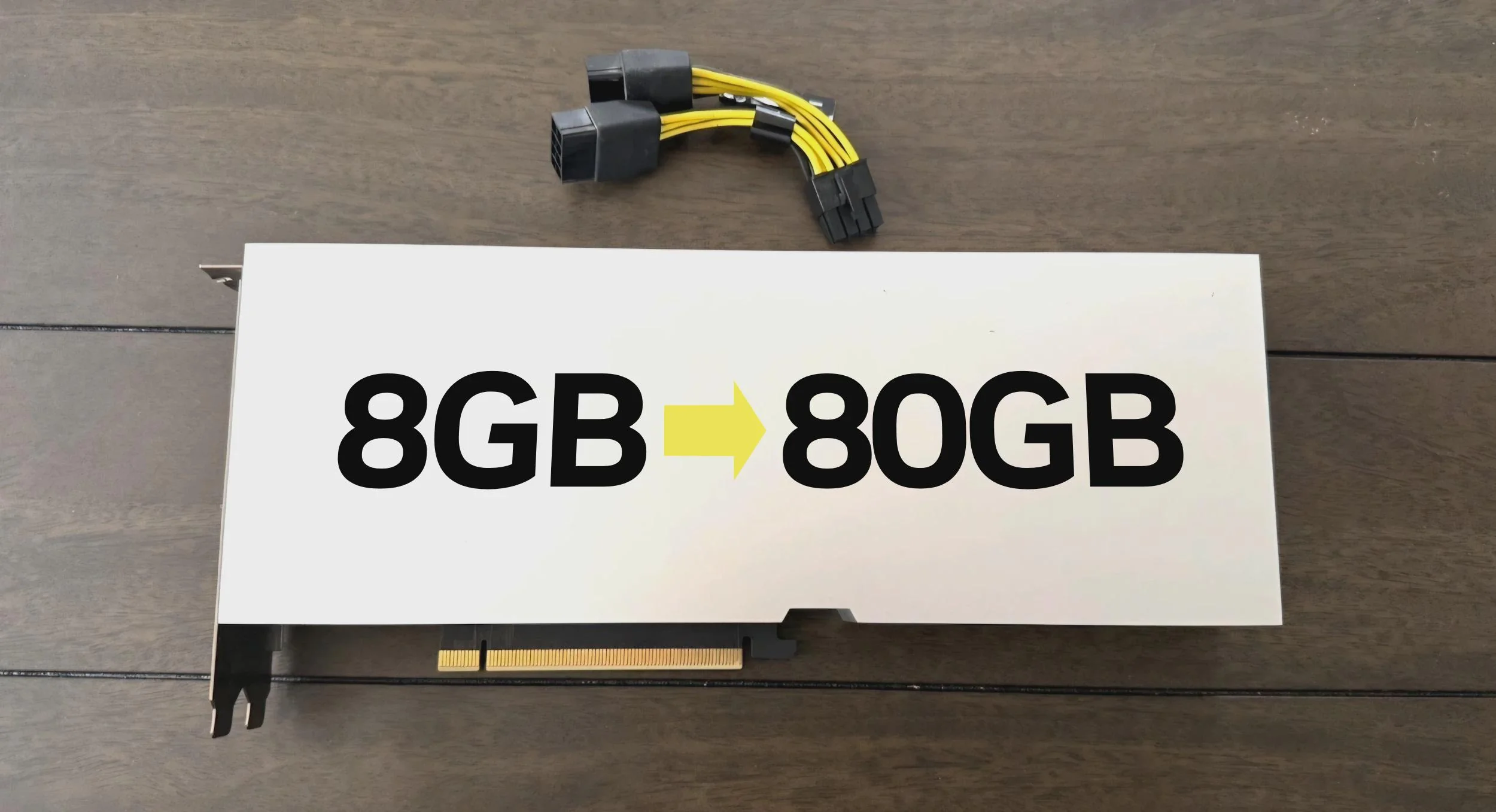
A hardware researcher has managed to unlock additional memory and processing resources on NVIDIA's CMP 170HX mining graphics card, allowing the modified GPU to outperform a retail NVIDIA A100 in a specific FP16 benchmark.
The modified CMP 170HX achieved 85.9 TFLOPS in a ProjectPhysX OpenCL test, compared with approximately 72.5 TFLOPS for the A100. This represents a performance advantage of around 18% in the tested workload.
The achievement comes from hardware researcher Kate, who used a voltage fault injection technique to modify restrictions built into the CMP 170HX's GA100 graphics processor.
The experiment also enabled an 8GB version of the mining GPU to access up to 80GB of HBM memory physically installed on the card.
Although the results are significant, the modified hardware has not been demonstrated to match the A100 across all professional computing workloads.
NVIDIA CMP 170HX Unlocks Up to 80GB of HBM Memory
NVIDIA originally designed the CMP 170HX as a specialized graphics processor for cryptocurrency mining.
The card uses the GA100 GPU architecture, which is also found in NVIDIA's A100 data center accelerator.
However, the mining version was sold with substantial restrictions on available memory and processing resources.
Earlier experiments using a tool called CMPUnlocker demonstrated that some of these limitations could be bypassed through software modifications.
The software allowed certain 8GB CMP 170HX cards to expose 64GB of memory, while some 10GB models could access 40GB.
Kate's newer experiment goes further by modifying how the GPU handles its internal hardware restrictions.
The researcher reportedly tested ten CMP 170HX cards originally configured with 8GB of accessible memory.
Nine successfully exposed 80GB of HBM, while one was limited to 64GB because some of its physical memory was not functional.
These findings suggest that substantial memory capacity was physically present on the cards despite being unavailable through their original configurations.
Voltage Fault Injection Exposes Disabled GPU Resources
The new modification uses a technique known as voltage fault injection.
This involves deliberately disrupting the voltage supplied to a chip during a carefully selected operation to influence how the hardware behaves.
In this case, Kate reportedly used the technique to interfere with how the GA100 processor reads its hardware configuration restrictions.
The experiment allowed normally protected fuse settings to be modified, exposing processing resources disabled in the original mining configuration.
The modified GPUs reportedly revealed approximately 120 to 126 working streaming multiprocessors.
Streaming multiprocessors, commonly called SMs, are processing units that contain resources responsible for executing many GPU computing operations.
Enabling additional functional SMs can increase the amount of parallel processing work the graphics card can perform.
However, the number of usable resources may vary between individual cards because some hardware components can be physically defective.
CMP 170HX Reaches 85.9 TFLOPS in ProjectPhysX FP16 Test
The performance results were measured using a ProjectPhysX OpenCL benchmark focused on FP16 fused multiply add operations.
FP16 refers to a numerical format using 16 bit floating point values, which is commonly used in certain graphics, scientific computing, and AI workloads.
The hardware modification produced a substantial improvement over the earlier software unlocking method.
| GPU Configuration | FP16 Performance |
|---|---|
| CMP 170HX with software unlock | 50.1 TFLOPS |
| Retail NVIDIA A100 | 72.5 TFLOPS |
| CMP 170HX with hardware unlock | 85.9 TFLOPS |
The hardware unlocked CMP 170HX delivered approximately 18.4% higher performance than the retail A100 in this particular test.
It also achieved considerably higher throughput than the software unlocked mining card.
However, this result measures a specific type of computing performance and cannot be used to determine overall GPU superiority.
Modified Mining GPU Still Lacks Verified A100 Features
Despite its benchmark performance, the modified CMP 170HX has several unresolved limitations.
The NVIDIA A100 is designed for professional data center environments, where reliability, memory protection, and specialized computing capabilities are important.
Features such as error correcting code memory, Multi Instance GPU support, and certain video processing functions have not been fully tested on the modified mining card.
PCIe and NVLink functionality also require additional work.
These limitations matter because professional workloads depend on more than raw computational throughput.
For example, ECC memory helps detect and correct certain memory errors, while Multi Instance GPU technology allows supported accelerators to divide hardware resources between separate workloads.
Until these functions are tested, the modified CMP 170HX cannot be considered a complete replacement for an A100.
CMP 170HX Prices Have Increased Following Unlocking Discoveries
Interest in NVIDIA's older mining card has increased as researchers continue discovering ways to restore restricted hardware capabilities.
Earlier reports indicated that CMP 170HX cards, which previously sold for approximately $100 on the secondary market, began reaching prices above $1,000 after software unlocking tools became available.
The possibility of accessing large amounts of HBM memory makes the hardware particularly interesting for experiments involving local AI models and other memory intensive applications.
However, these modifications require specialized knowledge and can introduce a risk of permanently damaging the graphics card.
Results may also differ between cards depending on their physical condition and the functional resources available.
Kate's experiment demonstrates that the CMP 170HX contains more usable hardware than its original mining configuration exposed.
The 85.9 TFLOPS result is a notable achievement in the tested FP16 workload, but broader testing is still necessary to determine how the modified card performs in real AI and professional computing applications.

Discussion (0)
Be the first to comment.