



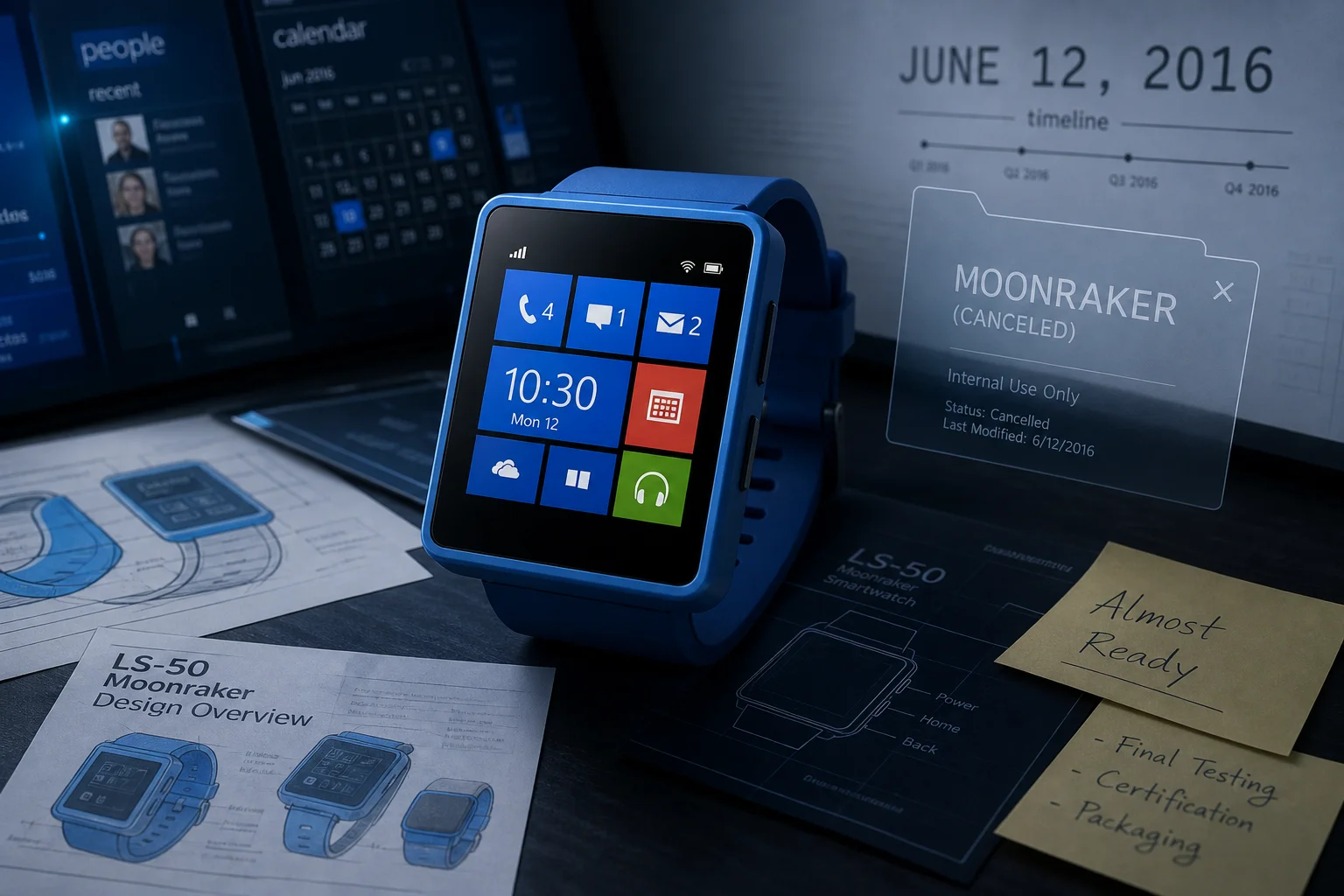
Microsoft’s unreleased Moonraker smartwatch still feels ahead of its time a decade later because it showed how close the company was to building a colorful, Windows Phone inspired wearable before the Apple Watch reshaped the category. The device never launched, but it remains one of the most interesting “what if” products from Microsoft’s mobile era.
Moonraker was originally a Nokia project before Microsoft acquired Nokia’s devices and services division. The smartwatch was reportedly close to being revealed alongside the Lumia 930, but Microsoft canceled it around the time of the acquisition. Images later surfaced online, showing a watch with bright straps, a simple square design, and a user interface influenced by Microsoft’s Metro design language.
Looking back now, Moonraker feels like more than a canceled gadget. It represents a moment when Microsoft still had a chance to connect Windows Phone, Lumia hardware, and wearable computing into one broader ecosystem.
Moonraker looked different from most early smartwatch ideas
The most striking part of Moonraker is how much personality it had. The watch used a colorful design that matched the Lumia identity, with bright straps and a clean interface that looked connected to Windows Phone rather than borrowed from another platform.
At the time, Microsoft was still experimenting with mobile hardware ideas. Windows Phone had a distinct visual style, and Moonraker appeared to extend that style to the wrist.
| Moonraker detail | What made it interesting |
|---|---|
| Codename | Moonraker |
| Model | LS 50 |
| Original developer | Nokia |
| Design style | Windows Phone inspired Modern UI |
| Planned reveal | Alongside Lumia 930 |
| Status | Canceled after Microsoft acquired Nokia’s phone business |
| Notable feature | Text interaction through wrist movement |
| Legacy | A lost Microsoft wearable from the Windows Phone era |
The watch reportedly supported gesture based actions, such as reading texts by lifting your arm and turning off the display by lowering it. Those ideas sound normal today, but they were still fresh in the early smartwatch market.
Microsoft canceled Moonraker before wearables took off
Moonraker’s cancellation is more painful in hindsight because the smartwatch market became much more important shortly afterward. Apple Watch helped define the category, while Samsung, Fitbit, Garmin, and others continued building wearable ecosystems.

Microsoft did release the Microsoft Band, but that product leaned more toward fitness tracking than a full smartwatch experience. Moonraker looked like it could have been a more direct Windows Phone companion, with stronger personality and tighter ecosystem appeal.
The timing was unfortunate. Microsoft had just absorbed Nokia’s phone business and was already facing major strategic questions around Lumia, Windows Phone, and mobile hardware. Moonraker seems to have been caught in that transition.
The design still captures what people liked about Windows Phone
A major reason Moonraker still draws attention is that it reflects what many fans liked about Windows Phone. It was clean, bold, colorful, and different. It did not look like a copy of Apple or Android design.
The Metro style worked especially well for small screens because it relied on simple typography, tiles, and quick glanceable information. A smartwatch could have been a natural place for that design language.
That is what makes Moonraker feel like an alternate timeline. It suggests a version of Microsoft that continued building a hardware ecosystem around Lumia phones, Windows services, and wearable devices.
Moonraker shows how Microsoft’s mobile ambitions faded before they could mature
The smartwatch also reminds us how many Microsoft ideas from that era were abandoned before they had a real chance to grow. Windows Phone had loyal fans, strong design, and interesting hardware, but it never gained enough market share to survive long term.
Moonraker may not have saved Windows Phone by itself. A smartwatch depends on a healthy phone ecosystem, and Microsoft’s mobile platform was already struggling. But it could have made Lumia feel more complete and more competitive.
The canceled watch also shows how Microsoft was not short on ideas. The company had bold hardware concepts. The problem was execution, timing, and commitment.
A decade later, Moonraker still feels unusually modern
Moonraker remains interesting because it does not look like a forgotten prototype with no future. It looks like a product that could have made sense if Microsoft had stayed in mobile longer.
Its colorful design, wrist gestures, phone integration, and clean UI all fit the direction smartwatches eventually took. The difference is that Microsoft stepped away before the market fully opened.
That is why Moonraker still matters to Windows Phone fans. It is not only a canceled watch. It is a reminder of the ecosystem Microsoft almost built, and of the stylish hardware ideas that disappeared with the end of Lumia.
Ten years later, Moonraker still feels like one of Microsoft’s clearest missed wearable opportunities. It may never have reached stores, but it remains one of the most memorable lost devices from the company’s mobile era.



Discussion (0)
Be the first to comment.