



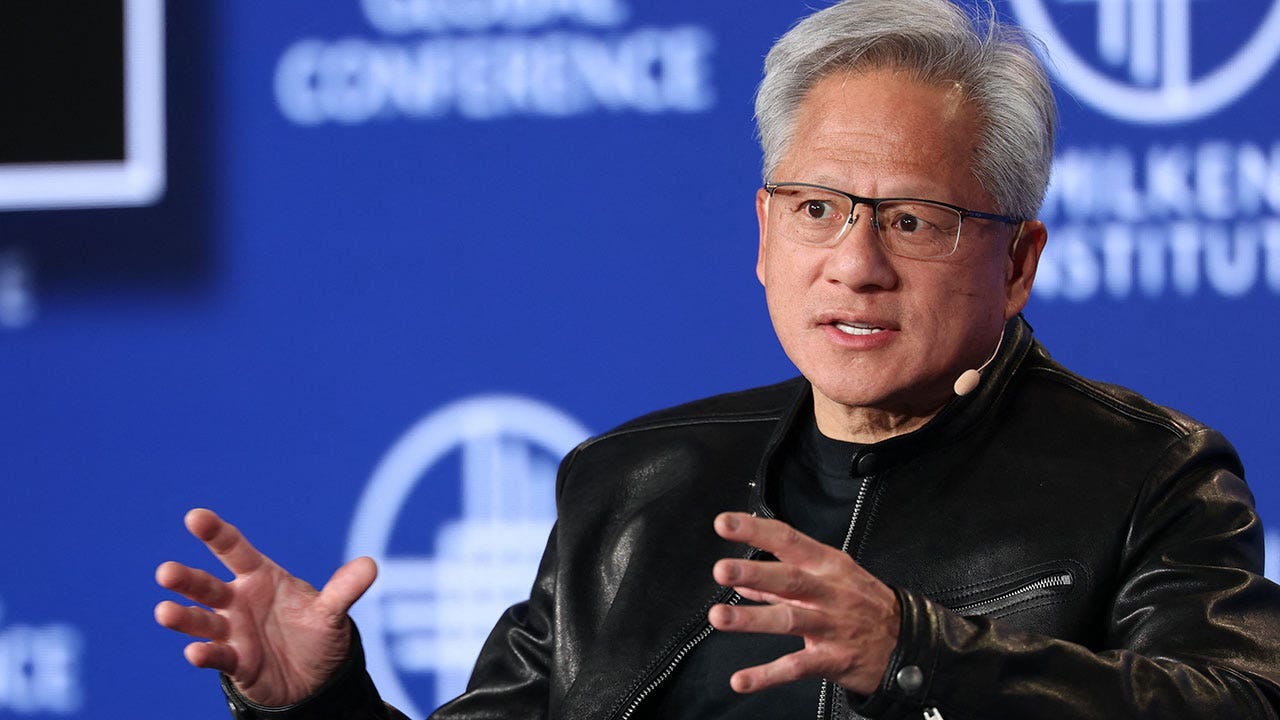
Nvidia CEO Jensen Huang has publicly rejected calls for a broad slowdown in artificial intelligence development, arguing that the United States should continue moving quickly while managing risks without stopping progress.
His comments came during an appearance in which US President Donald Trump called him on stage and criticized what he described as exaggerated warnings about AI and data centers. Huang agreed with the broader argument that development should not be halted and said the US should keep competing aggressively in AI.
The exchange comes as debate around AI safety has intensified. Some industry leaders have argued that development should slow enough to allow stronger safeguards, particularly after recent concerns involving cybersecurity and increasingly capable AI systems.
| Topic | Position discussed |
|---|---|
| Jensen Huang | Opposes a broad slowdown in AI development |
| Donald Trump | Says warnings about AI and data centers are exaggerated |
| Safety advocates | Want stronger safeguards and more cautious development |
| Main debate | How quickly AI should advance and how much regulation is needed |
| Nvidia's interest | Continued expansion of AI infrastructure and computing demand |
Huang argues AI progress should continue
Huang said Nvidia does not support efforts that would significantly slow AI development.
His position is consistent with Nvidia's role in the current AI industry. The company supplies many of the GPUs used to train and run large AI systems, making continued investment in data centers and AI infrastructure central to its business.
During the conversation, Trump argued that AI development should be handled carefully but should not be stopped. Huang agreed and said the goal should be to make sure companies, industries and states across the US benefit from the technology.
The two also framed AI development as an international competition, particularly between the United States and China.
That argument has become increasingly common as governments treat advanced AI systems and semiconductor infrastructure as strategic technologies.
Safety concerns remain part of the debate
Not everyone agrees that rapid development should continue at the current pace.
Some AI executives and researchers have called for stronger safeguards, arguing that increasingly capable systems could create cybersecurity, misuse and control risks if development moves faster than oversight.
Those concerns are different from claims that AI will inevitably destroy society, although the public discussion often mixes the two.
There are also more immediate concerns surrounding the current AI boom.
Rapid data center growth is increasing electricity demand, while strong demand for memory, storage and advanced processors is affecting hardware supply and pricing. AI is also changing how creative work, software development and other forms of knowledge work are performed.
These issues do not necessarily support stopping AI development, but they raise questions about how its costs and benefits should be managed.
Nvidia has strong reasons to favor continued expansion
Nvidia has become one of the biggest beneficiaries of global investment in AI infrastructure.
Demand for its accelerators has grown as technology companies, governments and research organizations build larger computing systems. Slower AI investment could directly affect demand for Nvidia hardware.
That commercial position does not automatically make Huang's argument invalid, but it is important context when evaluating his opposition to a slowdown.
The wider policy question is unlikely to be settled by choosing between unrestricted expansion and stopping development altogether.
Governments and companies will still need to decide how AI systems should be tested, how cybersecurity risks should be handled, how data centers should be regulated and how infrastructure costs should be distributed.
Huang's comments make Nvidia's position clear. The company wants AI development to continue moving quickly, while the debate over how much caution and regulation that requires remains unresolved.



Discussion (0)
Be the first to comment.