



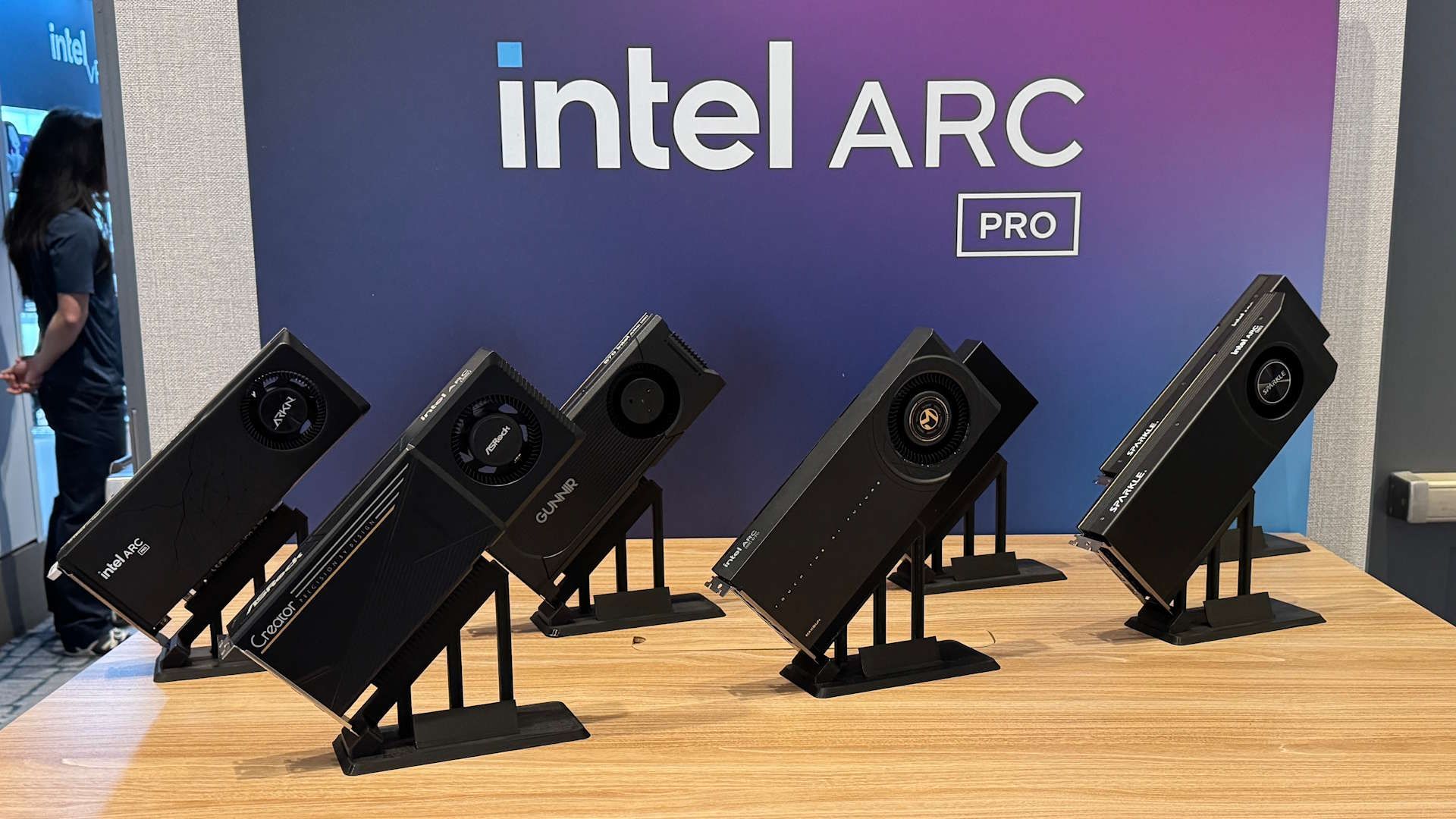
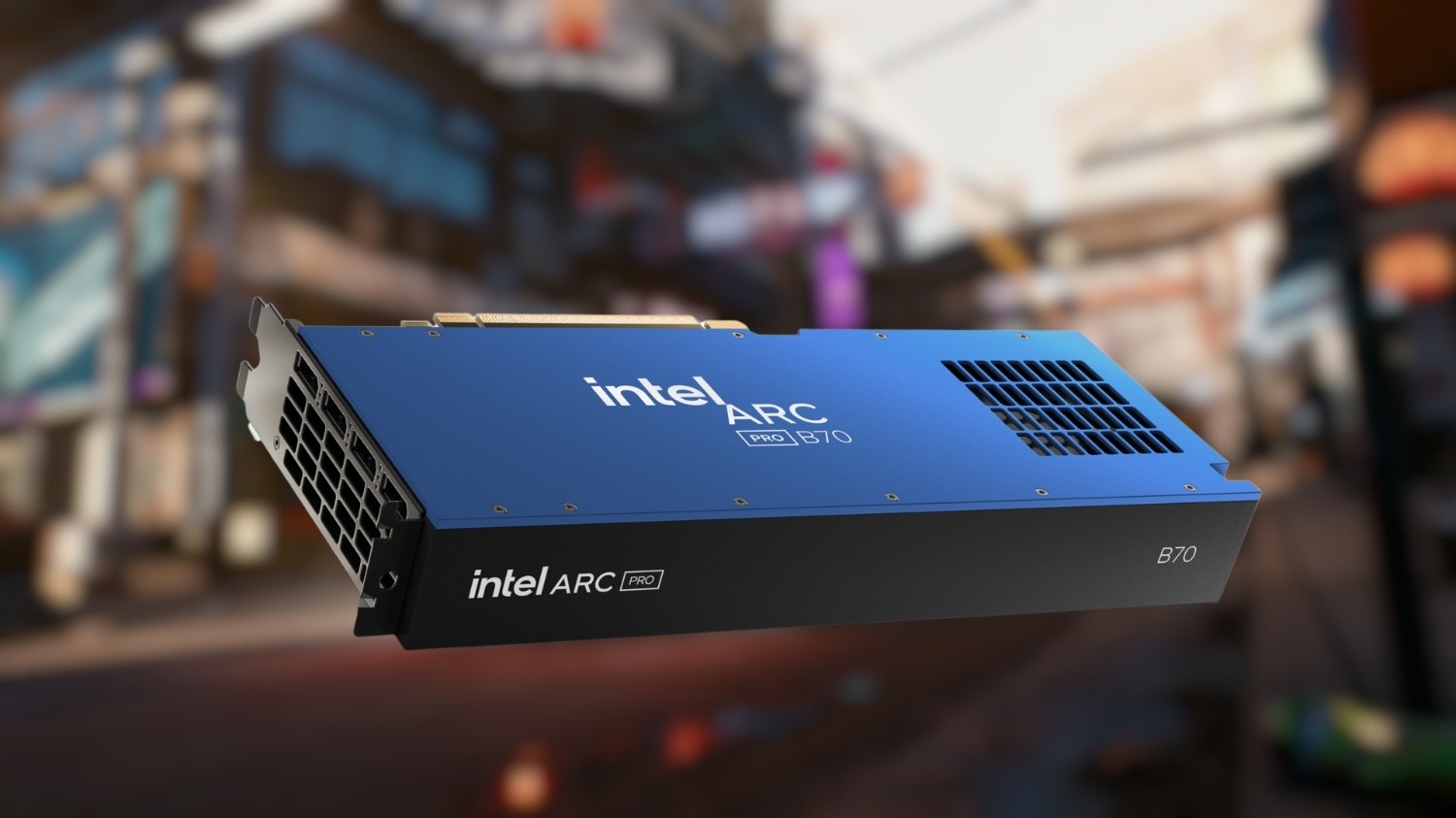
Intel’s Arc Pro B70 has been tested in games, and the results give a useful look at what a gaming focused Big Battlemage graphics card might have delivered.
The Arc Pro B70 is not sold as a normal gaming GPU. It is a professional card with 32GB of GDDR6 memory, a full BMG G31 Battlemage chip, 32 Xe2 HPG cores, 32 ray tracing units, and 367 INT8 TOPS for AI workloads. Still, Intel recently added gaming support for the card through new drivers, which made these tests possible.
The Arc Pro B70 is much faster than the Arc B580
In 1440p raster gaming, the Arc Pro B70 was up to around 40% faster than the Arc B580. In Cyberpunk 2077, it reached 90.27 FPS, compared with 66.02 FPS on the Arc B580 and 79.06 FPS on the RTX 5060 Ti 16GB.
That result is strong, but the picture changes across other games. In titles like Black Myth Wukong, Marvel Rivals, Monster Hunter Wilds, and Assassin’s Creed Shadows, the RTX 5060 Ti often took the lead. The Arc Pro B70 still showed a clear jump over Intel’s smaller Battlemage card.
Ray tracing results were more interesting. In F1 25, Doom The Dark Ages, and Cyberpunk 2077, the Arc Pro B70 beat the RTX 5060 Ti by about 9% on average. Against the Arc B580, it was up to 65.7% faster in ray tracing and around 40% faster on average.
The real story is the missing Arc B770
These results matter because the Arc Pro B70 uses the larger Battlemage GPU that many expected to appear in a gaming card, possibly as the Arc B770.
A gaming version with 16GB of memory, better pricing, and drivers tuned for games could have been a strong midrange option. Based on these results, it may have competed closely with the RTX 5060 Ti 16GB.
The problem is price and positioning. The Arc Pro B70 costs around $949 because it is a professional card with 32GB of memory. That makes it hard to recommend for gaming alone. A consumer version around $400 to $500 would have made much more sense for players.
The 32GB memory helps AI more than gaming
The Arc Pro B70 also did well in AI benchmarks. In MLPerf Client tests, it showed better token throughput and lower time to first token than the RTX 5060 Ti in some Windows ML workloads. Intel’s OpenVINO support could make its AI performance even stronger.
That explains why Intel chose this direction. The card is more useful as an AI and workstation product than as a gaming card. With memory supply tight and AI demand high, Intel likely sees more value in selling the bigger Battlemage chip to professional buyers.
Intel had a stronger gaming GPU hiding in plain sight
The Arc Pro B70 proves that Big Battlemage had real gaming potential. It is faster than the Arc B580 by a meaningful margin, and it can trade blows with NVIDIA’s RTX 5060 Ti 16GB in several tests.
The frustrating part is that this performance is locked inside a professional card that costs too much for most gamers.
If Intel had released a gaming focused Arc B770 with 16GB of memory and a fair price, it could have been one of the more interesting midrange GPUs of this generation. Instead, the Arc Pro B70 feels like a preview of a card many PC gamers may never get.


Discussion (0)
Be the first to comment.