If you are running a Windows-based computer or similar device, you can connect to another one using Remote Desktop Connection. This application uses the RDP (Remote Desktop Protocol) to allow you to use all the resources of the host machine through your PC's display. In other words, using this program, you can control another Windows PC from your computer, remotely on your local network or even over the internet. If you want to learn how to do this in Windows, read this tutorial:
NOTE: Before going through this tutorial, make sure that you have enabled the Remote Desktop Connection on the Windows computer to which you will be connecting. To find out how to do this, read this guide: How to enable Remote Desktop Connections in all versions of Windows. Also, because the steps described in this tutorial are similar in Windows 10, Windows 7 and Windows 8.1, most of the screenshots we use are taken in Windows 10.
How to open Remote Desktop Connection (RDC) in Windows
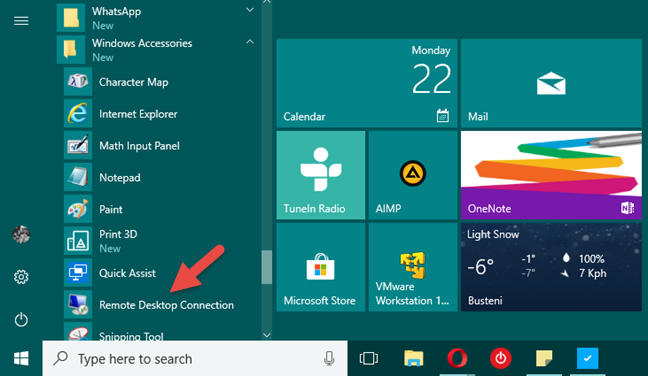
If you are using Windows 10, you can launch the Remote Desktop Connection client from the Start Menu. Open the Start Menu and scroll through the apps list until you find the folder called Windows Accessories. In it, click or tap on the Remote Desktop Connection to open it.
Windows, Remote, Desktop, Connection
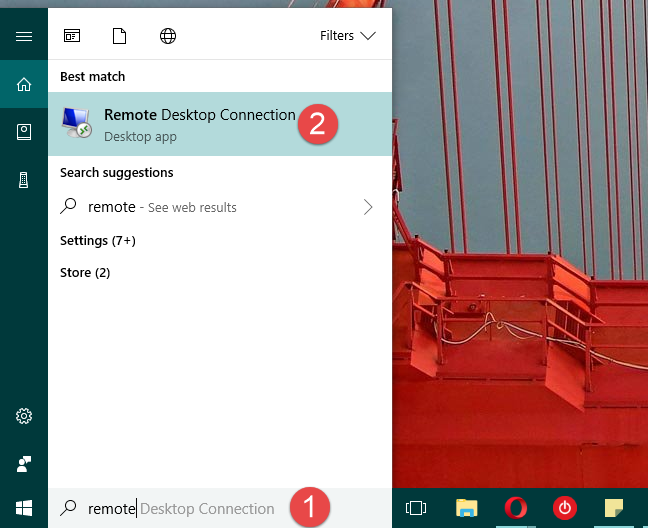
You can also use Cortana's search box from the taskbar. Type the word "remote" in the search field and click or tap on the appropriate result.
Windows, Remote, Desktop, Connection
Alternatively, you can click or tap the microphone icon on the same search box and say: "Open Remote Desktop Connection!".
Windows, Remote, Desktop, Connection
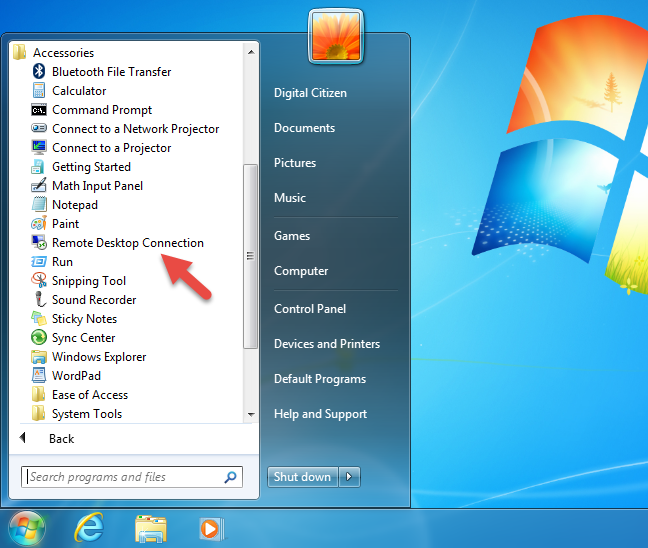
In Windows 7 you can also launch the Remote Desktop Connection client from the Start Menu. Click "All Programs" and navigate to the Accessories group. There, click the Remote Desktop Connection shortcut.
Windows, Remote, Desktop, Connection
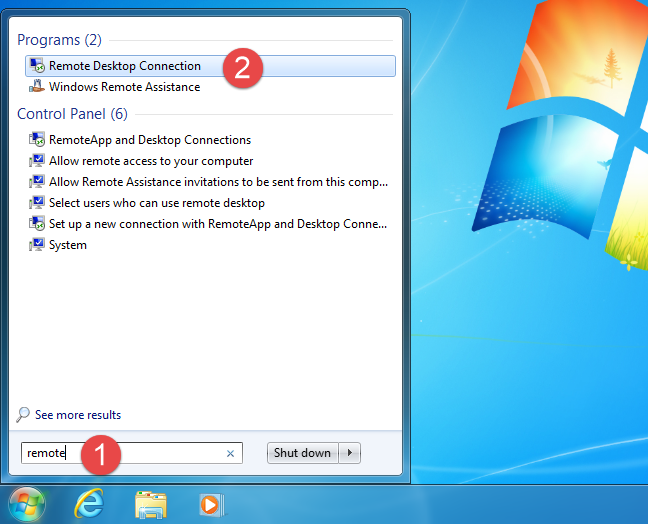
If you prefer, you can also use the search to find and open the Remote Desktop Connection client.
Windows, Remote, Desktop, Connection
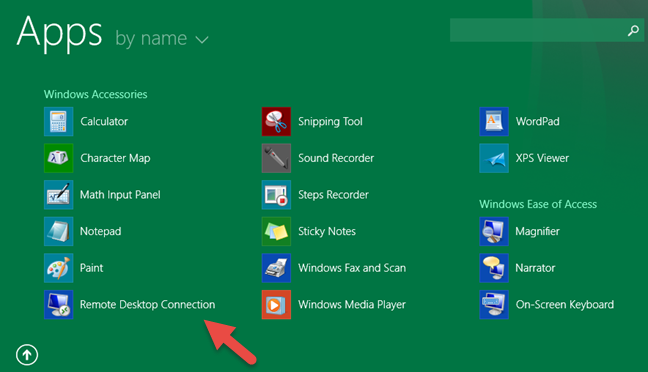
If you are using Windows 8.1, you can open the Remote Desktop Connection from the Start screen. Go to the Apps view, look for the Remote Desktop Connection client and click or tap its name to launch it. You should find it in the "Windows Accessories" folder.
Windows, Remote, Desktop, Connection
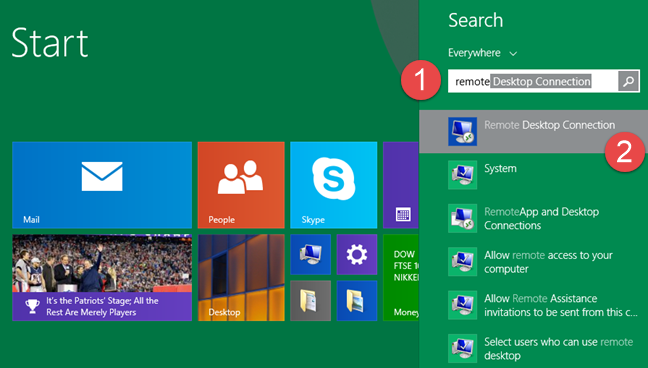
A slightly faster way of starting the Remote Desktop Connection client is to use the search. To do that, switch to the Start screen and write the word "remote." Then, click or tap the Remote Desktop Connection search result.
Windows, Remote, Desktop, Connection
How to use Remote Desktop Connection (RDC) in Windows
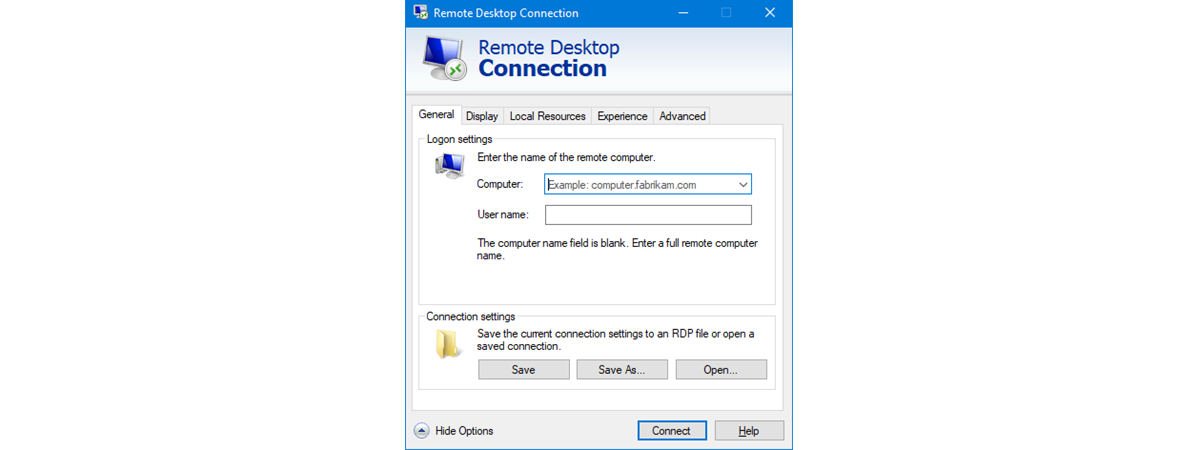
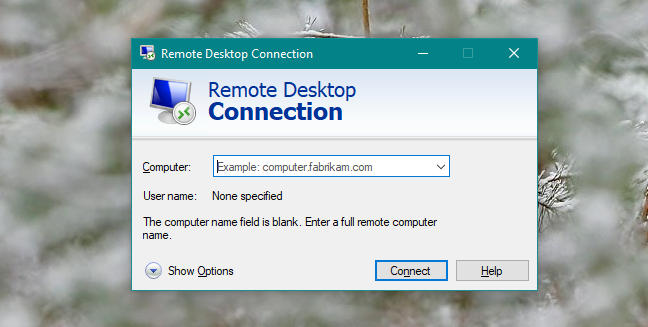
No matter which way you choose to launch it, once the Remote Desktop Connection client is opened, it should look like the next screenshot.
Windows, Remote, Desktop, Connection
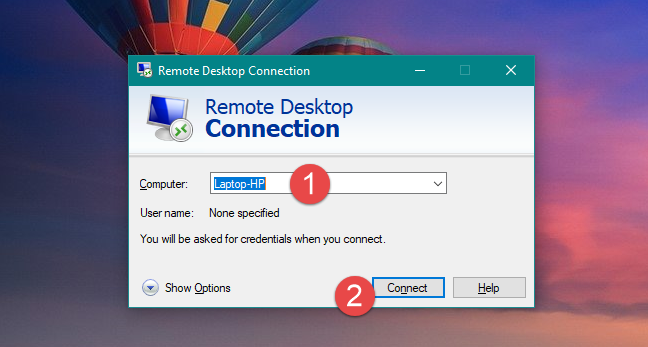
Using the Remote Desktop Connection client is as straightforward as it can be. First, type the full name of the computer to which you want to connect, and then click or tap on the Connect button.
The computer name is how the host computer identifies itself on the network. If you are not sure what the computer name is, you can see it in the "System Properties" window on the remote computer. Also, if you have troubles connecting using a computer name, you can connect using the host's local IP address.
Windows, Remote, Desktop, Connection
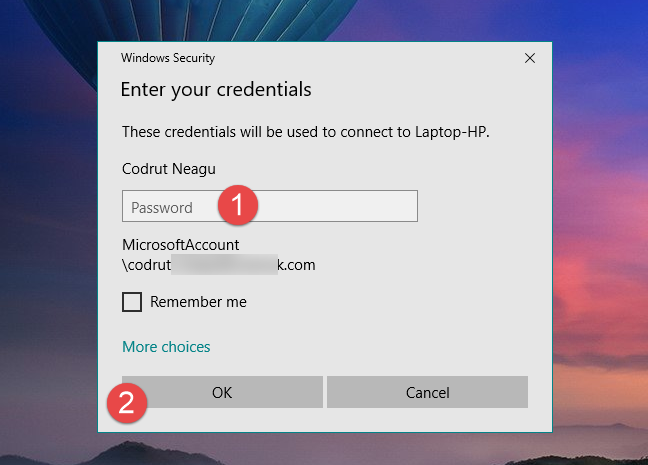
Then, the Remote Desktop Connection app asks for the user credentials that you want to use to sign in on the remote Windows computer. If the user account selected by default is the one you want to use, enter its password and press OK.
Windows, Remote, Desktop, Connection
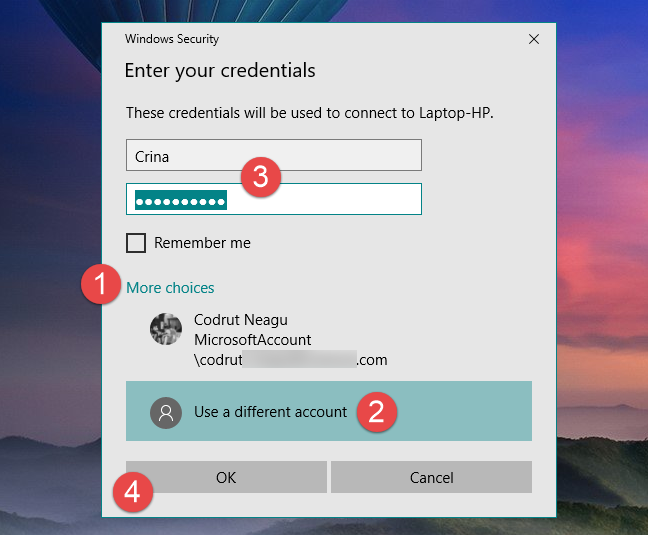
If you want to sign in using another user account defined on the remote computer, click or tap on "More choices" and then enter the credentials of that user account.
Windows, Remote, Desktop, Connection
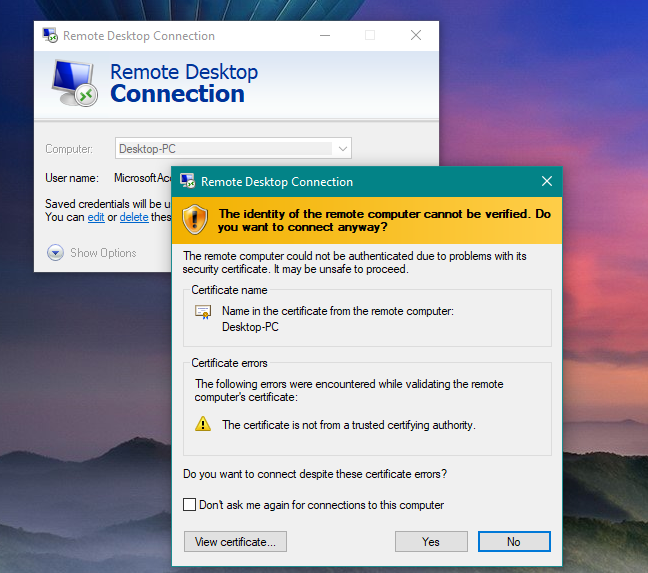
After you press on OK, the Remote Desktop Connection app attempts to connect to the remote computer you specified. Sometimes, like when you use an IP address to connect, you might see a warning about the server name on the certificate not matching the computer name you entered. This may also happen if you did not use the same capitalization when entering the computer name. As long as the certificate name displayed is something you recognize, it is safe to click/tap Yes and continue.
Windows, Remote, Desktop, Connection
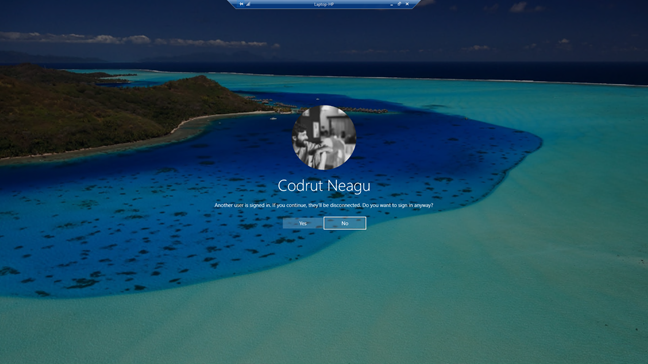
After connecting, if everything works OK, after a couple of moments, you should see the remote machine in a window of its own. To give the remote machine keyboard and mouse focus, click or tap inside the window or make it full screen. To close the connection, simply close the window.
Windows, Remote, Desktop, Connection
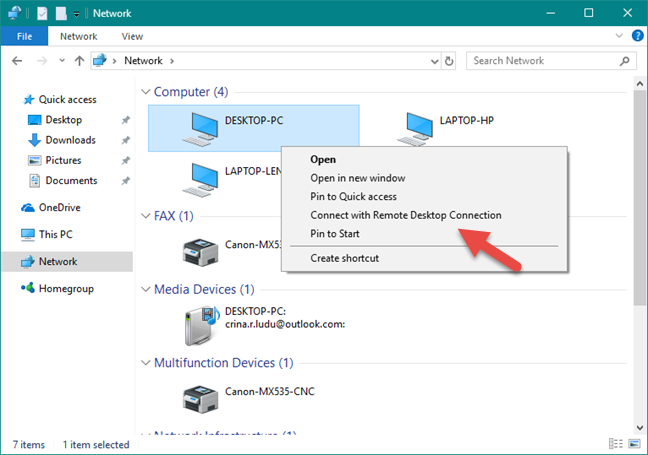
The next time you connect, you can save yourself the time of opening Remote Desktop Connection by opening the right-click menu for the computer to which you want to connect, in the Network pane from File/Windows Explorer, and then click or tap on "Connect with Remote Desktop Connection."
Windows, Remote, Desktop, Connection
On the next page of this guide, you can learn how to configure the Remote Desktop Connection (RDC) application, and you can also find out what is different at it in Windows 10, compared to Windows 7 and Windows 8.1.
How to configure Remote Desktop Connection (RDC) in Windows
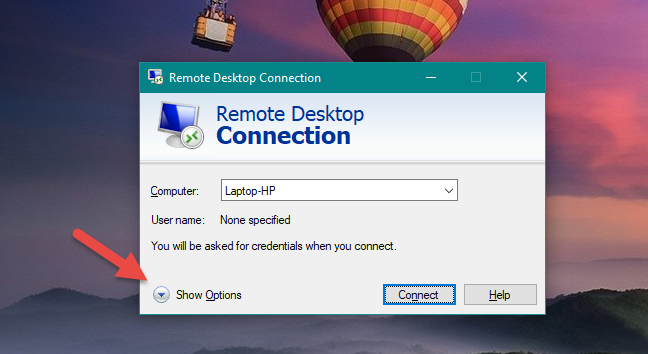
Some people might want to adjust all the detailed settings available in the Remote Desktop Connection program, before establishing any connections. To set the Remote Desktop Connection to work as you like it to, in its main console, expand the preferences by clicking or tapping Show Options.
Windows, Remote, Desktop, Connection
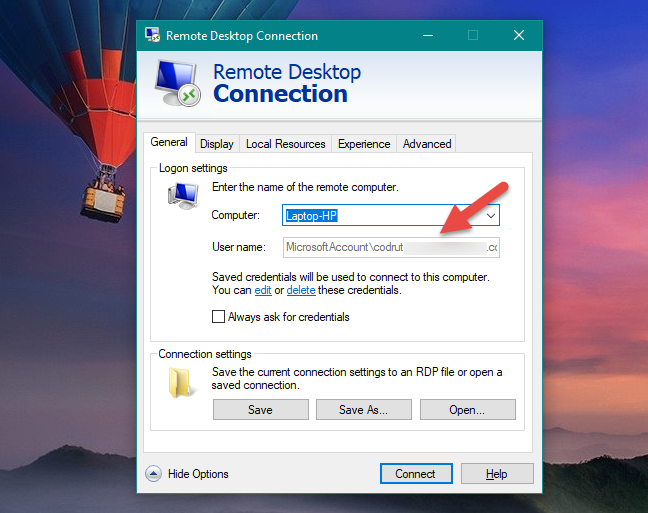
In the General tab, you can enter the name of the remote computer, and also the user account that you want to use by default, for the connection. Enter the username of an administrator account from the remote computer or a standard user account that has been enabled for Remote Desktop connections. In other words, use a user account that you would enter if you were logging in locally to the host machine.
In the following screenshot, you can see the username formatted as MicrosoftAccountUsername or ComputerNameUsername, depending on the user account type on the remote computer or device. You do not have to type it in like this, but when Remote Desktop Connection saves your connection settings, it reformats it so.
Windows, Remote, Desktop, Connection
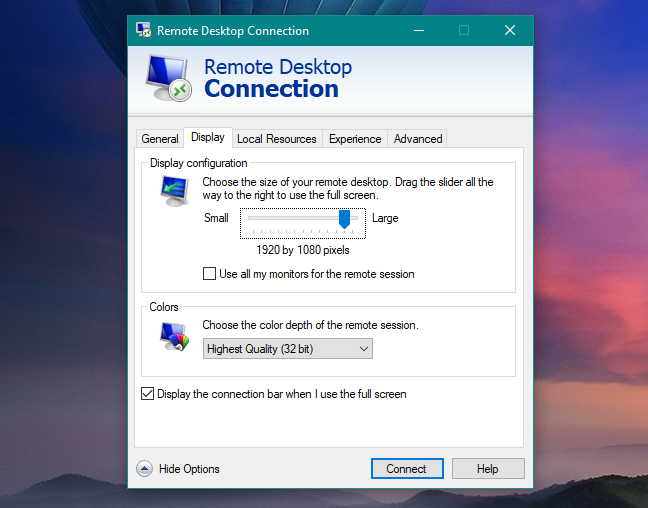
In the Display tab, you can tweak the video settings. By changing the screen size and color depth, you can improve the performance when connected remotely.
Windows, Remote, Desktop, Connection
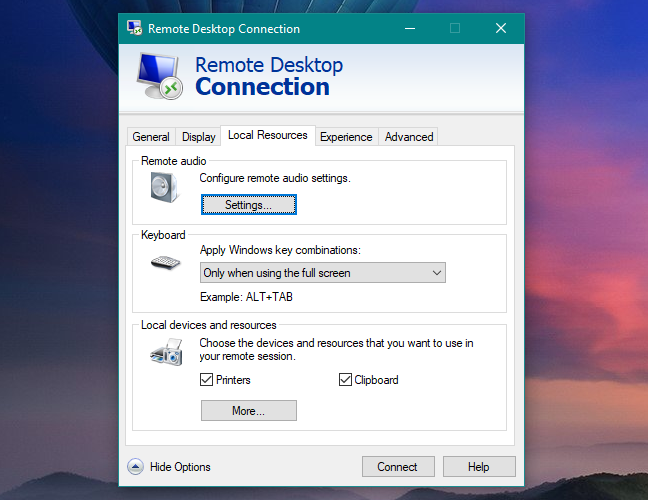
In the Local Resources tab, you can configure your audio, keyboard and devices settings.
Windows, Remote, Desktop, Connection
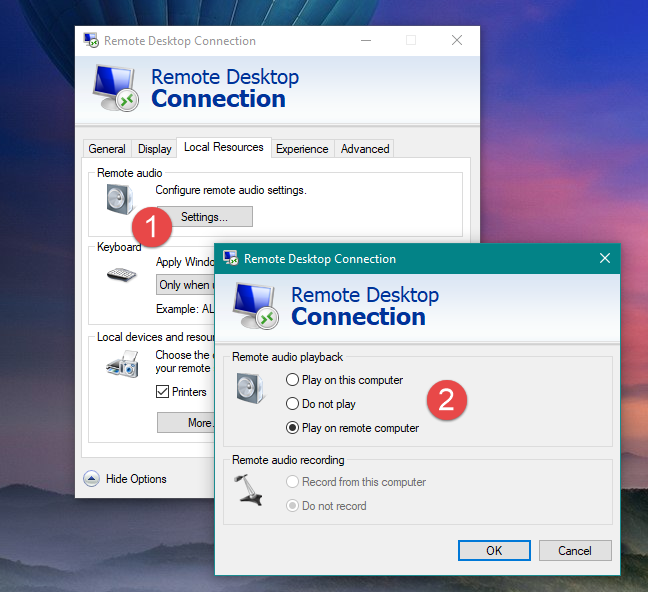
If you click/tap Settings under Remote Audio, you can choose whether you want to playback audio on the remote machine, on the client machine or neither. You can also enable recording from the client machine.
Windows, Remote, Desktop, Connection
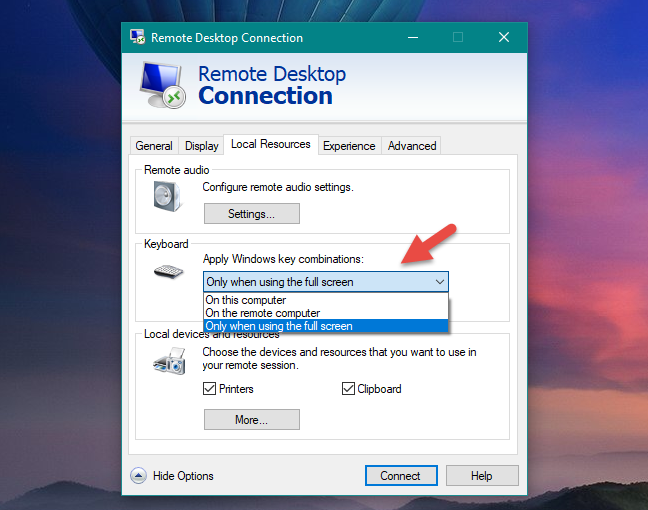
In the Keyboard section, you have three options for handling Windows key combinations (such as Alt + Tab and Ctrl + Alt + Del). By default, these key combinations are registered by the remote computer only when you are in full screen, and if you are in window mode, they are recognized by your computer (the client).
For example, if you are in full screen and you press Alt + Tab, you switch between windows on the remote machine. If you are in windowed mode, Alt + Tab switches between windows on your computer. You can change this so that Windows key combinations are only recognized by the client machine or the host machine.
Windows, Remote, Desktop, Connection
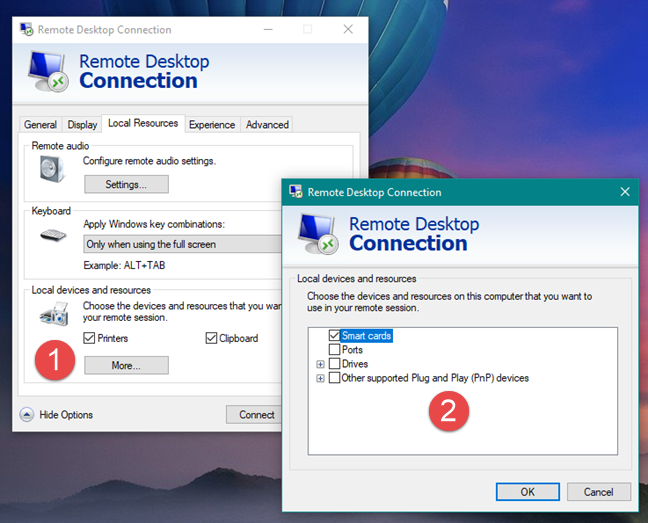
Lastly, you can choose the settings for the Local devices and resources. By default, you can share clipboards between machines (i.e., copy from the host and paste to the client) and print a document from the host machine on a printer connected to the client machine.
Windows, Remote, Desktop, Connection
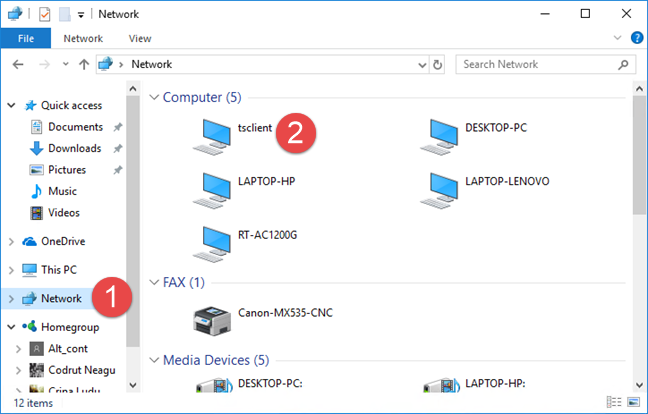
You may also want to share other devices and resources, such as hard drives. Click or tap More to see more options. If you check Drives, you can select which drives and volumes you want to share with the host machine. These show up under tsclient on the host machine, in the Network section of your File Explorer on Windows 10 and Windows 8.1, or in Windows Explorer on Windows 7.
Windows, Remote, Desktop, Connection
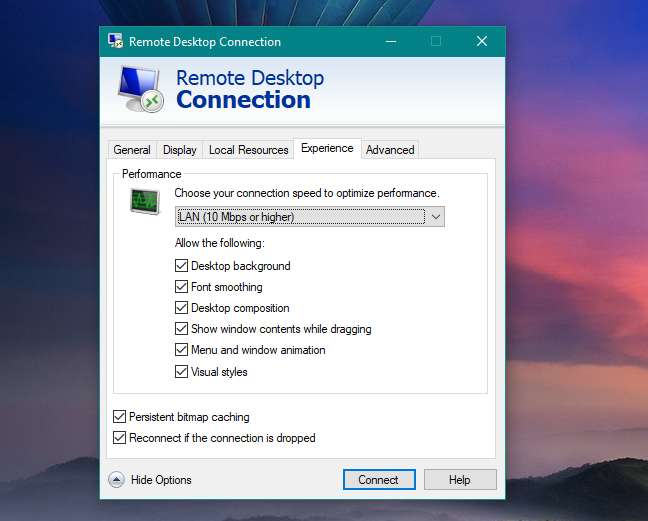
The Experience tab lets you further tweak settings for better performance. For example, it makes sense to disable the desktop background, menu and window animations since these are not essential for most tasks that you are performing remotely. You can also disable font smoothing to make the text a little bit more readable, especially when the screen is resized. Also, you can have Remote Desktop Connection choose the best settings for you based on your connection speed from the drop-down menu.
Windows, Remote, Desktop, Connection
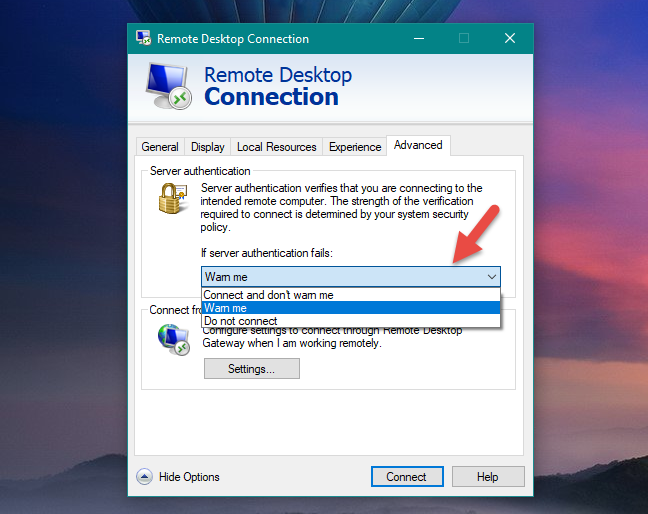
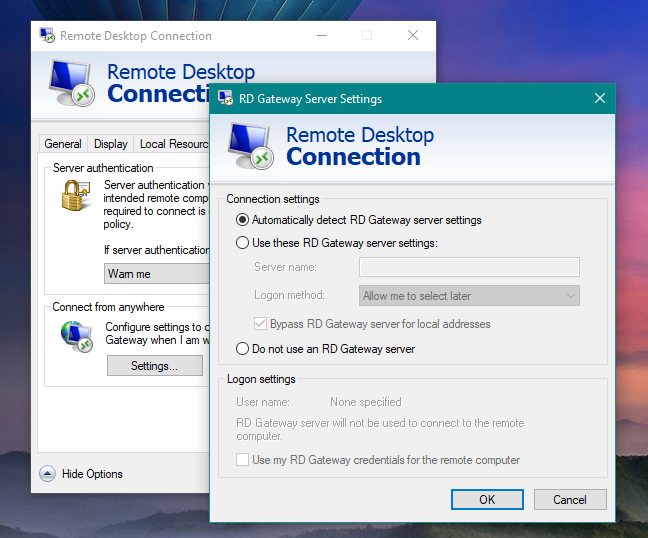
The Advanced tab gives you additional options, which you can use to change how Server authentication behaves. Normally, Remote Desktop Connection checks to make sure that the server name on the certificate matches the computer name you entered to initiate the connection. If they do not match, you are warned about it before connecting.
If you want to skip this message, you can choose to "Connect and don't warn me." This may be useful if you are using the IP address to connect to the remote machine. If that is the case, the authentication will always fail, since the remote computer does not identify itself on the server.
Alternatively, you can choose "Do not connect," if the server authentication fails, which cancels the connection without warning you if the server name does not match.
Windows, Remote, Desktop, Connection
Finally, you can also set up your Remote Desktop Gateway settings by clicking/tapping the Settings button under "Connect from anywhere." Remote Desktop Gateways are used for connecting into corporate networks or Virtual Private Networks (VPNs) from outside those networks. For example, if you were at home and you wanted to connect to your desktop at the office via Remote Desktop Connection, you may need to use a Remote Desktop Gateway. Check with your network administrator to find out how to configure these settings.
Windows, Remote, Desktop, Connection
What is different in Remote Desktop Connection (RDC) between Windows 10 and earlier versions of Windows
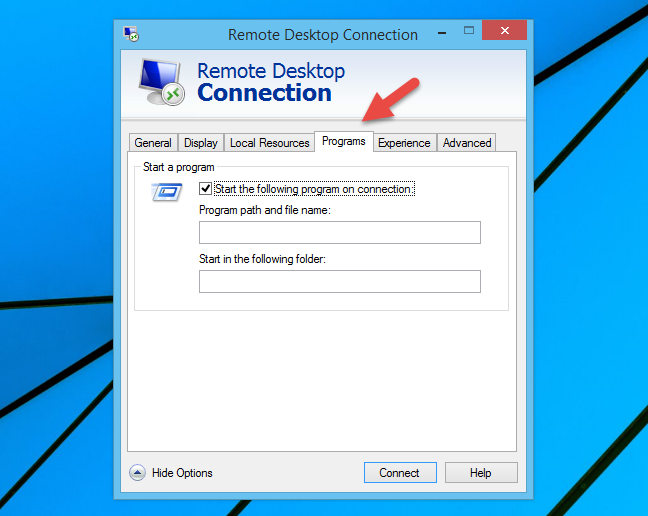
If you are using Windows 7 or Windows 8.1, in the Remote Desktop Connection window, besides the tabs presented in this article, you also have a tab called Programs. The Programs tab allows you to run a specific program when you connect to the remote machine. This allows you to run single programs on the remote computer without having to navigate through Windows Explorer or File Explorer.
To enable this feature, check the "Start the following program on connection" box and enter the program path and filename. If you want to set a working folder, type it in in the second box.
Windows, Remote, Desktop, Connection
Other than this, the Remote Desktop Connection client looks and works the same in all modern versions of Windows.
Do you use Remote Desktop Connection (RDC)?
As you have seen, with Remote Desktop Connection you can access applications and devices on a remote computer by logging in with an administrator or even with a standard user account. This is useful for technical support teams, systems administrators and those who occasionally work remotely and need access to the files and programs on their office computers. Did you ever use it, and if you did, do you like it? Do you prefer alternatives such as TeamViewer? Let us know in the comments section below.
Sir we want to access in a computer thrue lan how to we connected to windows when the windows is black
Gary ·
Super helpful and to the point!
Jean ·
I have Windows 10. I already have a RDC to a computer where I access QB and do some work there. How can I set up a second RDC through the internet to another Windows 10 computer? I don’t want to access both simultaneously, but at different times. Thanks.
Sem Jonson ·
LiteManager free remote access software, simultaneously remote access to several computers
Padraig ·
It used to be under earlier versions of Windows (XP) one could only connect to a computer whic was setup to accept RDP connections and only the Pro versions allowed this (not home) . Maybe this has changed ?
Padraig ·
It used to be under earlier versions of Windows (XP) one could only connect to a computer whic was setup to accept RDP connections and only the Pro versions allowed this (not home) . Maybe this has changed ?
Doug ·
To clarify please: The host computer is the one I am wanting to control remotely. I believe I am following the directions exactly. Additionally, I have disabled the firewall on the remote computer. I continue to get the “no go” popup, i.e., remote access has not been enabled, the computer is turned off, or connected to the network. I can open see it on the network. I’ve shared it from the root, so I can open anything, Suggestions for something I can check out greatly appreciated. Thanks in advance.
Kevin McDermott ·
Why, once my laptop at home is connected to my computer at the office through Remote Desktop Connection, does the computer at the office seem to move so much slower? Internet access seems to slow down and moving anything on screen is so fake. Are there settings needed to be made for this program somehow that will help the video and information transmit work ideally?
sanjeev ·
i am workig in a office. here i am using internet using Userneme and password provided by isp. this is my local internal network. my companies factory is out of main town approx 15km from my office. i want to remotely access pcs from factory to office’s pcs. should i need the same internet connection (username and password provided by isp) at factory’s computers to access office’s pcs. please help me…. it’s urgent. very urgent… thanks…
vishal ·
Wow!!!
What a great thing to update in RDC your computer system.
Don ·
Once I have connected to a remote computer will I be able to run a program on the remote computer such as QuickBooks?
Codrut Neagu ·
You can run anything. It’s just like you were in front of that remote computer.
steve ·
you can also use
Remote computer over wifi
with it, you can view your screen, hear your speaker, manage your keyboard and mouse directly through your mobile smartphone.
The above steps seems to be complicated. Instead, I would recommend using remote support tools such as logmein, gosupportnow, gotomypc, R-HUB, Bomgar etc. They are easy to use.
Szili ·
It possible parallel works in a same program me and remote person without disturbing each other?
Thank you
faiyaz Ahmed ·
Can we connect 2 or more in same way?
Ciprian Adrian Rusen ·
Yes, you can.
Lucas ·
So when you try to remotely connect to your home computer from a laptop, when you log in from the laptop does it log you in to your home computer account so anyone that’s home can access your account? because i know if you use the microsoft remote desktop app your home computer needs to be on but i don’t know if you need to be logged in… hopefully what i just said makes sense
Clive ·
AEROADMIN may be a better option to control a computer remotely. RDC is quite handy but it may not work behind NAT. Hope this helps.
Daniel Vivas ·
+1 for AEROADMIN. Just switched to it and it feels just great.































Discussion (20)
Sir we want to access in a computer thrue lan how to we connected to windows when the windows is black
Super helpful and to the point!
I have Windows 10. I already have a RDC to a computer where I access QB and do some work there. How can I set up a second RDC through the internet to another Windows 10 computer? I don’t want to access both simultaneously, but at different times. Thanks.
LiteManager free remote access software, simultaneously remote access to several computers
It used to be under earlier versions of Windows (XP) one could only connect to a computer whic was setup to accept RDP connections and only the Pro versions allowed this (not home) . Maybe this has changed ?
It used to be under earlier versions of Windows (XP) one could only connect to a computer whic was setup to accept RDP connections and only the Pro versions allowed this (not home) . Maybe this has changed ?
To clarify please: The host computer is the one I am wanting to control remotely. I believe I am following the directions exactly. Additionally, I have disabled the firewall on the remote computer. I continue to get the “no go” popup, i.e., remote access has not been enabled, the computer is turned off, or connected to the network. I can open see it on the network. I’ve shared it from the root, so I can open anything, Suggestions for something I can check out greatly appreciated. Thanks in advance.
Why, once my laptop at home is connected to my computer at the office through Remote Desktop Connection, does the computer at the office seem to move so much slower? Internet access seems to slow down and moving anything on screen is so fake. Are there settings needed to be made for this program somehow that will help the video and information transmit work ideally?
i am workig in a office. here i am using internet using Userneme and password provided by isp. this is my local internal network. my companies factory is out of main town approx 15km from my office. i want to remotely access pcs from factory to office’s pcs. should i need the same internet connection (username and password provided by isp) at factory’s computers to access office’s pcs. please help me…. it’s urgent. very urgent… thanks…
Wow!!!
What a great thing to update in RDC your computer system.
Once I have connected to a remote computer will I be able to run a program on the remote computer such as QuickBooks?
You can run anything. It’s just like you were in front of that remote computer.
you can also use
Remote computer over wifi
with it, you can view your screen, hear your speaker, manage your keyboard and mouse directly through your mobile smartphone.
Try it, it’s free
https://play.google.com/store/apps/details?id=com.polytech.remotecomputer
The above steps seems to be complicated. Instead, I would recommend using remote support tools such as logmein, gosupportnow, gotomypc, R-HUB, Bomgar etc. They are easy to use.
It possible parallel works in a same program me and remote person without disturbing each other?
Thank you
Can we connect 2 or more in same way?
Yes, you can.
So when you try to remotely connect to your home computer from a laptop, when you log in from the laptop does it log you in to your home computer account so anyone that’s home can access your account? because i know if you use the microsoft remote desktop app your home computer needs to be on but i don’t know if you need to be logged in… hopefully what i just said makes sense
AEROADMIN may be a better option to control a computer remotely. RDC is quite handy but it may not work behind NAT. Hope this helps.
+1 for AEROADMIN. Just switched to it and it feels just great.